Artifact
The Land Grant to Hunnubat-Nanaya (Louvre SB 23)
An object record bringing together its image, metadata, rights, and context.
- Timeline
- From 1186 BCE to 1172 BCE
- Region
- Mesopotamia
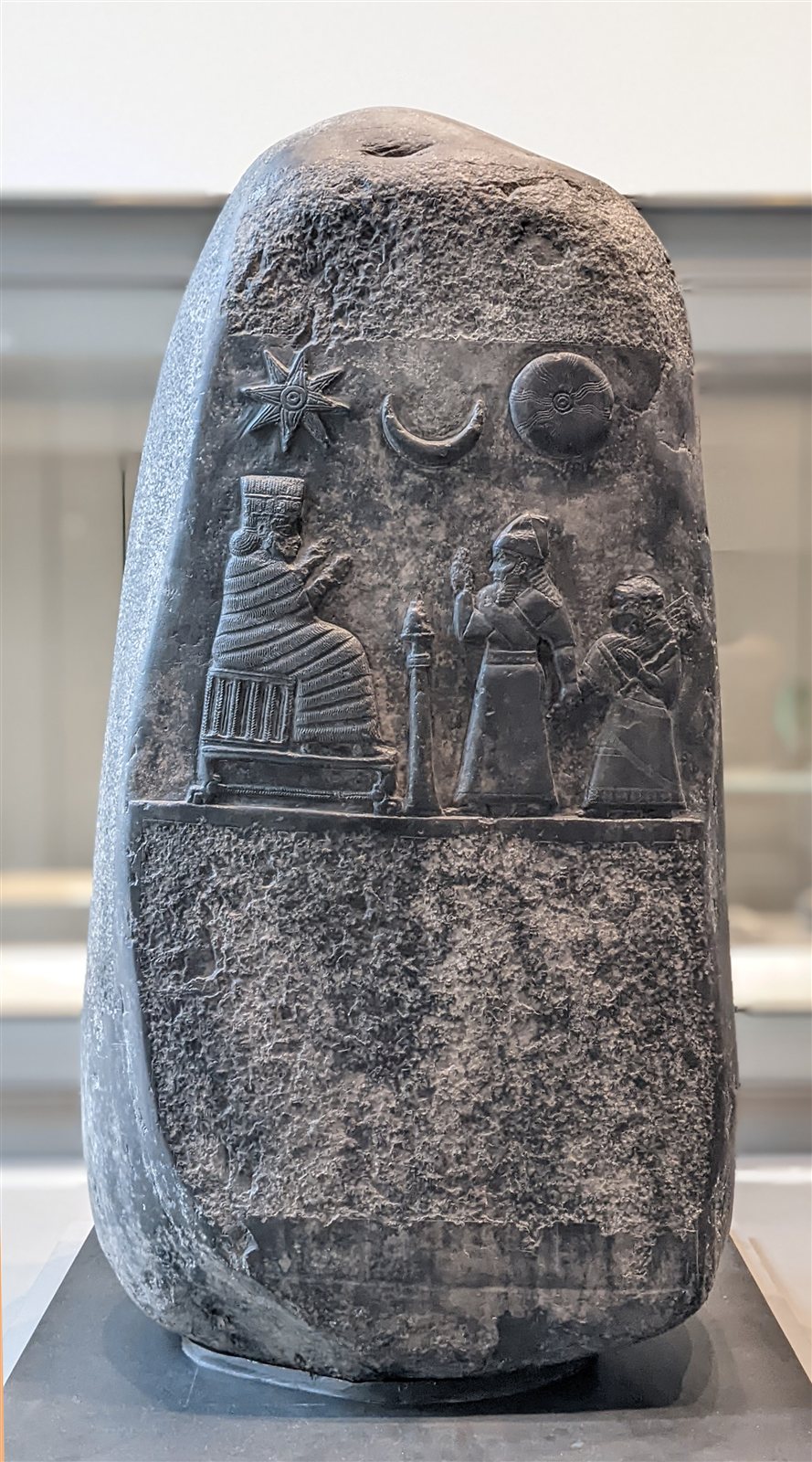
A Kassite king granted his daughter irrigated land and three villages protected by exemptions. On the limestone monument, he leads her before Nanaya, the goddess named in the inscription and in the princess’s own name.
Estimated reading time: 4 min Published Last reviewed:
Share article
Photograph
Photograph by Shonagon, Wikimedia Commons, CC0 1.0. Resized.
Louvre SB 23, showing the presentation of Hunnubat-Nanaya to Nanaya and the damaged surface below the relief
License · Image sourceObject details
- Title
- The Land Grant to Hunnubat-Nanaya (Louvre SB 23)
- Timeline
- From 1186 BCE to 1172 BCE
- Region
- Mesopotamia
- Rights
- CC0
Text
Introduction
King Meli-Shipak II takes his daughter Hunnubat-Nanaya by the hand and leads her before the seated goddess Nanaya. Carved above an AkkadianAkkadianAn ancient East Semitic language written in cuneiform from the third millennium BCE; its varieties include Babylonian and Assyrian, and it served in international diplomacy.Glossary · Click to read the explanation inscription, the scene marks a grant of land and privileges for three villages during his reign, conventionally dated 1186–1172 BCE. The limestone monument was made in Babylonia and found at SusaSusa, ancient ShushSusa is an archaeological city at Shush in southwestern present-day IranGlossary · Click to read the explanation. Now Louvre SB 23, it measures 83 × 42 × 33 cm. The Louvre identifies it as a kudurru, an inscribed monument recording a grant and the conditions that protected it. The inscription itself calls the stone a narû, a stele. [1][2][3][4][6]
Fields, canals and three villages
The inscription starts with land along the Royal Canal in the district of Malgî. In Jean-Vincent Scheil’s edition, it describes uncultivated land and then credits the king with establishing a reservoir and arranging irrigation so that the land could be farmed. The first column includes three villages in the grant to Hunnubat-Nanaya. The recapitulation gives an area estimated by the amount of seed it took, 40 gur in Scheil’s French translation. Scheil marks the number as uncertain in his transcription and prints four gur in the translation of the opening line. Marten Stol gives the main grant as 320 hectares of land for cultivation, with another 24 hectares suitable for gardens. [1][2][4]
The privileges concern the villages as well as the fields. In Scheil’s rendering, the first two columns exempt the villages from certain obligations involving livestock, labour and the maintenance of waterways. They restrict entry by officials and forbid obstructing the irrigation works or depriving the fields of water. The inscription identifies a sealed tablet of village exemptions that the king gave his daughter. It also says that he had the terms engraved on a stele and set before Nanaya. Joan Goodnick Westenholz’s translation marks the specific term for the place where the monument was set up as uncertain. [2][3][4]
The orchard in the Sealand
Column eight, as read by Scheil, describes an orchard near the Gate of AdadAdad: storm godAdad is the storm god in Mesopotamian traditions, associated with rain, thunder and powers of fertility or destruction.Glossary · Click to read the explanation and land adjoining it in the Sealand. The orchard had passed from an earlier owner to the governor of the Sealand. Meli-Shipak acquired it from the governor and assigned it and the earlier title to Hunnubat-Nanaya. The inscription again records sealed tablets. It exempts the orchard’s gardeners from royal dues and restricts entry by the palace gardeners. Scheil thought that a badly damaged passage in the next column might record a third transaction, since it names different people and gives a different measure of land. [2][4]
Hunnubat-Nanaya before Nanaya
The king raises one hand to his face and leads the princess with the other. Nanaya wears a flounced garment and a feathered crown. Westenholz describes the throne as resembling a temple and the platform beneath it as having lion-claw feet. Scheil considers the object on a stand between the figures a possible incense burner or a divine symbol. Stol identifies the stand as bearing an incense burner and describes what the princess holds as a harp or lyre. He treats her service to the goddess as a possibility. [1][2][3][4]
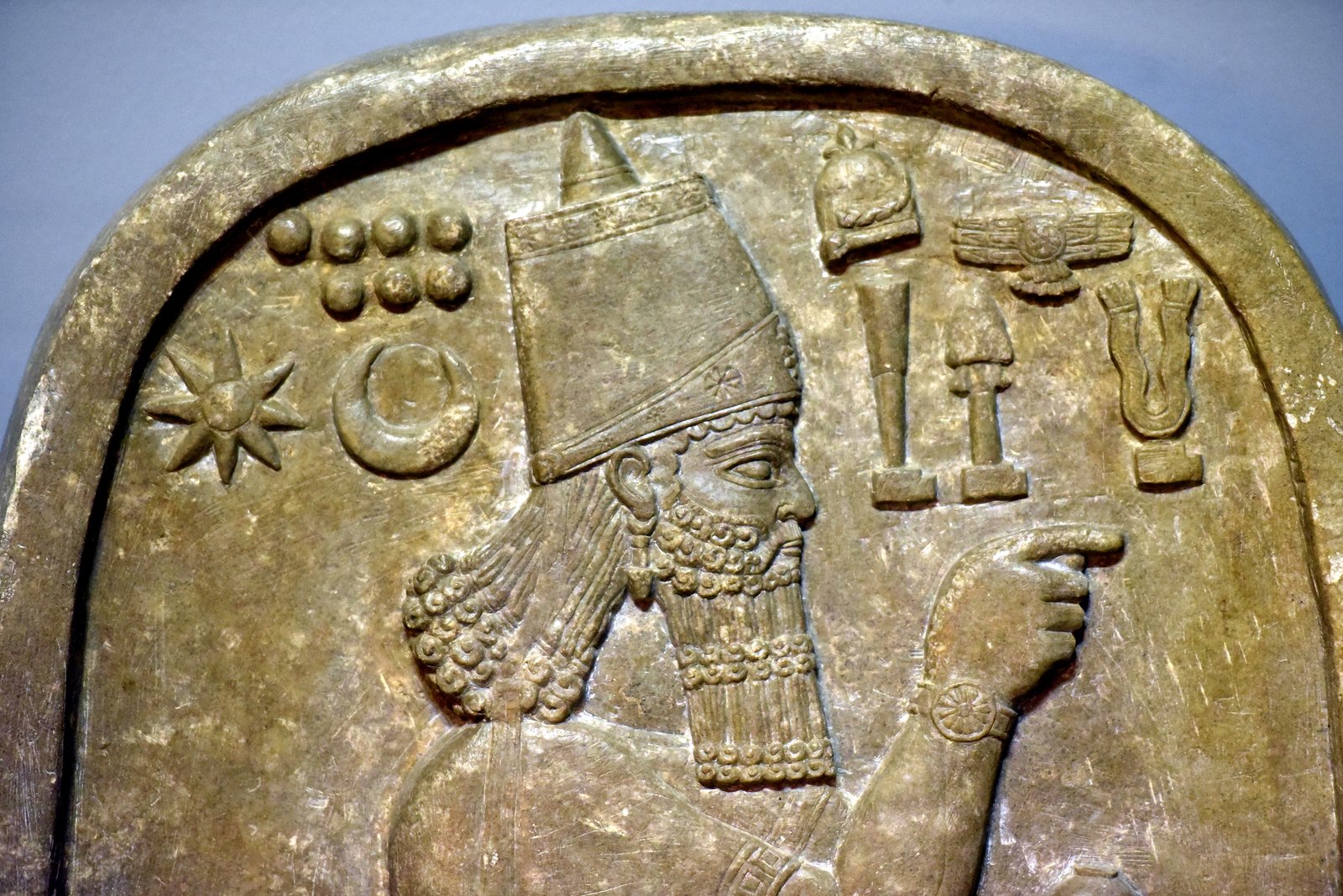
The star above the relief represents IštarInanna / IshtarA prominent Mesopotamian goddess whose Sumerian name Inanna became associated with Akkadian Ishtar across diverse traditions. She was associated with desire, war, royal authority and Venus, while local forms and genealogies varied among texts.Glossary · Click to read the explanation, the crescent SînNanna / Su’en / SinMesopotamian moon god known as Nanna, Su’en and Sîn/Sin. Worshipped especially at Ur and Harran, he is associated with the crescent and lunar cycle; names and myths have different histories.Glossary · Click to read the explanation, and the sun disk ShamashShamashMesopotamian god of the sun and justice, shown before Hammurabi on an eighteenth-century BCE stele preserved in the Louvre.Glossary · Click to read the explanation, according to the Louvre and Westenholz. Westenholz interprets these emblems as invoking the gods to guarantee the grant. She identifies the enthroned figure through the inscription and calls the relief the earliest known depiction of Nanaya in which an accompanying text names her. The reference to the stele placed before Nanaya also gives a context for the scene above the writing. [1][2][3]
Two monuments found at Susa
The Louvre locates the creation of SB 23 in Babylonia and reports that it reached Susa as war booty in the twelfth century BCE. It identifies Jacques de Morgan’s mission as the excavator and records that the monument entered the collection through the division of excavation finds. Scheil notes hammering on one inscribed face and points out that the presentation scene on that face was spared. A second monument in the Louvre, SB 24, was also made in Babylonia and discovered at Susa. Its image and inscription show hammering. The Louvre notes that its surviving scene appears to repeat the king’s presentation of his daughter on SB 23. [1][2][3][5]
References and notes
- Musée du Louvre, Département des Antiquités orientales, Kudurru du roi Melishipak II (SB 23) Inventory, relief and inscription, dimensions and material, origin and discovery, history Return to the text ↑
- Jean-Vincent Scheil, “Kudurru de Melišihu,” in Textes élamites-sémitiques, quatrième série, Mémoires de la Délégation en Perse 10 (1908) Pp. 87–94, opening description, cols. i–ii, viii and ix. Printed page images 87–88 checked against the scan’s transcript Return to the text ↑
- Joan Goodnick Westenholz, “Trading the Symbols of the Goddess Nanaya,” in Religions and Trade (Brill, 2014) Pp. 168–169, fig. 1 and nn. 3–5. Translation of col. ii 9–15, dating, iconography and transport to Susa Return to the text ↑
- Marten Stol, Women in the Ancient Near East (De Gruyter, 2016) P. 512, § 24.1, “Babylonia,” and n. 1. Areas, village exemptions, final purchase and relief Return to the text ↑
- Musée du Louvre, Département des Antiquités orientales, kudurru (SB 24) Inventory, description of the parallel relief and damaged inscription, provenance fields Return to the text ↑
- Sara Arroyo Cuadra, “Los narûs (kudurrus) babilónicos del Bronce Final y el Hierro,” Espacio, Tiempo y Forma. Serie I, Prehistoria y Arqueología 9 (2016), pp. 67–98 Pp. 71 and 73, nn. 4–5, with SB 23 cited for the placement formula and the word narû Return to the text ↑
Archive records may be reviewed and refined as better evidence or sources become available. Suggest a correction
Suggest a correction · Suggest a source for this record
Cite this record
IL Archive, «The Land Grant to Hunnubat-Nanaya (Louvre SB 23)», https://ilarchive.com/en/artifacts/meli-shipak-land-grant-sb23
Continue reading