Artifact
The Birth of Vegetation on a Sumerian Tablet (Louvre AO 6715)
An object record bringing together its image, metadata, rights, and context.
- Timeline
- From 2000 BCE to 1800 BCE
- Region
- Mesopotamia
A damaged clay tablet preserves the opening of the Sumerian debate between Tree and Reed. Its verses describe how Heaven and Earth bring forth the two plants. In one reading, they are friends before they become rivals.
Estimated reading time: 4 min Published Last reviewed:
Share article
Photograph
Poulpy, Wikimedia Commons. CC BY-SA 3.0. Cropped by Alonso de Mendoza and resized for this entry.
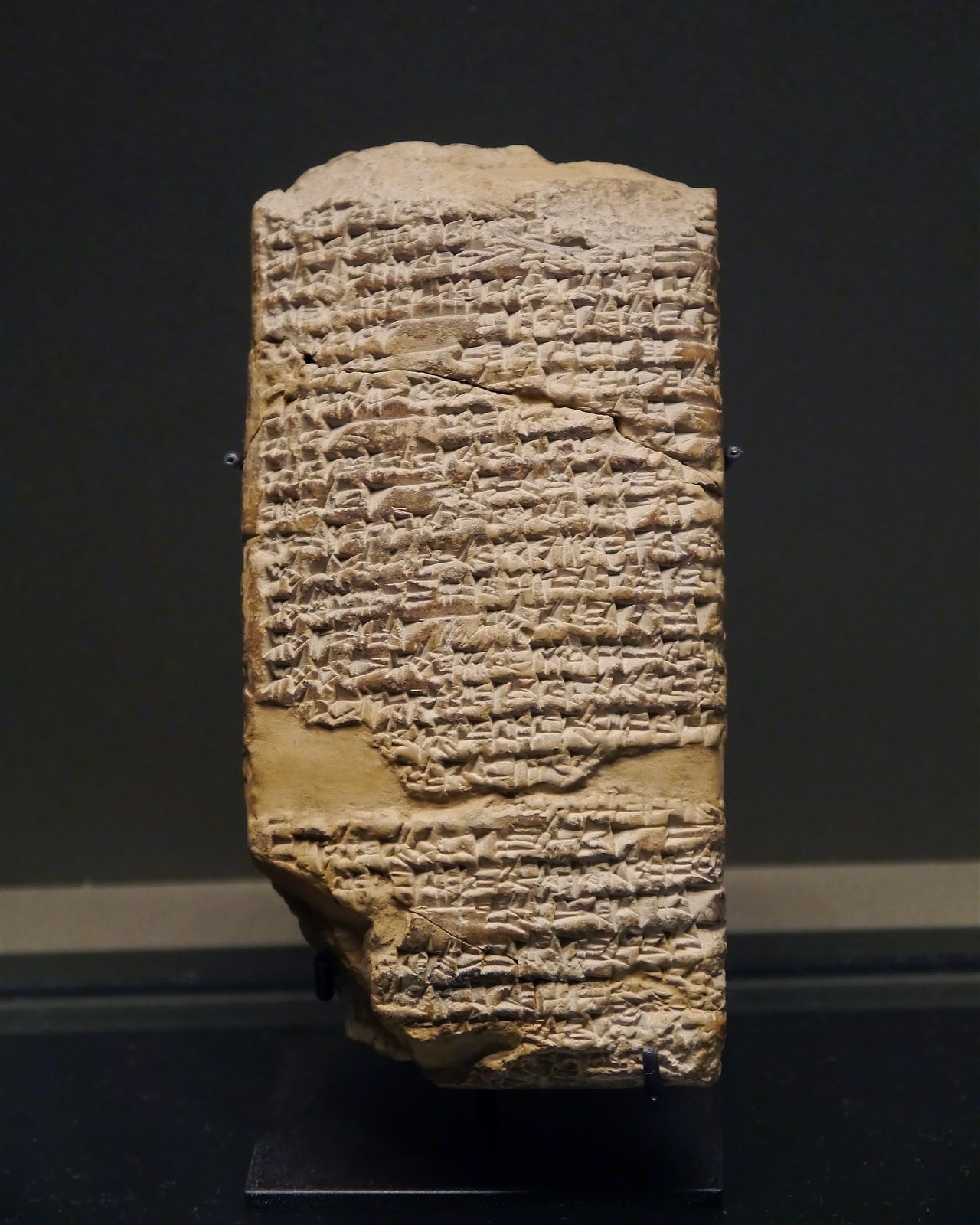
Clay tablet AO 6715 from the Louvre collection. An area of surface damage interrupts the cuneiform lines on the photographed face
License · Image sourceObject details
- Title
- The Birth of Vegetation on a Sumerian Tablet (Louvre AO 6715)
- Timeline
- From 2000 BCE to 1800 BCE
- Region
- Mesopotamia
- Rights
- CC BY-SA
Text
Introduction
Louvre AO 6715 preserves the opening of a Sumerian poem known as the debate between Tree and Reed. Its clay bears closely spaced lines of cuneiformCuneiformWriting with wedge-shaped signs, developed from Mesopotamian recording traditions and used for several languages from the third millennium BCE.Glossary · Click to read the explanation on both faces. The opening describes a union of Heaven and Earth that produces vegetation, including the two plants that give the poem its modern title. AO 6715 is one of several ancient copies used to read the composition. The condition of this tablet and the differences among copies affect how the scene can be understood. [1][2][3][4]
A clay tablet from Mesopotamia
The Louvre records the tablet as shaped and incised clay, 12.5 cm long, 6.3 cm wide and 3 cm thick. It describes the object as incomplete and its fragments as rejoined. A broad damaged patch interrupts the writing on the photographed face, and the loss of clay along the edges cuts into some lines. The museum records a purchase in 1914 from the dealer Elias Ibrahim Géjou. It assigns the object to MesopotamiaMesopotamiaHistorical region associated with the Tigris and Euphrates: Uruk, Ur, Eridu, cuneiform, Sumer, Akkad, Babylon and Assyria, their languages and cults, and the limits of archaeological evidence.Glossary · Click to read the explanation on stylistic grounds. The Cuneiform Digital Library Initiative gives the findspot as uncertain. [1][2]
The Louvre dates the tablet to about 2000–1800 BCE. The Cuneiform Digital Library Initiative, which lists it as P345397, classifies it as Old Babylonian and gives about 1900–1600 BCE as the span for that period. The poem could have begun circulating before this copy was made. Catherine Mittermayer proposes an earlier origin for the group of debate poems, taking into account the roles given to kings of the Third Dynasty of Ur. [1][2][5]
Henri de Genouillac published the handcopy in 1930 as entry 53 in volume 16 of the Louvre’s Textes cunéiformes. He records 30 lines on one face and 32 on the other, with damage near the beginning and greater loss at the end. His inventory also records a line total and a month notation near the end. It gives slightly different measurements of 127 × 63.5 × 29.8 mm. He interpreted the surviving text as a hymn about vegetation and the grain deity Ašnan. The Louvre and the Cuneiform Digital Library Initiative now identify the opening as part of the debate between Tree and Reed. [1][2][3]
Heaven and Earth in the opening verses
Gonzalo Rubio uses AO 6715 and other copies to establish the opening lines. He identifies the Louvre tablet as manuscript A and gives three other copies in which the opening is relatively well preserved. The resulting translation draws on a composite text partly based on Miguel Civil’s comparison of the tablets. In his reading, the earth first appears covered with materials such as lapis lazuli and carnelian, and then with green growth. The earth adorns herself for Heaven, and their union makes the two plants spring forth. The poem compares the earth to a cow and pictures abundance through drink and honey. The opening thus gives Tree and Reed a shared origin before their contest. [4]
Mittermayer reads the water from Heaven as rain that fertilizes the earth, and emphasizes the role of Earth in bringing forth the plants. She also points to a difference in the grammar of the copies at lines 6 and 7. It bears on whether to read the word for Heaven as a person, the sky god AnAn / AnuAn is the Sumerian sky god, called Anu in Akkadian. The sign AN by itself does not identify him: it also denotes sky or divinity.Glossary · Click to read the explanation, or as the sky. Her reading treats Heaven as divine and the earth as the ground that receives the rain. [5]
The two plants before the contest
In line 13, Herman Vanstiphout follows AO 6715 in reading that Tree and Reed were friends and that Tree gave a farewell greeting. Another copy has a verb that can mean “went out.” Vanstiphout proposes that a scribe read one sign as another and changed the verb accordingly. He tentatively reads the branches or foliage as starry and asks whether the image refers to the appearance of individual leaves or to the way they cluster. [6]
The poem belongs to a group of Sumerian debates in which two speakers argue for their own value. Mittermayer and Jana Matuszak place the decision in the wider composition in the hands of King Shulgi. A fragment from Ur, UET 6 194, preserves a request for the king to settle the dispute. In a damaged line that follows, Jeremiah Peterson reads that Shulgi answered the two speakers. [5][7][9]
Another tablet from Ur lists compositions by their opening words. The Oxford corpus identifies the entry beginning ki-ur₃ gal-e with the debate between Tree and Reed. [8]
References and notes
- Musée du Louvre, Département des Antiquités orientales, “Tablette : mythe sumérien sur la naissance de la végétation,” AO 6715, T 1903, TCL 16,53 Inventory, Description, Physical characteristics, Places and dates, and Historical data. These identify the debate, dimensions and material, condition, dating, stylistic attribution and acquisition from Géjou. Return to the text ↑
- Cuneiform Digital Library Initiative, “CDLI Literary 000763, ex. 001,” P345397 Museum Number, Period, Provenience, Text content and References. Matches AO 06715 to the composition, records uncertain provenience and gives the Old Babylonian period range and first publication. Return to the text ↑
- Henri de Genouillac, Textes religieux sumériens du Louvre, vol. II, Textes cunéiformes, Musée du Louvre XVI, Paris, Paul Geuthner, 1930 Inventory p. 5, no. 53, AO 6715, with the early interpretation, condition and count of lines on both faces. The entry refers to the handcopy on plate CXV. The description also mentions a line total and a month notation. See also Genouillac’s measurements. Return to the text ↑
- Gonzalo Rubio, “Time before Time: Primeval Narratives in Early Mesopotamian Literature,” in Time and History in the Ancient Near East, ed. L. Feliu, J. Llop, A. Millet Albà and J. Sanmartín, Eisenbrauns, 2013, pp. 3–17 Author’s offprint, pp. 9–10 and nn. 19–23. Composite text and translation of lines 1–10, with the description of AO 6715 as manuscript A and identification of the other main copies. Return to the text ↑
- Catherine Mittermayer, Was sprach der eine zum anderen? Argumentationsformen in den sumerischen Rangstreitgesprächen, De Gruyter, 2019 Pp. 13–16 on the genre and prologue, especially lines 6–10 and n. 104 on the manuscript variants. P. 34 on Shulgi’s role and an earlier origin for the debate poems. Return to the text ↑
- Herman L. J. Vanstiphout, “Ambiguity as a Generative Force in Standard Sumerian Literature, or Empson in Nippur,” in Mesopotamian Poetic Language: Sumerian and Akkadian, ed. M. E. Vogelzang and H. L. J. Vanstiphout, Styx, 1996, pp. 155–166 P. 155 n. 4, the variant readings of line 13, the reading of AO 6715 and the uncertain description of Tree’s branches. Return to the text ↑
- Jana Matuszak, “Doing Gender in Babylon: The Construction of Ideal Womanhood in Sumerian Literature from the Early 2nd Millennium BCE,” Old World: Journal of Ancient Africa and Eurasia, 2025, pp. 1–40 Pp. 8–10 on the characteristics of the precedence debates and p. 9 on Shulgi as the arbiter of Tree and Reed. Return to the text ↑
- The Electronic Text Corpus of Sumerian Literature, University of Oxford, “OB catalogue from Urim (U3),” c.0.2.05 Transliteration, segment A, line 1, and Cuneiform sources. Identifies the incipit of the debate from the Old Babylonian list of compositions on UET 6 196. Return to the text ↑
- Jeremiah Peterson, The Literary Sumerian of Old Babylonian Ur: UET 6/1–3 in Transliteration and Translation with Select Commentary, Part II: UET 6/2, Cuneiform Digital Library Preprints 16, 2019 P. 540, UET 6 194 (P346279), reverse lines 4′, 7′ and 8′. The requests for the king to judge the dispute and Peterson’s reading that Shulgi answered the contestants. Return to the text ↑
Archive records may be reviewed and refined as better evidence or sources become available. Suggest a correction
Suggest a correction · Suggest a source for this record
Cite this record
IL Archive, «The Birth of Vegetation on a Sumerian Tablet (Louvre AO 6715)», https://ilarchive.com/en/artifacts/vegetation-tablet-ao6715
Continue reading