Artifact
The Imdugud Relief from Tell al-Ubaid (British Museum 114308)
An object record bringing together its image, metadata, rights, and context.
- Timeline
- 2500 BCE
- Region
- Mesopotamia
A copper-alloy panel from the temple precinct at Tell al-Ubaid shows a lion-headed eagle gripping two stags. Excavation records and the British Museum’s reconstruction help explain what survives and where it may once have hung.
Estimated reading time: 5 min Published Last reviewed:
Share article
Photograph
Vassil / Wikimedia Commons, CC0 1.0.
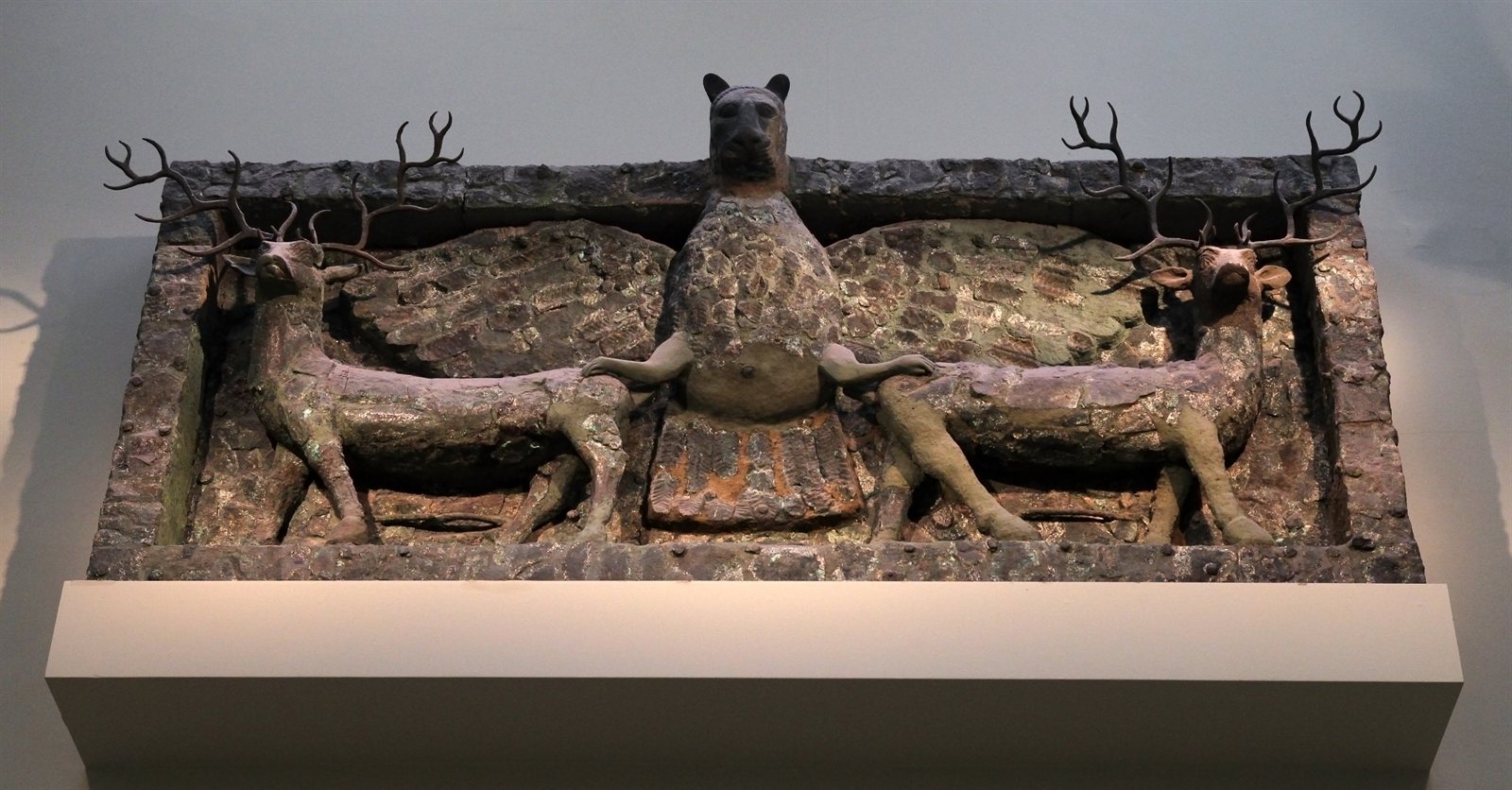
Imdugud relief from Tell al-Ubaid. A lion-headed eagle grips two stags. The head of the bird is a modern reconstruction (British Museum, 114308)
License · Image sourceObject details
- Title
- The Imdugud Relief from Tell al-Ubaid (British Museum 114308)
- Timeline
- 2500 BCE
- Region
- Mesopotamia
- Rights
- CC0
Text
Introduction
A bird with spread wings grips the hindquarters of two stags. The animals turn outward on either side of the bird, whose lion head projects from the panel. The British Museum identifies the central figure as Imdugud, the emblem of NingirsuNingirsuA major god of the Sumerian state of Lagash, invoked in Urukagina’s reform undertaking.Glossary · Click to read the explanation. The head of the bird is a modern reconstruction based on comparable ancient images. The panel came from the foot of a temple platform at Tell al-Ubaid. Its museum number is 114308 and its registration number is 1919,1011.4874. [1][2][8]
From the foot of the platform
Henry Hall excavated at Tell al-Ubaid for the British Museum in spring 1919. Augusta McMahon places the mound about 7.5 kilometres west-northwest of Ur, in the city’s hinterland. Hall traced parts of the platform and found copper animals and the relief against its southeast face. Leonard Woolley returned in 1923 with the joint British Museum and University of Pennsylvania expedition. His account describes a platform with a mudbrick core, stone foundations and stone steps leading up to a temple whose walls no longer stood. The much earlier occupation that gave the Ubaid period its name belongs to a different phase of the mound’s history. [1][2][3][4]
Woolley reports that the later expedition found a white marble foundation tablet near the front of the stairs, about eight metres from the façade. In the Sumerian inscription, A’anepada calls himself king of Ur and son of Mesanepada, also king of Ur, and says that he built a temple for Ninhursag. The tablet bears the number 116982 in the British Museum. The CuneiformCuneiformWriting with wedge-shaped signs, developed from Mesopotamian recording traditions and used for several languages from the third millennium BCE.Glossary · Click to read the explanation Digital Library Initiative groups it with a copper figure that bears the same dedication. The inscription identifies the builder and the recipient of the temple. Before the tablet was found, Hall had assigned the group of finds to about 3200 BCE or earlier. The British Museum now dates the relief to about 2500 BCE, in the Early Dynastic III period. [1][2][3][4][5]
Copper sheets and a restored head
The museum records the panel as 259.08 centimetres long and 106.68 centimetres high. It describes sheets of copper alloy hammered into shape and fastened with pins and twisted lengths of copper to a wooden core coated with bitumen. The catalogue also lists lead among the materials, without specifying its use in the description. The metal skin, backing and fasteners together made it possible to produce a broad surface with projecting forms. [1][8]
Hall reported severe corrosion when the relief was found. The spread wings helped him recognize the central bird. He says the excavators lifted and sent the panel to England in one piece, and that treatment had begun with the head of one stag when he gave his early account. The British Museum reports that only one stag’s head was recovered intact. It identifies the reconstructed lion head of the eagle as a restoration informed by images of the same period. The projecting head is now one of the clearest features of the composition. [1][2]
A proposed place on the façade
The British Museum suggests that the relief may have stood over the temple door. That placement connects a panel over two and a half metres long with a principal approach to the shrine. The fragments lay at the foot of the platform. Their findspot leaves the panel’s original height above ground and its exact position on the building uncertain. [1][2][3]
Other finds show how several kinds of decoration worked at the same shrine. Woolley describes wooden columns covered in bitumen and inlaid with shell and coloured material, as well as separate copper cattle in the round and reliefs of cattle fastened to the wall. He also reconstructs a mosaic frieze above a row of the copper reliefs. In one surviving inlay panel, preserved separately in the British Museum, pale shell bulls stand against dark shale. That panel has a copper border, with the inlay set into bitumen on a wooden board. [3][9]
The eagle and the stags
In an early account Hall described the animals as the eagle’s prey. Stefano Anastasio leaves the precise identification of the pair open, calling them ibexes or deer in his list of figures. A related arrangement appears on the inscribed plaque of Dudu from Girsu, where the Louvre identifies the two animals gripped by the same lion-headed bird as lions. Piotr Steinkeller points to another example from the Bagara temple at Lagash, where the eagle stands on two gazelles feeding on plants. On the basis of such comparisons, he reads the deer, ibex and gazelles as animals associated with Ninhursag and sees the bird as their protector. The grip is visible on the Tell al-Ubaid panel. The temple’s dedication gives the protective reading a context, while the image leaves the action open to interpretation. [1][2][5][6][7][8]
Quick answers
What is the Imdugud relief?
It is a copper-alloy panel from Tell al-Ubaid showing a lion-headed eagle gripping two stags. The British Museum holds it under number 114308. [1][8]
When was the relief made?
The British Museum dates it to about 2500 BCE, in the Early Dynastic III period. [1]
Where did it originally hang?
It was found at the foot of the temple platform. The British Museum suggests that it may once have been above the temple door. [1][3]
Is the eagle’s lion head ancient?
The head visible today is a modern reconstruction based on images of the same period. Only one of the stags’ heads was recovered intact. [1][2]
References and notes
- British Museum, ‘Copper frieze’, registration 1919,1011.4874 Description and object details for the findspot, composition, measurements, date, restoration and possible place above the door. Return to the text ↑
- H. R. Hall, ‘The British Museum Archæological Mission in Mesopotamia, 1919’, Journal of the Central Asian Society 9, part III (1922), pp. 119–126 P. 125, description of the relief, its corrosion and removal, and initial treatment of one stag’s head. Return to the text ↑
- C. Leonard Woolley, ‘The Excavations at Tell El Obeid’, The Museum Journal 15, no. 4 (1924) Opening account of Hall’s campaign, the platform and the foundation tablet. Sections ‘Columns’, ‘Copper Bulls’, ‘Frieze of Copper Bulls’ and ‘Inlay Frieze’. Return to the text ↑
- Augusta McMahon, ‘Tell al-Ubaid and the Ubaid period at Ur’, in J. Nicholas Postgate and David C. Thomas (eds.), Ur 1922–2022: Papers Marking the Centenary of Sir Leonard Woolley’s First Season of Excavations at Ur (British Institute for the Study of Iraq, 2024) Pp. 85–86, ‘Introduction’ and ‘Tell al-Ubaid Excavations’, on the site, excavation dates and distinction between the earlier settlement and the Early Dynastic temple. Return to the text ↑
- Cuneiform Digital Library Initiative, ‘RIME 1.13.06.03’, Q001331 Composite P431208, surface a, lines 1–7. Concordance of BM 116982 (P222837) and the other witness, P222838. Return to the text ↑
- Musée du Louvre, ‘Relief de Dudu’, AO 2354 Description and decoration of the upper register. Findspot at Tello and catalogue dating. Return to the text ↑
- Piotr Steinkeller, ‘More on Dudu, the Head of the Temple Household of Ningirsu under En-metena’, Nouvelles Assyriologiques Brèves et Utilitaires 2020, no. 4 Note 103, pp. 214–215, fig. 1 and n. 3, on the Bagara mace head and the interpretation of animals shown with Imdugud. Return to the text ↑
- Stefano Anastasio, Building between the Two Rivers: An Introduction to the Building Archaeology of Ancient Mesopotamia (Archaeopress, 2020) List of figures, entry for fig. 56, on the museum number 114308, materials and identification of the animals as ibexes or deer. Return to the text ↑
- British Museum, ‘Copper frieze’, registration 1924,0920.2 Description and details of the separate inlaid panel with shell cattle, shale background and copper border. Return to the text ↑
Archive records may be reviewed and refined as better evidence or sources become available. Suggest a correction
Suggest a correction · Suggest a source for this record
Cite this record
IL Archive, «The Imdugud Relief from Tell al-Ubaid (British Museum 114308)», https://ilarchive.com/en/artifacts/imdugud-relief-bm114308
Continue reading
Related readings