Site
The Tomb of Nefertari in the Valley of the Queens (QV 66)
- Timeline
- From 1279 BCE to 1213 BCE
- Region
- Egypt
Cut into limestone near Thebes for a queen of Ramesses II, QV 66 preserves painted funerary spells across its chambers. A broken sarcophagus lid, early photographs and conservation records help document the burial and what survives.
Estimated reading time: 3 min Published Last reviewed:
Share article
Text
Introduction
An entrance stair leads down into the painted tomb of Nefertari, a Great Royal Wife of Ramesses II. The tomb, designated QV 66, lies in the Valley of the Queens near ancient ThebesThebes, EgyptThebes, Egyptian Waset, was an ancient Egyptian city in the area of modern Luxor, with monuments on both banks of the Nile.Glossary · Click to read the explanation. Its chambers preserve scenes and spells that depict the queen's passage into the afterlife. It dates to the Nineteenth Dynasty, around the middle of the thirteenth century BCE. Ernesto Schiaparelli's Italian archaeological mission discovered it in 1904. [1][2][3][5]
The route through the tomb
The first stair leads into an antechamber. An opening to the east gives access to an annex. From the antechamber a second, longer stair descends to the burial chamber, which has pillars and three side rooms. The Theban Mapping Project's plan and sections show how the rooms are arranged on different levels. The underground route brings the painted scenes into view in stages. [2][3]
On the antechamber's south wall, Nefertari sits at a board playing senet. The same group of scenes shows her ba perched on a small shrine and depicts the queen again in adoration. The museum archive associates the scene with Spell 17 of the Egyptian Book of the DeadEgyptian Book of the DeadA modern name for a variable collection of Egyptian funerary spells and images intended for the afterlife, not a single book with a fixed sequence.Glossary · Click to read the explanation. At the far end of the lower stair, a kneeling, winged MaatMaatAn Egyptian principle of truth, justice, and right order, also embodied by the ostrich-feather goddess Maat; differently expressed in rule, ritual, and funerary judgment.Glossary · Click to read the explanation appears over the burial chamber entrance. Inside, painted gates and their guardians accompany Spells 144 and 146. [3]
Offerings in the eastern annex
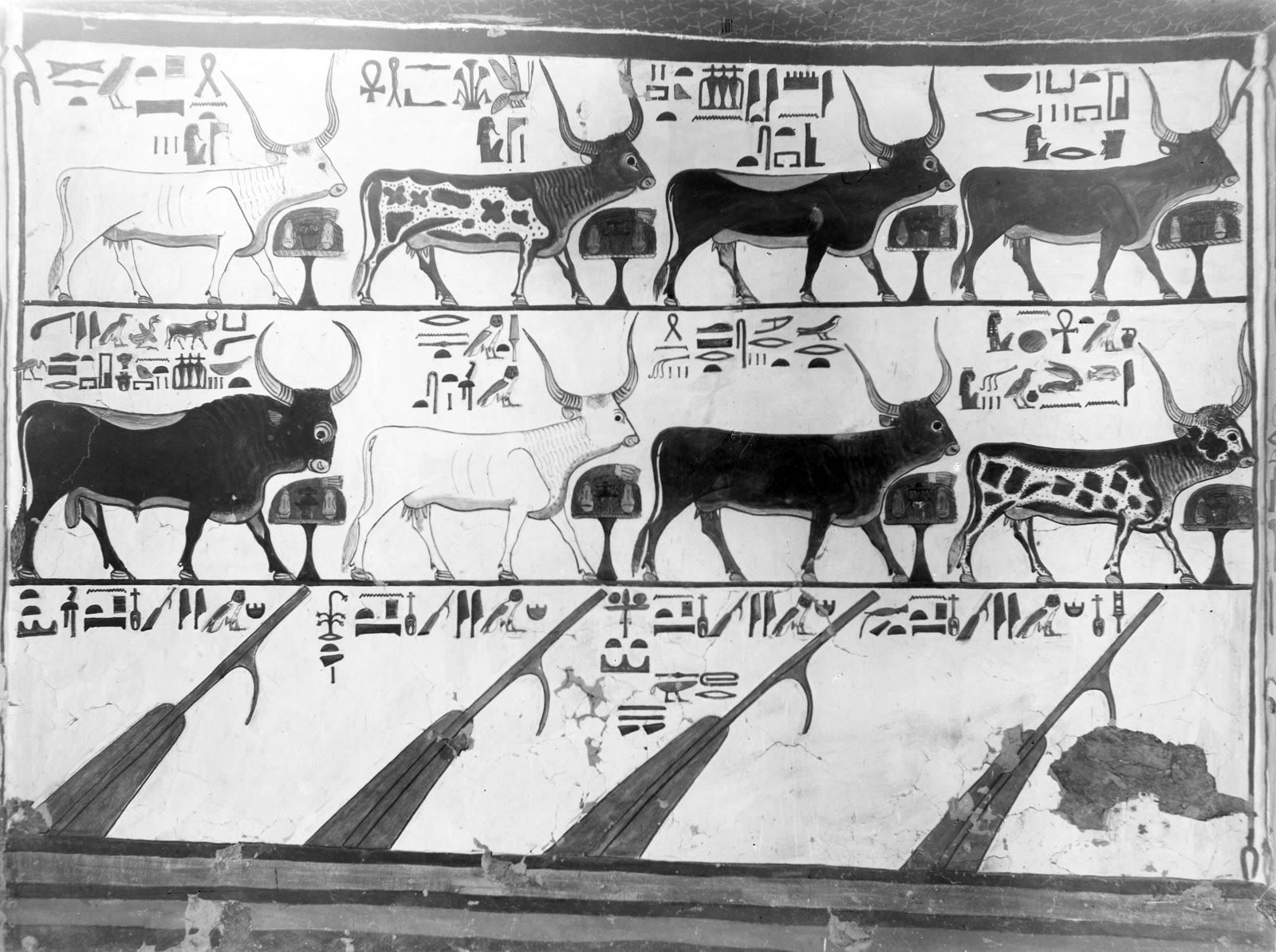
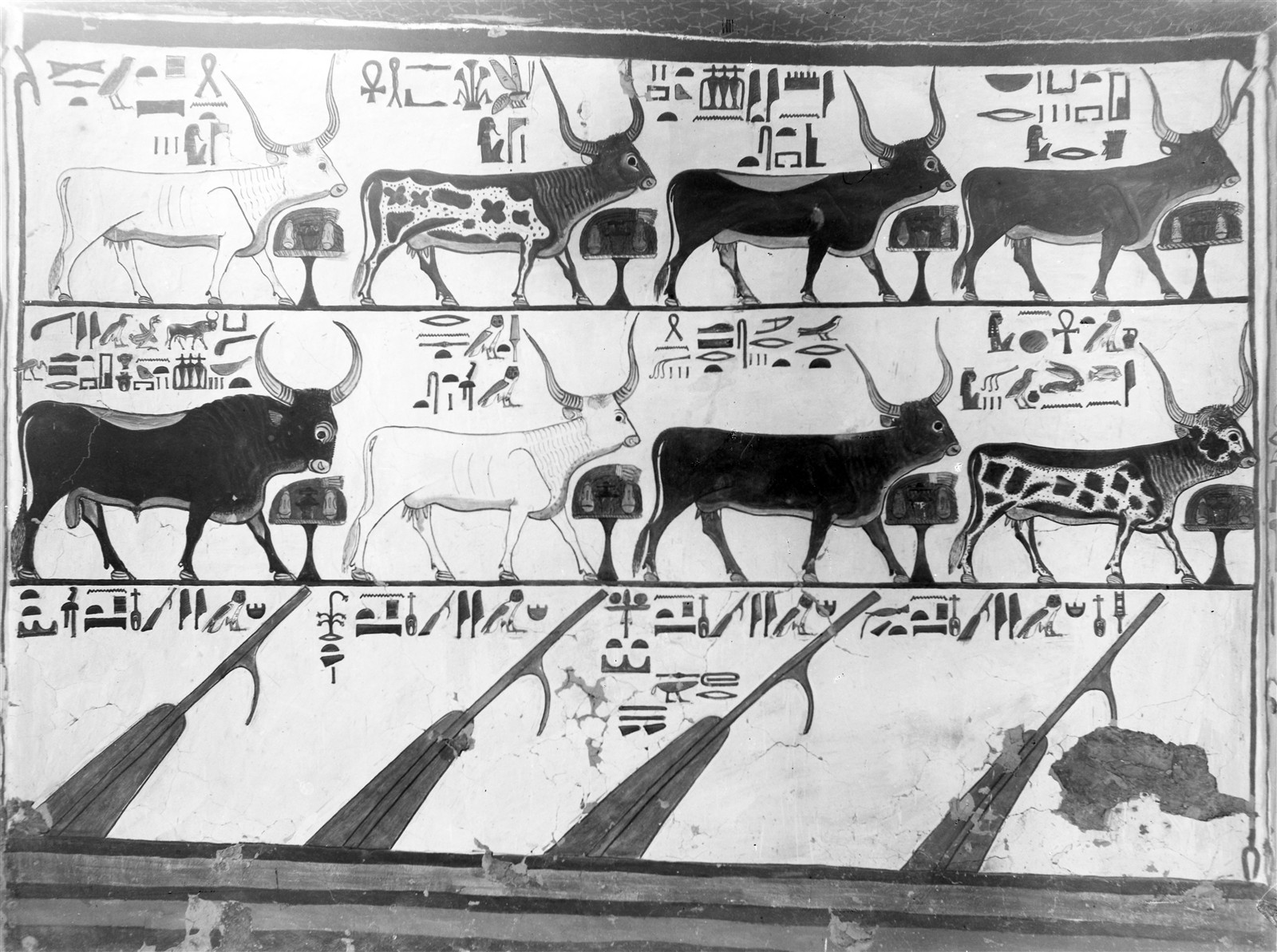
On the south wall of the first eastern annex, seven cows and a bull fill two horizontal registers. Each animal has a food offering before it. Below them are four steering oars. The archive of the Museo Egizio identifies both elements as parts of Spell 148 and explains the food as nourishment for the queen and the oars as aids in her journey among the stars. Nefertari appears on the adjacent wall, where the archive identifies her as reciting the invocation. The scene survives in an early photograph of the wall. [3]
The burial and its discovery
The Italian excavators found a burial that had been plundered in antiquity. The surviving funerary equipment included wooden shabtis, small figures bearing Nefertari's name, and pieces of her stone sarcophagus. The Museo Egizio in Turin holds the fragmentary pink-granite lid under inventory number Suppl. 5153. The museum dates it to the reign of Ramesses II, 1279–1213 BCE. [1][4][5]
The excavators also recovered mummified leg fragments. Michael E. Habicht and colleagues conclude that they most likely belonged to Nefertari. That identification remains provisional. Their radiocarbon results were earlier than expected, and they weighed them alongside the archaeological context and the burial objects. [5]
How the paintings were preserved
The painters worked on layers of plaster that levelled the uneven limestone. Changes in humidity caused salts in the limestone and plaster to crystallize. Paint eroded and sections of plaster detached. Early photographs and conservation records document how much of the decoration had already been damaged. [3][6][7]
Between 1986 and 1992 the Egyptian Antiquities Organization and the Getty Conservation Institute surveyed and treated the painted surfaces. The conservators mapped where the plaster and paint had deteriorated, stabilized the most vulnerable areas and examined samples of plaster, pigments and salts. They limited work on the paintings to consolidation and cleaning, which helped preserve the surviving surfaces and the evidence of how they were made. [6][7]
Quick answers
Where is the tomb of Nefertari?
QV 66 is in the Valley of the Queens near Luxor in Egypt. [1][2]
Who discovered it?
The Italian archaeological mission led by Ernesto Schiaparelli discovered the tomb in 1904. [1][4]
What do its wall paintings show?
They include the queen playing senet, offerings from Spell 148, and the gates and guardians of the burial chamber. [3]
What survives from the burial?
Among the surviving objects are wooden funerary figures and the fragmentary pink-granite sarcophagus lid now in the Museo Egizio in Turin. [4][5]
References and notes
- Egyptian Ministry of Tourism and Antiquities, “The Anniversary of the Discovery of Queen Nefertari’s Tomb” Official notice on Schiaparelli's discovery in 1904, Nefertari's marriage to Ramesses II and the Valley of the Queens. Return to the text ↑
- Walton Chan, QV 66 — Nefertari, Dynasty XIX, Theban Mapping Project, 2021 Single sheet with plan, sections and axonometric drawings. Areas A, B and Ba, C, D and Da–Dc. Return to the text ↑
- Museo Egizio Photo Archive, “Theban Region / Valley of the Queens / QV 66, Tomb of Nefertari” Scenes 2 and 16–17, plate E00613, the stair and lintel in scene 28, and the gates in scenes 30–34. Photographs document the positions of the paintings and visible losses. Return to the text ↑
- Museo Egizio, “Fragmentary Lid of the Sarcophagus of Queen Nefertari,” Suppl. 5153 Material, date, reign, findspot and excavation information in the museum catalogue. Return to the text ↑
- Michael E. Habicht et al., “Queen Nefertari, the Royal Spouse of Pharaoh Ramses II: A Multidisciplinary Investigation of the Mummified Remains Found in Her Tomb (QV66),” PLOS ONE 11, no. 11 (2016), e0166571 Abstract and Introduction, the section on sandals and other objects, and the Conclusion and table 1. Date, surviving burial goods and the qualified identification of the leg fragments. Return to the text ↑
- Getty Conservation Institute, “Tomb of Nefertari” Project history, collaboration with the Egyptian Antiquities Organization, 1986–1992 campaign and the scope of painting treatment. Return to the text ↑
- Lorain Wang and Cameron Trowbridge, “Processing the Material Record of the Tomb of Nefertari Project,” Getty, 2018 Introduction and sections on scientific analysis and conservation treatment. Plastered limestone, deterioration by salt and humidity, condition survey and analysis of materials. Return to the text ↑
Suggest a correction · Suggest a source for this record
Cite this record
IL Archive, «The Tomb of Nefertari in the Valley of the Queens (QV 66)», https://ilarchive.com/en/sites/tomb-of-nefertari-qv66
Continue reading