Study
Proverbs and Amenemope: when the sages’ counsel converges
An extended study of a topic, with evidence and references.
- Timeline
- From 1200 BCE to 500 BCE
- Region
- Egypt and the Southern Levant
Proverbs 22:17–23:11 and a thirty-chapter Egyptian instruction: strong parallels, meaningful changes, and the disputed “thirty” reading.
Share article
Text
# Proverbs and Amenemope: when the sages' counsel converges
The Book of Proverbs warns against exhausting oneself in pursuit of wealth: riches may grow wings and fly away. An Egyptian instruction attributed to the scribe Amenemope also imagines wealth escaping on a bird's wings. More is involved than a shared moral commonplace. Within a short span, the texts also converge on listening to wisdom, defending the poor, avoiding an angry person, respecting field boundaries, and behaving cautiously at a powerful person's table. Proverbs 22:17–23:11 has therefore become one of the best-studied examples of a connection between HebrewHebrewA Northwest Semitic language in the Canaanite group, with ancient and modern forms.Glossary · Click to read the explanation literature and ancient Egyptian wisdom. [1][2][4][7]
Calling the relationship “copying” and then treating the whole of Proverbs as a translation of an Egyptian book conceals what the evidence actually shows. The Hebrew passage selects, rearranges, and reformulates advice; it also puts some of it in the setting of trust in YHWHYahwehThe divine proper name written YHWH in the Hebrew Bible.Glossary · Click to read the explanation. The writer's identity, the date of transmission, and the route by which the instruction reached a Hebrew milieu remain unknown. We can describe a probable literary relationship in a particular passage, not a documented biography of the manuscript that carried it. [7][8]
What is the Instruction of Amenemope, and what has survived?
The *Instruction of AmenemopeInstruction of AmenemopeThirty-chapter Egyptian wisdom instruction preserved on a British Museum papyrus and scribal exercises; compared with Proverbs 22:17–23:11.Glossary · Click to read the explanation* is an Egyptian wisdom work framed as a scribe's counsel to his son. It addresses attentive listening, moderation, conduct before the powerful, the property of vulnerable people, and honesty in writing and measurement. It has a prologue and thirty chapters; the closing chapter explicitly refers to that number. These are Egyptian chapters. They should not be transferred automatically to the structure of Proverbs before the disputed reading of the Hebrew verse is examined. [4]
The fullest known witness is British Museum papyrus EAEnkiMesopotamian deity associated with deep fresh water, wisdom and Eridu, known as Ea in Akkadian tradition. The earliest preserved written mention does not date his cult’s origin or identify Ubaid Eridu’s deity.Glossary · Click to read the explanation 10474. On palaeographic grounds the Thesaurus Linguae Aegyptiae catalogue dates this copy to the beginning of the Saite period, during Psamtik I's reign, in the seventh century BCE. Scholars often propose an earlier composition, perhaps around 1200–1000 BCE or the late second millennium. The surviving manuscript dates an act of copying, not the invention of every saying in it. The proposed composition date is not as secure as the physical date of the papyrus. [5][7][8]
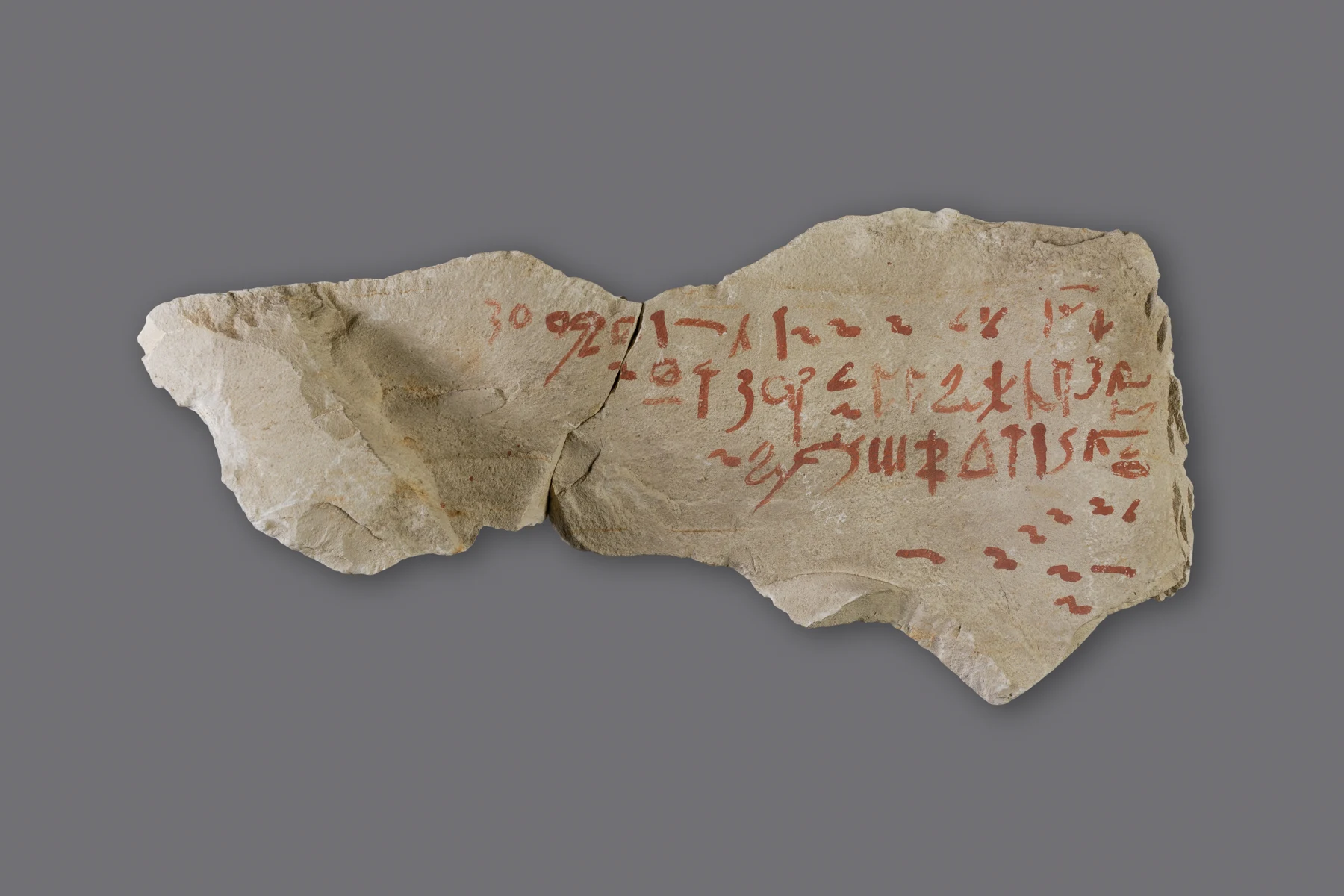
The image accompanying this study has a different status again. It shows a limestone ostracon inscribed in hieratic with the beginning of Amenemope, now in the Metropolitan Museum of Art as 26.3.165. The museum dates it to the Persian period in Egypt, approximately 525–404 BCE, and tentatively places it among the exercises of a scribe at Thebes. It documents the continued copying and teaching of the work centuries after its likely composition; it is not a page of the author's first copy. [6][10]
Where are the closest parallels?
Proverbs contains several collections. We should not presume that every part of the book was composed at once. The passage at issue begins in 22:17 with a call to incline the ear, listen to the words of the wise, and keep them inside oneself and on one's lips. Amenemope's first chapter likewise urges the pupil to listen, put the teaching in the heart, and keep it within. The Egyptian prologue speaks of answering those who have sent the learner; Proverbs 22:21 refers to returning reliable words to those who sent him. This succession is more precise than the general observation that both cultures valued wisdom. [1][4][7]
Several related admonitions follow. Proverbs 22:22 prohibits robbing the weak and crushing the poor at the gate; Amenemope cautions against exploiting a needy person. Proverbs 22:24–25 warns against associating with a quick-tempered man; the Egyptian instruction similarly advises against befriending the hot-headed. Proverbs 22:28 forbids moving an old boundary set by ancestors, while Amenemope warns against shifting field markers and encroaching on a widow's land. [1][4][7]
These examples are not all equally probative. Avoiding a hothead or protecting the poor could arise independently in many societies. But the clustering of these themes with field markers, a superior's dining table, winged wealth, and food that must be vomited within a short textual stretch raises the probability of a literary relationship. The case does not rest on one maxim; it rests on a bundle of correspondences, some involving unusual details. [1][2][4][7]
The ruler's table and the bird that carries riches away
In Proverbs 23:1–3, a pupil is told to pay close attention and restrain his appetite when eating with a ruler. Amenemope chapter 23 warns against impulsive behavior while eating before an official and directs attention to the vessel set before the diner. The social scene is close, but the Hebrew lines are no line-by-line translation. They refashion courtly advice in their own language and imagery. [2][4][7]
The following verses turn to wealth: do not wear yourself out seeking it, because it flies away. In the Egyptian text wealth takes wings like geese; in Hebrew it flies like an eagle. The texts share the thought and the architecture of the image, but differ in the bird. Bernd Schipper interprets that difference as an adaptation of Egyptian imagery to a Hebrew writer's horizon. At a minimum, it shows that the connection does not require every feature to be repeated verbatim. [2][4][7]
Then comes a more striking image: food turns against its eater and is vomited. In Proverbs 23:6–8 the warning concerns the table of a grudging host; in Amenemope it concerns a self-interested desire for a poor person's bread. Vomiting connects the passages vividly, yet the setting and target of each admonition differ. Careful comparison records the distinctive shared image and the difference in the reasons attached to it. [2][4][7]
Boundaries and vulnerable people: where does the reasoning change?
The Hebrew section treats land boundaries twice: first in Proverbs 22:28, then in 23:10 with the addition of the orphan's fields. Amenemope warns against moving field markers and specifically taking a widow's land. Both protect property that can be seized from a vulnerable owner. Yet the Hebrew references to ancestors and orphans, alongside the Egyptian references to a widow and measuring lines, reveal the different settings in which the advice is spoken. [1][2][4]
Proverbs 22:23 adds a reason not to crush the poor: YHWH will plead their cause. Proverbs 23:11 likewise says that the fatherless have a powerful redeemerKinsman-Redeemer in RuthA relative exercising a family property-redemption right in Ruth 4; he need not be the deceased husband’s brother.Glossary · Click to read the explanation who will contend with an aggressor. Amenemope also speaks about the god and the consequences of wrongdoing; it should not be depicted as a “secular” instruction devoid of religion. But the naming of YHWH and his role as defender of the vulnerable form part of the Hebrew religious framing. Ethical resemblance does not erase theological difference, and theological difference does not erase textual resemblance. [1][2][4][7]
Nor does every Hebrew saying have a direct Egyptian counterpart. The call to trust YHWH in 22:19 and the warning against becoming a surety for debt in 22:26–27 are examples Schipper sets outside the close parallels. Selection and recomposition are therefore more accurate terms than a word-for-word translation of thirty Egyptian chapters. [1][7]
Does Proverbs 22:20 say “thirty”?
This verse has long been a focus of debate. Because Amenemope explicitly mentions thirty chapters, Adolf Erman proposed in 1924 that the Hebrew word in Proverbs 22:20 be emended to mean “thirty.” Hugo Gressmann then sought thirty sayings in the longer Proverbs collection extending to 24:22. The proposed number became an apparent bridge between the two works and entered modern interpretations and translations. [4][7][8]
The consonants and Hebrew reading traditions, however, are not settled in that way. The Masoretic ketiv can be read as “formerly” or “the day before yesterday”; other reading and translation traditions have favored “choice/excellent sayings,” while the proposed emendation yields “thirty.” The older Jewish translation linked here says “excellent things,” not “thirty.” Schipper argues for retaining the temporal reading and connecting it with “today” in the preceding verse and with instruction spread over several days. He cites a dated Egyptian writing exercise as supporting context. This is a specific scholarly argument, not a meaning that follows automatically from the Egyptian number. [1][7]
The matter remains open to more than one analysis. The secure thirty in Amenemope's conclusion does not prove that Proverbs 22:20 originally used the same word, or that every part of 22:17–24:22 has an equally close Egyptian parallel. The most concentrated cluster lies in 22:17–23:11. The larger section contains further material, and 24:23 introduces another collection with “These also are sayings of the wise.” Locating the boundaries of the literary units is part of the question; it is not a counting detail to be assumed away. [2][3][4][7][8]
How could an Egyptian instruction reach a Hebrew writer?
Egypt and the southern LevantThe LevantThe Levant is a regional name for lands along the eastern MediterraneanGlossary · Click to read the explanation were not sealed worlds. Political and commercial contact, together with scribal cultures, makes the circulation of texts and advice possible. Egyptian school exercises show that Amenemope continued to be copied and taught. Schipper proposes that the Hebrew author also drew on an Egyptian scribal technique: selecting the opening sayings of chapters and reusing them in a new composition. The Met ostracon physically attests copying of the instruction's opening, but it is late. It cannot be presented as the source copy seen by the author of Proverbs. [6][7]
We do not possess an early Hebrew manuscript translating all of Amenemope, a document naming the person who carried it, or a preserved itinerary from a particular Egyptian library to an editor of Proverbs. The connection could have involved the Egyptian text directly, or a scribal or linguistic intermediary. The stronger evidence concerns the relationship between the passages; the intermediary's name, workplace, and exact date remain open questions. Nor does the book's heading “Proverbs of Solomon” by itself date every collection to one author or reign. [1][7][8]
Conversely, the London papyrus is a seventh-century copy, whereas scholars generally place the Egyptian work's composition earlier. The oldest surviving complete copy cannot simply be ranked against every Hebrew layer as though copy-date equalled composition-date. Equally, the Egyptian work cannot be assigned to the year its London papyrus was written. The argument for transmission from Egypt toward the Hebrew passage rests on Egyptian literary history, the pattern of parallels, and scholarly chronological estimates—not merely on which two physical objects survive. [5][7][8]
Did the relationship make the works identical?
No. Amenemope belongs to Egyptian administrative and religious life: scribes, fields, weights, and references elsewhere to Egyptian gods. Proverbs contains Hebrew collections with varied language and religious framing; in this passage trust in YHWH and his defense of the poor are explicit. Even when the texts share an image or injunction, they can attach different reasons and functions to it. [1][2][4]
This observation does not diminish either work. If wisdom traveled between traditions here, scribes learned from existing texts and composed for their own language and audience. “Theft” is a poor historical description of a process whose participants and social conventions we cannot identify; yet denying all connection because “good advice is universal” overlooks the dense cluster of images and details. An academic account describes both the strength and the limits of the relationship. [7][8][9]
What can be said at different levels of confidence?
- Certain: An Egyptian instruction with thirty chapters and comparatively late physical witnesses survives; Proverbs 22:17–23:11 repeats a distinctive cluster of subjects and images. [1][2][4][5][6]
- Strongly probable: The Hebrew passage used Amenemope or a closely circulating form of it, selecting and adapting rather than translating the whole book. Many scholarly readings favor that direction, while debating the mechanics. [7][8]
- Disputed: Whether Proverbs 22:20 means “thirty,” and exactly where the unit to be compared directly with Amenemope begins and ends. [1][3][4][7]
- Unproven: The writer's or intermediary's identity, the manuscript route, a precise borrowing date, or the claim that either the London papyrus or Met ostracon was the copy consulted by a writer of Proverbs. [5][6][7]
This comparison reveals more than a contest over “who said it first.” A memorable image can cross languages and borders: wealth that flies, a field marker that must stay in place, a meal requiring caution. But the movement of an image does not end literary creation. In Egypt these ideas belonged to a scribe's teaching to his son; in Proverbs they became part of the sages' address linking conduct, trust in YHWH, and protection of vulnerable people. A literary kinship in this passage is probable, and a change of meaning is visible too. [1][2][4][7]
Related reading
References and notes
- The whole short chapter was displayed in the English edition and verses 17–29 read closely; the Hebrew wording of 22:19–21 was checked against Schipper's citation. The old JPS translation of 22:20, 'excellent things', is a translation choice, not proof that the Hebrew says thirty. Proverbs 22:17–29, Hebrew and JPS 1917 Return to the text ↑
- The entire short bilingual chapter was displayed; verses 1–17 read closely, especially the ruler's meal, wealth/eagle, grudging food/vomiting, ancient boundary and orphan's field. Verse 12 begins a fresh instruction after the strongest Amenemope parallels. Proverbs 23:1–17, Hebrew and JPS 1917 Return to the text ↑
- Whole chapter displayed; vv22–23 read closely to locate the boundary 'these also are sayings of the wise'. Not a complete source-critical study of the chapter. Proverbs 24:22–23, JPS 1917 Return to the text ↑
- Selected sections of the 10-page rehosted translation read closely, including the prologue, chapters 1, 2, 6, 7, 9, 11, 23 and 30. Other pages sampled but the complete translation was not read line by line; no independent hieratic collation. Paraphrase rather than reproduce long passages from the modern copyrighted translation. Miriam Lichtheim translation in The Context of Scripture; PDF pp. 1–4, 9–10, prologue, chapters 1, 2, 6, 7, 9, 11, 23 and 30, with selected intermediate passages Return to the text ↑
- Full object metadata and bibliographic fields read. The catalogue's palaeographic date under Psamtik I and reported Theban-West find were checked; no claim to have inspected or read each Egyptian manuscript line. A linked Egyptian text view was inaccessible. Thesaurus Linguae Aegyptiae, papyrus BM EA 10474 catalogue Return to the text ↑
- Entire short collection catalogue, archaeological context, dating and public-domain image statement read; photo identified on Wikimedia Commons as the Met institutional CC0 image. The hieratic signs were not deciphered independently. Metropolitan Museum of Art, ostracon 26.3.165 Return to the text ↑
- Full web article including comparison table, argument about Egyptian school exercises, 22:20 ketiv and bibliography read. Its proposed school technique and 'day before yesterday' interpretation are presented as Schipper's argument, not settled fact. Cited books and papers were not thereby counted as read. Bernd U. Schipper, Proverbs in Egyptian Scribal Style (2026), full article, comparison table and notes Return to the text ↑
- Publisher's public chapter summary only read, not the full chapter or book. It reports broad scholarly preference for Proverbs depending on Amenemope, proposed Egyptian date 1200–1000 BCE, changed order, and old thirty-sayings proposal. Katharine J. Dell, The Book of Proverbs in Social and Theological Context (2006), chapter 3 public summary only Return to the text ↑
- Institutional publication record and abstract only, not the 21-page book chapter. Used solely to establish that current scholarship distinguishes the Amenemope/Proverbs 22:17–23:11 connection from other proposed Egyptian affinities in Proverbs and Job. Michael V. Fox and Suzanna R. Millar, Egyptian Wisdom, Cambridge Companion to Biblical Wisdom Literature (2022), institutional abstract Return to the text ↑
- Full file information, Met source and CC0 licensing read. The photo depicts the actual ostracon; it is not an image of a biblical proverb or the original autograph of Amenemope. Wikimedia Commons file page for Met 26.3.165 Return to the text ↑
Suggest a correction · Suggest a source for this record
Cite this record
IL Archive, «Proverbs and Amenemope: when the sages’ counsel converges», Edition 1, https://ilarchive.com/en/studies/proverbs-and-amenemope
Continue reading