Ancient text
Instruction of Amenemope
A text for line-by-line reading, with transliteration, translation, and resources.
An Egyptian thirty-chapter instruction on speech, justice, and professional ethics, preserved in papyrus EA 10474 and later scribal exercises; examines specific Proverbs 22:17–23:11 parallels and their limits.
Estimated reading time: 11 min Published Last reviewed:
Share article
Text
Introduction
The Instruction of Amenemope is an Egyptian wisdom work depicting a scribe instructing his son in thirty chapters about restraint in speech, fairness to the vulnerable, and proper conduct in work and wealth. Its surviving copies show how the work circulated and was taught in Egypt. The similarities between some passages and the HebrewHebrewA Northwest Semitic language of the Canaanite group, encompassing Iron Age epigraphy, Biblical, Rabbinic, medieval and Modern Hebrew; its scripts and pronunciations changed over time.Glossary · Click to read the explanation “Words of the Wise” in the Book of ProverbsBook of ProverbsThe Book of Proverbs collects wisdom texts in the Hebrew Bible on learning, conduct and social relationships.Glossary · Click to read the explanation invite a historical comparison, not a presumption that one entire book was copied from another. This entry distinguishes the proposed date of composition from the dates of surviving witnesses, and evidence of literary contact from hypotheses about its route.
The work and the teacher's voice
The text belongs to the Egyptian tradition of instructions: literary counsel in which an authoritative teacher addresses a younger pupil. Its prologue names Amenemope as the son of Kanakht, describes activities associated with scribal work, grain administration, and land, and connects the speaker with Akhmim and Abydos in Upper Egypt. The addressee is named Hor-em-maakheru, the youngest of his children, and his mother is called Tawosre. These are identities within the work's literary presentation; they do not establish that one verifiable historical individual composed every chapter. A colophon in the principal manuscript names Senu, son of Pemu, as the scribe. The copyist's name should not be confused with that of the teacher speaking in the text. [4]
A long prologue precedes thirty numbered chapters. In the final chapter the speaker explicitly calls attention to “these thirty chapters,” explains their educational value, and praises the trained scribe fit for court service. The imagined audience thus inhabits a world of administration and religion, but the book's concerns extend beyond vocational preparation to justice and relationships. It is not a narrative recounting events with a datable plot: the father-to-son address is a literary frame, not an independently verified biography. [4]
Manuscripts, language, and dating
The work is Egyptian and survives principally in hieratic, an Egyptian script employed for writing on papyrus, ostraca, and writing boards. Specialist catalogue descriptions classify its language as literary Late Egyptian. British Museum papyrus EAEnkiMesopotamian deity also known as Ea, linked with Eridu and the Abzu (deep fresh waters), wisdom, incantations, and narratives of creation and cosmic order. Later written attestations do not identify the deity of Eridu’s earliest layers.Glossary · Click to read the explanation 10474 preserves the fullest text, with a prologue, individual chapters, and headings marked out in the manuscript. The date of a written copy, however, is not the date at which the composition first took shape. Recent scholarship often favors a composition in the Ramesside period of the late second millennium BCE, whereas palaeographic assignments of surviving witnesses vary. Earlier researchers gave the British Museum manuscript a much wider range than the dates often cited today. [5][8][9]
A cautious outline separates hypotheses from attested objects:
- Approximately the thirteenth–eleventh centuries BCE: a frequently proposed period of composition based on language and the Ramesside instructional tradition, not a date furnished by an author's autograph.
- Approximately the Twenty-first–Twenty-second Dynasties: early dates suggested for a Cairo ostracon and a Stockholm papyrus fragment containing parts of chapters 7–11. The proposals have different evidentiary strengths; the Cairo object's dating is reported from older scholarship, not from direct inspection in this review.
- Probably the seventh or sixth century BCE: a commonly cited palaeographic date for papyrus EA 10474; a specialist Egyptian catalogue associates a witness with the Saite period. Neither determines when the work's chapters were first composed.
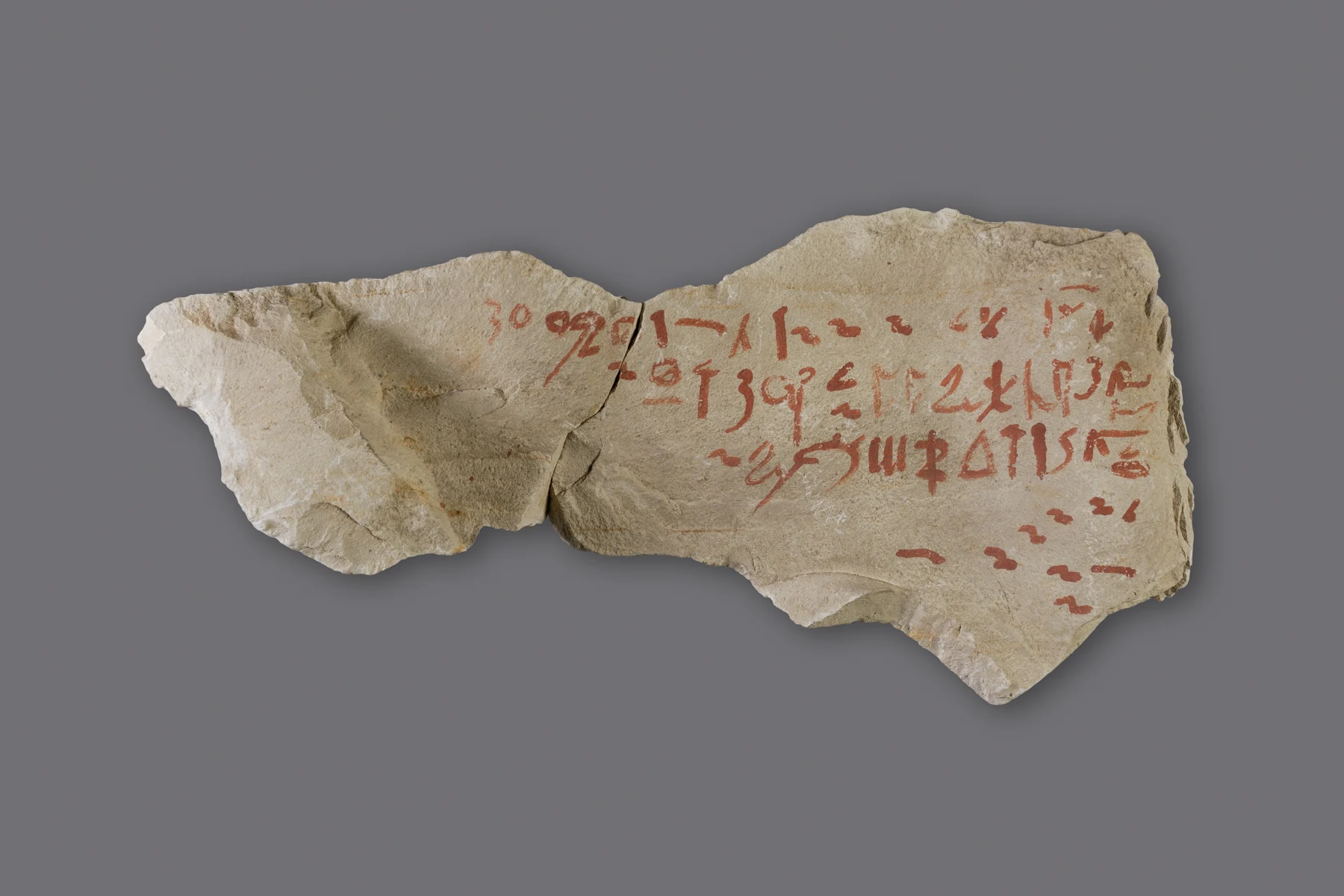
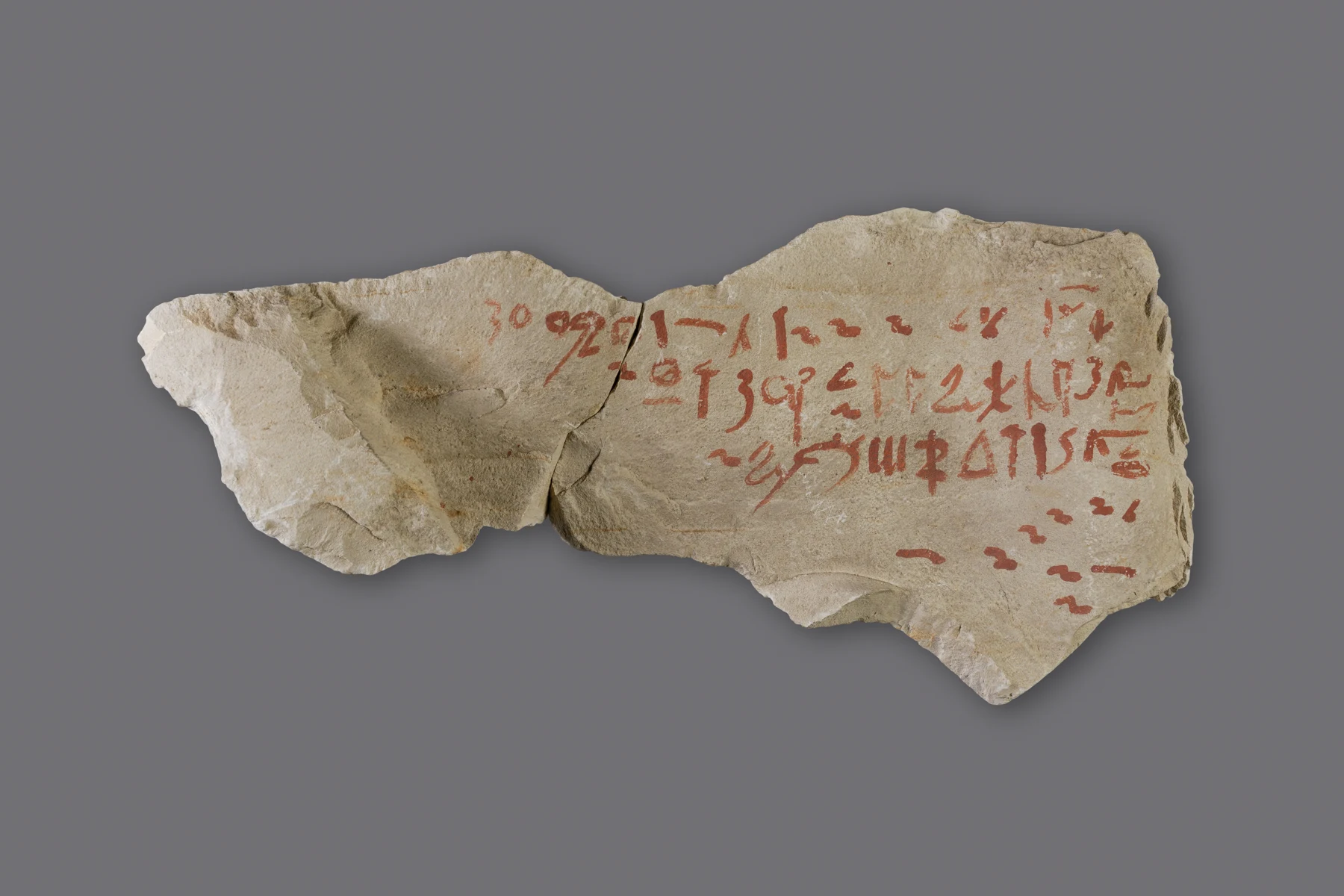
- 525–404 BCE: limestone ostracon 26.3.165 in the Metropolitan Museum of Art, bearing the work's opening in hieratic. The museum locates its findspot at Deir el-Bahri in Thebes, Egypt. It documents later use of the opening, not the original act of composition. [6]
Further school witnesses include boards and ostraca associated with Turin, the Louvre, and Moscow. Writing board Turin 6237, with successive lines and indications of days, provides physical evidence for exercises in copying the teaching; by itself it cannot establish how the Hebrew book was composed. The image reproduced here is the Metropolitan Museum's ostracon, not the British Museum papyrus. [7][9]
What the instruction teaches
The opening chapter urges the listener to hear the sayings, lodge them in the heart or inner self, and govern speech; it likens disciplined words to something moored securely. A recent study prints a romanized Egyptian phrase from this opening. The following is a transliteration published in a secondary study, not a fresh reading of the hieratic object. Chapter 1, column III, lines 9–10, includes: [4][10]
Chapter 2, column IV, lines 4–7, warns against harming the poor, people with disabilities, and elders. Chapter 6 treats respect for agricultural boundaries as an issue of practical justice: neither field markers nor surveying cords nor a widow's boundary should be moved. Chapter 9 warns against associating with an irascible person; chapter 18 reflects on the limits of human knowledge about tomorrow. Egyptian religious conceptions of divine judgment, fate, and the consequences of wrongdoing inform these teachings; their ethics are not detached from their religious setting. [4]
Chapter 20 forbids favoring the well dressed over the ragged in judgment and condemns false documents. Chapter 25 discourages mocking a blind person, a person of short stature, or someone who is lame. Chapter 29 counsels allowing a poor person to cross a river without the fare that can be collected from the rich. Such passages show how much of Amenemope merits attention independently of its biblical parallels. A reference to a council of thirty in a legal context elsewhere in the instruction does not identify that council with the book's thirty chapters. [4]
Specific parallels with Proverbs
The closest concentration of correspondences occurs in the Hebrew “Words of the Wise,” particularly Proverbs 22:17–23:11. Some studies extend the comparison to 24:22 in search of a group of thirty sayings, but that larger boundary does not automatically define the section with the densest Egyptian parallels. Nor can such correspondences, by themselves, date the final compilation of the Book of Proverbs. [7][10]
Amenemope's opening appeal, III.9–16 (chapter 1), to listen and retain the instruction in the heart resembles Proverbs 22:17–18, where ears, heart, and the preservation of words likewise occur together. The force of the comparison is greater than the general injunction to listen: similar images are juxtaposed in two instructional openings. Yet the Egyptian image of a mooring post for the tongue is not identical to every word of the preserved Hebrew; attempts to assimilate the imagery have sometimes required conjectural changes to Hebrew readings. [7][10]
Chapter 2, IV.4–5, on protecting the vulnerable can be compared with Proverbs 22:22; chapter 9, XI.13–14, on avoiding the hot-tempered with Proverbs 22:24–25. The injunction against moving agricultural markers and encroaching on a widow's land, VII.12–15 and VIII.9–10, recalls Proverbs 22:28 and 23:10–11. The precise wording matters. In its transmitted Hebrew form Proverbs 23:10 speaks of an “ancient boundary” and subsequently of the fields of orphans; the word “widow” is not written at that location. The Egyptian parallel prompted a conjecture that the Hebrew should be emended to refer to the widow, but that is a proposed critical reading, not an attested Hebrew manuscript reading. [4][10]
Amenemope's directions about eating in the presence of an official, XXIII.13–18 (chapter 23), resemble Proverbs 23:1–3, with its attention to the food and to conduct before a ruler. In chapter 7, IX.10–X.5, the wealth that people pursue disappears with wings like those of geese; Proverbs 23:4–5 imagines wealth rising like an eagle. The argument for adaptation rests on a distinctive combined image of vanishing riches, not on identical species of bird. Chapter 11, XIV.5–18, warns against coveting another's food and describes an excessive mouthful being vomited up; Proverbs 23:6–8 offers a related warning but differs in whose meal is at issue and what conduct is condemned. [4][7][9]
“Thirty” and textual decisions
Amenemope's thirtieth chapter, XXVII.7–8, expressly refers to thirty chapters. A crucial textual problem occurs at Proverbs 22:20. The written Hebrew שִׁלְשׁוֹם (shilshom) can mean “formerly” or “the day before yesterday,” while Adolf Erman proposed שְׁלוֹשִׁים (sheloshim), “thirty,” by comparison with Amenemope. The traditional reading tradition also preserves a different vocalization interpreted as “choice” or “excellent things.” No single unambiguous witness therefore compels the numeral “thirty.” [7][10]
The numerical emendation aligns the Hebrew phrase with the number of Egyptian chapters and may suit one reconstruction of the Hebrew collection's organization. By itself, however, it proves no transfer of thirty complete chapters. In 2026 Bernd U. Schipper proposed retaining the written shilshom: the reference to “today” in Proverbs 22:19 might frame lessons conducted across several days, analogous to the day notations on the Turin board. This is a proposed explanation of pedagogical form, not evidence of a particular intermediary Hebrew manuscript. [7]
The Egyptian witnesses also require editorial judgment. At XXIV.4 (chapter 24), Lichtheim reports that the Turin board reads a word rendered “gift” where the British Museum papyrus has a reading rendered “nose,” and she adopts a translation based on weighing the witnesses. She records other lexical uncertainties and restorations. The brief English formulations used here are therefore renderings informed by a modern translation, not fresh editions of the hieratic text or a claim that there is one indisputable reading throughout. [4]
What the similarities establish—and what they do not
The evidence is stronger than a loose resemblance between common moral sayings. Listening, the poor, the angry person, field boundaries, dining with an official, and winged wealth cluster within a limited Hebrew passage, with some unusually telling images. Literary contact with the Egyptian Amenemope tradition, and probable use of its material in composing this part of Proverbs, explain this concentration better than coincidence alone. The use would nonetheless have been selective and transformative: the motifs are rearranged and differently framed. It does not make the Hebrew author a literal translator of the whole Egyptian instruction. [7][11]
John Ruffle challenged the strength of a number of comparisons in 1977: advice may diverge in purpose even where food or boundary language overlaps, the Hebrew order does not reproduce the Egyptian sequence, and certain Hebrew instructions—such as the warning against financial surety at Proverbs 22:26–27—lack a close counterpart. His objections discourage overstatement, but they do not readily explain the localized accumulation of some distinctive images. J. A. Emerton revisited the debate in a later defense of literary connection; only his publisher's abstract, not the full paper, was available for this review. [9][11]
Michael V. Fox has explained selection and rearrangement in terms of an editor moving through an Egyptian text, whereas Schipper points to documented Egyptian school practices of learning chapter openings and redeploying them. Only the published abstract of Fox's study was consulted here, whereas Schipper's accessible article and arguments were read in full; the difference in evidentiary access matters. An Egyptian–Hebrew or Aramaic intermediary, or educational and oral exchanges across language communities, remains conceivable, but no particular intermediary manuscript or route has been demonstrated by the evidence examined here. Neither a later papyrus date nor the biblical book's final editorial form can simply be projected onto the original composition of the parallel material. [7][12]
This entry draws on selected passages from Miriam Lichtheim's published English translation, specialist comparative discussions, and institutional records for the witnesses. It does not claim an independent hieratic collation or firsthand consultation of Vincent Laisney's 2007 critical edition. Distinguishing an attested reading, a modern translator's decision, and a scholar's emendation is therefore essential wherever the interpretation turns on a contested word. [4][8][10]
Quick answers
What is the Instruction of Amenemope?
It is an Egyptian wisdom work in which a teacher speaks to a younger pupil. A long prologue is followed by thirty numbered chapters. [4]
How old is it, and which copy is the fullest?
Recent scholarship often favors composition in the Ramesside period, in the late second millennium BCE, though surviving copies are dated differently. British Museum papyrus EA 10474 preserves the fullest text. [5][8][9]
Does the teacher Amenemope necessarily name a real author?
No. The father-to-son address is a literary frame, and the names do not prove that one verifiable historical person wrote every chapter. The copyist, Senu, is a different person from the teacher. [4]
What kind of advice does it give?
It deals with fair treatment of others, for example, not mocking a blind person, a person of short stature, or someone who is lame. [4]
What does the Metropolitan Museum ostracon show about the date?
This limestone ostracon, which bears the work's opening in hieratic, dates to 525–404 BCE. It shows later use of the opening, not when the work was first composed. [6]
References and notes (9)
- Miriam Lichtheim (trans.), “Instruction of Amenemope,” in The Context of Scripture, vol. 1, text 1.47; published English translation and editorial notes, rehosted as a ten-page PDF. Selected reading: prologue; chapters 1–2, 6–7, 9, 11, 18, 20, 23–25, 29–30; Senu colophon; PDF pp. 1–5 and 7–10; no independent hieratic collation. Return to the text ↑
- Berlin-Brandenburg Academy, Thesaurus Linguae Aegyptiae; indexed catalogue metadata for the Egyptian text, script/language, and a witness attributed to Psammetichus I. Detailed access was blocked by site verification; search-index metadata only was consulted. Indexed metadata only: Literary Late Egyptian/Late Hieratic; witness dated to Psammetichus I; no access to original Egyptian text. Return to the text ↑
- The Metropolitan Museum of Art, “Hieratic Ostracon with the beginning of The Wisdom of Amenemope,” collection record 558553, object 26.3.165; object details, collection image and public-domain designation. Dynasty 27, 525–404 BCE; limestone and ink; Deir el-Bahri, Thebes; Open Access information. Return to the text ↑
- Bernd U. Schipper, “Proverbs in Egyptian Scribal Style,” TheTorah.com, published 19 May 2026, updated 5 October 2026; accessible full essay and its detailed parallel chart read. Proverbs 22:17–23:11 vs. Amenemope 1.5–6; III.9–16; IV.4–5; VII.12–13; IX.10–X.5; XI.13–14; XXIII.13–18; XXVII.7–8; Prov 22:20 and writing boards. Return to the text ↑
- British Museum, collection catalogue for papyrus EA 10474; indexed institutional record metadata only, as direct catalogue access returned a block. No physical inspection or complete digital collation. EA 10474; indexed entry EA10474-1 and catalogue bibliography only. Return to the text ↑
- John Ruffle, “The Teaching of Amenemope and Its Connection with the Book of Proverbs,” Tyndale Bulletin 28 (1977): 29–68; selected sections of full PDF read. Printed pp. 29–35 (witnesses/dating), 55–62 (comparisons), 62–67 (critique and conclusion), not PDF page numbers. Return to the text ↑
- Alexandru Mihăilă, “The Teachings of Amenemope and the Book of Proverbs of Solomon (22:17–24:22),” Roots 10, pp. 69–81; PDF masthead says 2024 while bibliographic line says 2023; published Egyptological transliterations and textual comparisons. Printed pp. 69–77 read selectively and extensively; conclusion and references pp. 78–81 surveyed; especially pp. 70–75 and Hebrew textual discussion pp. 76–77. Return to the text ↑
- J. A. Emerton, “The Teaching of Amenemope and Proverbs XXII 17–XXIV 22: Further Reflections on a Long-Standing Problem,” Vetus Testamentum 51 (2001): 431–465; publisher abstract or abstract metadata only, not full paywalled article. Abstract only; pp. 431–465 NOT directly read. Return to the text ↑
- Michael V. Fox, “From Amenemope to Proverbs: Editorial Art in Proverbs 22:17–23:11,” Zeitschrift für die alttestamentliche Wissenschaft 126 (2014): 76–91; publisher summary and Schipper’s discussion only, not full article. Abstract and bibliographic metadata only; argument details not directly inspected in the paper. Return to the text ↑
Archive records may be reviewed and refined as better evidence or sources become available. Suggest a correction
Suggest a correction · Suggest a source for this record
Cite this record
IL Archive, «Instruction of Amenemope», https://ilarchive.com/en/texts/instruction-of-amenemope
Continue reading
Related readings