Study
Job and the righteous sufferer in Babylon: the question of justice before Job
An extended study of a topic, with evidence and references.
- Region
- Babylonia, Assyria and Judah
Ludlul, the Babylonian Theodicy and Job: upright suffering, different debates and endings, and the limits of evidence for borrowing.
Share article
Text
When Job loses his children, possessions, and health, he does not know why disaster has struck. The reader knows something the protagonist does not: a conversation in the heavenly council about the meaning of human piety preceded his ordeal. Friends arrive and offer explanations, Job disputes them, and a divine voice speaks from the storm. The story poses a sharp question: does suffering disclose a hidden offense, or can an upright person suffer for reasons that his conduct does not explain? [3][4][5]
The question did not begin with the Book of Job. Before the HebrewHebrewA Northwest Semitic language in the Canaanite group, with ancient and modern forms.Glossary · Click to read the explanation book reached us, Mesopotamian scribes knew poems about a person who fulfilled religious duties yet lost his standing and health, or a sufferer who watched wrongdoers prosper while devotion failed to bring the expected help. The two best-known comparanda are Ludlul bēl nēmeqiLudlul bēl nēmeqiAkkadian poem of a sufferer who praises Marduk after illness, lost standing and recovery; compared with Job, though its form and damaged guilt passage differ.Glossary · Click to read the explanation, “I will praise the LordRabbTitle of lordship, ownership or care by context; applied to God in Lord of worlds.Glossary · Click to read the explanation of Wisdom,” and the Babylonian Theodicy, a modern title for a poetic dialogue. Ludlul is sometimes called the “Babylonian Job.” That convenient label can obscure the fact that these are three different works, not versions of one story. [1][2][7][13]
Comparison reveals a long history of reflection on pain and justice. Similarity alone does not prove that the author of Job copied a particular Babylonian poem. We need to read what each text says, distinguish a work’s possible date of composition from the date of surviving tablets, and compare each narrative’s structure and ending. [1][2][7][8]
A surviving tablet and an older work
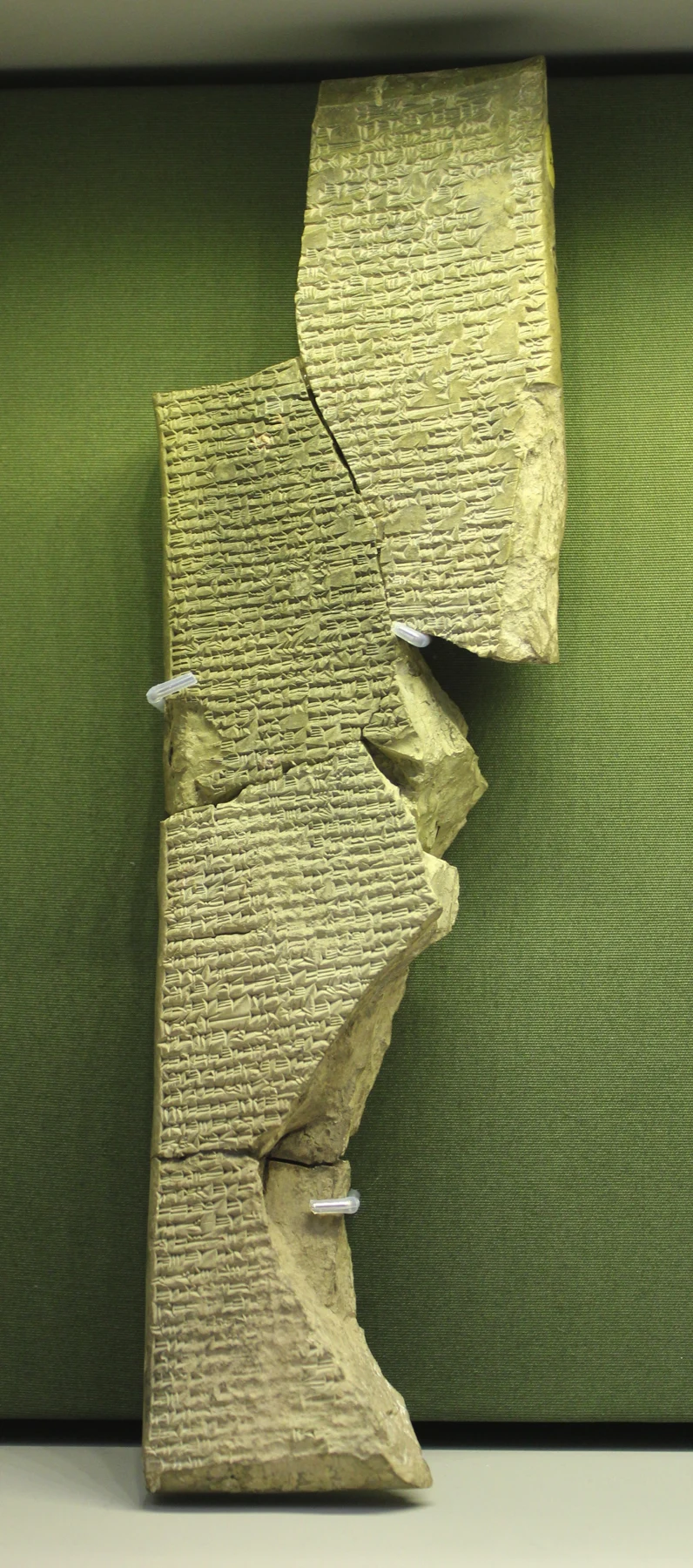
The image accompanying this article shows a cuneiformCuneiformWriting with wedge-shaped signs, developed from Mesopotamian recording traditions and used for several languages from the third millennium BCE.Glossary · Click to read the explanation tablet from NinevehNineveh and KuyunjikNineveh is an ancient Assyrian city near Mosul in northern Iraq; Kuyunjik is one of its archaeological moundsGlossary · Click to read the explanation containing a witness to tablet II of Ludlul. Its museum numbers are K.2518 and DT.358. It dates approximately to the seventh century BCE and belongs among copies associated with AshurbanipalAshurbanipalAshurbanipal was an Assyrian king of the seventh century BCE, reigning about 668–631 BCEGlossary · Click to read the explanation’s library. The photograph was taken while the object was displayed at the Louvre; the tablet is in the British Museum’s collection. It is a later copy of part of the work, neither the author’s first manuscript nor a tablet containing the entire poem. [8][14]
The modern text of Ludlul has been reconstructed from several witnesses. In one current reconstruction it occupies five tablets and roughly six hundred lines. Older editions counted four tablets, so any stated number should be tied to an edition. Scholars think the work was composed before its surviving Assyrian copies, perhaps in the late second millennium BCE, but cannot assign it a precise year or assume that every part was written at once. The Kassite king Nazi-Maruttaš, known from the thirteenth century BCE, figures in scholarly discussions of its date. The protagonist’s name also occurs in two administrative records from that reign; this does not turn the poem’s account of his illness and recovery into a documented biography of the person named there. [1][7][8][11]
The Babylonian Theodicy is often placed near the end of the second millennium or the beginning of the first, though its precise composition date remains debated. It has twenty-seven stanzas of eleven lines each. The opening signs of the lines form an acrostic attributing the work to Šaggil-kīnam-ubbib. Here too we must separate the poem’s composition from the dates of its surviving copies and from an ancient cuneiform commentary that later explained difficult words. A commentary’s date is not the birth date of the work it discusses. [2][13][15]
Nor can the date of Job be inferred from the time in which its protagonist is placed. Edward Greenstein argues from the book’s language and other indications for composition in Persian-period Judah. Other scholars posit stages in the formation of its prose frame and poetic debate; their sequence and dates are contested. We cannot line up three “original versions” on an exact timeline, even though the Babylonian comparanda belong to an earlier traceable literary history. [12]
Ludlul: praising Marduk after losing everything
Ludlul opens by praising MardukMardukBabylon’s god, elevated with the city’s history. Enuma Elish celebrates his rise and cosmic ordering; sources associate him with Nibiru and Jupiter. Earliest origins and functions remain uncertain.Glossary · Click to read the explanation, the god of BabylonBabylonBabylon is an ancient city in central present-day Iraq, south of BaghdadGlossary · Click to read the explanation. After the hymn, a man named Šubši-mešrê-Šakkan recounts the collapse of his life. He loses favor and standing, becomes severely ill, and finds his relationships with others overturned. Messages that he seeks from the divine realm no longer seem clear. He lists the worship and offerings he has performed and asks bitterly how a human being could know what truly pleases a god. In some passages divination and investigation fail to account for his condition; the problem is not diagnosed as a simple shortage of offerings. [1][7]
Here a reader may think of Job: a man who believes he has lived conscientiously yet cannot connect his affliction to a known offense. But the poem does not proceed as Job does. Ludlul is an extended retrospective account in the sufferer’s voice. Dreams and ritualRitualAn organised or distinguished practice meaningful to a community; it may leave traces, but its form alone does not reveal an associated doctrine.Glossary · Click to read the explanation specialists are crucial to his healing. In the final movement he recovers health and standing and goes to Marduk’s temple in Babylon with thanks and offerings. The work turns uncertainty into praise of Marduk’s power to alter a human fate, without establishing a formula by which his will can be calculated beforehand. [1][7][11]
There is a further limit to the comparison. After the sequence of dreams and healing, a damaged passage in tablet III contains words concerning sin, followed by a line in which the protagonist’s offenses are carried away by the wind. Alan Lenzi reads this as an acknowledgment of wrongdoing and its removal. Because the preceding lines are broken, however, we cannot recover the offense’s details or claim that the sufferer knew from the outset of a specific sin deserving his ordeal. The label “righteous sufferer” must not erase the difference between this trajectory and Job’s opening, which explicitly describes Job as upright. [1][7]
Ludlul has no opening heavenly-council scene that informs its readers of a test of the hero’s piety in the way Job’s frame does. Nor does it stage a long debate with three friends whose statements are condemned at the end. “Babylonian Job” may suggest a thematic kinship, but misleads if taken to mean that a preserved original was copied line for line into Job. Modern research also emphasizes Ludlul’s history among scribes and practitioners of healing and ritual. Reading it only to ask about Job removes it from its own setting. [1][7][11]
The Theodicy: a sufferer and a friend, without a narrated cure
The second Babylonian poem does not have a man look back from his sickbed to recount his cure. A sufferer and a learned friend take turns speaking. The sufferer begins with the loss of his parents, then describes hardship and his frustrated expectation that devotion should be met with good fortune. He sees people neglect a goddess and thrive, while the person who prays and fulfills obligations suffers. His complaint expands from his own life to society: a powerful person wins praise for violence, and an innocent poor person is humiliated. This is more than a complaint about bodily pain; it is a protest about the order of the world he sees. [2]
The friend replies that the gods’ plan lies beyond human knowledge, that the swindler’s success need not last, and that divine worship cannot be reduced to the pursuit of riches. Their exchange is a carefully made literary work, with recurring images of animals, wealth, and poverty and a patterned acrostic in its line openings. Its proximity to the arguments between Job and his friends thus concerns the form of inquiry through dialogue as well as the topic. [2][9][10]
The ending resists a simple verdict. In Lambert’s translation, the friend’s penultimate speech acknowledges distorted human speech and the oppression of the poor by the powerful. The sufferer then thanks his friend but continues to ask his god and goddess for compassion. The poem does not narrate the end of his troubles or the return of his wealth. Benjamin Clarke argues that the sufferer’s case has affected the friend’s position; Takayoshi Oshima instead reads the sufferer as ultimately accepting his friend’s advice and the poem as favoring devotion despite uncertain reward. This is a disagreement over the ending, not a fact that a modern narrator can settle from one excerpt. [2][9][10]
In Job, the reader knows what Job does not
The Book of Job distributes knowledge differently. The opening calls Job upright. The reader then hears YHWHYahwehThe divine proper name written YHWH in the Hebrew Bible.Glossary · Click to read the explanation and “the adversary” discuss a decisive question: does Job fear God without reward? Calamity is permitted within limits, but Job neither witnesses that council scene nor learns of it afterward. When his friends arrive, they debate suffering without the information that the reader possesses. The author has not simply forgotten to offer an opening explanation; the distance between what we know and what the sufferer knows is part of the book’s design. [3]
In chapter 4 Eliphaz states a principle that seems secure to him: when did the innocent perish, and do those who sow trouble not reap it? In chapter 5 he urges Job to understand affliction as divine correction followed by healing. Job refuses to let this ready-made rule replace his experience. In chapter 21 he asks why the wicked flourish, and elsewhere demands a hearing for his complaint. His position is not identical to that of the Babylonian sufferer, but both works test the explanation of disaster as deserved punishment. [4][5]
YHWH’s reply from the storm in chapters 38–41 widens the scene to earth, sea, animals, and what humans cannot control or know. It does not disclose to Job the earlier council conversation known to the reader. The ending then states that the friends have not spoken rightly as Job has and recounts the restoration of his health and standing. That restoration may recall Ludlul, but the route to it differs. Job hears a divine address and the friends’ words are judged; Ludlul’s protagonist narrates healing and thanksgiving rituals for Marduk. [1][6]
Where the works converge and diverge
All three works examine moral recompense: can an observer infer guilt from a person’s misfortune? Each disrupts the simple hope that upright behavior invariably brings safety. Poverty, lost status, sickness, isolation, and the limits of human knowledge about divine intentions appear across this literary field. Such convergences explain the comparison’s continuing value. [1][2][3][7]
The differences are equally consequential. Ludlul is praise of Marduk after restoration, with dreams, ritual specialists, and a damaged reference to the protagonist’s offense. The Theodicy is a patterned dialogue between two speakers without a narrated recovery. Job adds a council scene hidden from its protagonist, three friends, divine speeches, and a final judgment on what the friends have said. The two Babylonian poems work in a religious world of several gods; Job places YHWH at the center of its protagonist’s question. These are not stages on a simple ladder from a “defective” answer to a “complete” one. Each text arranges its questions and voices in its own setting. [1][2][3][6][7]
Did Job’s author read Ludlul?
That is a historical possibility, not an established fact. The Babylonian traditions may predate Job, and scribes in the ancient Near EastAncient Near EastA historical and geographical term covering Mesopotamia, the Levant and neighbouring ancient societies.Glossary · Click to read the explanation had channels through which texts and literary forms could circulate. The Theodicy resembles Job in its exchange of arguments; Ludlul resembles it in affliction followed by restoration. Those resemblances justify asking about contact. They do not furnish a tablet showing that Job’s author read either poem, an early Hebrew translation of one, or a long and distinctive verbal sequence that settles the route of transmission. Some similarities may belong to a wider repertoire of wisdom and lament, or to separate reflections on a recurring human problem. [1][2][7][9][10]
Degrees of evidence matter. We can confidently say that Mesopotamian literature considered the plight of a devoted sufferer before the Book of Job reached its surviving form, and that Babylonian texts questioned the rewards of worship and the justice of human fortune. Job shares themes and forms with this regional history of reflection. The assertion that “Ludlul is the original from which the entire Book of Job was copied” exceeds the evidence examined here. Indirect literary contact remains possible, but a question for investigation rather than a foregone headline. [1][2][7][11]
What the comparison offers
In Ludlul a man cannot understand his collapse and praises Marduk after recovery. In the Theodicy we hear an open question about a violent rich person and a humiliated poor one; the sufferer ends by asking for mercy. In Job the reader enters the heavenly council before listening to the protests of a man denied that knowledge, and watches his friends fail to reduce his suffering to a formula of sin and punishment. [1][2][3][6]
The historical value lies not in finding a “first Job” whose name and homeland can simply be changed. It lies in seeing several distinct ancient attempts to understand the distance between moral expectation and lived experience. Those attempts took shape in worlds of scribes, temples, and texts circulating over centuries. Their precise literary connections still require closer evidence. A sound comparison keeps resemblance, difference, and historical uncertainty together. [7][9][10][11]
Findings by degree of confidence
- Established: Ludlul and the Babylonian Theodicy differ from Job in language, structure, and ending. All three initially confront a sufferer unable to find an easy explanation for what has happened. A damaged passage in Ludlul later speaks of an offense removed, so their accounts of innocence should not be equated. [1][2][3][6][7]
- Established: The cover photograph shows a later witness to Ludlul tablet II, not a manuscript from the poem’s original composition. [8][14]
- Probable: The works share a broader ancient Near Eastern field of wisdom questions and literary forms; that does not mean each directly borrowed the other’s wording. [7][9][10][11]
- Debated: Their precise composition dates and some textual layers, as well as the meaning of the Theodicy’s final exchange. [7][9][10][12]
- Unproven: That Job’s author directly copied Ludlul or the Babylonian Theodicy as the source of the entire book. [1][2][7]
For a case with more specific wisdom-text parallels, see Proverbs and Amenemope. For a comparison of creation accounts with different structures and purposes, see Genesis and Enūma Eliš.
References and notes
- Akkadian transliteration and English translation inspected at I 1–45, II 1–30 and 114–120, III 25–44 and 53–74, IV 1–5 and 39–45, V 1–13, 42–60 and 111–120. Not all approximately 600 reconstructed lines independently collated. CDLI P491222, Ludlul composite, tablets I–V; selected lines Return to the text ↑
- Search-indexed substantial translation excerpts of stanzas I–VIII, XII–XVII and XIX–XXVII inspected; the final five stanzas (XXIII–XXVII, lines 243–297) examined closely. The host did not open directly, so the complete 297 lines and the newer Oshima edition were not read. W. G. Lambert translation of the Babylonian Theodicy, selected stanzas Return to the text ↑
- Job chapters 1 and 2 read in full, as part of a primary-text pass also covering chapters 1–7, 9, 13, 19, 21 and 38–42. Other chapters not read in this pass. Job 1–2, Hebrew and JPS 1917 Return to the text ↑
- Job chapters 4 and 5 read in full; Eliphaz’s statements in 4:7–8 and 5:17–18 checked. Translation debates in other passages not treated as settled. Job 4–5, Hebrew and JPS 1917 Return to the text ↑
- Job chapter 21 read in full, especially verses 7–15 on the fortunes of the wicked. Job 21, Hebrew and JPS 1917 Return to the text ↑
- Job chapters 38–42 read in full. Divine speeches, 42:7, and restoration checked. The disputed wording of 42:6 is not made the basis of a definitive theological resolution. Job 38–42, Hebrew and JPS 1917 Return to the text ↑
- The open publisher PDF’s introduction (printed pp. 1–8), table of contents, and printed pp. 232–234 and 326–328 read. The full 539-page book was not read. Selected later pages discuss the protagonist’s initial ignorance and the damaged Ludlul III 58–61 passage about sin being carried away. Alan Lenzi, Suffering in Babylon (2023), introduction pp. 1–8; selected pp. 232–234, 326–328 Return to the text ↑
- Abstract and printed pp. 311–319 examined, not every bibliography page. Confirms object K.2518+DT.358 as a Nineveh tablet-II witness on loan from British Museum to Louvre; discusses distinct manuscript sets. Aino Hätinen, “Ludlul bēl nēmeqi in Ashurbanipal’s Library” (2024), pp. 311–319 Return to the text ↑
- Publisher-hosted article abstract only, not the ten-page paper. Its interpretation of the poem’s ending as favoring the friend is attributed to Oshima. Takayoshi Oshima, “The Babylonian Theodicy” (2015), abstract Return to the text ↑
- Journal record and approximately the first three pages of a rehosted article preview inspected; full journal PDF returned 403 and was not read. The opening states Clarke’s alternative reading of the ending; it is attributed, not treated as consensus. Benjamin Clarke, “Misery Loves Company” (2010), article record and opening preview Return to the text ↑
- Open PDF abstract and printed pp. 13–20 read, with selected body passages at pp. 37–41, 50, 54–55 and 61–63 inspected. Not the entire 62-page article. Anthony P. SooHoo, “Lament and Hope in Ludlul Bēl Nēmeqi” (2024), selected pages Return to the text ↑
- Complete short Yale University Press online excerpt read, not the whole book. Persian-period dating presented as Greenstein’s argument rather than scholarly unanimity. Edward L. Greenstein, public excerpt on dating Job Return to the text ↑
- Only the indicated four PDF pages inspected; used for the Babylonian Theodicy acrostic and attributed author, not a date inferred from authorial attribution. Sophus Helle, The First Authors (2020), PDF pp. 38–39 and 352–353 Return to the text ↑
- Full Commons file description, photographer attribution, source/license and object identification inspected; the original downloaded JPEG was visually checked. Hätinen independently corroborates tablet identity. No CDLI image is reused. Zunkir photograph, file page and CC BY-SA 4.0 license Return to the text ↑
- Public introduction to the commentary, its approximate date, acrostic and philological character read. Detailed line-by-line cuneiform commentary not read. Cuneiform Commentaries Project, ancient commentary on the Babylonian Theodicy Return to the text ↑
Suggest a correction · Suggest a source for this record
Cite this record
IL Archive, «Job and the righteous sufferer in Babylon: the question of justice before Job», Edition 1, https://ilarchive.com/en/studies/job-and-mesopotamian-sufferer
Continue reading