Entity · Religious title
Rabb
A reference page linking a name, group, or concept to the materials that discuss it.
Rabb expresses mastery, ownership or governance by context: a title of God in “Lord of the worlds,” but also of a human master in Joseph’s story, not a second deity in Qur’an 1:2 or 6:102.
Estimated reading time: 8 min Published Last reviewed:
Share article
Text
Introduction
Rabb is an Arabic word for a relationship of mastery, possession or direction; its precise scope depends on who is speaking, to whom, and about whom. In the Qur'anThe QuranThe central scripture of Islam, consisting of 114 Arabic surahs; its study distinguishes Quranic discourse from manuscript history, reading traditions, and historical inference.Glossary · Click to read the explanation it describes God, but it also designates a human master within a narrative. A single English rendering such as Lord therefore cannot establish the referent in every passage, and similar-looking Semitic words do not by themselves prove that a religious doctrine moved from one people to another. This entry examines attested usages, the histories of their textual witnesses, and the difference between what a passage says and what later theology makes of it.
Form and meaning: from master to Lord of the worlds
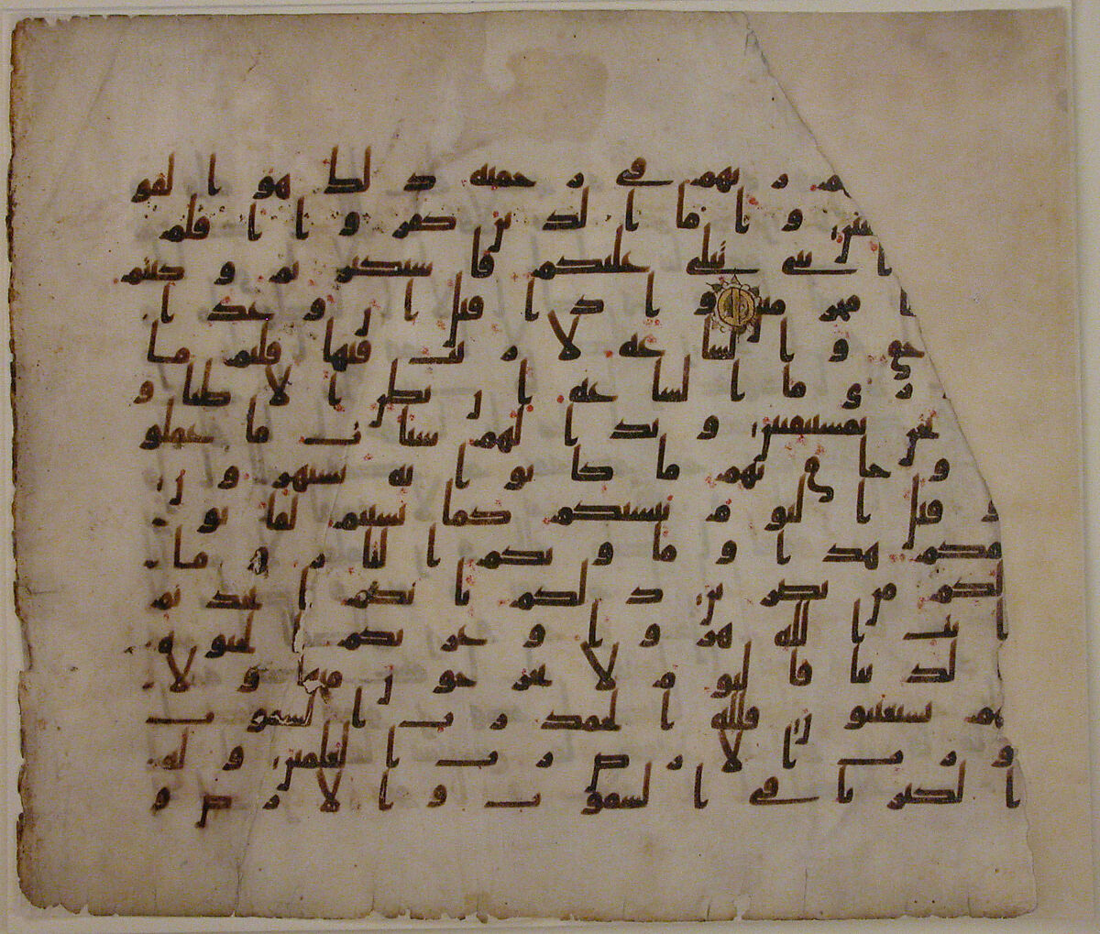
Arabic rabb belongs to the root r-b-b; forms include rabbī (“my lord”), rabbuka (“your lord”) and the plural arbāb. Lexicons record a master who commands obedience, an owner or proprietor, and someone responsible for directing or caring for something. These senses overlap without being identical. Master fits a person's employer or superior; owner fits a possessive relationship; Lord of the worlds expresses encompassing sovereignty in religious discourse. Badawi and Abdel Haleem's dictionary of Qur'anic usage distinguishes the human master, an object of worship, and a designation of God. Edward William Lane's nineteenth-century compilation of earlier Arabic lexicography records ownership, ordering, improvement and nurture. The presence of all these senses in a later lexicon does not establish their equal distribution in every earlier period. [3][4]
Different formations must also be kept apart. In its morphological analysis, the Quranic Arabic Corpus assigns the noun rabb to r-b-b, but the verb rabbayā in “as they raised me when I was small” to r-b-w. This is a classification of word forms, not proof that sovereignty and upbringing never interacted historically; equally, it does not authorize deriving every use of rabb automatically from “education” or “rearing.” Nor does a possible lexical relationship between rabbāniyyūn and HebrewHebrewA Northwest Semitic language of the Canaanite group, encompassing Iron Age epigraphy, Biblical, Rabbinic, medieval and Modern Hebrew; its scripts and pronunciations changed over time.Glossary · Click to read the explanation or Aramaic expressions establish a one-way transfer of a religious office. [5][6][3]
When the lord is human: Joseph's story
Within the story of JosephJoseph in Genesis and the Qur’anFigure whose story in Genesis and Sūrat Yūsuf combines enslavement, accusation, prison and advancement in Egypt.Glossary · Click to read the explanation, the immediate dialogue identifies the referent. One of the prisoners is told that he will “serve wine to his rabb”: this is the human master he serves, not a god. Joseph tells the prisoner expected to be released to “mention me to your rabb,” meaning his superior at court. Commentators have disagreed about the antecedent of the subsequent expression “Satan caused him to forget the mention of his lord”; a historical conclusion should not be built on silently fixing that disputed pronoun. [7][8]
The two uses even appear in one utterance after the king summons Joseph:
Location: Qur'an, Joseph 12:50. A contextual rendering is: “Go back to your master [the king] ... my Lord [God] knows their plotting.” The intervening words are omitted here for brevity; this is not presented as an uninterrupted quotation. The distinct referents are supported by the course of the dialogue, not by assuming that the word has changed its basic lexical shape mid-sentence. [9]
When Joseph asks, “Are diverse arbāb better, or Allah, the One, the Overpowering?” in 12:39, the plural belongs to a religious contrast and designates competing objects of worship or divine powers. Pharaoh's claim, “I am your supreme rabb,” in 79:24 is a boast placed in a character's mouth and condemned by the narrative. It is neither the narrator's definition of Pharaoh nor independent historical evidence of the vocabulary of his Egyptian court. The speaker and the literary position of a statement matter. [10][11]
Divine usage: an epithet, not a second personality
The opening sura, al-Fātiḥa, contains the short declaration:
Location: Qur'an 1:2; “Praise belongs to Allah, Lord and sustainer of the worlds.” Here rabb describes AllahAllahAllāh: the Arabic designation of the one God in Islam, also used in other Arabic-speaking traditions. Its pre-Islamic attestations vary in context and historical meaning.Glossary · Click to read the explanation in a construct phrase; it is not the proper nameProper nameA name that identifies a particular person, place, group, or entity in context, unlike a common noun denoting a class. Spelling alone may not settle the distinction.Glossary · Click to read the explanation of another deity standing beside him. The relationship between the terms becomes still more explicit in al-Anʿām:
Location: Qur'an 6:102, followed by “Creator of all things, so worship him.” That is, “That is Allah, your Lord; there is no god other than him.” The pronouns, the object of worship and the creator refer to the same being in the verse. Its syntax does not support reading “Allah” and “your rabb” as two different divine persons. The preceding verse also rejects attributing a consort or child to God, but reconstructing when each doctrine arose requires evidence beyond these two verses. [1][2]
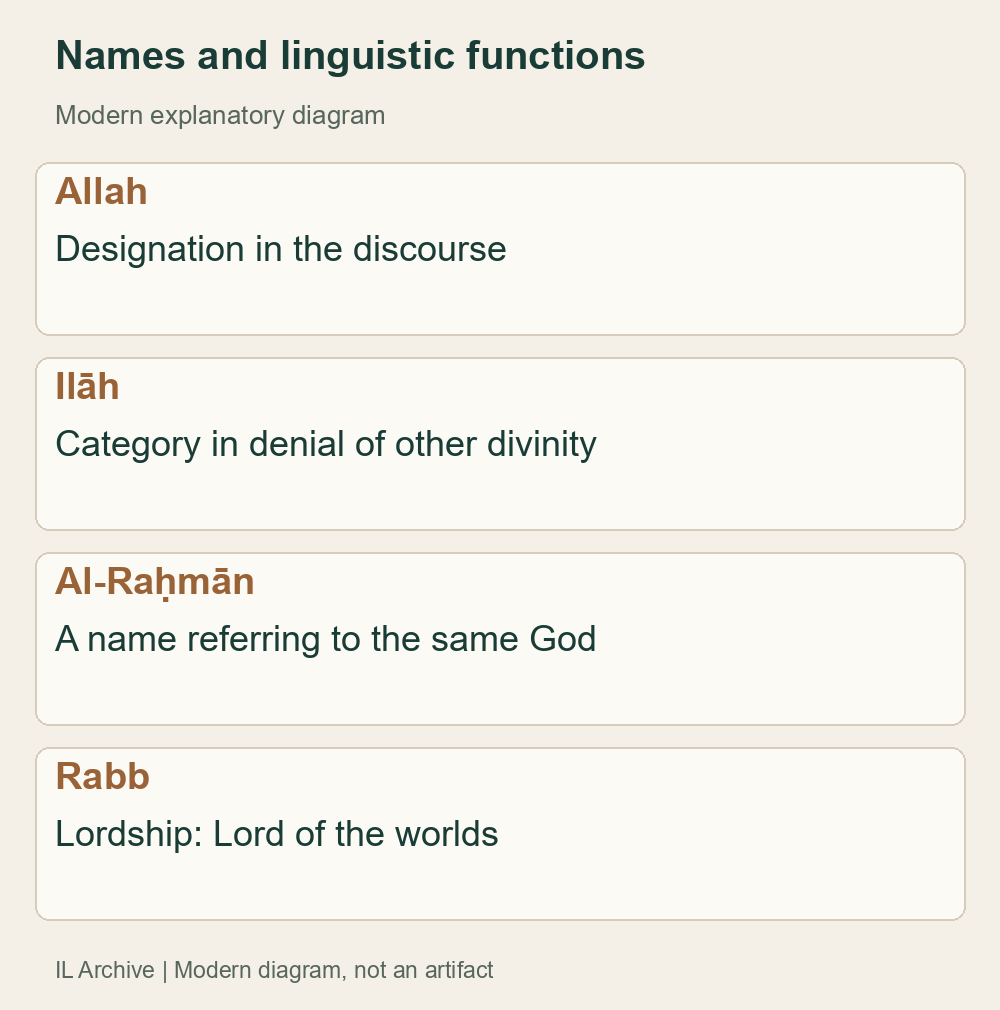
It is therefore useful to distinguish a designation of the being addressed, ilāhArabic ilahʾIlāh: Arabic common noun for a god or deity, with the broken plural āliha; distinct from the specific designation Allāh and understood from context.Glossary · Click to read the explanation as a noun for a deity or object of worship, rabb as a description of lordship and relationship, and al-RaḥmānAl-RaḥmānQuranic divine designation co-referring with Allah.Glossary · Click to read the explanation as a name by which that same God may be invoked in 17:110. This compares the words' functions within Qur'anic discourse; it does not, on its own, settle the etymology of the name Allah or the history of al-Raḥmān outside the Qur'an. [12]
In his commentary on al-Fātiḥa, Muḥammad ibn Jarīr al-ṬabarīAl-TabariAbbasid-era historian and Qur'anic exegete (c. 839–923 CE). His commentary records competing views on Abraham's son, then favors Isaac.Glossary · Click to read the explanation (died 923 CE) distinguishes the master, owner and one who sets matters right as senses of rabb. His discussion is valuable for the history of Arabic-Islamic interpretation and for contextual meaning. But the commentary was written generations after the Qur'anic discourse emerged; even a traditional explanation is not thereby an early manuscript witness to the wording of each verse or evidence for a specific title in pharaonic Egypt. [13]
Hebrew and Aramaic comparison: related forms, different functions
The Semitic languagesSemitic languagesA branch of the Afroasiatic language family, including Akkadian, Ugaritic, Hebrew, Aramaic, Arabic, Ethio-Semitic and South Arabian languages; a linguistic, not racial or religious, classification.Glossary · Click to read the explanation offer comparable r-b forms, yet a witness must be allowed to mean what it means in its own sentence. In Biblical HebrewHebrewA Northwest Semitic language of the Canaanite group, encompassing Iron Age epigraphy, Biblical, Rabbinic, medieval and Modern Hebrew; its scripts and pronunciations changed over time.Glossary · Click to read the explanation, Rebecca speaks of provisions for guests in the Book of GenesisBook of GenesisHebrew book of the Torah containing Noah’s flood, survival offering and covenant with living creatures.Glossary · Click to read the explanation:
Location: Genesis 24:25; “We have straw and fodder in abundance.” Here rav (רַב) means “plentiful,” not a divine “Lord.” The Brown–Driver–Briggs lexicon confirms this adjectival use in that passage. Phonetic and etymological proximity do not erase the difference in function. [14][15]
In Biblical AramaicAramaicNorthwest Semitic language varieties documented since the early first millennium BCE, including Old and Imperial Aramaic, Syriac, Jewish dialects, and living Neo-Aramaic forms.Glossary · Click to read the explanation, the Book of DanielBook of DanielA book combining court tales of wisdom and deliverance with visions of kingdoms and the future, formed in stages.Glossary · Click to read the explanation uses a compound indicating an office:
Location: Daniel 2:14; “chief of the guard” or “commander of the king's executioners,” describing Arioch. The rab element indicates chiefship, not a god's name. We are reading a Biblical Aramaic text transmitted through the Masoretic Hebrew–Aramaic textual tradition and displayed in modern digital editions, not a Babylonian clay tablet bearing this wording. [16][17]
The Greek Gospel of JohnGospel of JohnOne of the New Testament Gospels, opening with the Word, creation and the Word becoming flesh.Glossary · Click to read the explanation provides another use that cannot simply be equated with Qur'anic Arabic: it transliterates a form of address and explains it for Greek readers.
Location: John 1:38, in the Greek text of the New Testament edition consulted; “Rabbi (which means Teacher).” This attests a title of respect and instruction in a Jewish context, not the appearance of Qur'anic Arabic in an original Greek sentence, and the title alone does not identify the addressee as a deity. Studies of the title likewise distinguish rab, rabbi and rabban by form and social usage. [18][19]
Chronology and the limits of inference
- Sixth century BCE: the Babylonian court setting of Daniel's story; it is not the date of the extant Aramaic text under examination. [20]
- Persian and Hellenistic periods, down to approximately 164 BCE: scholarship reconstructs stages in the development of Daniel's court talesCourt TaleAn analytical category for stories in which a sage or outsider faces tests of skill, loyalty, or survival at a royal court, through contest, accusation, or reversal; it does not establish one textual origin.Glossary · Click to read the explanation, while the visions took their later form amid the crisis under Antiochus IV in 168–164 BCE. The “chief of the guard” occurs in a court tale; its wording cannot simply be dated by the events narrated or by the visions' last stage. [20][21]
- Approximately the late first century CE: a widely proposed date for the final form of the Gospel of John, with arguments for earlier dating and compositional stages. This is distinct from the period in which its narrative places Jesus' conversation. [22]
- Seventh century CE: the historical setting of the emergence of Qur'anic discourse. The digital edition used to examine rabb is not itself a manuscript copied in that period.
- Ninth–tenth centuries CE: the era of al-Ṭabarī's commentary; 1008–1009 CE is the copying date of the Leningrad Masoretic Codex (National Library of Russia, shelfmark EVR I B 19a), which underlies electronic editions of the Hebrew Bible. That copy date is not a date of composition for Genesis or Daniel. [13][23]
The evidence supports a firm but bounded conclusion. Rabb can identify a human master in the Qur'an, plural lords or deities in a polemical religious comparison, and God as Lord of the worlds. Hebrew and Aramaic comparisons reveal related linguistic forms whose observed functions range from abundance to command and teaching. None of these examples alone dates the first idea of cosmic sovereignty or proves a linear transfer of a title from one particular god to another. A larger historical claim would require independently dated texts, adequate contexts and a testable route of transmission, not a shared cluster of consonants or a uniform translation.
References and notes (23)
- Qur’an, al-Fātiḥa 1:2; Arabic text displayed by Quran.com. Al-Fātiḥa 1:2, “rabb al-ʿālamīn”; verse text read. Return to the text ↑
- Qur’an, al-Anʿām 6:101–102; Arabic text and immediate context on Quran.com. Al-Anʿām 6:101–102, lordship, divinity, creation and denial of offspring; both verses examined in context. Return to the text ↑
- Elsaid M. Badawi and Muhammad Abdel Haleem, Arabic-English Dictionary of Qurʾanic Usage, Brill, 2008. Root r-b-b, printed p. 342; examples of human masters, divinity and divine designation. Return to the text ↑
- Edward William Lane, Arabic-English Lexicon, s.v. rabb (nineteenth century), digitized entry. Entry rabb: owner, master, chief, regulator, fosterer, plural arbāb. Return to the text ↑
- University of Leeds, Quranic Arabic Corpus, dictionary entry for root r-b-b. Root forms and listed examples, including 1:2 and 12:39 and rabbāniyyūn. Return to the text ↑
- University of Leeds, Quranic Arabic Corpus, dictionary entry for root r-b-w. Root r-b-w, including the form rabbayāni in 17:24. Return to the text ↑
- Qur’an, Yūsuf 12:41, Quran.com. Yūsuf 12:41, “he will serve wine to his rabb,” the cupbearer context. Return to the text ↑
- Qur’an, Yūsuf 12:42, Quran.com. Yūsuf 12:42, “mention me to your rabb” and the disputed pronoun in “mention of his lord.” Return to the text ↑
- Qur’an, Yūsuf 12:50, Quran.com. Full verse Yūsuf 12:50, “return to your rabb” and “my rabb knows their plotting.” Return to the text ↑
- Qur’an, Yūsuf 12:39, Quran.com. Yūsuf 12:39, the contrast “different arbāb” / “Allah, the One.” Return to the text ↑
- Qur’an, al-Nāziʿāt 79:24, Quran.com. Al-Nāziʿāt 79:24, Pharaoh’s “I am your highest rabb” as condemned narrated speech. Return to the text ↑
- Qur’an, al-Isrāʾ 17:110, Quran.com. Al-Isrāʾ 17:110, “call upon Allah or al-Raḥmān” and the shared referent. Return to the text ↑
- Muḥammad ibn Jarīr al-Ṭabarī (d. 923), Jāmiʿ al-bayān, commentary on al-Fātiḥa 1:2, King Saud University digital text. Commentary on “rabb al-ʿālamīn”; master, owner and one who sets matters right. Return to the text ↑
- Book of Genesis 24:25, Masoretic Hebrew text as displayed by Mechon-Mamre. Genesis 24:25 and Rebecca’s remark about straw and fodder, adjective rav. Return to the text ↑
- Francis Brown, S. R. Driver and Charles Briggs, Brown–Driver–Briggs Hebrew Lexicon (1906), entry רַב (7227). Sense “many/great” and Genesis 24:25 at the opening of the entry. Return to the text ↑
- Book of Daniel 2:14, pointed Biblical Aramaic, digital Masoretic text displayed by BibleHub. Daniel 2:14, the expression רַב־טַבָּחַיָּא and the name Arioch. Return to the text ↑
- Brown, Driver and Briggs, Brown–Driver–Briggs, Biblical Aramaic entry רַב (7229), online display. Daniel 2:14: chief/captain, alongside other senses of greatness in Daniel. Return to the text ↑
- Gospel of John 1:38, Greek text of the SBL Greek New Testament (SBLGNT, 2010), digitally displayed. John 1:38, Ῥαββί and the explanatory Διδάσκαλε. Return to the text ↑
- Louis Isaac Rabinowitz, “Rabbi, Rabbinate,” Encyclopaedia Judaica, reproduced by Jewish Virtual Library. Opening entry: the development and social usage of rav, rabbi and rabban. Return to the text ↑
- Tawny Holm, “Book of Daniel,” Oxford Research Encyclopedia of Religion (2019); accessible publisher abstract. Abstract only: sixth-century BCE court setting and probable finalization by about 164 BCE. Return to the text ↑
- Carol Newsom, “Daniel,” Oxford Bibliographies in Biblical Studies (2010); accessible introduction. Introduction only: development of court tales across Persian/Hellenistic periods, visions c. 168–164 BCE. Return to the text ↑
- Eric D. Huntsman, “The Gospel of John,” in New Testament History, Culture, and Society, ed. Lincoln H. Blumell (2019), pp. 204–321; online text. Section on dating and compositional stages only; suggested 90s CE and earlier alternatives. Return to the text ↑
- National Library of Israel, manuscript catalogue: Leningrad Codex, National Library of Russia, Ms. EVR I B 19a. Catalogue metadata: copyist, copying date 1008–1009 CE, shelfmark and holding institution. Return to the text ↑
Suggest a correction · Suggest a source for this record
Cite this record
IL Archive, «Rabb», https://ilarchive.com/en/entities/rabb
Continue reading