Entity · Divine designation
Al-Raḥmān
A reference page linking a name, group, or concept to the materials that discuss it.
A Qurʾānic divine name co-referring with Allah in 17:110, with earlier lexical parallels in religiously diverse South Arabian inscriptions.
Estimated reading time: 2 min Published Last reviewed:
Share article

Text
Introduction
Al-Raḥmān is a prominent Qurʾānic divine designation with a broader linguistic history in ancient Arabia. This entry compares specified Qurʾānic passages with late South Arabian inscriptions and scholarship, distinguishing direct textual evidence from proposals about religious transmission.
A divine designation in the Qurʾān
Al-Raḥmān belongs to the Arabic root r-ḥ-m, associated with mercy. QurʾānThe QuranThe central scripture of Islam, consisting of 114 Arabic surahs; its study distinguishes Quranic discourse from manuscript history, reading traditions, and historical inference.Glossary · Click to read the explanation 17:110 invites invocation of “Allah” or “al-Raḥmān” and refers to the beautiful names of the same deity; it does not enumerate two competing gods. Sūrat al-Raḥmān (55:1–4) connects the designation with teaching, creation and speech. [1]
Different literary settings
At 19:88–93 the Qurʾān challenges the attribution of a son to al-Raḥmān; at 25:60 it records opposition to the command to prostrate to al-Raḥmān. The formula “In the name of Allah, al-Raḥmān, al-Raḥīm” appears at 1:1 and elsewhere. Context matters: occurrences of the same title need not serve identical rhetorical purposes. [3]
Raḥmānān in South Arabian inscriptions
Late South Arabian inscriptions attest a designation commonly transcribed Raḥmānān. Its use belongs to a changing landscape in which Ḥimyarite kings adopted forms of scripturally influenced monotheismMonotheismBelief that only one God possesses divinity in its fullest sense. Historically distinct from exclusively worshipping one deity without denying others; its theological forms vary.Glossary · Click to read the explanation from the later fourth century CE. Jewish and Christian contexts are not interchangeable, and the associated expressions, dates and inscriptional settings require individual examination. [2][4]
Linguistic relationship and historical limits
The earlier attestation of a similar divine designation is evidence of a shared regional religious vocabulary. Alone, resemblance cannot identify a particular intermediary, a one-way borrowing, or one unchanging theological referent across centuries. Nor should the Qurʾānic co-reference of Allah and al-Raḥmān simply be projected onto every earlier inscription. [2][5]
How scholars evaluate the evidence
We need to distinguish the letter sequence on a stone, the role of the name in its invocation, and a scholar’s reconstruction of the religious institution behind it. Gajda emphasizes debates about the character of Ḥimyarite monotheism, while Kjær traces divergent late antique contexts. Linguistic affinity and a fully identical theology are different propositions. [4][5]
Images and their limits
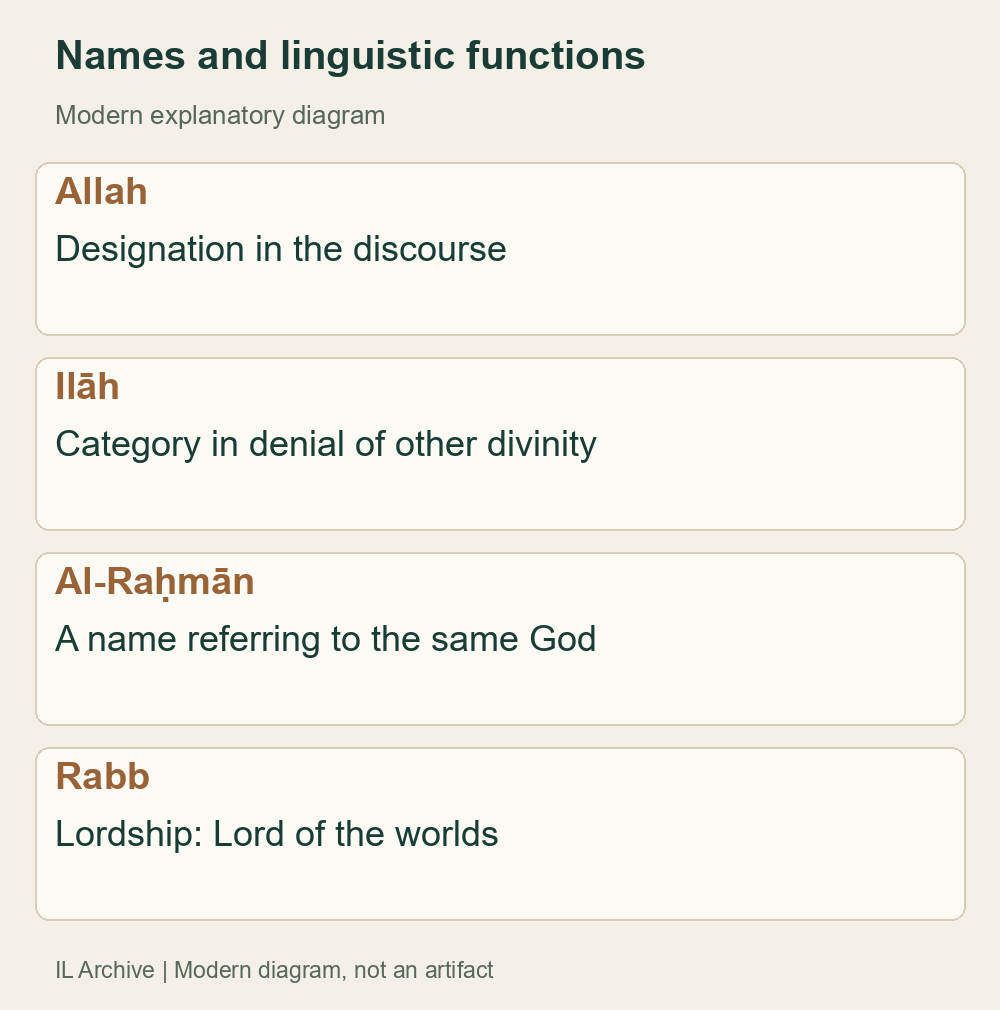
The inherited chart compares word functions in selected Qurʾānic examples; it is neither a photograph of an inscription nor a proven etymological tree. The new symbolic cover is likewise modern conceptual art, not a documented archaeological monument or landscape.
Conclusion
Qurʾān 17:110 establishes the co-reference of Allah and al-Raḥmān in that verse. Epigraphic research establishes pre-Islamic South Arabian use of Raḥmānān in diverse religious settings. Any specific chain of historical transmission requires additional dated evidence rather than a shared name alone.
References and notes (5)
- Qurʾān 17:110; displayed text, Quran.com / Quranic Arabic Corpus. Displayed verse: Allah and al-Raḥmān co-refer; verse alone does not establish a transmission route from Yemen. Return to the text ↑
- Sigrid K. Kjær, “‘Rahman’ before Muhammad: A pre-history of the First Peace (Sulh) in Islam”, Modern Asian Studies 56.3 (2022), 776–795. DOI 10.1017/S0026749X21000305. Abstract and selected late-Sabaic/Jewish examples: Raḥmānān in differing southern contexts. Author’s distinct-deity readings not generalized as facts; no physical inscription examination. Return to the text ↑
- Qurʾān 19:88–93, 25:60, 55:1–4, 1:1. Specified passages; references checked, no modern translation reproduced. Return to the text ↑
- Iwona Gajda, “Remarks on Monotheism in Ancient South Arabia” (2017), pp. 247–256. Published chapter abstract only; full chapter not accessed. Return to the text ↑
- Iwona Gajda, “Religions of Ancient South Arabia From Polytheism to Monotheism” (2026). Only the publisher abstract dated 10 February 2026; full text not read. Return to the text ↑
Suggest a correction · Suggest a source for this record
Cite this record
IL Archive, «Al-Raḥmān», https://ilarchive.com/en/entities/ar-rahman