Study
Gog and Magog: from Ezekiel to the enclosed nations
An extended study of a topic, with evidence and references.
Leader, land, nations and barrier: Genesis, Ezekiel and Revelation through Alexander, the Quran and hadith, with Gyges, Marduk and witness dates examined.
Share article
Text
Introduction
Gog and MagogGog and MagogNames with different roles in genealogies, invasion prophecy, end-time nations and barrier traditions.Glossary · Click to read the explanation have different roles in texts from different periods: a genealogy of peoples, an end-time attack, and nations behind a barrier. This study follows those changing roles from Genesis, Ezekiel and Revelation to the SyriacSyriacA literary form of Aramaic, with an extensive Christian heritage and earlier non-Christian attestations.Glossary · Click to read the explanation Alexander Legend, the QuranQuranCentral text of Islam, used here as evidence of its religious discourse.Glossary · Click to read the explanation and hadith. It asks what each witness adds and when, and how far the evidence supports a historical connection between them. Resemblance alone does not identify a route of transmission, a living people or a certain site for the barrier.
A name moving between different worlds
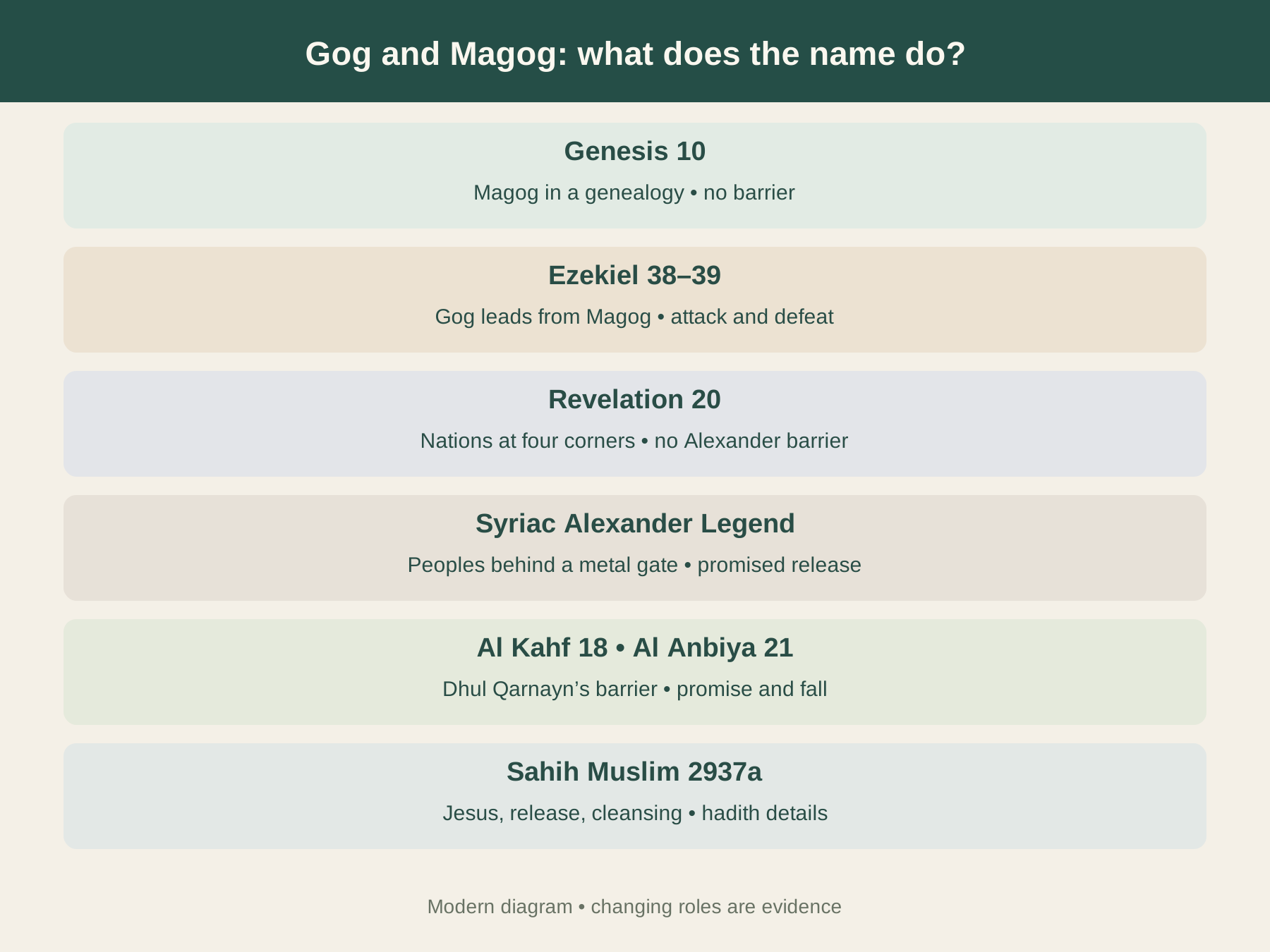
Gog and MagogGog and MagogNames with different roles in genealogies, invasion prophecy, end-time nations and barrier traditions.Glossary · Click to read the explanation may seem to name one people waiting behind one wall from the beginning of history. Yet the texts that formed this picture do not say the same thing. In Genesis, Magog appears in a genealogy of peoples. In Ezekiel, Gog comes from the land of Magog to lead an attack. In Revelation, the names describe the world's hostile nations. In a Syriac tradition about Alexander, they enter a story about closing a mountain passage; in the Quran, they appear in Dhul Qarnayn's story and the promise that the barrier will fall. [1][10][15]
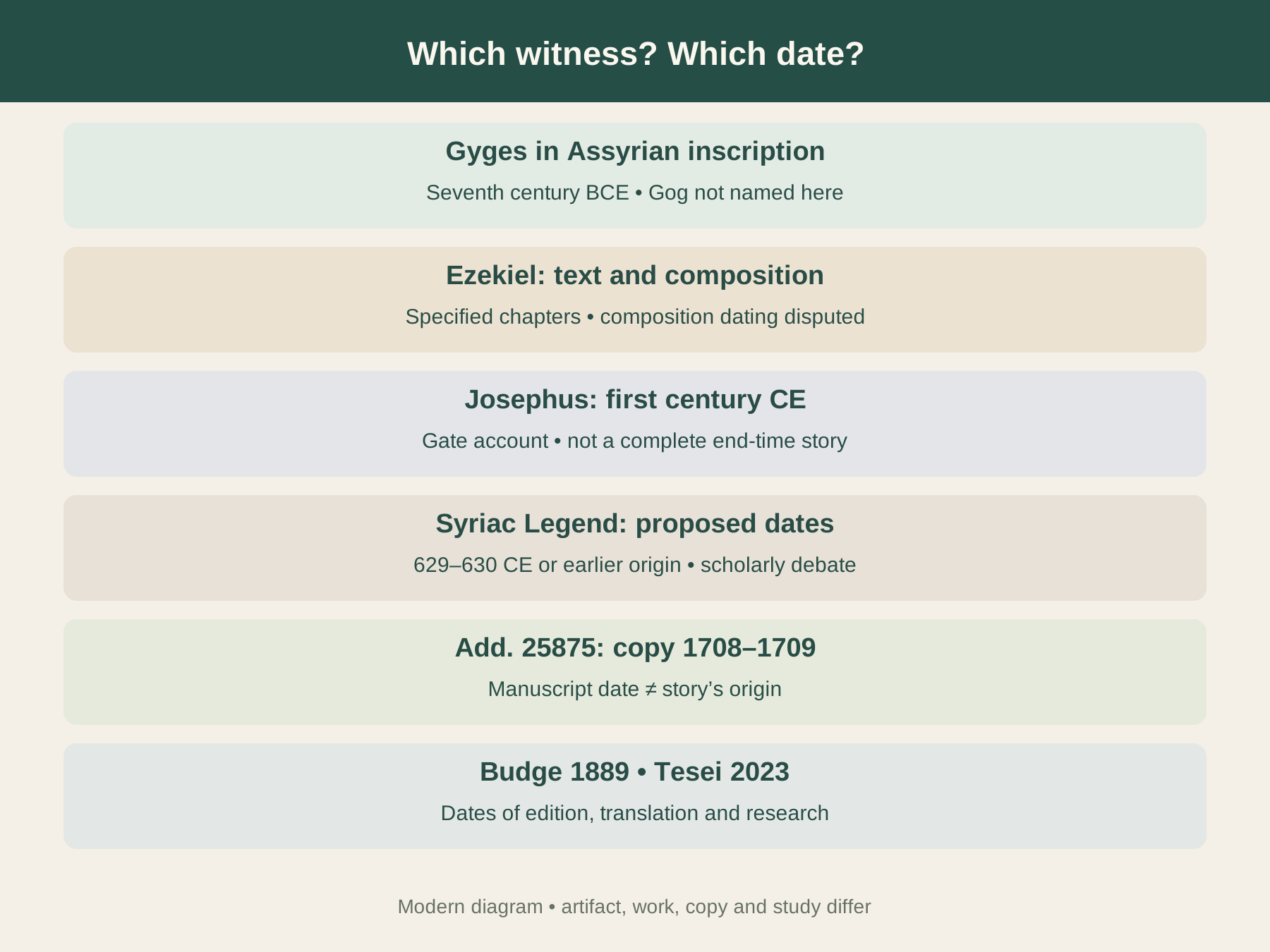
The witnesses belong to different periods. Ezekiel is set in the sixth-century BCE Babylonian exileBabylonian exileJudean deportations to Babylonia and the kingdom’s collapse in the early sixth century BCE; several phases, not everyone removed or returned at once.Glossary · Click to read the explanation; Revelation is commonly dated to the late first century CE. Scholars debate whether the Syriac Alexander Legend first took shape in the sixth or early seventh century, and the Quranic passage belongs to the seventh century. A story's setting, composition and surviving copies have different dates. [19][20][11][12]
Magog in the table of nations
Genesis 10:2 lists Magog among Japheth's sons, alongside Gomer, Madai, Javan, Tubal, Meshech and Tiras. The passage places these names in a genealogy explaining the spread of peoples after the flood. Here there is no warrior king called Gog, no peoples imprisoned by Alexander and no iron wall. [1]
A name in an old genealogy can designate an ancestor to whom a people is attributed, whereas another text uses it for a land or community. We should therefore read the name's role in each passage before assuming that every occurrence describes two fixed individuals. The order of biblical books does not by itself establish when each passage was composed.
Gog in Ezekiel: leader, land and coalition
Ezekiel 38 opens an address to Gog, from the land of Magog, associated with Meshech and Tubal. His broad coalition includes Persia, Cush, Put, Gomer, Beth Togarmah and others. He comes from the far north, while the coalition's names span different regions: the picture exceeds a single local army. [1]
The targets are people who have returned to their land and live securely. Gog plans plunder and advances like a storm and a cloud covering the land. Divine power intervenes through earthquake, confusion in battle, pestilence, rain, hail and fire. The confrontation displays YHWHYahwehThe divine proper name written YHWH in the Hebrew Bible.Glossary · Click to read the explanation's holiness before the nations; it is not a human commander's victory opening the way to a new kingdom. [1]
A detail sometimes lost in retelling is that Gog plans to attack unwalled villages in 38:11. These belong to his intended victims. The chapter does not describe Gog imprisoned behind a barrier erected by a king. [1]
The aftermath belongs to the story
Ezekiel does not end simply with the enemy's death. Weapons burn as fuel for seven years; bodies are buried for seven months to cleanse the land; birds and animals are summoned to feast on the defeated. The account then returns to exile, Israel's return and its relationship with its God. [1]
These elements do more than describe an invasion. Threatening weapons become a resource, the bodies require organized cleansing, and defeat displays divine sovereignty. We cannot collect the endings of later accounts and attribute them all to Ezekiel: neither the barrier nor Alexander belongs to this scene.
Is Gog Gyges, king of Lydia?
AshurbanipalAshurbanipalAshurbanipal was an Assyrian king of the seventh century BCE, reigning about 668–631 BCEGlossary · Click to read the explanation's inscriptions record GygesGyges of LydiaSeventh-century BCE king of Lydia in western Anatolia, called Guggu in an Assyrian inscription; his identification with Ezekiel's Gog is unproven.Glossary · Click to read the explanation, king of LydiaLydiaAncient kingdom in western Anatolia with its capital at Sardis; neither a modern state nor a synonym for Magog.Glossary · Click to read the explanation in western AnatoliaAnatoliaAnatolia is the region occupying the Asian part of present-day TurkeyGlossary · Click to read the explanation, as Guggu; text 11, column ii, lines 95–125. An envoy, conflict with the Cimmerians—nomadic groups known in Anatolia in the eighth and seventh centuries BCE—and defeat appear in this seventh-century BCE Assyrian royal account. [3][22]
Connecting Guggu with Gog is an interpretive proposal, not a demonstrated identity. RöselChristoph RöselAuthor of the 2012 German WiBiLex entry on Gog and Magog, surveying explanations of the names and their evidence.Glossary · Click to read the explanation surveys different interpretations and notes that Magog is unattested as a name in the ancient Near Eastern texts he discusses. A proposed derivation or reconstructed place-name must not become a supposedly discovered inscription. [2]
Thus Gyges' presence in the inscription is direct evidence; using his name to explain Gog is an inference. The Assyrian lines read here do not name Gog and Magog as two imprisoned nations, Alexander or an end-time barrier. [3]
What about Marduk and Babylon?
StrineCasey A. StrineScholar of ancient Israel, Judah and the Near East who proposed reading Ezekiel's Gog in relation to Babylonian Marduk traditions.Glossary · Click to read the explanation proposes that Gog embodies MardukMardukBabylon’s god, elevated with the city’s history. Enuma Elish celebrates his rise and cosmic ordering; sources associate him with Nibiru and Jupiter. Earliest origins and functions remain uncertain.Glossary · Click to read the explanation and Ezekiel reshapes Babylonian sovereignty through battle, weaponry and temple. His argument uses a Greek chapter order and a sixth-century BCE setting; ToomanWilliam A. ToomanProfessor of Hebrew Bible and ancient Judaism at St Andrews whose reading of Gog differs from the Marduk proposal.Glossary · Click to read the explanation offers a different reading. This is a contextual hypothesis, not an explicit mention of Marduk. [4][5]
The comparison raises a Mesopotamian question without supplying a complete Sumerian story transferred with its names. Structure, access to traditions and chronology require testing. An interpretation connecting a text with its environment differs from a primary text identifying its own source.
Revelation: from northern leader to the world's nations
In Revelation 20:7–10, Satan is released after the thousand years and deceives the nations at the earth's four corners, Gog and Magog, gathering them for battle. They surround the saints' camp and the beloved city; descending fire consumes them. Satan is then cast into the lake of fire. [1]
The geographical scope is worldwide; the construction is no longer simply a leader called Gog ruling Magog. The prisoner released in these verses is Satan: they do not say Alexander built a barrier for the nations. BøeSverre BøeNorwegian New Testament and Revelation scholar who compared Gog and Magog in Ezekiel and Revelation.Glossary · Click to read the explanation's comparison of Ezekiel and Revelation highlights reuse of images in a new context. [6]
The resemblance is not a guess based solely on the word “battle”: rare names, collective confrontation and divine resolution appear in both traditions. Yet sequence, community and narrative purpose change. A travelling image does not retain an unchanged meaning.
Josephus: two strands not yet one story
In Antiquities 1.6.1, JosephusFlavius JosephusFirst-century Jewish historian who retold older narratives, including Abraham’s test, in Jewish Antiquities.Glossary · Click to read the explanation interprets Magog as ancestor of the people Greeks call Scythians, ancient peoples associated with the steppes north of the Black Sea. [25] This is a late first-century Jewish reading of the table of nations, not a document from NoahNoahNoah is the flood-story figure in Genesis and a prophet in the Qur’anGlossary · Click to read the explanation's time proving a people's ancestry. [7]
In Jewish War 7.7.4, he describes a raid by the Alans—ancient Iranian groups north of the Caspian and Black seas—on Media in northwestern IranIranIran is the modern country containing Shush, ancient SusaGlossary · Click to read the explanation and Armenia in the Caucasus, through a passage Alexander had closed with iron gates, according to his account. The king of Hyrcania, a historical region southeast of the Caspian Sea, lets them through. [23][26][27] Here is a relatively early attribution of gates to Alexander, but the paragraph names neither Gog and Magog nor the end of the world. [8]
Joining the paragraphs and saying Josephus already told the complete Syriac story would be a mistake. We have two strands: Magog interpreted as Scythians, and a report about gates and a northern passage. Their fusion into a detailed end-time narrative needs another witness.
Christian interpretation was not uniform either
In City of God 20.11, written in the early fifth century CE, AugustineAugustineFourth- and fifth-century Christian author describing his changing grasp of nonspatial divine presence.Glossary · Click to read the explanation rejects restricting Gog and Magog to one particular people or identifying them as Getae and Massagetae because of similar letters. He reads the four corners of the earth as the worldwide presence of the Church's adversaries. [9]
His symbolic explanation of the names belongs to his theology; it is not a historical dictionary settling their origins. Its value here is evidence of a real difference within Christian tradition: some readers seek a people beyond the frontier, while others understand the image universally.
This shows that applying the names to each new political enemy was neither history's only interpretation nor a conclusion imposed on every reader by the text.
The Syriac legend: a king closes the passage
In the Christian Syriac Alexander LegendSyriac Christian Alexander LegendChristian prose narrative of Alexander’s journeys and the gate restraining nations; distinct from Romance and Poem, with debated dating.Glossary · Click to read the explanation translated by Budge in 1889, local elders tell the king about peoples beyond the mountains. They call them Huns and include Gog and Magog among their kings. Their horrifying descriptions construct a literary enemy; they are not evidence for actual Hunnic life. [10]
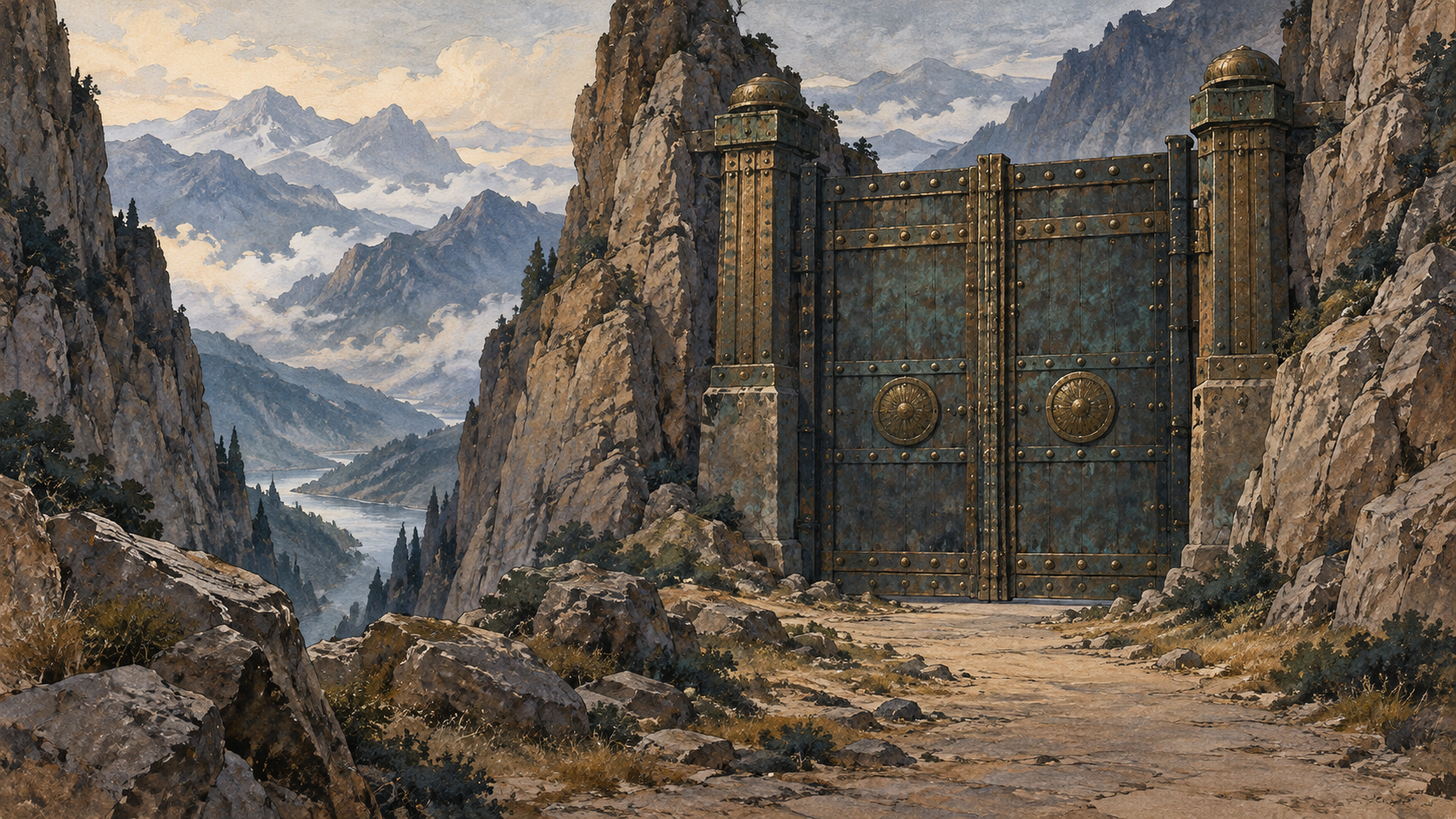
Alexander brings workers and erects an iron and bronze gate between the mountains, with thresholds, bolts and a key. He inscribes an account of the nations' future departure, when divine command brings down the barrier. The release belongs to a vision of warring kingdoms, history's end, Roman sovereignty and the transfer of rule to the Messiah. [10]
The story has changed: the enemy not only attacks but lives behind a structure preventing passage until an appointed time. The king who restrains it is not a figure in Ezekiel. Alexander, enclosed nationsEnclosed nationsNarrative motif of peoples beyond a barrier until their release, not a fixed ethnic name.Glossary · Click to read the explanation of the north, a metal barrier and promised release form this tradition's distinctive combination.
Which Syriac work, and which date?
BrockSebastian P. BrockSyriac literature scholar who distinguishes the Syriac Alexander Romance, Christian Legend and poem.Glossary · Click to read the explanation distinguishes the long Syriac Alexander Romance, the poem and the appended Christian Legend. Sharing a volume does not make them one work. He presents a date around 629–630 CE for the Legend: a scholarly dating, not a manuscript written by Alexander. [11]
TeseiTommaso TeseiScholar of late-antique traditions and the Quran who proposes an earlier layer for the Syriac Alexander Legend.Glossary · Click to read the explanation instead proposes an origin under JustinianJustinian IEastern Roman emperor from 527 to 565 CE; his reign is used in a proposed dating of a Syriac Alexander Legend layer.Glossary · Click to read the explanation and treats the Seleucid-year 940 prophecy as an addition referring to events of 626–629 CE. We report his published abstract, not a reading of the whole chapter. Dating differences matter when examining relations with the Quran. [12][13]
The manuscript Budge describes in his introduction, Add. 25875, dates to 1708–1709 CE. This dates a late copy, not the story's origin. Likewise, 1889 dates a modern edition and translation. Three dates differ: formation of the work, the surviving copy and scholarly publication. [10]
In another chapter abstract, Tesei connects the royal builder with Christian interpretations of Daniel's visions and imperial sovereignty. This interprets the legend's political and religious horizon; it does not attest that the historical Alexander built such a barrier. [14]
The Quran: mercy bounded by a promise
In Al Kahf 18:92–98, Dhul Qarnayn reaches people between mountain barriers. They ask him for a barrier against Gog and Magog's corruption. He requests their practical assistance, uses pieces of iron and then molten metal. The people cannot climb or pierce the structure, but he attributes it to his LordRabbTitle of lordship, ownership or care by context; applied to God in Lord of worlds.Glossary · Click to read the explanation's mercy and says his Lord's promise will level it. [15]
The barrier is no everlasting human triumph. The following verses move to surging, the trumpet and gathering. Al Anbiya 21:96–97 describes Gog and Magog's release and the true promise approaching. The end-time connection is clear; coordinates, Alexander's name, named Hunnic kings, a key and bolts are absent from these passages. [15][16]
The Syriac comparison concerns a specific cluster: a travelling hero, people asking protection, a barrier between mountains, iron and copper-based metal, and future release under divine authority. Differences remain: a solid barrier without a description of hinged doors, and without the Syriac text's detailed Roman Christian programme. [10][15]
Hadith adds another scene
The report of al Nawwas ibn Sam'an preserved in Sahih Muslim 2937a places Gog and Magog's appearance after the Dajjal. Jesus and his companions take refuge at Mount Tur; the report then describes the drinking of Lake Tiberias' water and their prayer. Insects attack the invaders' necks, birds carry away their bodies, and rain cleanses the earth. These are hadith details, not Al Kahf's text. [17]
They allow comparison of destruction and cleansing with older traditions without making the scenes identical. Ezekiel summons birds to eat bodies; in the Islamic report, birds carry them away. Different functions are part of the evidence, not obstacles to discard. [1][17]
We also distinguish compilation of a hadith collection from the period attributed to its speakers. This studies witnesses and narrative forms; similarity does not replace hadith scholars' assessments of the report with a historical verdict of our own.
Derbent: real walls, no automatic prophetic solution
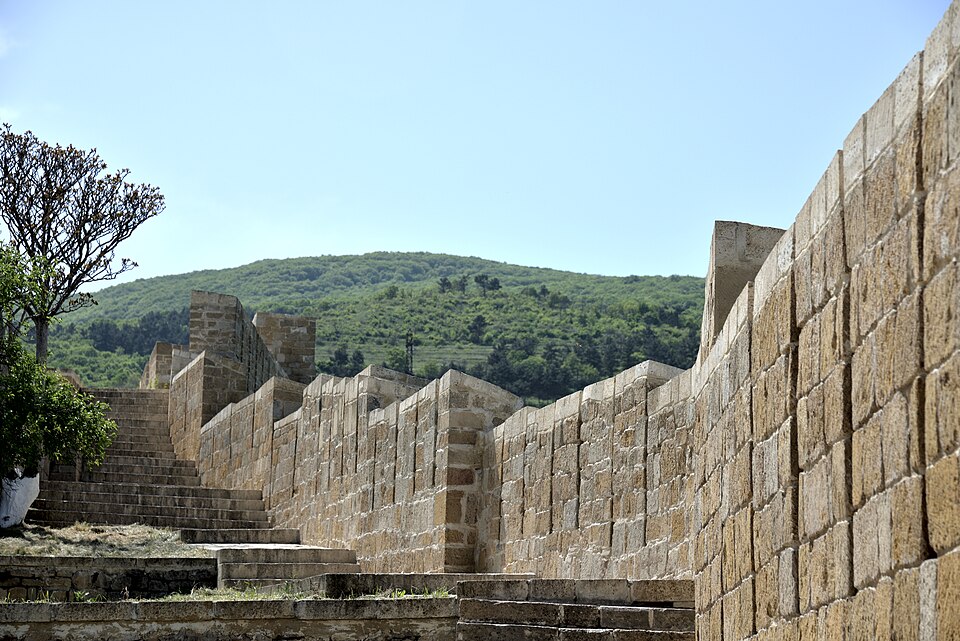
DerbentDerbentCaspian-coast city in Russia's Dagestan with Sasanian fortifications; its existence does not identify Dhul Qarnayn's barrier.Glossary · Click to read the explanation stands on the Caspian coast in Dagestan, now part of Russia. UNESCO dates its Sasanian fortifications to the fifth and sixth centuries CE and describes walls extending between the mountains and the sea. Real frontier structures illuminate the importance of passes; they do not prove this is the Quranic barrier. [18]
The historical Alexander lived centuries before these fortifications. Attribution to him in a later story differs from archaeological dating of masonry. Finding a great northern wall cannot by itself establish the names or original locations of prophetic peoples. [11][18]
How was the story pictured centuries later?
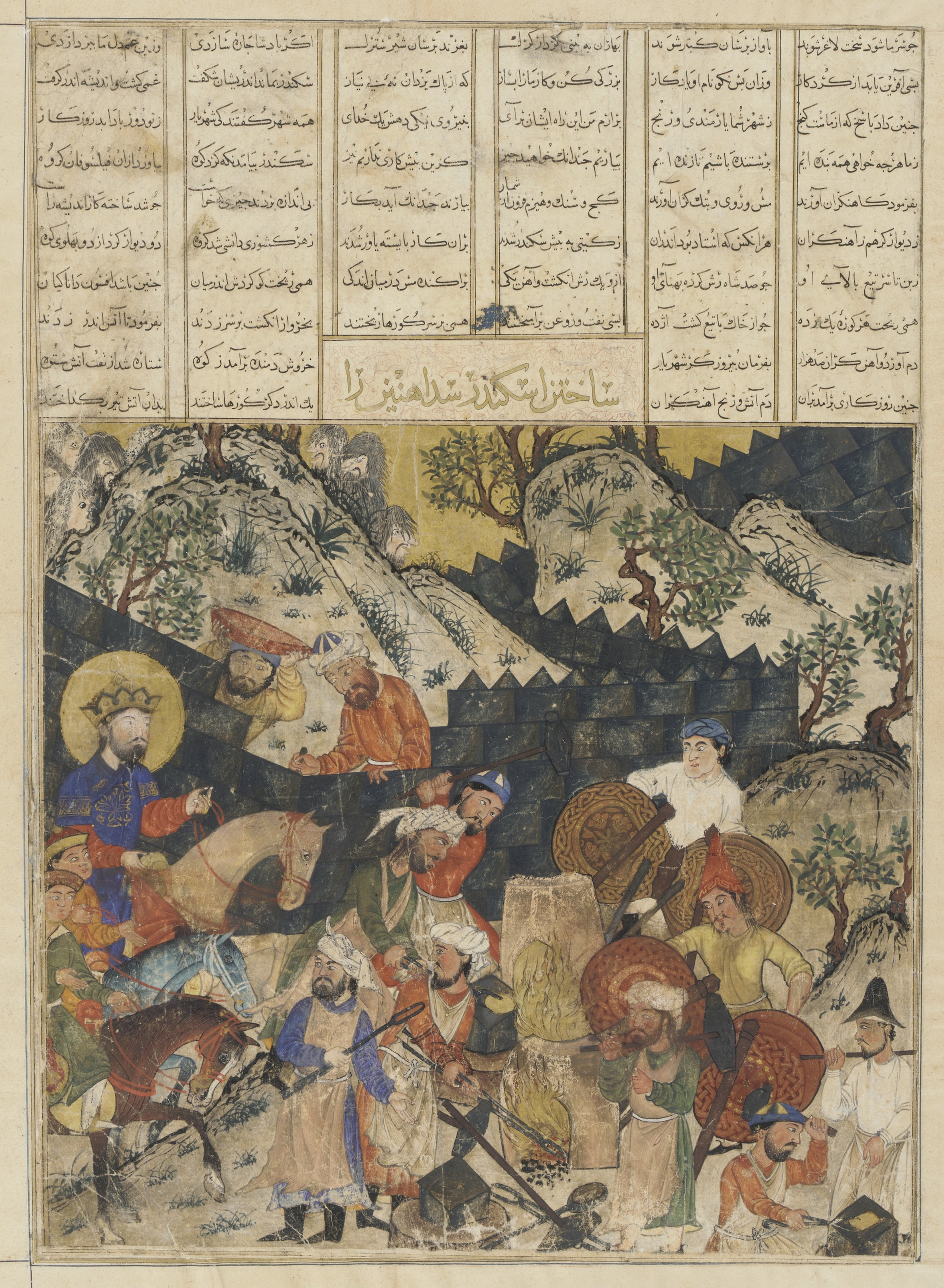
A folio of the Shahnama, a Persian epic completed by Ferdowsi around 1010 CE, illustrated in Tabriz in northwestern Iran around 1330–1340 CE shows Alexander overseeing a barrier built against Gog and Magog. It witnesses the story's later life in Persian art, not a fourth-century BCE scene or evidence of a historical wall. [21][24]
What travelled, and what remains open?
The evidence supports different levels of conclusion:
- Direct: names play different roles in Genesis' genealogy, Ezekiel's leader and land, Revelation's nations, and the peoples behind the Syriac and Quranic barriers.
- Strong comparison: mountain barrier, metal, nations and promised release form a cluster more specific than two general stories of danger.
- Disputed: identifying Gog with Gyges or Marduk, the Legend's compositional dating and routes by which forms reached the Quranic environment.
- Unproven: a particular Syriac copy read by an identifiable transmitter, or a modern people identified as Gog and Magog from name resemblance alone.
Priority alone does not reveal transmission. Between dependence on a particular book and no relationship at all lie circulating traditions, oral forms, lost texts and reinterpretation. The archive distinguishes the strength of comparison from that of each proposed route.
Readers did not all receive Gog and Magog as they appear in Ezekiel. The enemy expanded, joined gates and Alexander, and entered different visions of the end. We can research this history without judging a religion's truth or turning it into political prophecy about living peoples.
References and notes
- Specified passages, complete. Genesis 10:1–5; Ezekiel 38–39; Revelation 20:7–10; KJV Return to the text ↑
- Survey of name interpretations. Christoph Rösel, Gog / Magog, WiBiLex (2012) Return to the text ↑
- Gyges in the inscription. Jamie Novotny and Joshua Jeffers, RINAP 5/1 (2018), Ashurbanipal 11 ii 95–125, pp. 237–238 Return to the text ↑
- Complete chapter, 87–108. C. A. Strine, Chaoskampf against Empire, in Lenzi / Stökl, Divination, Politics, and Ancient Near Eastern Empires (2014), pp. 87–108 Return to the text ↑
- Publisher abstract only. William A. Tooman, Gog of Magog: Reuse of Scripture and Compositional Technique in Ezekiel 38–39 (2011); publisher abstract Return to the text ↑
- Book abstract only. Sverre Bøe, Gog and Magog: Ezekiel 38–39 as Pre-text for Revelation 19,17–21 and 20,7–10 (2001; ebook 2019); abstract Return to the text ↑
- Magog and Scythians. Josephus, Antiquities 1.6.1 (§123), Whiston translation Return to the text ↑
- Alans and gates account. Josephus, Jewish War 7.7.4, Whiston translation Return to the text ↑
- Universal interpretation of nations. Augustine, City of God 20.11; Marcus Dods historical translation Return to the text ↑
- Historical translation; 144–158 and introduction i. E. A. Wallis Budge, The History of Alexander the Great (1889), Christian Legend, pp. 144–158; Introduction p. i Return to the text ↑
- Works distinguished and proposed dating. Sebastian P. Brock, Alexander Cycle, Gorgias Encyclopedic Dictionary of the Syriac Heritage (2011), electronic entry Return to the text ↑
- Book abstract only. Tommaso Tesei, The Syriac Legend of Alexander’s Gate (online 2023; copyright 2024); abstract Return to the text ↑
- Chapter abstract only. Tesei, The 940 ag Prophecy, pp. 30–44; DOI 10.1093/oso/9780197646878.003.0004; abstract Return to the text ↑
- Chapter abstract only. Tesei, Alexander, the Danielic Visions, and the Gate against Gog and Magog, pp. 105–120; DOI 10.1093/oso/9780197646878.003.0008; abstract Return to the text ↑
- Al Kahf 92–102. Quran, Al Kahf 18:92–102; Arabic text Return to the text ↑
- Al Anbiya 95–97. Quran, Al Anbiya 21:95–97; Arabic text Return to the text ↑
- Al Nawwas report, Gog passage. Sahih Muslim 2937a, report of al Nawwas ibn Sam‘an; Arabic text and displayed English translation Return to the text ↑
- Fortification dating and context. UNESCO, Citadel, Ancient City and Fortress Buildings of Derbent, description / Outstanding Universal Value Return to the text ↑
- Publisher description only: the Book of Ezekiel is situated in the sixth-century BCE Judean exile to Babylonia. This does not date every line of chapters 38–39. Publisher description only; Ezekiel's exilic setting Return to the text ↑
- Introduction only: Revelation is commonly dated around 95–96 CE, possibly containing earlier material. The full bibliography was not read. Oxford Bibliographies introduction only; dating of Revelation Return to the text ↑
- Museum object label and description read: an illustrated Shahnama folio from Tabriz, ca. 1330–1340 CE, a later depiction of the barrier story rather than contemporary evidence for Alexander. Museum object description, S1986.104 Return to the text ↑
- The entry's opening and Near Eastern sections were consulted: nomadic groups active in the eighth and seventh centuries BCE; origins and archaeological identifications remain debated. Their mention does not identify them with Gog. Iranica, Cimmerians, opening and Near Eastern sections consulted Return to the text ↑
- The opening historical section was consulted: Iranian groups known north of the Black and Caspian seas in the early centuries CE; it notes raids on Armenia and Media with a reference to Josephus. Iranica, Alans, opening historical section consulted Return to the text ↑
- Only the opening paragraphs were read: Ferdowsi completed the Persian epic in 1010 CE. The later illustrated folio has a separate date from the poem's completion and the stories it depicts. Iranica, Shahnama headword, opening paragraphs only Return to the text ↑
- The entry's identification was read: Iranian nomadic peoples of the steppes north of the Black Sea in the seventh to fourth centuries BCE. Josephus's identification of Magog with them is an ancient interpretation, not proof of descent. Iranica, Scythians, introductory identification only Return to the text ↑
- The opening geographical paragraphs were read: Media was an ancient region and kingdom of northwestern Iran whose boundaries changed over time; this is an approximate location, not a fixed map. Iranica, Media, opening geographical paragraphs only Return to the text ↑
- The opening location and Hyrcania references were read: the ancient name concerns the Gorgan region by the southeastern Caspian. This does not identify Josephus's particular passage. Iranica, Gorgan pre-Islamic history, opening location and Hyrcania references only Return to the text ↑
Research history
Substantive changes are retained here. Minor copy edits remain in the internal operational log.
-
Substantive record update
Suggest a correction · Suggest a source for this record
Cite this record
IL Archive, «Gog and Magog: from Ezekiel to the enclosed nations», Edition 2, https://ilarchive.com/en/studies/gog-magog-and-enclosed-nations
Continue reading