Person · Philosopher or theologian
Augustine
Augustine (354–430 CE), from rhetoric teacher in Roman Africa to bishop of Hippo: a historical reading of his writings on evil, time, grace and will, distinguishing the Confessions from neutral biography.
Estimated reading time: 8 min Published Last reviewed:
Share article

Text
Introduction
Why does Augustine (354–430 CE) belong to the history of both philosophy and religion? A teacher of rhetoric in Roman Africa who became a Christian bishop, he wrote about being, evil, the will, time, and the nature of the church. This entry follows his life, the evidence behind his arguments, and the changing questions posed by philosophical teaching and religious controversy. Particular attention goes to his departure from the idea of God as a body occupying space [1], without reducing his thought to that one issue.
The Confessions is neither a neutral record of every event nor a warrant for reading his late positions back into his youth. We distinguish his Latin formulations, his retrospective account of his life, and later historical interpretation.
A life between Thagaste, Milan, and Hippo
Aurelius Augustinus was born in 354 CE at Thagaste, now Souk Ahras in Algeria, in Roman Africa. He studied rhetoric at Carthage and taught it; a long-term relationship produced his son Adeodatus. For years he was associated with Manichaeism, a religious movement that explained the world through a conflict of light and darkness, before turning against its explanation of evil. He moved to Rome around 383 and taught rhetoric in Milan from 384, where the preaching of Bishop Ambrose and philosophical books available in Latin affected him. [2]
He represents his embrace of ascetic Christianity as occurring in 386; he was baptized at Milan in 387 and returned to Africa. Ordained a priest at Hippo Regius (modern Annaba) in 391, he became bishop around 395–396. Preaching, running a congregation, and religious disputes then became central to his work. He died in 430 while the Vandals were besieging Hippo. The passage from teacher to bishop helps explain the changing character of his questions, not merely his personal biography. [2]
The following approximate sequence concerns events and composition, not dates of surviving manuscript copies:
- 354: birth in Thagaste.
- c. 373–382: association with Manichaeism.
- 384–387: Milan, conversion, and baptism.
- 391 and c. 395–396: priesthood and episcopate at Hippo.
- c. 397–400: composition of the Confessions.
- c. 399–420, possibly later: work on On the TrinityTrinityChristian formulation of divine unity and Father/Son/Spirit distinction, with a history of debate.Glossary · Click to read the explanation.
- c. 413–426: The City of God, following the sack of Rome in 410.
- 430: death at Hippo.
His writings belong to different genres
Augustine wrote early philosophical dialogues, biblical exegesis, sermons, letters, replies to opponents, and large treatises. The thirteen books of the Confessions (Confessiones) address God and reconstruct the past through memory and grace. They are invaluable evidence for his life but also prayer, confession, and interpretation, not a modern autobiography or a transcript of events. After its retrospective narrative, the work turns to memory, time, and Genesis. On the Trinity (De trinitate) investigates Trinitarian relations and the image of God in the human mind; The City of God (De civitate Dei) combines replies to Christianity’s critics with an account of history and ultimate destiny. [3]
Incorporeal being and the problem of evil
In Confessions book VII Augustine reconsiders his earlier inability to conceive of a reality not extended in space. He had rejected a human-shaped deity yet pictured the divine presence as if it were a subtle body permeating other bodies. Of that earlier state he writes in Latin: [1]
Our translation: “Yet I was compelled to think of something bodily across regions of space.” He subsequently contrasts an elephant with a sparrow: if God were spatially distributed, the larger body would contain a larger “portion” of God. This is not a denial of divine presence in the world; it rejects measuring that presence by physical size and division. [1]
The “books of the Platonists” helped him think beyond sensible things. Scholars connect them with NeoplatonismNeoplatonismModern name for Platonic currents flourishing from the third century CE, including Plotinus, Porphyry, Iamblichus and Proclus. They examined the first principle, Intellect, Soul and the world, while disagreeing over interpretation and practice.Glossary · Click to read the explanation and possible writings of PlotinusPlotinusThird-century CE philosopher central to Neoplatonism, whose treatises were collected as the Enneads.Glossary · Click to read the explanation or Porphyry, but the precise contents of his reading remain uncertain. Augustine himself marks a decisive boundary between what he found there and what he regarded as specifically Christian: [1]
“But that the Word became flesh and dwelt among us, I did not read there” (Confessions VII.9). He describes ancient philosophy from within a later Christian argument; his words alone therefore cannot reconstruct what every Platonist philosopher individually taught. [1]
On evil he denies that there is an eternal evil substance confronting a good creator. Things are good to the extent that they exist, though in differing degrees; corruption reduces an existing good. This is the account commonly called the “privation of good” (privatio boni). It does not make suffering or harmful actions unreal: evil is not an independently created kind of substance. In this respect he opposes the Manichaean dualism that he describes, but the account of his former associates in his polemics is not a substitute for their own surviving sources. [4]
Knowledge, mind, and time
Augustine examines knowledge through memory, will, and unchanging truth. In On the Trinity X he distinguishes memoria (memory), intellegentia (understanding), and voluntas (will), treating them as relationally different yet belonging to a single mental life. This provides an intellectual analogy, not an empirical demonstration that a human mind is literally the divine Trinity. His language of “illumination” likewise concerns the mind’s ability to judge by truth that cannot be reduced to sense data; it does not abolish inquiry and human judgment. [5]
In Confessions XI, while discussing creation, he asks: [6]
“What, then, is time? If nobody asks me, I know.” He goes on to examine a past that no longer is, a future not yet present, and memory, attention, and expectation as conditions of our experience of duration. It would oversimplify this discussion to define time as nothing more than a private feeling, or to treat his philosophical reflection as a scientific measurement of the universe’s age. [6]
Will and grace: development within his thought
In early writings such as On Free Choice of the Will (De libero arbitrio), he rejects explaining wrongdoing through an evil power alien to the person and insists on the will’s responsibility for choice. His closer interpretation of Paul and later disputes increasingly emphasize the damage wrought upon the will by original sin, as he understands it, and the need for gratia, divine grace not earned in advance. The distinction between choosing and being able to act rightly becomes pivotal. Scholars do not agree on a single formula that would reconcile every statement he made about freedom and divine predestination. [7]
The dispute sharpened in his opposition to the Pelagians, named after the ascetic Pelagius. His opponents stressed human responsibility, capacity, and obedience; not all of them denied every meaning of grace. Augustine argued instead that fallen humanity could not attain salvation by its independent effort. Julian, the bishop of Eclanum, accused him of reviving Manichaean dualism and undermining freedom; Augustine replied that his opponents diminished the significance of sin. Important parts of Julian’s arguments survive within Augustine’s responses, a limitation that matters when weighing either charge. [8]
Church, coercion, and the two cities of love
His dispute with the Donatists, African Christian groups who regarded themselves as preserving the church’s purity after persecution, concerned legitimacy, sacraments, and the power of bishops and the state. Augustine defended ecclesiastical unity and the validity of baptism regardless of the administering minister’s personal holiness. In Letter 93 to Vincentius (c. 408), he justified some forms of imperial coercion to bring dissenters back, claiming that pressure could prompt correction; his addressee objected to compelling people to be righteous. The letter is direct evidence of Augustine’s later defense of coercion, not neutral evidence of Donatist motives or assent. [9]
The City of God followed the sack of Rome in 410, partly in response to claims that Christians had weakened the empire. The “earthly city” does not simply equal Rome, nor does the “city of God” equal every visible church institution. The organising contrast is the direction of love. Book XIV, chapter 28 opens with: [10]
“Two loves, then, made two cities.” He goes on to contrast self-love pursued to contempt of God with love of God pursued beyond self-glorification. This is a moral and eschatological contrast within his religious interpretation of history, not a ready-made map for classifying states. [10]
Textual layers and subsequent reception
What Augustine experienced in the fourth century must be distinguished from his composition of it years later and from the dates of surviving manuscripts and editions. In his Retractationes (Revisions), written near the end of his life, he reconsidered parts of his earlier work. His writings should therefore not be flattened into one timeless statement. The Latin critical-edition series CSEL and CCL offer scholarly texts; the brief Latin passages reproduced here were checked against accessible digital transcriptions, not against the complete apparatus of all manuscript witnesses. [11]
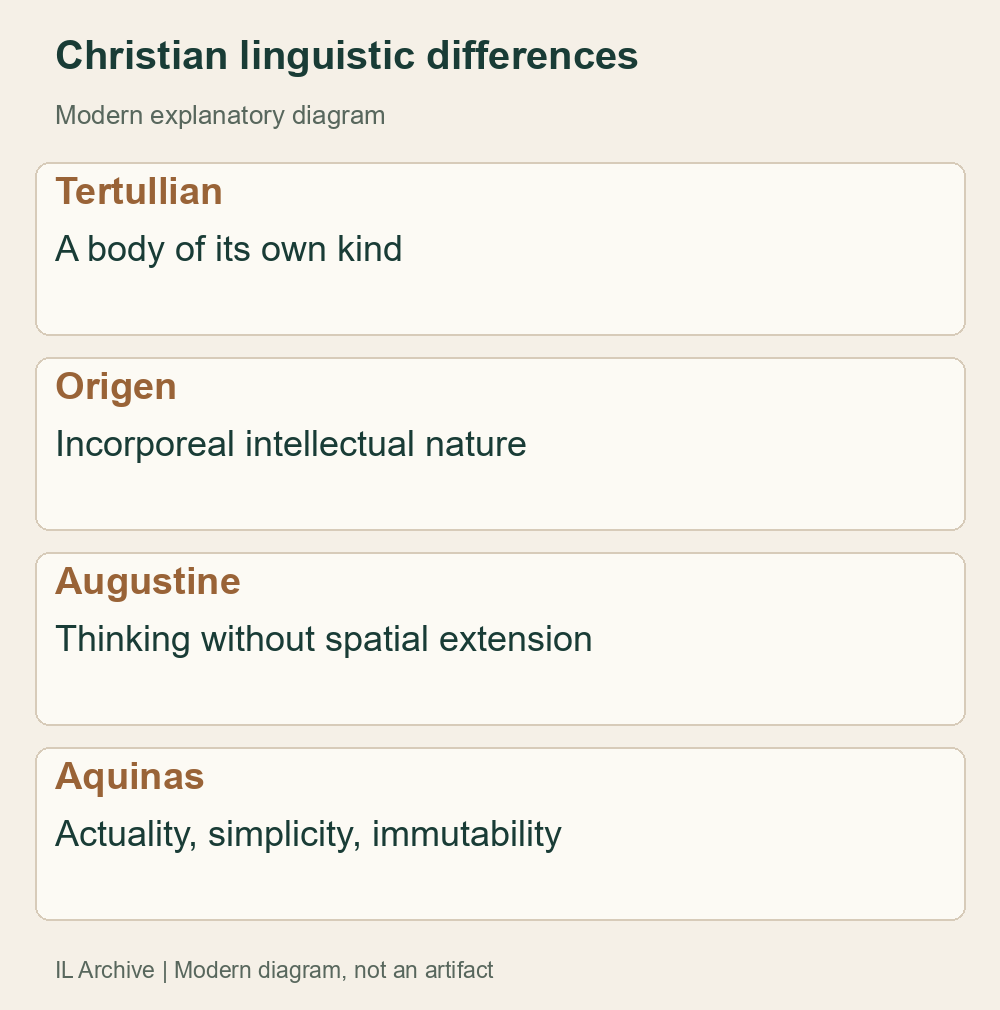
His impact spread through Latin Christian theology and debates on freedom and grace and was interpreted differently in Catholic, Protestant, and other traditions. For orientation only, the following modern diagram condenses formulations from particular texts by TertullianTertullianLatin Christian writer in Carthage around 200 CE. His writings span apology, doctrinal controversy, and religious practice. This entry examines his language of soul, Christ’s flesh, Word, and spirit alongside the limits of biography, textual chronology, and disputed affiliations.Glossary · Click to read the explanation, OrigenOrigenChristian exegete and theologian from Alexandria (c. 185–253), known for biblical textual comparison, commentaries and On First Principles. His works survive in Greek and through later translations and quotations.Glossary · Click to read the explanation, Augustine, and Thomas AquinasThomas AquinasThomas Aquinas (c. 1225–1274): Dominican philosopher and theologian whose unfinished Summa theologiae examines divine being and simplicity, immutability, and the relationship of reasoning to revelation.Glossary · Click to read the explanation, authors separated by centuries. It neither depicts a single inevitable progression of Christian thought nor documents their actual appearances, and it cannot replace reading their texts.
References and notes (11)
- Augustine, Confessiones, Latin text hosted by James J. O’Donnell (Georgetown), with an explicit caveat on the exact digital edition’s provenance; book VII passages checked directly. Book VII, chapter 1 (spatial imagination), chapters 9–10 (Platonist books and their limits) Return to the text ↑
- Christian Tornau, “Augustine of Hippo,” Stanford Encyclopedia of Philosophy, revised 2024. §§ 1 “Life” and 2 “Work” Return to the text ↑
- Tornau, “Augustine of Hippo,” Stanford Encyclopedia of Philosophy: genres and the Confessions. § 2 “Work,” paragraphs on Confessions, De trinitate and De civitate Dei Return to the text ↑
- Augustine, Confessiones, online Latin text; argument from corruption to privation of good. Book VII, chapters 12–13 Return to the text ↑
- Augustine, De trinitate, Latin text with an older English translation at The Logic Museum; argument checked against the Latin passage. Book X, chapter 11, §§17–18; chapter 12, §19 Return to the text ↑
- Augustine, Confessiones, James J. O’Donnell’s online Latin text; short quotation translated independently. Book XI, chapter 14 and the following inquiry into duration Return to the text ↑
- Tornau, “Augustine of Hippo,” Stanford Encyclopedia of Philosophy: free choice, grace, and development. §§ 7.4–7.6, especially 7.5–7.6 Return to the text ↑
- Tornau, “Augustine of Hippo,” Stanford Encyclopedia of Philosophy: the Pelagian controversy and mediated texts of Julian. §§ 1–2 on the Pelagian dispute and material embedded in Contra Iulianum opus imperfectum Return to the text ↑
- Augustine, Letter 93 to Vincentius (c. 408), older English translation at New Advent; the relevant translated sections were read, not collated with Latin. Chapter 1 §§1–2 and chapter 2 §5 on coercion Return to the text ↑
- Augustine, De civitate Dei, Latin text at Monumenta; short clause independently translated in all three languages. Book XIV, chapter 28, opening sentence and contrast between the cities Return to the text ↑
- Tornau, “Augustine of Hippo,” Stanford Encyclopedia of Philosophy; Work, Editions and Legacy sections. §§ 2 and 11; Bibliography → Editions (CSEL and CCL) Return to the text ↑
Suggest a correction · Suggest a source for this record
Cite this record
IL Archive, «Augustine», https://ilarchive.com/en/people/augustine
Continue reading