Person · Philosopher or theologian
Origen
Christian exegete and theologian in Alexandria and Caesarea (c. 185–253), associated with the Hexapla, biblical commentaries and On First Principles; his Greek, Latin and later reception must be distinguished.
Estimated reading time: 10 min Published Last reviewed:
Share article
Text
Introduction
Origen (c. 185–253 CE) was a Christian biblical interpreter, teacher and theologian from AlexandriaAlexandria (Egypt)Alexandria is a city on Egypt’s Mediterranean coast, founded by Alexander the Great in 331 BCE and an important center of trade and culture.Glossary · Click to read the explanation who spent the latter part of his life in Caesarea in Palestine. His work went beyond defending the beliefs of his age: he compared different forms of biblical texts, interpreted their meaning, and examined the relationships between God, the world, reason and freedom. His importance is inseparable from a problem of evidence: some works survive in Greek, others through translations or excerpts shaped by people writing centuries after his death.
This entry introduces his works and the main stages of his life, identifies the strongest evidence for his ideas, and separates what can be read in his texts from what was later attributed to him in controversies over “Origenism.” Dates are approximate where the evidence does not support greater precision.
Alexandria and Caesarea: a life reconstructed
Origen grew up in Roman Alexandria, where Greek learning intersected with Jewish and Christian writings. Eusebius of CaesareaEusebius of CaesareaThird- and fourth-century Christian bishop and author of Church History.Glossary · Click to read the explanation, an early-fourth-century church historian, says that Origen's father Leonides was killed in a persecution around 202 and that his son turned to teaching and scriptural study. He also reports that the young Origen castrated himself after reading a Gospel saying literally. Yet no independent contemporary witness establishes the episode, and some ancient writers themselves doubted it; it should not be presented as certain fact. Similar caution applies to calling him the head of a formally organized “school”: his teaching is much clearer in the evidence than any fixed institutional structure. [2] [3]
Origen visited Caesarea in Palestine in the second decade of the third century and eventually settled there after a conflict with Demetrius, bishop of Alexandria, over his ordination as presbyter, around 230–232. In Caesarea he continued teaching, dictation and biblical exposition with the assistance of students and patrons, among them Ambrose, who supported his literary work. He was imprisoned and tortured during the persecution under Emperor Decius, around 250–251, and probably died in or around 253. These dates are not drawn from Origen's own personal record but reconstructed from later testimony weighed by historians. [2] [3]
His references to philosophy, logic and language attest extensive Greek education, although his writing is not simply a restatement of Platonism. Whether he was the same person as the philosopher named Origen in reports concerning PlotinusPlotinusThird-century CE philosopher central to Neoplatonism, whose treatises were collected as the Enneads.Glossary · Click to read the explanation, and which Ammonius was his teacher, remain matters of scholarship. Sharing a name is not proof of identity. [3]
The Hexapla and differences between biblical texts
His best-known text-criticalTextual criticismComparison of written witnesses and ancient translations to explain variant readings and textual transmission, distinguishing attested text from restorations and inferred ancestors.Glossary · Click to read the explanation enterprise was the Hexapla, a comparison of the HebrewHebrewA Northwest Semitic language of the Canaanite group, encompassing Iron Age epigraphy, Biblical, Rabbinic, medieval and Modern Hebrew; its scripts and pronunciations changed over time.Glossary · Click to read the explanation biblical text and Greek forms arranged in parallel columns. These included Hebrew represented in Greek letters, the translations of Aquila, Symmachus and Theodotion, and the SeptuagintSeptuagintA name for the varied ancient Greek translations and writings associated with Jewish scripture; beginning with the Torah, the texts differ across books and manuscripts.Glossary · Click to read the explanation, an older Greek translation of books written in Hebrew. Eusebius describes the compilation, a separate four-version arrangement, and further versions of some books. The point of juxtaposing columns was to make comparison possible and document differences, not automatically to declare one text corrupt and another correct. [4]
The complete ancient Hexapla has not survived. Parts of its textual work are known through quotations and annotations in Greek traditions and through later translations, notably the Syro-Hexapla. This seventh-century SyriacSyriacAn Aramaic literary language rooted in Edessa, first attested in non-Christian inscriptions and later prominent in Christian writing, scholarship, translation and liturgy.Glossary · Click to read the explanation version drew on a related Greek textual tradition and preserved critical signs and many readings. Consequently the third-century date of Origen's project must be distinguished from the date of a particular manuscript or translation transmitting a reading. No single Syriac reading should automatically be treated as a direct photograph of an original Greek column. [4] [5]
Reading Scripture and educating the reader
Origen wrote sustained commentaries, sermons delivered to congregations, and studies of particular interpretive problems. Works surviving at least partly in Greek include the Commentary on John and Against Celsus; other commentaries and homilies are known through later Latin translations. His “spiritual” interpretation did not always amount to denying a literal meaning. He examined verbal structure and context but held that some passages demand a moral or spiritual understanding beyond a sequence of events or the surface of their wording. He could reject a literal detail without denying the story's entire narrative setting. [3] [12]
A letter to his student Gregory, later a bishop, explains the role of secular learning in this enterprise. Philosophy, geometry and related studies could help responsible reading of Scripture, but were not to become a higher authority than the text being interpreted. Origen compared selecting their useful elements to the Israelites' use of Egyptian possessions in the Book of Exodus. This is a rhetorical analogy in an ancient Christian letter, not independent historical proof of the event it invokes. [7]
In On Prayer, a treatise preserved in Greek, Origen distinguishes the simple act of praying from praying in the proper manner. The following brief extract is from section 2.1 of the Greek text as displayed online, followed by a new English rendering of this limited phrase, not of the whole paragraph:
He is concerned with the disposition of the worshipper and the manner of petition, not necessarily with imposing a fixed liturgical formula. The short Greek wording has been checked directly in a bilingual display; the English rendering above was composed for this entry. [6]
An incorporeal God: what On First Principles actually shows
In On First Principles (Peri Archon or De principiis), probably composed in Alexandria around 220–230, Origen asks how descriptions such as “light,” “fire” and “spirit” should be applied to God. Treating these figures as material bodies, he argues, misconstrues scriptural language. God's nature is not measured by limbs or spatial dimensions, nor imagined as a bigger bodily mind. Book I, chapter 1, section 6 includes this short formulation as transmitted in the Latin translation of Rufinus of AquileiaRufinus of AquileiaChristian writer and translator, c.345–411 CE, who translated Greek works including Origen’s On First Principles into Latin.Glossary · Click to read the explanation and then in an older English rendering. It is not an independently verified verbatim quotation from a complete surviving Greek original:
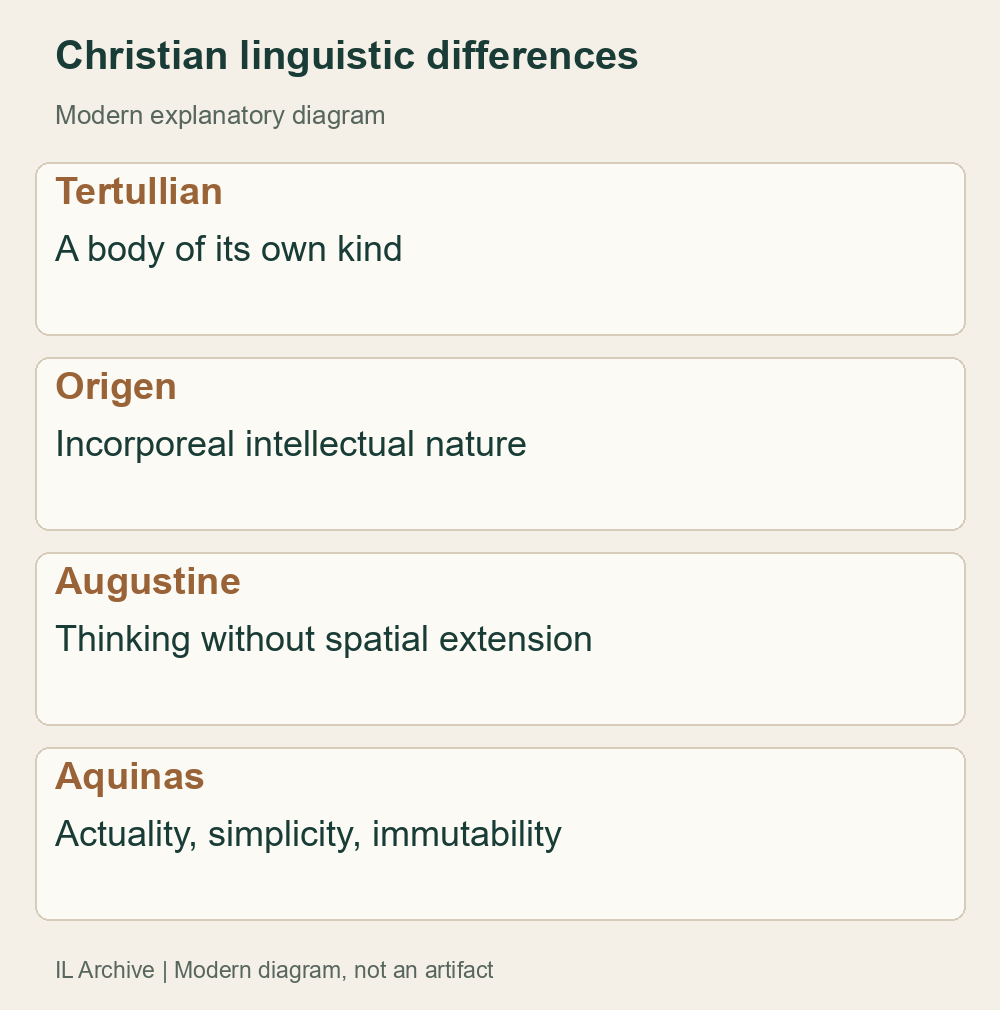
This is a brief extract from a longer argument describing an “uncompounded intellectual nature,” with neither increase nor diminution. It demonstrates a position in this passage of Origen, not unanimity among early Christians: TertullianTertullianLatin Christian writer in Carthage around 200 CE. His writings span apology, doctrinal controversy, and religious practice. This entry examines his language of soul, Christ’s flesh, Word, and spirit alongside the limits of biography, textual chronology, and disputed affiliations.Glossary · Click to read the explanation, for instance, used the vocabulary of body differently. The following modern editorial diagram compares statements from texts written in different periods; it is neither a series of portraits nor an ancient manuscript. [1]
But the line does not authenticate every word in the book attributed to Origen. The Greek original of On First Principles is not intact; Greek excerpts survive in the fourth-century Philocalia, while other testimonies come from disputed polemics of uneven reliability. The continuous work survives through Rufinus' Latin translation, c. 397–398. In his preface Rufinus acknowledged omitting or altering passages he considered inconsistent with the faith or with other passages; he defended this partly by alleging corruption in Greek copies. The Latin sentence is thus important evidence, but exact verbal or elaborate doctrinal claims require comparison with Greek witnesses wherever they exist. [9] [11]
Reason, Logos, freedom and the final outcome
Origen connects divine incorporealityDivine incorporealityThe denial that divine essence is an extended body with parts or spatial occupation; distinct from invisibility and simplicity, with the meaning of body and place varying by school.Glossary · Click to read the explanation with his understanding of the LogosLogosGreek term for speech, explanation or reason, also used for cosmic rationality. Philo uses it in accounts of creation, while John’s prologue speaks of the Word becoming flesh; its function varies with context.Glossary · Click to read the explanation (“Word” or “Reason”), the Son as divine wisdom, mediator of creation and interpreter of Scripture. “Logos” here denotes a theological concept, not an alternative name for Origen or the title of a book. Origen speaks of the distinction between Father, Son and Spirit, and of the Son's eternity, using conceptual language that had not yet acquired the formulations of later councils. In places he describes an order of relation in which the Father is the source and the Son stands in a distinctive relationship to him. His whole thought should not be retrofitted to the terminology of fourth- and fifth-century disputes as if he had written after them. [12]
Freedom of choice and moral responsibility were central concerns: he argued against determinism and considered how divine foreknowledge relates to human action. His accounts of souls existing before bodies, successive worlds and the final restoration (apokatastasis) are harder to settle. Some passages invite expansive readings of restoration and purification; categorical claims about endless reincarnation or salvation without exception can depend on hostile later witnesses or uncertain texts. The strongest historical conclusion is that he persistently investigated freedom, ultimate destiny and purification. A single definitive system attributed to him, without indicating textual mediation and semantic disagreement, is less secure. [11] [12]
Against Celsus: an extant rebuttal and a lost opponent
Late in life Origen composed Against Celsus in eight books, around 248, answering a Greek critique attributed to Celsus and probably written in the later second century. The discussion concerns objections to Christian narratives, philosophy, prophecy and the position of Christians in society. In the preface Origen admits that he undertakes a detailed reply to Celsus even though he regards believers' lives as a form of defence in themselves. The work is therefore a major witness to educated debate in the third century, rather than a ready-made creed. [8]
But Celsus' own book is not independently extant: the opponent's voice is selected and framed inside Origen's rebuttal. We may attribute an argument to “Celsus as represented by Origen,” but cannot assume that Origen's order reproduces the order of Celsus' lost composition. Origen's rebuttal survives in a Greek textual tradition, unlike the complete text of On First Principles, preserved via Latin. [8] [3]
What survives, and what translators changed
Evidence varies by work: substantial Greek texts, Greek sections of commentaries, Latin versions of homilies, extracts in collections such as the Philocalia, and passages cited by opponents seeking to refute propositions attributed to him. These layers cannot be combined into one unmediated “original Greek text.” Nor should a book be dated by a late manuscript that preserves it, or by the date of a translation that made it accessible. [3] [11]
The issue is especially clear in the Commentary on Romans. Rufinus explains in the preface to his early-fifth-century Latin translation that he condensed a much longer Greek work. He also admits adding explanations to what he regarded as incomplete in other translations. A Latin sentence in these works is not invariably Origen's wording reproduced exactly. This does not nullify their value; it specifies which historical inferences they can sustain. [10]
Origen and the later movements called “Origenism”
Subsequent Christian interpreters drew upon his scholarship, while controversies over his ideas sharpened in the late fourth and sixth centuries. In the sixth-century disputes, lists of anathemas targeted propositions labelled “Origenist,” especially on souls' pre-existence and final destiny. Yet the relationship of the fifteen anathemas to the formal sessions of the Council of Constantinople in 553 is a complex issue of documentary history. The attested sessions concerned chiefly the “Three Chapters” controversy. A later condemnation alone cannot establish that every proposition it rejects came verbatim from a writer who died roughly three centuries before it. [13] [14]
The historically useful distinction is between Origen writing in the third century, his texts as transmitted by admirers and detractors, and movements subsequently associated with his name. Both anathemas and defences illuminate the times in which they were formulated, but neither substitutes for examining evidence closest to Origen's lifetime. [11] [13] [14]
Brief chronology
- c. 185: probable birth in Alexandria.
- c. 202: his father's death according to Eusebius; his emergence as a teacher.
- c. 216: activity in Caesarea followed by a return to Alexandria; journey stages are approximate.
- c. 220–230: On First Principles and work on the Hexapla and commentaries; no precise date for every section.
- c. 230–232: ordination, conflict with Alexandria's bishop, and establishment in Caesarea.
- c. 248: Against Celsus, written decades after Celsus' own critique.
- c. 250–253: persecution, torture and death.
- 397–398: Rufinus' Latin On First Principles, not its date of composition.
- Sixth–seventh centuries: “Origenist” controversies and Syriac transmission of Hexaplaric material.
The sequence combines probable events in a life, proposed dates for works and dates of subsequent transmission; inclusion in the same chronology does not make their evidence equally direct. [2] [3] [5] [9] [13] [14]
Conclusion: weighing the evidence
The most reliable historical picture of Origen depends on works read in Greek, reports by an early historian checked against other sources, and Latin witnesses assessed together with their translators. His distinctive contribution lay in linking close examination of biblical texts with philosophical and ethical interpretation, and in treating textual variation, freedom and divine language as questions to investigate. What remains unsettled—especially some cosmological theories attributed to him and the exact character of later judgments—must be presented as an issue of witnesses, not filled in with a confident late narrative. [3] [11] [12]
References and notes (14)
- Origen, On First Principles I.1, §§6–7 Rejection of body and magnitude; transmitted through Rufinus’s Latin version. Return to the text ↑
- Eusebius of Caesarea, Ecclesiastical History, Book VI (published older English translation) Chs. 1–8, 23–26, 39: life, teaching, persecution; a fourth-century account rather than independent eyewitness evidence for every event. Return to the text ↑
- M. J. Edwards, “Origen,” Stanford Encyclopedia of Philosophy, substantive revision 21 July 2026 §§1–2 on life, philosophical setting, and evidential limits; relevant portions of the remaining sections. Return to the text ↑
- Eusebius of Caesarea, Ecclesiastical History, Book VI Ch. 16 §§1–4, testimony about the Hexapla, parallel versions and the Tetrapla. Return to the text ↑
- T. M. Law, Origenes Orientalis: The Preservation of Origen’s Hexapla in the Syrohexapla of 3 Kingdoms, Göttingen, 2011 Institutional publisher description only, Göttingen Septuaginta DSI vol. 2; book text not consulted; seventh-century Syriac translation and critical signs. Return to the text ↑
- Origen, On Prayer (De oratione), Greek text with parallel English display §2.1 and start of §2.2; Greek quotation checked directly; the three short renderings are newly composed. Return to the text ↑
- Origen, Letter to Gregory, preserved in the Philocalia, older English translation §§1–2, Greek philosophy and geometry as preparatory learning and the spoils-of-Egypt analogy; Greek wording not collated. Return to the text ↑
- Origen, Against Celsus (Contra Celsum), Book I, older English translation from Greek Preface §§1–4 and opening Book I on rebuttal and the opponent’s claims; Celsus’ lost text not independently checked. Return to the text ↑
- Rufinus of Aquileia, Preface to his Translation of Origen’s Peri Archon (397–398), in his Prefaces Preface on omitting or regularising passages; older English translation read, not the Latin original. Return to the text ↑
- Rufinus of Aquileia, Preface and Peroration to the Latin Commentary on Romans (c. 407) Both sections: compression of fifteen Greek volumes and admission of explanatory additions elsewhere; translator’s testimony. Return to the text ↑
- M. J. Edwards, review of John Behr (ed./trans.), Origen: On First Principles, Journal of Theological Studies 70 (2019), 402–405 Visible review extract only, not the full review; discussion of Rufinus’ Latin, intermittent Greek and hostile paraphrases. Return to the text ↑
- M. J. Edwards, “Origen,” Stanford Encyclopedia of Philosophy, revised 2026 §§3–6, incorporeality, Logos, creation, freedom, and interpretive disputes over souls and restoration; secondary synthesis. Return to the text ↑
- Second Council of Constantinople (553), edited English selection in Nicene and Post-Nicene Fathers “Sentence of the Synod” on the Three Chapters and the appended “Anathemas Against Origen” 1–15 and Justinian’s anathemas; editorial placement does not itself prove conciliar adoption. Return to the text ↑
- Mark DelCogliano, “Acts of the Second Council of Constantinople (May–June 553),” Cambridge Edition of Early Christian Writings (2022), pp. 341–390 Publisher abstract only, not the chapter text; focus on the Three Chapters. Richard Price (2009), Appendix I on anti-Origenist canons, checked only in publisher TOC. Return to the text ↑
Suggest a correction · Suggest a source for this record
Cite this record
IL Archive, «Origen», https://ilarchive.com/en/people/origen
Continue reading