Study
How did the Trinity emerge?
An extended study of a topic, with evidence and references.
A history of witnesses and formulation, from letters and gospels to fourth-century terminology and two creeds, distinguishing texts, interpretation and reception.
Share article
Text
A question about formulation
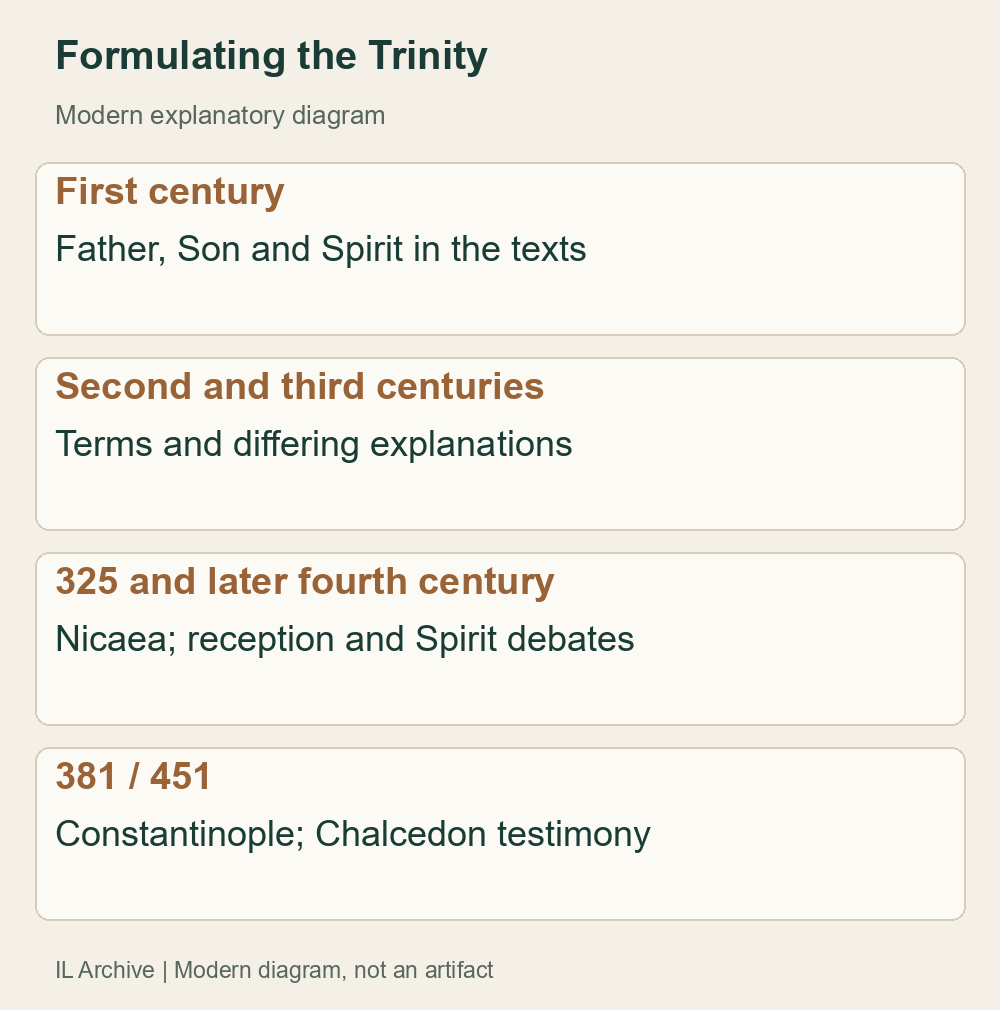
How did the doctrine of the TrinityTrinityChristian formulation of divine unity and Father/Son/Spirit distinction, with a history of debate.Glossary · Click to read the explanation emerge? The New Testament does not contain the technical formula “one essenceOusia — essenceGreek term for essence or nature, with meanings changing between authors.Glossary · Click to read the explanation, three hypostasesHypostasisTerm later used for distinguishing Father, Son and Spirit within one divinity.Glossary · Click to read the explanation”; Father, Son and Spirit did not suddenly appear in 325 either. Between those points lies a history of religious language, worship and interpretation, followed by technical terms, arguments and conciliar formulas. Historical investigation describes this development; it does not by itself establish the doctrine’s truth or falsity. [1]
The useful question is how language about Father, Son and Spirit became a precise formulation of unity and distinction. What do early texts actually say, and what do later interpretations add?
Centuries before the councils
First Thessalonians is commonly dated around 50–51 CE, conditionally on a reconstruction of Paul’s movements. Calling it the earliest surviving complete New Testament work dates the literary composition transmitted by later manuscripts; it does not mean its complete original first-century manuscript survives. [2]
Its opening places the community in God the Father and the LordRabbTitle of lordship, ownership or care by context; applied to God in Lord of worlds.Glossary · Click to read the explanation Jesus Christ. The Holy Spirit then appears in Paul’s account of proclamation and reception. These religious relationships precede Nicaea by nearly three centuries. All three names are not in the opening verse, however, and the letter supplies no technical essence/hypostasis system. [3]
One God and one Lord
In 1 Corinthians 8:6 Paul distinguishes one God, the Father, from whom all things come, and one Lord, Jesus Christ, through whom all things come. Jesus is not simply the name of an absent teacher: he has a place in the community’s account of God and the world. [4]
That place remains debated. Richard Bauckham and N. T. Wright read the passage as including Jesus in divine identity; Thomas Gaston and Andrew Perry challenge that inference. [4] This verse alone does not settle the dispute and does not say “consubstantialHomoousios — consubstantialTerm in the 325 creed relating the Son’s substance to the Father, debated in reception.Glossary · Click to read the explanation with the Father.” Its early significance must remain distinct from the claim that it literally states the fourth-century creed.
Jesus in a cosmic scene
Philippians 2:6–11 joins the form of God, abasement, death and exaltation, then depicts cosmic homage and confession of Jesus as Lord, to the glory of God the Father. This exceeds the description of a merely respected human being. [5]
The passage is sometimes studied as a hymn Paul used, potentially containing older material. A pre-Pauline hymn is not an explicit fact stated by the text, however, and its precise date is not preserved. Exalted status in the poem is not automatically a later definition of Father/Son unity. This is important early testimony, not minutes from Nicaea.
The Spirit is also present
The Spirit does not first appear when councils debate him. In 1 Corinthians 12:4–6 gifts, ministries and activities are arranged around Spirit, Lord and God. The closing blessing of Second Corinthians joins Christ’s grace, God’s love and fellowship of the Holy Spirit. [6][7]
This is the language of prayer and communal life before a philosophical definition. It supplies material later theologians use, but alone does not explain whether Spirit denotes active power or a distinct being, or how equality with Father and Son should be formulated. The history of the Spirit’s textual presence differs from the history of precise vocabulary for his divinity.
Baptism and threefold language
Matthew 28:19 preserves an instruction to baptize in the name of Father, Son and Holy Spirit. Joining the three names therefore cannot be described as a fourth-century conciliar invention. [8]
A ritualRitualAn organised or distinguished practice meaningful to a community; it may leave traces, but its form alone does not reveal an associated doctrine.Glossary · Click to read the explanation formula does not answer every ontological question. Communities can share baptismal names while explaining their relationship differently. Nor can this passage alone date every first-century practice. It establishes the formula in the received textual tradition; precise language of essence and hypostasis requires further witnesses.
The Word in John
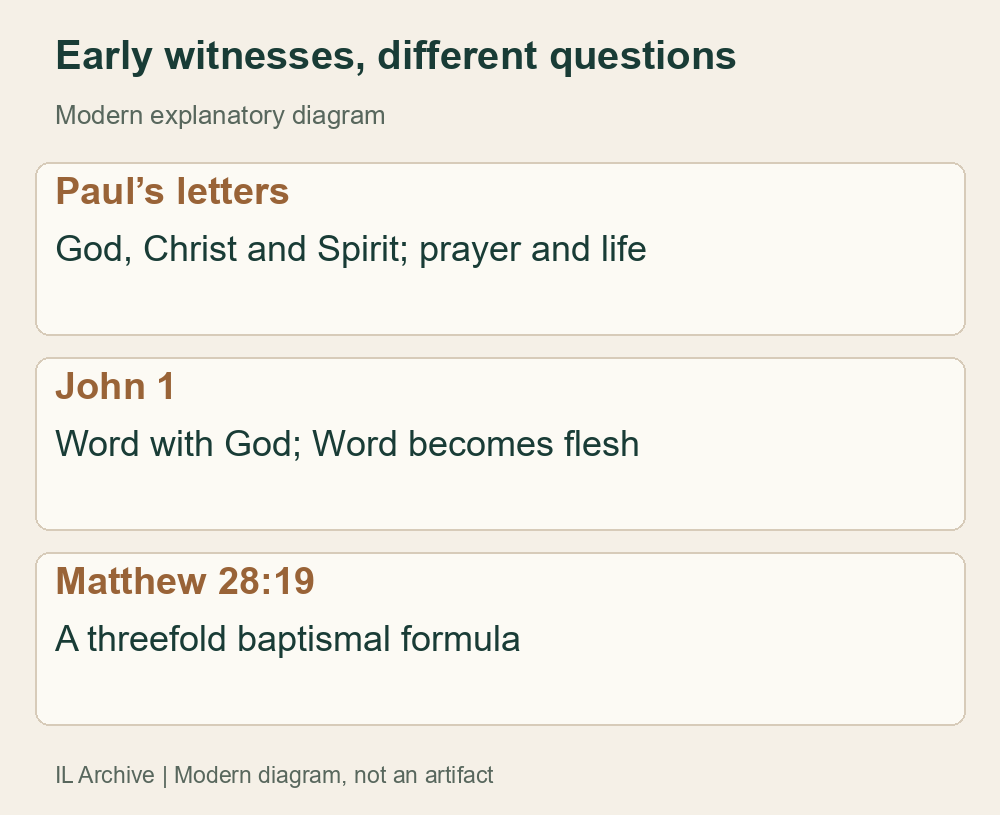
John opens with a denser picture: the Word, or LogosLogosGreek word for word or discourse, used in John’s language of God and incarnation.Glossary · Click to read the explanation, was with God and was divine, then became flesh. Distinction and divine relationship coexist in the language, making it central to Christian interpretation. [9]
John does not supply a Nicene glossary. Logos has multiple linguistic and philosophical uses; its occurrence alone does not prove borrowing an entire doctrine from one Greek school. Later disputes concern how these statements should be read alongside other texts, not simply discovery of a new word absent from scripture.
The texts are not one early creed
Paul’s letters and the gospels were not written by one council in one meeting. Their genres, settings and descriptions of Father, Son and Spirit differ. Their later collection as scripture encouraged readers to seek a formula for reading them together. [1][3][9]
Three layers should remain distinct: each text’s explicit statements, historical comparison’s inferences, and a church’s normative interpretation of the whole. Early roots do not place every later detail verbatim in the first century. Absence of the technical formula does not erase the material that prepared for it.
When did the word Trinity appear?
Around 180 CE Theophilus of Antioch uses trias while interpreting creation’s days, referring to God, his Word and Wisdom. This is regarded as the earliest known surviving Christian use of the Greek term, not its first use in the entire Greek language. [10][11]
The word’s appearance does not establish completed Nicene content. God, Word and Wisdom here are not a detailed account of consubstantial equality. Word and idea must be traced together while distinguishing a label’s emergence from the stabilization of its technical meaning centuries later.
Tertullian and Latin vocabulary
In the early third century, TertullianTertullianLatin Christian author of the late second and early third centuries with a distinctive body–spirit vocabulary.Glossary · Click to read the explanation’s Against Praxeas discusses God’s unity and the distinction of Father, Son and Spirit using Latin language of substance, persons and Trinity. He aims to preserve unity without erasing distinction. [12]
This decisively places the discussion before Constantine, without making all Tertullian’s ideas identical to the final formula. Terms move between legal, philosophical and theological usage. “One substance and three persons” summarizes his argument’s direction; it should not eliminate differences between his framework and the fourth century.
Why was unity language insufficient?
One rejected solution is called modalismModalismLabel for positions opponents argued erased Father/Son/Spirit distinction.Glossary · Click to read the explanation: explaining Father, Son and Spirit in a way that, opponents argue, erases their real distinction. Tertullian describes this dispute as a participant, not necessarily a neutral observer. [12]
Sabellius’s name belongs to this history, but the surviving material does not justify placing every non-Nicene position in one school. “Three masks worn by one person” may illustrate an opponent’s objection; it is not an exact account of every position or an explanation of hypostasis’s linguistic history.
Origen: distinction with order
Third-century OrigenOrigenSecond- and third-century Christian exegete; the surviving First Principles argues for an incorporeal God.Glossary · Click to read the explanation distinguishes three hypostases: Father, Son and Spirit. That distinction accompanies ordering and dependence between them; it is not automatically the equality of later Nicene formulation. [13]
His text also requires care in translation. An old English version cannot alone settle every Greek distinction between unbegotten and uncreated. The passage’s overall structure is a firmer basis, with terminology’s history kept visible. Origen is neither simply a bearer of a completed fourth-century formula nor a theology reducible to one translated sentence.
The words were not stable
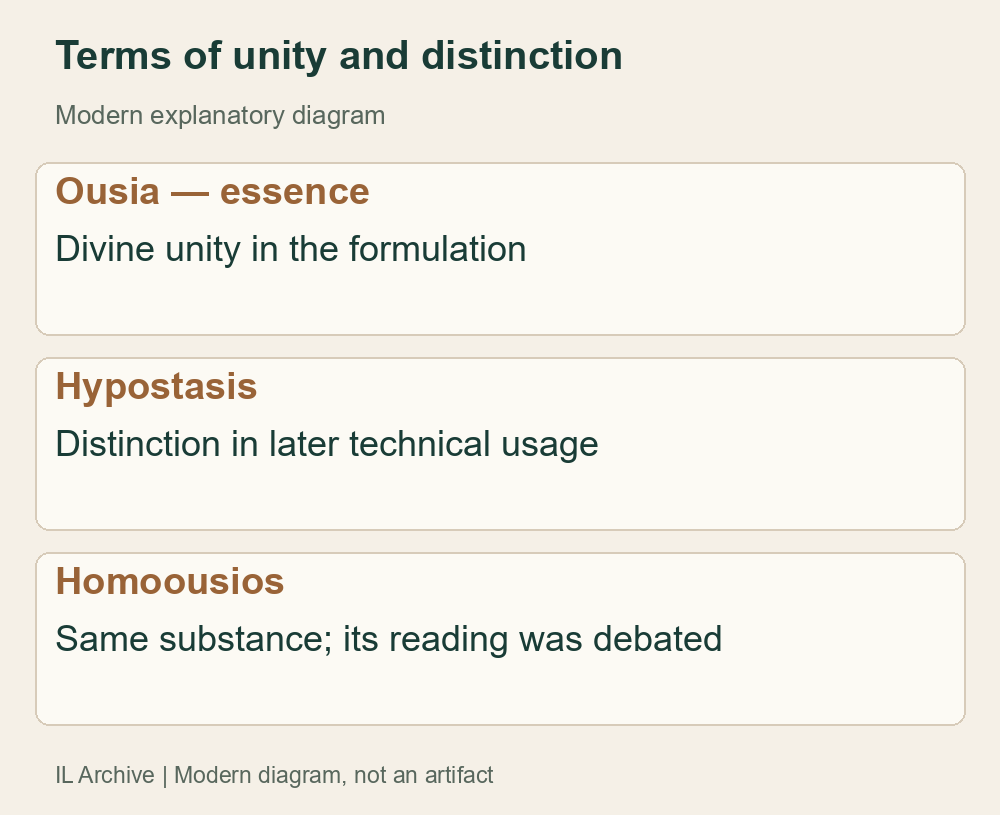
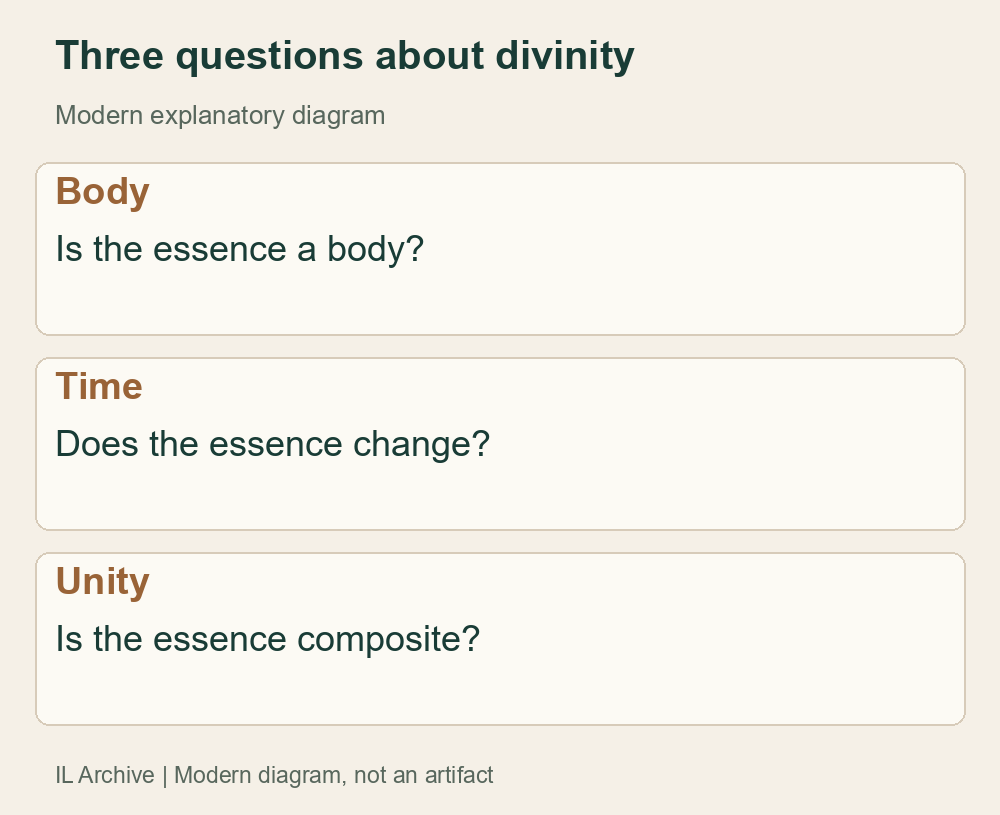
Ousia, or essenceOusia — essenceGreek term for essence or nature, with meanings changing between authors.Glossary · Click to read the explanation, and hypostasisHypostasisTerm later used for distinguishing Father, Son and Spirit within one divinity.Glossary · Click to read the explanation did not carry one fixed meaning for every author. This helps explain the dispute; it is not a complication to remove. In the fourth century, distinguishing the terms becomes a tool for specifying unity and distinction. [20][21]
Modern “person” may suggest an independent psychological centre like a human individual. Applying that meaning automatically to ancient persona or hypostasis changes the question. A term must first be read in its author’s usage, then traced through change, rather than imposing one later definition on all texts.
Arius did not say merely an ordinary human
In the early fourth century, disagreement over the Son becomes a major crisis. Arius’s transmitted letter to Eusebius of Nicomedia makes the Father alone without beginning; the Son precedes ages and the world but has a beginning. This is not simply an ordinary human Jesus: it is an exalted Son whose eternity is not identical to the Father’s. [14]
The letter survives in fifth-century Theodoret within an anti-Arian frame. Its words must be distinguished from the transmitting author’s comments and later popular portraits. The dispute is not merely whether Jesus matters, but the kind of relationship joining him to the Father and the meaning of generation, beginning and divinity.
Constantine and the emperor’s role
Constantine convened the Council of NicaeaFirst Council of NicaeaCouncil convened by Constantine in 325, a major stage that did not immediately end dispute.Glossary · Click to read the explanation in 325 at Nicaea, modern İznik. Church unity and imperial politics formed part of the setting, alongside real theological questions debated long before the emperor. [12][15]
His role should not disappear into a purely theological story: Eusebius of Caesarea’s letter credits his support and explanation of homoousios. It also describes participants’ discussion and Eusebius’s acceptance. This is a participant explaining his position, not neutral minutes. Imperial power at the council does not establish that it created Father/Son/Spirit language from nothing.
What did the 325 text decide?
The received Nicene CreedNicene CreedCreed associated with the 325 council, distinct from the expanded form associated with 381.Glossary · Click to read the explanation describes the Son as from the Father’s substance, begotten rather than made, and true God from true God. It adds homoousiosHomoousios — consubstantialTerm in the 325 creed relating the Son’s substance to the Father, debated in reception.Glossary · Click to read the explanation, of the same substance as the Father. [16]
The issue is delimiting permitted claims about the Son, not the first appearance of reverence for Jesus. The definition belongs within its contemporary disputes. It is neither a declaration of three independent gods nor a statement that Father and Son are one indistinguishable name. The 325 text is also not word-for-word the longer creed many Christians recite today.
The term needs its usage history
Homoousios is usually rendered consubstantial or of the same substance. Participants also explained what it did not mean: bodily division of the Father, or generation by cutting physical material. Eusebius’s defence of his acceptance makes this visible. [15]
A dictionary therefore cannot establish that every bishop understood every detail identically in 325. The term’s meaning, including the alternatives it excluded, developed through reception. Its later normative strength does not remove the different ways it was understood in its own period.
A qualification about the anathemas
The received Nicene anathemas reject describing the Son as created. In a 2026 study, however, Mark Edwards examines variant witnesses and disputes the originality of ktistos in the 325 text. This is a contested thesis, not a new consensus cancelling the received version. [16][17]
Three matters must remain separate: the version we read, reconstruction of its original, and later established Nicene interpretation. The study cannot support the opposite of its argument, nor can a textual dispute prove sudden invention of the whole doctrine. Begotten rather than made remains in the text, with the history of its meaning under discussion.
The Spirit at Nicaea: a short clause
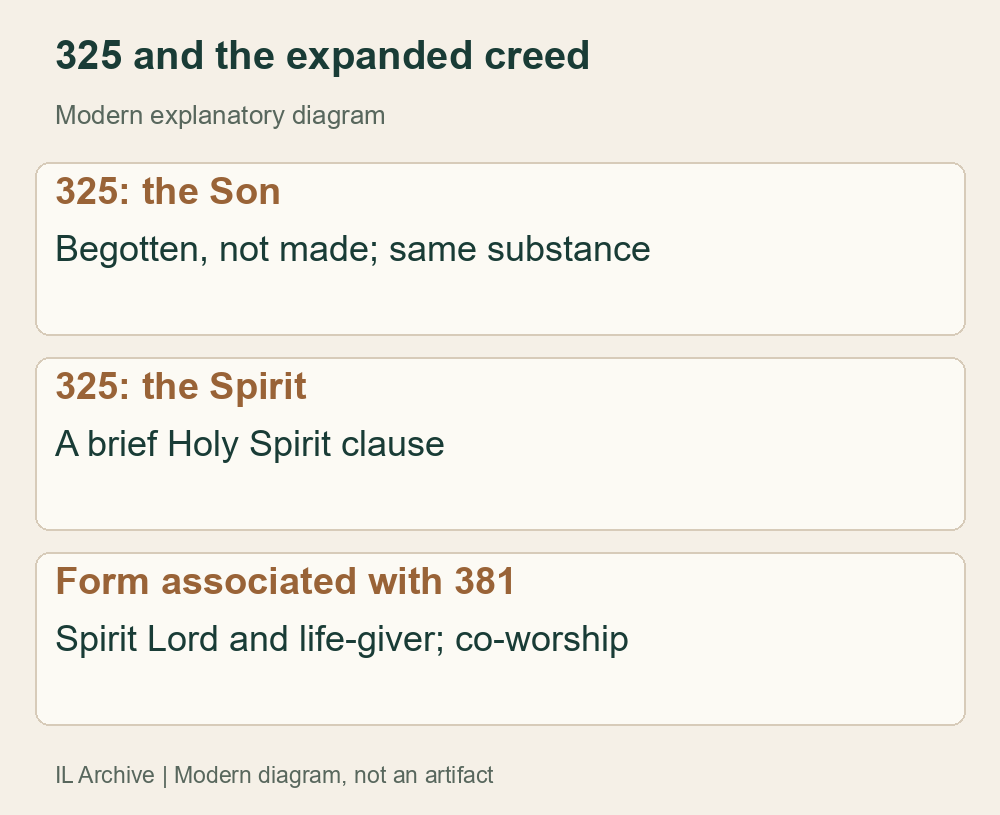
After detailed statements about the Son, the 325 creed gives the Holy Spirit a short clause. It does not yet contain all the familiar Spirit language: Lord and life-giver, proceeding from the Father, worshipped and glorified with Father and Son. These belong to the expanded form associated with Constantinople. [16][22]
The difference matters. Attributing the whole familiar creed to Nicaea in 325 erases a stage of debate. The brief clause does not mean the Spirit was previously absent from Christianity: letters and worship formulas already show him. The change concerns normative detail, not the Spirit’s first mention.
Nicaea did not end the dispute
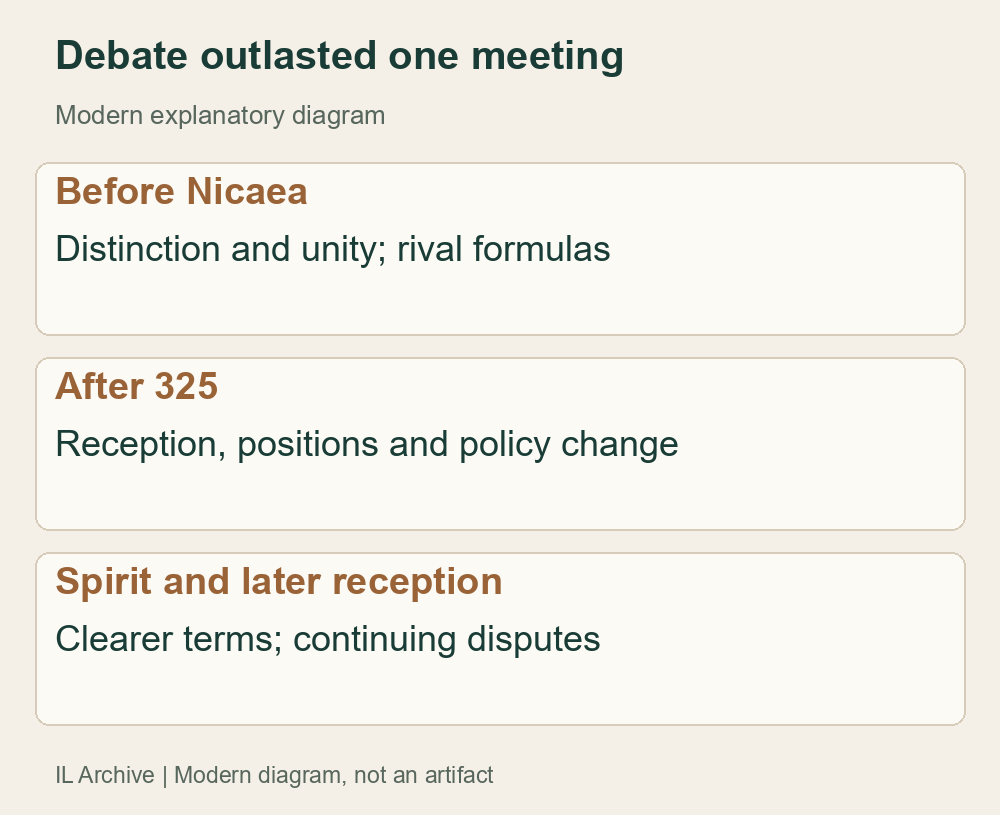
The decision of 325 did not instantly become stable consensus. Later decades brought competing formulas, changing positions and imperial policy, with bishops exiled and recalled. Sara Parvis’s account of reception to 360 describes fluctuation rather than uninterrupted victory from the first meeting. [18]
This alters the story of a council deciding and everyone immediately believing. The formula required interpretation, defence and alliances; religion’s relationship with power was prominent. Politics alone does not exhaust the arguments, however: divine unity and the distinction of Son and Spirit remained questions of scripture, interpretation and worship.
The question of the Spirit’s divinity
Late in the fourth century Gregory of Nazianzus records real disagreement about the Spirit: activity or power for some, creature for others, God for others, and guarded language for still others. He then argues for the Spirit’s divinity and shared Godhead with Father and Son. [19]
This is not a neutral survey of every Christian, but an argument by a participant. It nevertheless shows that the Spirit’s presence in prayer did not end the question of status. Clarifying that status is one reason the fourth century matters decisively for doctrinal formulation.
The Cappadocians: unity and distinction
Basil of Caesarea, Gregory of Nazianzus and Gregory of Nyssa are major names in this development. Basil’s Letter 236.6 distinguishes general essence from particular hypostasis, retaining one divinity and the properties of Father, Son and Spirit. [20][21]
The formula becomes clearer: one essence, three hypostases. Its defenders intend to preserve divine onenessMonotheismBelief in a single God as the only deity, rather than merely the highest among several gods.Glossary · Click to read the explanation with real distinction, neither three separate gods nor one individual merely changing roles. This describes their intended meaning; the historian need not turn explanation into a judgment of the doctrine’s religious truth or falsity.
The limits of analogy
Water in three states, a sun with light and heat, or one person holding three roles are familiar modern analogies. They can introduce what the formula’s defenders reject: division, succession, inequality or erased distinction. [19]
Gregory himself examines the limits of natural images in Oration 31. The task is not to invent a friendlier picture and call it a definition. Historical understanding begins with authors’ terms and arguments rather than a modern analogy deciding their intention for them. This article’s diagrams display debates and vocabulary; they neither depict the divine being nor provide a physical model of it.
Constantinople in 381
The Council of Constantinople met in 381 under Theodosius I. Church tradition associates it with the expanded formula describing the Spirit as Lord and life-giver, proceeding from the Father, worshipped and glorified with Father and Son. [23][22]
This is much fuller than the Spirit clause of 325 and makes his status part of normative worship language. Dating the council to 381 does not mean every sentence originated in one session, or that every Christian immediately reached final agreement. The text’s history and the history of its recognition also need attention.
381 and 451: council and attestation
The expanded creed is usually called Niceno-Constantinopolitan. Attributing every word to 381 is not simply transcription of surviving minutes proving each sentence. Clear conciliar attestation in the acts of Chalcedon in 451 presents the Nicene creed and the creed of the fathers associated with Constantinople as two texts. Earlier related forms also enter discussion of its origin. [22]
The careful formulation is associationShirkAssociating others with God in Quranic discourse; not equivalent to denying God’s existence.Glossary · Click to read the explanation with 381 in ecclesial reception and clear documentation in 451, with the intervening textual path under investigation. This does not remove the 381 council’s role; it distinguishes an event’s date from clear surviving attestation of the whole formula.
And the Son was added later
Latin filioqueFilioqueLater western Latin addition concerning the Spirit’s procession, absent from the expanded Greek creed.Glossary · Click to read the explanation means and the Son. It is a later western addition to the Spirit’s procession language, absent from the Greek text associated with Constantinople, which says from the Father. [22][24]
It became part of long theological and ecclesial disputes. It should not be projected into 325, treated as original in 381, or used to reduce all eastern and western positions to one sentence. The dispute also reminds us that doctrinal history did not end with the fourth century.
Is the Trinity a copy of a pagan triad?
Groups of three in other religions do not establish the origin of the Christian Trinity. Three gods with genealogies and separate functions are not the same structure as the theology of one essence and three hypostases. Greek philosophical tools were used, but transmission of a word is not transmission of a ready-made doctrine. [10][12][20]
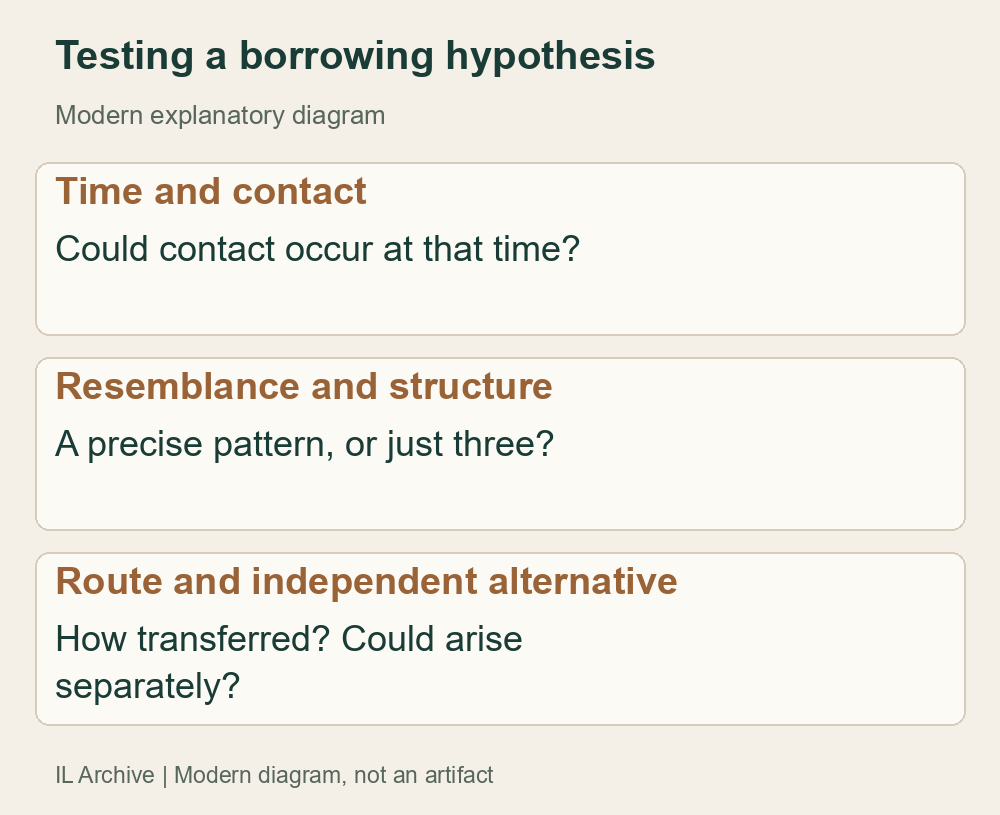
A specific borrowing hypothesis needs six tests: chronological compatibility, possible contact, precision of resemblance, structural similarity, a transmission route, and possible independent developmentIndependent developmentSimilar elements arising without historical transmission between them.Glossary · Click to read the explanation. These are this article’s analytical rules, not ancient testimony proving a transfer. Neither numerical resemblance alone nor advance denial of every cultural influence is sufficient.
Language, worship, interpretation and power
The doctrine became possible through a long accumulation: multiple texts, prayer and baptism, defence of divine oneness, reverence for Christ, religious experience of the Spirit, philosophical terms, and conflict involving authors, bishops and empires. No single strand does all the work. [3][7][8][12][15]
“Politics made the Trinity” is insufficient, as is a reading that places the complete technical formula at the beginning and changes only its label. Councils are important instruments for defining boundaries, within a history preceding them and continuing afterward.
How should an ancient witness be read?
A participant’s letter such as Eusebius’s, Arius’s letter preserved by a later opponent, and Gregory’s argumentative oration are different kinds of evidence. Antiquity does not make a text neutral; polemic does not make it worthless. We ask who speaks, who transmits the words, and what purpose and vocabulary the text has. [14][15][19]
Modern scholarship adds another layer, reconstructing a phrase’s origin or proposing a competing interpretation. This article’s references therefore specify what was actually read, distinguishing publisher summaries from complete chapters. These limits make the argument reviewable rather than assigning every link the weight of direct testimony. [17][18]
A timeline without collapsing the evidence
First century: Father/Son/Spirit language, an exalted Jesus, prayer and baptism formulas. Second and third centuries: labels and differing explanations, including Theophilus, Tertullian and Origen. In 325: a creed focused on the Son’s relation to the Father. [3][8][10][12][13][16]
The rest of the fourth century brings reception conflicts, fuller definition of the Spirit and clarification of essence/hypostasis. Constantinople meets in 381; Chalcedon clearly attests the expanded creed in 451. Later disputes include filioque. Ordering the evidence makes neither development a straight line nor all Christians a group with one position. [18][19][20][22][23][24]
What can be said with confidence?
Textually established: Father/Son/Spirit language precedes Nicaea, Christian formulations precede Constantine, and the 325 creed differs from the expanded creed. The decision also did not prevent continuing dispute. These conclusions rest on specific witnesses, not one assumed belief for every community. [3][8][12][16][18][22]
The degree of correspondence between first-century language and later definition is interpretative. Pre-Pauline material, origins of every expanded clause and variants in some 325 anathemas require qualification. Direct copying of a pagan triad, or one person’s one-day invention, remains unestablished. [5][17][22]
How, then, did the Trinity emerge?
The evidential path begins with religious language about Father, Jesus and Spirit, then becomes a question of preserving unity and distinction together. Words and arguments develop, councils define boundaries, and later generations reread earlier texts within their established formula. [1][12][20][22]
A believer may understand this as clarification of an earlier faith; a historian can study development in language, doctrine and institutions. These descriptions do not automatically cancel each other, but answer different questions. Evidence establishes a history of formulation: roots earlier than Nicaea, technical expression shaped through prolonged disputes, and reception continuing beyond the fourth century.
References and notes
- Keith Ward, Christ and the Cosmos (2015), ch. 6, “Three Centres of Consciousness?”, pp. 33–42. Publisher summary and metadata only: distinguishes New Testament language from three coequal persons in one substance. Not a full chapter reading or consensus on early Christianity. Return to the text ↑
- A. E. Harvey, A Companion to the New Testament (2004), “1 Thessalonians”, pp. 649–654. Publisher summary: conditional dating around 50–51 CE and earliest surviving complete New Testament literary work, not a complete physical first-century manuscript. Return to the text ↑
- 1 Thessalonians 1:1–10, displayed KJV translation. Displayed verses read: Father and Jesus in 1:1; Spirit in 1:5–6, not one threefold formula in the first verse. Return to the text ↑
- 1 Corinthians 8:6, displayed KJV translation. Distinguishes one God, the Father, and one Lord, Jesus Christ. Gaston and Perry’s abstract only also read: reports and disputes Bauckham/Wright’s reading, not a complete article reading. Return to the text ↑
- Philippians 2:6–11, displayed KJV translation. Whole passage read: form of God, abasement, exaltation and cosmic homage. A pre-Pauline hymn is an analytical possibility, not an explicit statement here. Return to the text ↑
- 1 Corinthians 12:4–6, displayed KJV translation. Spirit, Lord and God in gifts, ministries and activities: threefold language, not a definition of three coequal hypostases. Return to the text ↑
- 2 Corinthians 13:14, displayed KJV translation. Christ’s grace, God’s love and fellowship of the Spirit; numbered verse 13 in some editions. Return to the text ↑
- Matthew 28:19, displayed KJV translation. Received baptismal formula in the name of Father, Son and Holy Spirit; does not alone date every practice or theory of substance. Return to the text ↑
- John 1:1–14, displayed KJV translation. Verses 1–14 read: Word with God, Word divine, incarnation. No later essence/hypostasis definition. Return to the text ↑
- Theophilus of Antioch, To Autolycus II.15, translated in ANF 2. Uses a triad of God, his Word and Wisdom in interpreting creation’s days; the word alone is not the later Nicene formula. Return to the text ↑
- Cassini, “Transcendentals and Trinity”, The Heythrop Journal (2009), DOI 10.1111/j.1468-2265.2008.00436.x. Only paragraph on Theophilus’s trias around 180 read. Earliest known surviving Christian usage, not invention of the Greek word. Return to the text ↑
- Tertullian, Against Praxeas 2–3, translated in ANF 3. Unity of substance and Father/Son/Spirit distinction in Tertullian’s polemic; his terminology is not identical to later usage. Opponent description is polemical testimony. Return to the text ↑
- Origen, Commentary on John, Book II, section 6, translated in ANF 9. Distinguishes three hypostases with ordering and dependence unlike later Nicene grammar. Old English translation cannot alone settle Greek unbegotten/uncreated distinctions. Return to the text ↑
- Arius, Letter to Eusebius of Nicomedia, preserved in Theodoret, Ecclesiastical History I.4. Letter embedded in fifth-century Theodoret read. Arius’s Son precedes ages but has a beginning; not merely an ordinary human Jesus. Transmitting frame hostile to Arius. Return to the text ↑
- Eusebius of Caesarea, Letter on the Council of Nicaea, sections 1–11, transmitted by Athanasius. Displayed letter read: Eusebius credits Constantine’s recommendation and explanation of homoousios and explains acceptance. A participant defending his position, not neutral minutes. Return to the text ↑
- Creed of Nicaea (325), received translation with anathemas, Fordham Internet History Sourcebooks / NPNF 14. Received text: begotten, not made, of the Father’s substance; brief Spirit clause. Anathemas contain creature here, with scholarly dispute over originality across witnesses. Return to the text ↑
- Mark Edwards, “What Did the Nicene Creed Say?”, Ecclesiastical Law Journal 28.1 (2026), pp. 106–116, DOI 10.1017/S0956618X25101105. Abstract, introduction and selected anathema-variant discussion read. Edwards disputes original ktistos in 325 and offers a different term reading: his thesis, not consensus. Return to the text ↑
- Sara Parvis, “The Reception of Nicaea and Homoousios to 360”, The Cambridge Companion to the Council of Nicaea (2021), pp. 225–255. Publisher summary only: changing reception, formulas and imperial politics to 360; not a complete reading of chapter arguments. Return to the text ↑
- Gregory of Nazianzus, Oration 31, Fifth Theological Oration, translated in NPNF 7. Selected passages on Spirit debates, divinity, unity/distinction and limits of analogies read. Advocate for the later standard position, not neutral report on all Christians. Return to the text ↑
- Basil of Caesarea, Letter 236.6, translated in NPNF 8. Distinguishes general ousia from particular hypostasis, one divinity with Father/Son/Spirit properties. Section 6 only read. Return to the text ↑
- Paul S. Fiddes, Spirit, Cambridge Elements in Religion and Monotheism (2026), sections 3.1–3.2. Selected passages in 3.1–3.2 on theological vocabulary, Spirit and Cappadocians read, not the whole book. Modern person is not an automatic synonym of ancient hypostasis. Return to the text ↑
- Niceno-Constantinopolitan Creed, received text and editorial introduction, NPNF 14, CCEL. Creed and introduction read: Spirit Lord and life-giver, from Father, worshipped with Father and Son. Heading preserves Chalcedonian presentation. Attribution to 381 distinguished from 451 documentation and earlier related forms. Return to the text ↑
- First Council of Constantinople (381), introductory heading, NPNF 14, CCEL. Heading and contents read: 381 and Theodosius as eastern emperor. Page is not complete council minutes. Return to the text ↑
- Historical excursus on “and the Son”, NPNF 14, CCEL. Opening on later western filioque addition to from the Father read. Used for text history only, not editor’s reconciliatory view of the entire doctrinal dispute. Return to the text ↑
Suggest a correction · Suggest a source for this record
Cite this record
IL Archive, «How did the Trinity emerge?», Edition 1, https://ilarchive.com/en/studies/trinity-development
Continue reading
![Gold coin of Ptolemy II, Alexandria, ca. 261–246 BCE; the illustrated obverse bears Arsinoe II’s head. Context for Hellenistic Egypt, not a portrait of Philo or proof of a Torah translation commission. [24]](/media/1436)
![Quran manuscript folio, Met 1979.201, late eighth–early ninth century, Central Islamic Lands; ink, colours and gold on parchment. Later codex transmission, not a seventh-century copy or an image of the verses cited here. [28]](/media/1332)