Entity · Religious text
The Nicene Creed: the 325 text and the form attributed to 381
A reference page linking a name, group, or concept to the materials that discuss it.
- Names
- Nicene Creed (325) · Symbolum Nicaenum
- Timeline
- 325 CE
- Region
- Nicaea (İznik, Bithynia; modern Türkiye)
A historical and textual distinction between the creed of Nicaea (325) and the Niceno-Constantinopolitan creed linked to 381, attested at Chalcedon (451), explaining homoousios, the Holy Spirit and the later Filioque.
Estimated reading time: 7 min Published Last reviewed:
Share article

Text
Introduction
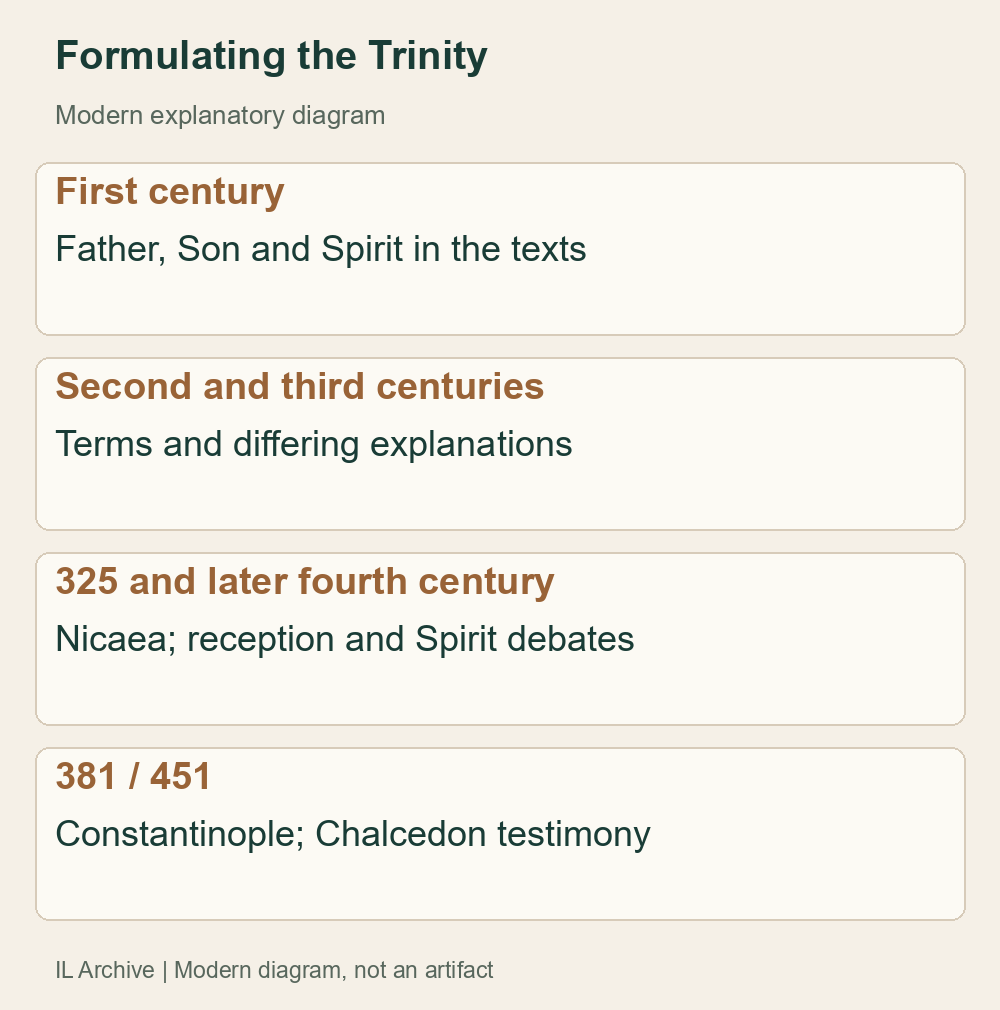
The “Nicene Creed” can mean the confession associated with the First Council of NicaeaFirst Council of NicaeaChristian council convened by Constantine in 325 at Nicaea; issued a creed on Father and Son and addressed church affairs, with disputes continuing over its reception.Glossary · Click to read the explanation in 325 CE, but in present-day church usage it often means a longer formula traditionally associated with Constantinople in 381. This entry distinguishes the two texts, their wording and their witnesses. It does not treat a later copy as the original minutes of a council or attempt to narrate the entire history of Christian doctrine. [1][2]
Reading guide
- The controversy at Nicaea in 325 and the relation between Father and Son.
- The wording of the earlier creed, its anathemas and textual uncertainties.
- The expanded form and the significance of 381 and 451.
- Liturgical names, translation choices and subsequent additions.
A creed, not a civil or disciplinary code
A creed is a short profession of faith, not a collection of legal rules. The council met at NicaeaNicaea (İznik)City in northwestern Türkiye where the Council of Nicaea met in 325 CE.Glossary · Click to read the explanation in Bithynia, now İznik in TürkiyeTurkeyTurkey is a modern country including Anatolia and territory in southeastern EuropeGlossary · Click to read the explanation, at the summons of Emperor Constantine IConstantine IRoman emperor, reigning in 306–337 CE, who convened Nicaea in 325.Glossary · Click to read the explanation. It also dealt with matters of ecclesiastical discipline; those canons must not be mistaken for the creed. Unlike many longer instructional or liturgical confessions, this text responded to a particular dispute about the Son and his relation to the Father.
The debate grew out of disagreements involving the Alexandrian presbyter AriusAriusEarly fourth-century Alexandrian presbyter associated with disputes over the Son.Glossary · Click to read the explanation and his opponents over the Son's origin and existence. It is misleading to say that the 325 meeting ended the controversy: disputes and alternative formulations continued throughout the fourth century. Nor does the creed alone tell us everything each participant believed or what every Christian community accepted. [3]
What the 325 formula actually says
The text begins by professing one God, the Father, maker of visible and invisible things, before dwelling at greater length on Jesus Christ, the Son. The published English translation in the edition associated with Henry Percival includes phrases rendered here as “from the substance of the Father”, “begotten, not made” and “of one substanceHomoousios — of the same substanceHomoousios: “of the same substance.” Used for the Son in relation to the Father in the 325 Nicene Creed to distinguish him from creatures. Its precise implications remained contested as ousia and hypostasis acquired sharper later uses.Glossary · Click to read the explanation with the Father”. The relevant Greek term is homoousios (ὁμοούσιος); translating it as “consubstantial” does not eliminate the history of arguments about its significance. The confession goes on to mention incarnation, suffering, resurrection, ascension and future judgement; its main text ends with a notably brief profession of faith in the Holy SpiritHoly SpiritName present in Christian texts and worship, whose relation to Father and Son was defined in Trinitarian formulations.Glossary · Click to read the explanation. [1]
These words should not be presented as a complete fourth-century statement of the later doctrine of the TrinityTrinityChristian formulation of divine unity and Father/Son/Spirit distinction, with a history of debate.Glossary · Click to read the explanation. The 325 text does not expressly name the Virgin Mary or Pontius Pilate; its Spirit clause lacks such phrases as “Lord and giver of life” and “who spoke through the prophets”. An omission is not a denial. It shows the limited scope of a document addressing a particular controversy.
A near-contemporary account comes from Eusebius of CaesareaEusebius of CaesareaThird- and fourth-century Christian bishop and author of Church History.Glossary · Click to read the explanation in a letter to his own church. He sets out first the formula he says he proposed and then that issued by the council, explaining why he could accept the expression “one in essence” without implying that the Father's substance was divided. This is invaluable participant testimony, but it also serves to defend his decision before his community; it is not a neutral transcript of every debate. [4]
Anathemas and variations among witnesses
In the received texts the profession is followed by anathemas rejecting claims that there was a time when the Son did not exist, that he came to be from non-existent things, or that he was changeable. The widely circulated Fordham translation also includes “creature” in the sequence of condemned assertions. The fact that this wording appears there does not establish that it was present in every ancient line of transmission. [1]
There is also a difference between what Arius himself taught and how his opponents represented his views. Writers such as Eusebius and Gregory of NazianzusGregory of NazianzusFourth-century bishop and theologian, one of the Cappadocian Fathers.Glossary · Click to read the explanation were participants in theological controversies, not disinterested recording devices. Later authors, including Basil of CaesareaBasil of CaesareaFourth-century bishop and theologian, brother of Gregory of Nyssa.Glossary · Click to read the explanation, offered accounts of the vocabulary that should not be substituted for the wording of the creed itself.
In a peer-reviewed 2026 study Mark J. Edwards argues that the anathema containing ktiston (“created” or “creature”) is absent from several important witnesses, while present in others. His 2021 chapter on the creed also identifies this textual question. This is a scholar's assessment of the evidence, not a claim that we have collated lost original council manuscripts, and it does not justify silently changing the wording of the source cited in note 1. [5][3]
374, 381 and 451: dates with different meanings
The longer “Niceno-Constantinopolitan Creed” is traditionally associated with the council of ConstantinopleConstantinopleLate antique and medieval city on the historic peninsula of modern Istanbul.Glossary · Click to read the explanation in 381, convened under Theodosius ITheodosius IRoman emperor in 379–395 CE, during whose reign Constantinople met in 381.Glossary · Click to read the explanation. Its differences from 325 extend well beyond the addition of a final paragraph. Nevertheless, precisely how the transmitted formula was composed or adopted at the meeting of 381 remains a historical question. The Ancoratus attributed to Epiphanius, dated around 374, preserves a confession strikingly close to it; scholars have offered different explanations of that relationship. The passage examined here is an older published English rendering and editorial comparison, not a fresh collation of its Greek witnesses. [6]
A particularly important documentary witness comes from the acts of the Council of ChalcedonChalcedon (Kadıköy)Ancient city at modern Kadıköy on Istanbul’s Asian side.Glossary · Click to read the explanation in 451. They describe the reading of a creed attributed to the “318 fathers” of Nicaea and another to the “150 fathers” of Constantinople. Those numbers are traditional labels in the acts, not an independently verified count reconstructed here from an attendance register. The evidence establishes that Chalcedon endorsed this attribution; by itself it cannot settle every question about the composition and earlier transmission of the expanded text. [7]
A comparison of the two texts
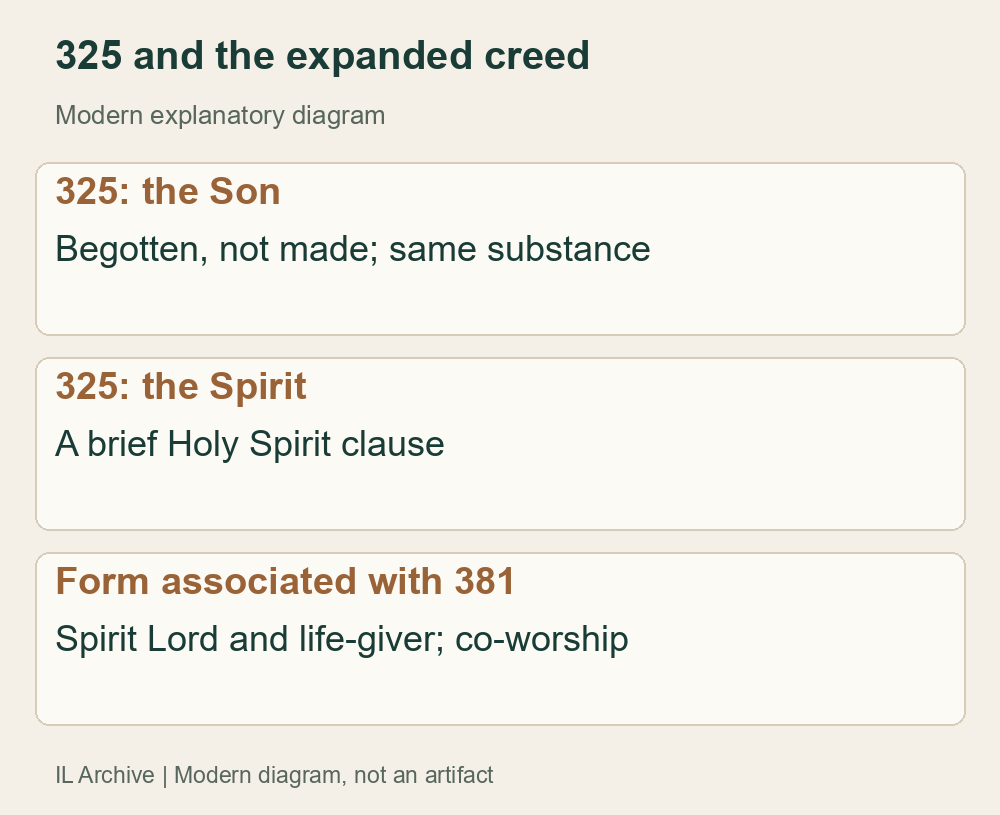
- In 325: emphasis on the Son's derivation from the Father, “from the Father's substance”, “begotten, not made” and shared substance; a very short Holy Spirit clause follows, then anathemas in transmitted forms.
- In the creed associated with 381: the Son is begotten “before all ages”; the incarnation is specified as through the Holy Spirit and the Virgin Mary, and the crucifixion under Pontius Pilate. The Holy Spirit article is much fuller, followed by statements about the one Church, baptism, resurrection of the dead and the life to come. The 325 anathemas are not appended to this version. [2]
- What the differences do not prove: an idea appearing in the longer form need not have been invented in 381, and the textual changes do not imply that all fourth-century churches were reciting the same wording.
The Spirit and the later Filioque
The expanded text calls the Holy Spirit “the Lord and giver of life”, says that the Spirit “proceeds from the Father”, is worshipped and glorified with Father and Son, and spoke through the prophets. It does not itself formulate every subsequent philosophical explanation of divine substance and persons. The World Council of Churches uses the name “Nicene-Constantinopolitan Creed” for this version and acknowledges that it is often called simply the “Nicene Creed”. [8]
The FilioqueFilioqueLatin for “and the Son,” added in Western use to the clause about the Holy Spirit in the creed associated with Constantinople (381). Absent from the received Greek text; disputed in doctrine and the authority to amend the creed.Glossary · Click to read the explanation—Latin for “and the Son”—belongs to the later history of the Western Latin wording of the procession clause. It is absent from the Greek text associated with 381. The Roman Catholic Catechism itself acknowledges that textual fact, while explaining the Latin theological tradition and noting the continuing disagreement with Orthodox churches. An accurate quotation should therefore identify whether it follows a Greek text, a later Western liturgical Latin version or a translation of one of them. [9]
Evidence, advocacy and interpretation
The main phrases of 325 can be checked against published editions and Eusebius' letter; subsequent works by Gregory of Nazianzus, Basil of Caesarea and Gregory of NyssaGregory of NyssaFourth-century bishop of Nyssa and theologian, one of the Cappadocian Fathers.Glossary · Click to read the explanation shed light on later arguments but should not be put into the mouths of the bishops in 325. Eusebius defends his own subscription, while narratives about Constantine offer another perspective. Contemporary evidence, a later council's acts, an editor's historical introduction and modern textual criticismTextual criticismComparison of written witnesses and ancient translations to explain variant readings and textual transmission, distinguishing attested text from restorations and inferred ancestors.Glossary · Click to read the explanation serve distinct purposes.
Neither “Arian” nor homoousios should be used as if a label or single word explained every participant's theology. Athanasius, writing later in defence of Nicaea, construed the issue sharply; juxtaposing his discussion with Eusebius' letter shows that even the interpretation of the agreement was contested. We distinguish what the transmitted creed states from a partisan fourth-century explanation and from a present-day historian's reconstruction. [10]
Conclusion
The confession associated with Nicaea in 325 sought to delimit claims about the Son and Father, while the attached condemnations pose genuine textual questions. The fuller confession traditionally attributed to Constantinople in 381, and prominently documented at Chalcedon in 451, became the much more familiar liturgical text. Dating the council, identifying the precise creed, locating the surviving witness and distinguishing later reception are all essential whenever the term “Nicene Creed” is used.
References and notes (10)
- H. R. Percival (ed.), “The Ecthesis of the Synod at Nice” (325), in The Seven Ecumenical Councils, NPNF, series 2, vol. 14; online transcription, Paul Halsall, Fordham Internet History Sourcebooks. Published English text of the 325 profession and anathemas; this version contains “creature”; no collation of all Greek witnesses was conducted. Return to the text ↑
- H. R. Percival (ed.), “The Holy Creed Which the 150 Holy Fathers Set Forth”, in The Seven Ecumenical Councils, NPNF, series 2, vol. 14, pp. 163–164; Christian Classics Ethereal Library (CCEL). Editorial introduction and transmitted Niceno-Constantinopolitan text; the Holy Spirit, baptism and life to come; printed pp. 163–164 in the online edition. Return to the text ↑
- Mark J. Edwards, “The Creed”, in The Cambridge Companion to the Council of Nicaea, ed. Young Richard Kim, Cambridge University Press, 2021, pp. 135–157; publisher’s abstract only. Publisher’s summary, bibliographic metadata and selected reference list only; the full chapter, pp. 135–157, was not read. Return to the text ↑
- Eusebius of Caesarea, “Letter to His Church on the Council of Nicaea”, transmitted by Athanasius; NPNF English translation at New Advent. Letter §§1–11 in the published English translation: Eusebius’ proposed creed, council formula, defence of “one essence” and subscription. Return to the text ↑
- Mark J. Edwards, “What did the Nicene Creed say?”, Ecclesiastical Law Journal 28, no. 1 (2026), pp. 106–116, Cambridge University Press, DOI:10.1017/S0956618X25101105. Online article’s substantive text from Introduction through Conclusion, particularly “Why a creed?”, “Thoughts on creation” and the ktiston variant; no manuscript collation. Return to the text ↑
- Epiphanius of Salamis, Ancoratus (c. 374), creed passages quoted in H. R. Percival’s introduction to the Niceno-Constantinopolitan Creed, The Seven Ecumenical Councils, NPNF, CCEL. Percival’s introduction and English quotations from Ancoratus chapters 119–120; no direct reading of the Greek text or manuscript edition. Return to the text ↑
- Council of Chalcedon (451), acts: Sessions II and IV and Definition of Faith; English extracts in H. R. Percival (ed.), The Seven Ecumenical Councils, NPNF, at New Advent. English excerpts from sessions II and IV and the Definition: reading of the creeds attributed to the 318 and 150 fathers. Return to the text ↑
- World Council of Churches, “Nicene-Constantinopolitan Creed”, institutional presentation of its English, French, German and Spanish translations, 15 August 2025 (webpage only, not the PDF). Institutional webpage and its description of EN/FR/DE/ES translations and the naming ambiguity; the linked PDF was not read. Return to the text ↑
- Catechism of the Catholic Church, §§245–248, Holy See website; its account of the 381 wording, the later Filioque and the Latin perspective on the Orthodox disagreement. §§245–248, especially the text of 381 compared with the later Latin Filioque and the Catholic account of Orthodox disagreement. Return to the text ↑
- Athanasius of Alexandria, De decretis Nicaenae Synodi (“On the Decrees of Nicaea”), §§19–20; NPNF English translation at New Advent. §§19–20 in the published English translation: Athanasius’ later polemical defence of “from the substance” and report of opponents’ reasoning. Return to the text ↑
Suggest a correction · Suggest a source for this record
Cite this record
IL Archive, «The Nicene Creed: the 325 text and the form attributed to 381», https://ilarchive.com/en/entities/nicene-creed
Continue reading