Entity · Historical council
First Council of Nicaea
A reference page linking a name, group, or concept to the materials that discuss it.
- Timeline
- 325 CE
Christian council convened by Constantine in 325 at Nicaea; issued a creed on Father and Son and addressed church affairs, with disputes continuing over its reception.
Estimated reading time: 8 min Published Last reviewed:
Share article
Text
Introduction
The First Council of Nicaea was a gathering of bishops from across the Roman Empire, convened by Emperor Constantine in 325 at NicaeaNicaea (İznik)City in northwestern Türkiye where the Council of Nicaea met in 325 CE.Glossary · Click to read the explanation, near present-day Istanbul. It is famous for a creed concerning the relationship between Jesus Christ, as the “Son”, and God, the “Father”, but also addressed church divisions, discipline and the date of Easter. To understand its significance we must read the text of 325 rather than project later formulas back onto it, and distinguish surviving decisions from accounts of the proceedings.
The gathering and imperial power
After defeating Licinius and consolidating imperial power in 324, Constantine IConstantine IRoman emperor, reigning in 306–337 CE, who convened Nicaea in 325.Glossary · Click to read the explanation regarded disputes among Christian communities as obstacles to the unity he sought. Bishops were summoned from various regions, predominantly the eastern Roman provinces, and assembled at Nicaea in Bithynia, today's İznik in TurkeyTurkeyTurkey is a modern country including Anatolia and territory in southeastern EuropeGlossary · Click to read the explanation. Imperial provision for travel and expenses was integral to this gathering: it was no theological debate isolated from government. Modern scholars differ over the precise attendance, often estimating approximately 250–300 bishops; the familiar figure of 318 became prominent in later ecclesiastical memory. [1]
The meeting had more than one agenda. The bishops faced an Alexandrian dispute about the Son, the Melitian division in Egypt, divergent Easter observances, and questions of episcopal jurisdiction and clerical discipline. Its decisions did not produce an immediate, settled consensus: bishops and emperors argued over their meaning for decades. Work on the reception of Nicaea supports this picture, although only the publisher's abstract of Sara Parvis's chapter was available for this review. [2]
The dispute over Father and Son
AriusAriusEarly fourth-century Alexandrian presbyter associated with disputes over the Son.Glossary · Click to read the explanation was an Alexandrian presbyter, not the founder of a position adequately summarized by a single slogan. He stressed that the Father alone was without origin and held that the Son owed his existence to the Father, without sharing the Father's unoriginated existence in the same way. On the other side, Alexander, bishop of Alexandria, argued that the Son, as God's Word and Wisdom, was not one creature among others but had always been with the Father. The parties advanced differing readings of scriptural passages such as Proverbs 8:22 and John 1:1–3. The issue was how to describe the Son's divinity and relation to the Father, not a sudden first vote on whether Christ could be called divine. [3]
Language itself posed difficulties. Ousia (οὐσία)Ousia — substance and essenceOusia (οὐσία): a Greek noun variously translated being, substance, or essence. In later Christian debates it could designate a common divine essence contrasted with distinct hypostases; this meaning is not universal in earlier texts.Glossary · Click to read the explanation could denote being, essence or substance depending on context; hypostasis (ὑπόστασις)HypostasisHypostasis is a Greek term with changing meanings. In later Trinitarian theology it distinguishes Father, Son and Spirit within one divine essence; earlier Greek, biblical and Syriac usages require separate contextual reading.Glossary · Click to read the explanation had not yet acquired the stable technical meaning of “person” or distinct subsistence found in much later TrinitarianTrinityChristian formulation of divine unity and Father/Son/Spirit distinction, with a history of debate.Glossary · Click to read the explanation usage. Homoousios (ὁμοούσιος)Homoousios — of the same substanceHomoousios: “of the same substance.” Used for the Son in relation to the Father in the 325 Nicene Creed to distinguish him from creatures. Its precise implications remained contested as ousia and hypostasis acquired sharper later uses.Glossary · Click to read the explanation in the formula of 325 signaled that the Son was “of the same substance” as the Father, rather than made like created beings. It would be anachronistic to read these terms as if the later refinements had already been settled in 325. [4]
The creed issued in 325
The Nicene Creed of 325The Nicene Creed: the 325 text and the form attributed to 381Profession of faith adopted at Nicaea in 325, focused on the Son’s relation to the Father and ending with a short Spirit clause. Distinct from the longer creed associated with 381, also commonly called “Nicene Creed”.Glossary · Click to read the explanation professes the Father as maker of visible and invisible things, the Son as begotten of the Father, “not made” and “of the same substance” as the Father, and the Holy SpiritHoly SpiritName present in Christian texts and worship, whose relation to Father and Son was defined in Trinitarian formulations.Glossary · Click to read the explanation in a short clause. It closes with anathemas against statements such as “there was when he was not.” These anathemas define the council's polemical boundary; they are not a neutral or exhaustive transcript of every opponent's views. [4][5]
The following brief phrases come from the Greek form of the 325 creed printed by Wolfram Kinzig on the basis of transmitted witnesses and the critical edition cited in his study. They are not transcriptions from a surviving autograph written by the council's participants: [4]
The first means “begotten, not made; of the same substance as the Father.” The second means “there was when he was not”, a proposition condemned in the anathemas rather than asserted as the council's belief. The third means “and in the Holy Spirit.” The contrast between the detailed clauses on the Son and the brevity of the Spirit clause points to later development of teaching about the Holy SpiritHoly SpiritName present in Christian texts and worship, whose relation to Father and Son was defined in Trinitarian formulations.Glossary · Click to read the explanation in the more familiar creeds; it does not imply that speaking of Father, Son and Spirit began at Nicaea. [4]
A further Greek phrase, “ἢ κτιστὸν” (“or created”), occurs in some versions of the anathemas and is placed in brackets in the critical text printed by Kinzig. Mark Edwards discusses its presence in Athanasius's transmission and its absence from other witnesses, including Theodoret and the Chalcedonian testimony. It must not be presented as an undisputed reading in every line of transmission. This variant concerns the additional anathema clause, not the “begotten, not made” wording of the creed itself. [4][8]
How do we know what happened?
No full, surviving minutes permit historians to reconstruct every intervention at the council. There are transmitted forms of the creed, anathemas and canons, letters close to the event and narratives written later. One particularly important contemporary witness is a letter from Eusebius of CaesareaEusebius of CaesareaThird- and fourth-century Christian bishop and author of Church History.Glossary · Click to read the explanation to his church explaining why he accepted the wording. He reports that Constantine encouraged use of the term for sameness of substance and interpreted it in non-physical terms. But this is a participant defending his decision to his community, not the minutes of a session or conclusive evidence that the emperor invented the word. [1]
Eusebius's later Life of Constantine depicts the council and the emperor's address within a work praising its subject. It illuminates imperial aspirations but should not be treated as a verbatim, disinterested recording. Fifth-century church historians belong to another chronological layer. We must therefore separate the event of 325, the composition of fourth-century letters and subsequent narratives, the later manuscript copies through which they were transmitted, and the modern translations and editions we read today. [6]
Canons, divisions and Easter
Twenty ecclesiastical canons have been transmitted as belonging to the first council. They concern ordination, movement of clergy, penance and regional jurisdiction. Canon 6, for example, recognizes the customary authority of Alexandria in Egypt, Libya and the Pentapolis while referring to comparable customs in Rome and Antioch; canon 20 prescribes standing for prayer on Sundays and during Pentecost. These are rules of church administration, not a list of biblical books. The synodal letter also describes an accommodation concerning the followers of Melitius, as part of the attempt to heal division in Egypt. [5]
The assembly supported a common observance of Christian Easter, a policy attested in Constantine's letter preserved by Eusebius. Yet the surviving twenty canons do not contain the detailed annual calculation sometimes attributed to the council. The emperor's letter uses hostile language about Jews; this should be attributed to Constantine's rhetoric and the history of the Easter controversy, not recast as though every phrase were a canon drafted collectively by the bishops. [6][7]
From 325 to 381 and 451
Disagreement continued after Nicaea: some opponents were exiled and later policies about individuals and exclusions shifted. Supporters of Nicaea also disagreed over the meanings of substance and hypostasis. Monks, bishops and political authorities all took part in this history; a simple story of victors and losers does not explain it. Trinitarian theologyTrinityChristian formulation of divine unity and Father/Son/Spirit distinction, with a history of debate.Glossary · Click to read the explanation developed through the ensuing decades, notably through clearer language about one divine essence and three hypostases. [2][3]
The creed of 325 must be distinguished from the longer “Niceno-Constantinopolitan Creed”, linked to the Council of ConstantinopleConstantinopleLate antique and medieval city on the historic peninsula of modern Istanbul.Glossary · Click to read the explanation in 381 under Theodosius ITheodosius IRoman emperor in 379–395 CE, during whose reign Constantinople met in 381.Glossary · Click to read the explanation. The longer text elaborates on the Holy Spirit and differs in several expressions. The Council of ChalcedonChalcedon (Kadıköy)Ancient city at modern Kadıköy on Istanbul’s Asian side.Glossary · Click to read the explanation in 451 is an important witness to its transmission and attribution. The attestation of a text in 451 does not by itself establish that every word was drafted literally in a session in 381; still less may the whole longer text be assigned to the editors of 325. [4][8]
Did Nicaea choose the books of the Bible?
The popular story that the bishops voted at Nicaea on which New Testament books belonged in the Bible is not supported by the surviving council documents. The creed, anathemas, twenty canons and surviving synodal letter do not contain a decree fixing a biblical canon. This is a statement about the limits of the evidence: lack of a surviving decree does not mean that no Christian community debated scripture, or that the formation of book lists ended on one date. [5]
Before the council, Eusebius distinguished accepted, disputed and rejected writings in Ecclesiastical History 3.25, evidence of ongoing debate before 325. After the council, Athanasius's thirty-ninth Festal Letter, dated 367, enumerated the twenty-seven New Testament books and distinguished canonical books from others suitable for reading. These witnesses explain the gradual history of book lists more convincingly than an unsourced voting legend, while some church traditions have continued to differ over Old Testament books. [9][10]
A brief chronology and what it establishes
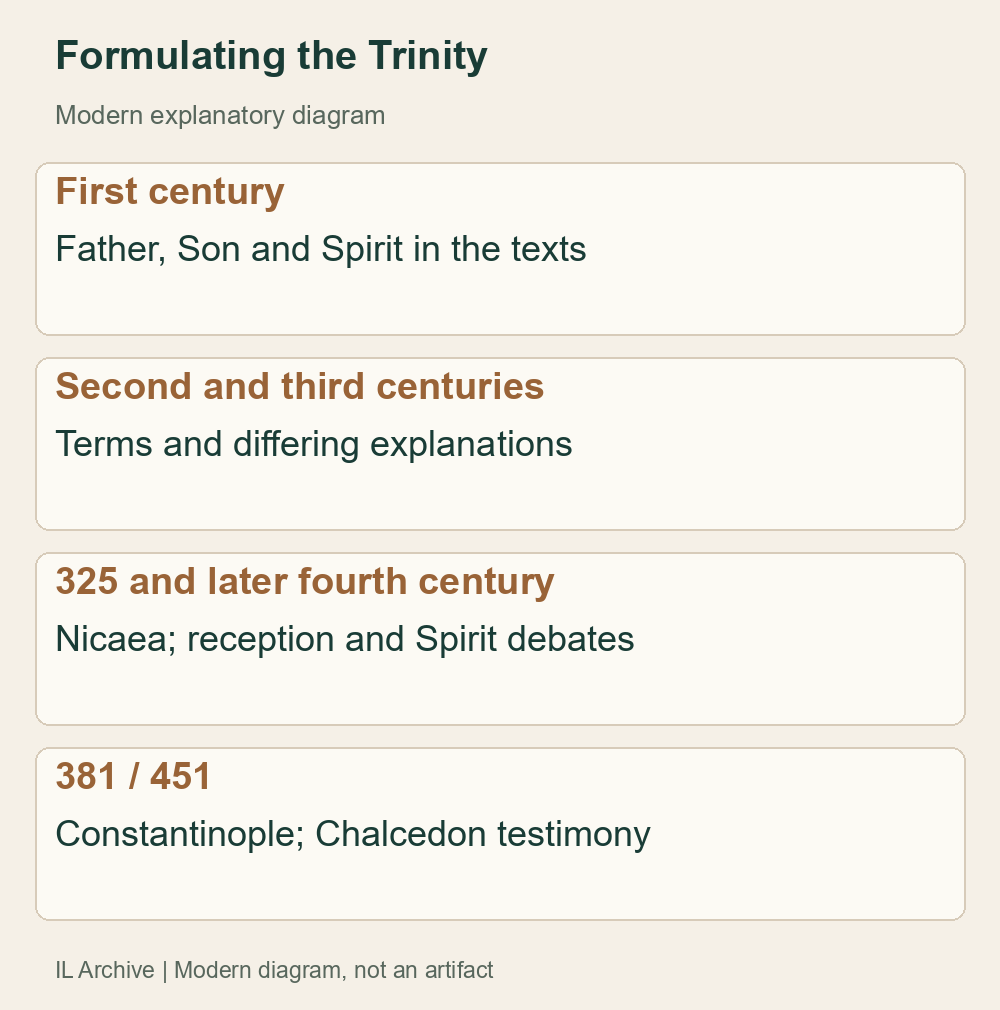
- Second and third centuries: varied language about Father, Son and Spirit and diverse interpretations; the history of the Trinity did not begin in 325.
- Approximately 318–324: an Alexandrian controversy intensifies and spreads among bishops; the details of its beginnings are difficult to establish.
- 325: the first council at Nicaea issues its creed and twenty canons and addresses divisions and the Easter question.
- From the 330s to about 360: disputes about receiving its formulas and shifting ecclesiastical and imperial alliances.
- 367: Athanasius's thirty-ninth letter, important evidence about biblical book lists, not a decision of Nicaea.
- 381: Council of Constantinople and a new phase of creedal formulation and reception.
- 451: Chalcedon's witness to the longer creed associated with 381; transmission does not automatically date the invention of every sentence.
The accompanying illustration is a modern editorial timeline with separate language versions, not a historical photograph of the place or a documented reconstruction of the bishops' sessions. Nicaea matters for the texts and institutions shaped through it, while firm limits remain on what can be established about its debates and the later reception of its decisions.
References and notes (10)
- Eusebius of Caesarea, Letter to the Church of Caesarea concerning the Council of Nicaea, §§1–11; transmitted with Athanasius; John Henry Newman and Archibald Robertson translation, Nicene and Post-Nicene Fathers, 2nd series, vol. 4 (1892). Read the displayed English letter, especially §§1–6: Eusebius’s formula, his defence of homoousios and his account of Constantine; not official proceedings. Return to the text ↑
- Sara Parvis, “The Reception of Nicaea and Homoousios to 360”, in The Cambridge Companion to the Council of Nicaea (2021), pp. 225–255. Publisher abstract only, not the chapter or printed pages; used for the general subject of reception and disputes to 360, not unread details. Return to the text ↑
- Rebecca Lyman, “The Theology of the Council of Nicaea”, St Andrews Encyclopaedia of Theology, University of St Andrews, 25 April 2024. Read accessible full scholarly article, sections 1.1–1.2, 2.1–2.2.1 and 3: dispute, exegesis, participants, proceedings, reception; not a separate reading of every cited book. Return to the text ↑
- Wolfram Kinzig, “The Creed of Nicaea: Old Questions, New Answers”, The Ecumenical Review 75, no. 2 (2023), pp. 215–234. Read open full article, especially printed Greek creed (FaFo §135c), terminology, composition and sections 1–4; Greek excerpts taken from an edition, not an autograph manuscript. Return to the text ↑
- “First Council of Nicaea (A.D. 325): Nicene Creed, Twenty Canons and Synodal Letter”, Henry Percival translation, Nicene and Post-Nicene Fathers, 2nd series, vol. 14 (1900), New Advent. Read creed, anathemas, canons 1–20 and the synodal letter on the linked page; canon numbers are sections, not PDF pagination, and the online text is an editorial compilation. Return to the text ↑
- Eusebius of Caesarea, Life of Constantine, book III, chapters 10–21, Ernest Cushing Richardson translation, Nicene and Post-Nicene Fathers, 2nd series, vol. 1 (1890), New Advent. Read chapters on the council and Easter correspondence, especially III.10–21; later fourth-century panegyric, not council minutes. Return to the text ↑
- Orthodox Church in America, “Concerning the Date of Pascha and the 1st Ecumenical Council”, historical discussion of Easter observance and calculations. Read the “Background of the Paschal Issue” and “The Issue and the Council at Nicea” sections; modern denominational historical interpretation, not a 325 original. Return to the text ↑
- Mark Edwards, “What did the Nicene Creed say?”, Ecclesiastical Law Journal 28, no. 1 (2026), pp. 106–116, open HTML via Cambridge Core; compared with Kinzig’s open treatment. Read open full HTML article, Introduction, Why a creed?, Trinity, creation and Conclusion plus notes on witnesses including note 34; no claim to reading manuscript originals or checking the publisher PDF. Examines the variant “ἢ κτιστὸν”. Return to the text ↑
- Eusebius of Caesarea, Ecclesiastical History, book III, chapter 25, historical NPNF English translation, New Advent. Read III.25 concerning acknowledged, disputed and rejected writings; not a council document. Return to the text ↑
- Athanasius of Alexandria, Thirty-Ninth Festal Letter (367), §§4–7, R. Payne-Smith translation, Nicene and Post-Nicene Fathers, second series, vol. 4 (1892). Read the displayed English translation, §§4–7: 27 New Testament books and the distinction between canonical and readable texts; online extract, not a fourth-century autograph. Return to the text ↑
Suggest a correction · Suggest a source for this record
Cite this record
IL Archive, «First Council of Nicaea», https://ilarchive.com/en/entities/council-of-nicaea
Continue reading