Entity · Theological term
Homoousios — of the same substance
A reference page linking a name, group, or concept to the materials that discuss it.
Homoousios (“of the same substance”) in the creed of Nicaea (325) marked the Son as belonging to the Father’s reality, not to the created order. Its interpretation was debated and the ousia/hypostasis distinction became sharper later.
Estimated reading time: 7 min Published Last reviewed:
Share article

Text
Introduction
What did the bishops at the Council of NicaeaFirst Council of NicaeaChristian council convened by Constantine in 325 at Nicaea; issued a creed on Father and Son and addressed church affairs, with disputes continuing over its reception.Glossary · Click to read the explanation in 325 CE mean when they called the Son “of the same substance” as the Father? This entry traces the Greek word ὁμοούσιος (homoousios) through the creed, participants’ accounts and subsequent controversy. It distinguishes the council’s actual wording from interpretations refined over the following decades without turning a theological formula into a physical depiction of God.
The word and its translations
Homoousios combines an element meaning “same” with ousia, a Greek noun variously associated with being, essence or concrete reality depending on author and context. “Equal in substance” is an intelligible rendering, but “of the same substance” or “consubstantial” better conveys that the issue was not merely equality of rank. In Nicene Christian usage the Son is homoousios tō patri, “of the same substance as the Father”. Neither this formula nor the noun ousia implies a divisible material substance or a philosophical definition shared unchanged by writers in every century. [2]
The word also differs from homoiousios, “similar in substance”. The distinction of a single Greek letter became important in some fourth-century disputes, yet the disputants did not form two uniform camps: advocates of related formulas differed about the nature of similarity, substance and the usefulness of such terms at all. [3]
The dispute before 325
A controversy at Alexandria between the presbyter AriusAriusEarly fourth-century Alexandrian presbyter associated with disputes over the Son.Glossary · Click to read the explanation and his bishop Alexander concerned the Son’s standing, eternity and derivation from the Father. Arius radically distinguished the Son from the unbegotten Father while assigning the Son a place above other creatures. Opponents feared that this reduced the Son to the created order; others feared that language of a single substance could erase the distinction between Father and Son. These are descriptions of competing arguments within ancient Christianity, not exhaustive labels for everyone involved. [3]
Nicaea did not invent homoousios in 325; the term had already circulated in shifting senses. Fourth-century opponents appealed to an earlier controversy surrounding Paul of Samosata and a third-century council at Antioch. Debate over the word is recorded by Athanasius of Alexandria, who argued that a previous rejection of a bodily interpretation did not preclude a different use. No independent complete minutes of that earlier synod are available to settle the exact wording of a decree issued around 268. The testimony is a later polemical account rather than an unproblematic transcript. [5]
What the creed of 325 actually says
The bishops assembled at Nicaea, modern İznik in TurkeyTurkeyTurkey is a modern country including Anatolia and territory in southeastern EuropeGlossary · Click to read the explanation, adopted the confession now called the Creed of NicaeaThe Nicene Creed: the 325 text and the form attributed to 381Profession of faith adopted at Nicaea in 325, focused on the Son’s relation to the Father and ending with a short Spirit clause. Distinct from the longer creed associated with 381, also commonly called “Nicene Creed”.Glossary · Click to read the explanation in 325. The Son is described as “begotten of the Father”, then more precisely “from the substance of the Father”, “begotten, not made”, and “of the same substance as the Father”. The accompanying anathemas reject claims that the Son “once was not”, came to be from nothing, or came from “another hypostasis or ousia”. This is the wording of a doctrinal document preserved through textual witnesses, not a New Testament quotation or a verbatim record of every bishop’s speech. [2]
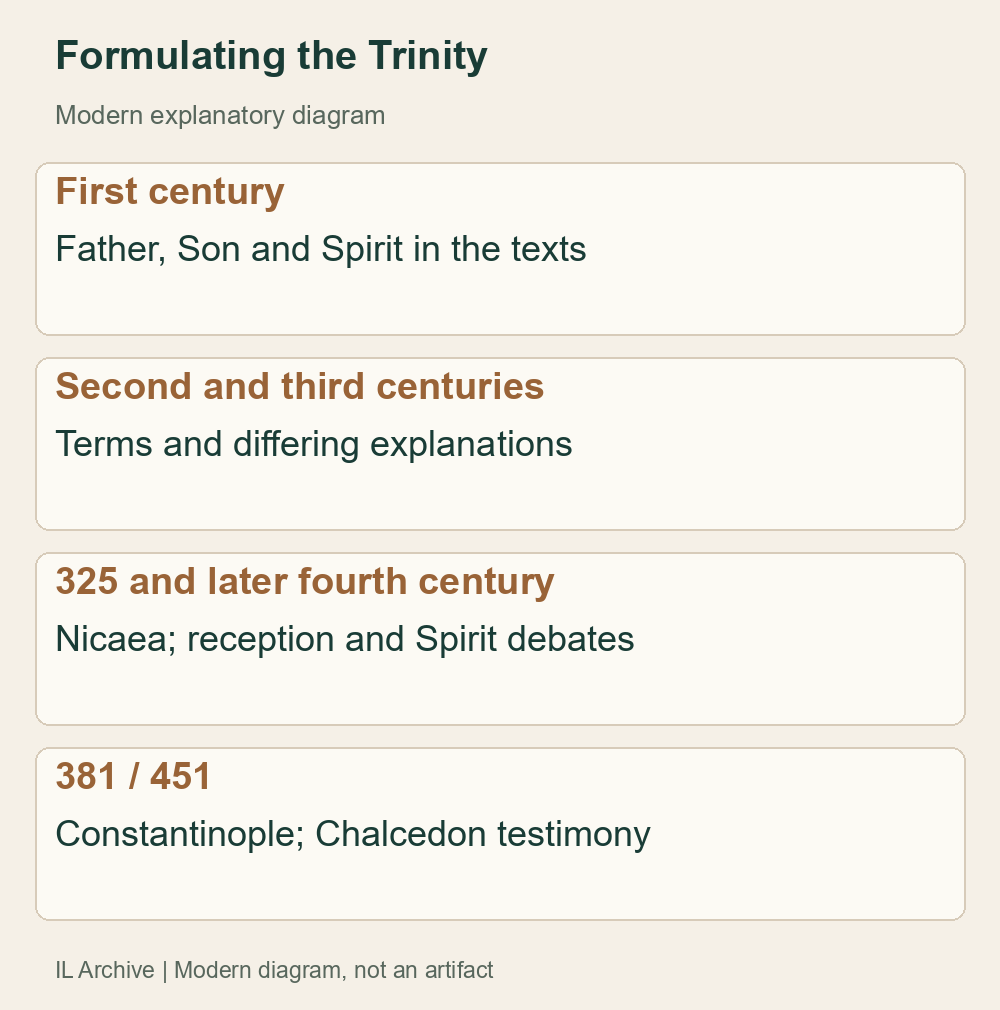
The section on the Holy SpiritHoly SpiritName present in Christian texts and worship, whose relation to Father and Son was defined in Trinitarian formulations.Glossary · Click to read the explanation in the 325 text consists only of the short affirmation “And in the Holy Spirit”. The much fuller later account of the Spirit, and the developed expression “one ousia, three hypostases”, should not simply be projected back onto the original creed. Its immediate controversy chiefly concerned the Son’s relation to the Father rather than a complete technical dictionary of the TrinityTrinityChristian formulation of divine unity and Father/Son/Spirit distinction, with a history of debate.Glossary · Click to read the explanation. [3]
Eusebius of Caesarea: consent with an explanation
The bishop and historian Eusebius of CaesareaEusebius of CaesareaThird- and fourth-century Christian bishop and author of Church History.Glossary · Click to read the explanation wrote to his church after the council to explain his signature. According to his account, Emperor Constantine IConstantine IRoman emperor, reigning in 306–337 CE, who convened Nicaea in 325.Glossary · Click to read the explanation recommended the addition of “of the same substance”, interpreting it in a non-bodily sense: no part separated from the Father, no division of an incorporeal nature. Eusebius says that he asked about “from the Father’s substance” and “begotten, not made”, and accepted the creed after hearing explanations. [1]
This letter is a near-contemporary witness by a participant, but it is also a defence addressed to his own community. It does not demonstrate that Constantine coined the word, composed every part of the creed, or that all bishops shared Eusebius’s understanding. Rather, it reveals a margin of interpretation within a political and ecclesiastical agreement on one formula. [3]
Athanasius: why “from God” was not enough
Writing after the council in On the Decrees of Nicaea (De Decretis), Athanasius of Alexandria, an influential defender of its decisions, argued that the phrase “from God” could also be used of created things. He maintained that “from the substance of the Father” and “consubstantial” excluded treating the Son as belonging to the created order. His analogy of radiance and light expressed inseparable derivation, while he explicitly opposed projecting bodily separation onto divine being. [4]
This is later theological advocacy, not a transcript of the lost deliberations in 325. Athanasius articulated the Father–Son relation more assertively than Eusebius’s account of what he had been willing to sign. Reading both together shows how the term became a focus for further interpretation.
Ousia and hypostasis: a distinction shaped over time
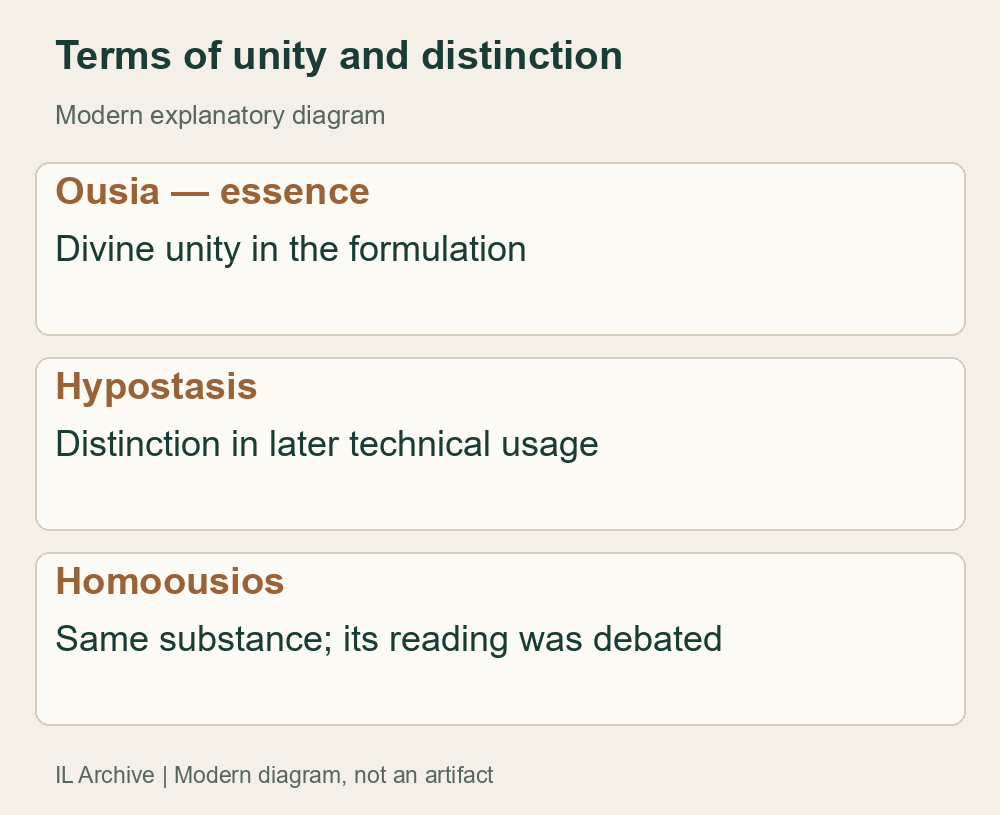
The 325 anathema speaks of “another hypostasis or ousia”, suggesting that the words could overlap in that particular setting. Later debates increasingly distinguished ousia (essence)Ousia — substance and essenceOusia (οὐσία): a Greek noun variously translated being, substance, or essence. In later Christian debates it could designate a common divine essence contrasted with distinct hypostases; this meaning is not universal in earlier texts.Glossary · Click to read the explanation, expressing divine unity, from hypostasisHypostasisHypostasis is a Greek term with changing meanings. In later Trinitarian theology it distinguishes Father, Son and Spirit within one divine essence; earlier Greek, biblical and Syriac usages require separate contextual reading.Glossary · Click to read the explanation, designating Father, Son and Holy Spirit without collapsing their distinction. That later distinction should not be retroactively imposed on every earlier use. [2]
In the conciliatory Tome to the Antiochenes of 362, Athanasius and fellow bishops could accept language of “one hypostasis” from some and “three hypostases” from others, provided neither group meant to deny the real distinctions or profess three gods. Basil of CaesareaBasil of CaesareaFourth-century bishop and theologian, brother of Gregory of Nyssa.Glossary · Click to read the explanation, in Letter 236 §6, distinguished what is common from what is particular: shared essence on the one hand and the distinguishing properties of Father, Son and Spirit on the other. Both documents testify to technical language becoming more precise decades after Nicaea. [6] [7]
Disputes after the council
Signing the creed in 325 did not end disagreement. In later decades, some proposed language of being “like in substance”, others spoke of likeness “according to Scripture”, and still others were reluctant to discuss substance at all. Councils and alliances were also affected by imperial politics and relationships among bishops. Athanasius’s objections to successive formulas show that fourth-century positions cannot be compressed into two fixed and simple sides. [5]
Historical interpretation should therefore distinguish public acceptance of common wording from agreement on a comprehensive account of all its implications. A council participant’s letter, later apologies for the creed, and records of other synods belong to different moments and serve different purposes. [3]
The creed of 325 and the later familiar version
The text commonly recited today and called “the Nicene Creed” is generally the expanded Niceno-Constantinopolitan form associated with the council of Constantinople in 381 and known through later testimony; it is not a word-for-word copy of the 325 formula. The expanded version retains the Son’s being “of the same substance as the Father”, but develops the account of the Spirit, alters other wording and does not reproduce the original anathemas in the same way. Comparing the forms prevents the initial decision from being confused with its reception. [8]
Greek, Latin, English, French and Arabic
Ecclesiastical Latin generally renders homoousios as consubstantialis; English commonly uses consubstantial or of the same substance, and French consubstantiel or de même substance. Latin essentia and substantia could each intersect with Greek ousia, while substantia could sound to a Greek reader closer to hypostasis. Those linguistic asymmetries sometimes produced suspicion before the actual belief intended was explained. Christopher Stead discusses this problem in a philosophical chapter on unity of substance; only the publisher’s chapter summary, not its complete pages, was accessible for this review. [9]
Arabic “musāwin fī l-jawhar” is a familiar convention, while “min al-jawhar nafsihi” foregrounds the original Nicene formulation. “Hypostasis” is a historical theological term, not a simple synonym for a modern psychological “person”. The accompanying diagram is a modern explanatory glossary—not a fourth-century manuscript or a material picture of divine being.
What the evidence can establish
We possess a creed of 325 preserved in later textual transmission, a near-contemporary participant’s letter, and apologetic and conciliatory discussions written in subsequent decades. They are different kinds of evidence. In its Nicene setting, homoousios marks the Son as not belonging to the created order and specifies his relation to the Father; by itself it neither supplies one meaning for every earlier occurrence nor proves that all later distinctions were already settled in 325. Keeping the witnesses and their purposes distinct supports an exact historical account without affirming or negating a religious commitment. [3]
References and notes (9)
- Eusebius of Caesarea, Letter on the Council of Nicaea to the Caesareans, §§1–11; the Greek was transmitted in Athanasius, and the text consulted is J. H. Newman and A. Robertson’s English translation in NPNF2, vol. 4 (1892), at New Advent. §§4–11, within the whole displayed English letter; a participant’s defence, not neutral minutes. Return to the text ↑
- Philip Schaff (ed.), Creeds of Christendom, vol. II, “Symbolum Nicænum. A.D. 325”, Greek creed, Latin parallel and textual annotations, CCEL. 325 creed section: clauses on the Son, Holy Spirit, anathemas, and ousia/hypostasis. Return to the text ↑
- Mark Edwards, “What did the Nicene Creed say?”, Ecclesiastical Law Journal (Cambridge University Press), published online 4 March 2026. Full HTML accessible; read introduction, translated 325 creed, section “What does the Creed say about the Trinity?”, conclusion “Creeds and dogma”, and relevant passages; not every footnote checked. Return to the text ↑
- Athanasius of Alexandria, De Decretis (“On the Decrees of Nicaea”), §§19–24; a historical English translation on New Advent, not a complete collation with the Greek. §§19–24, “from the Father’s essence”, “of one essence” and the radiance/light analogy. Return to the text ↑
- Athanasius of Alexandria, De Synodis (“On the Synods”), especially §§43–45 and selected descriptions of later conciliar formulas, historical English translation at New Advent. §§43–45 on Paul of Samosata and selected extracts of §§21–30 on competing formulas; entire work not read line by line. Return to the text ↑
- Athanasius and the Alexandrian synod, Tomus ad Antiochenos (362), §§5–6, historical English translation at New Advent. §§5–6, the debate over one or three hypostases; consulted these displayed sections. Return to the text ↑
- Basil of Caesarea, Letter 236, §6, on common ousia and particular hypostasis, historical English translation at New Advent. Letter 236 §6 only, on terminology; not the complete correspondence. Return to the text ↑
- Philip Schaff, Creeds of Christendom, vol. I, §8 “The Nicene Creed”, comparison of 325 with the form attributed to 381 and its later witnesses. §8, paragraphs on textual differences and Chalcedon’s 451 attestation. Return to the text ↑
- Christopher Stead, “Unity of Substance”, in Philosophy in Christian Antiquity (Cambridge, 1994), chapter 14, pp. 160–172; publisher’s chapter summary only was accessible/read, not the full chapter pages. Publisher summary only: ousia/hypostasis and substantia/essentia translation differences. Return to the text ↑
Suggest a correction · Suggest a source for this record
Cite this record
IL Archive, «Homoousios — of the same substance», https://ilarchive.com/en/entities/homoousios
Continue reading