Entity · Theological term
Filioque
A reference page linking a name, group, or concept to the materials that discuss it.
Filioque (“and the Son”) is a Latin addition to the creed associated with Constantinople in 381: its textual and doctrinal history, the Greek–Latin dispute, the authority for its insertion and modern dialogue.
Estimated reading time: 11 min Published Last reviewed:
Share article
Text
Introduction
Filioque is a Latin expression meaning “and the Son.” Within the Western form of the Niceno-Constantinopolitan Creed it modifies the statement about the Holy SpiritHoly SpiritName present in Christian texts and worship, whose relation to Father and Son was defined in Trinitarian formulations.Glossary · Click to read the explanation: the Spirit proceeds “from the Father and the Son,” rather than simply “from the Father,” as the Greek text reads. The controversy is not only about a word. It concerns the history of a shared creed, the distinction between the eternal origin and temporal sending of the Spirit, the meaning of Greek and Latin theological terms, and the authority to alter an ecumenically received confession. This article distinguishes those questions and the evidence for them, without adjudicating a religious doctrine.
What does the text actually say?
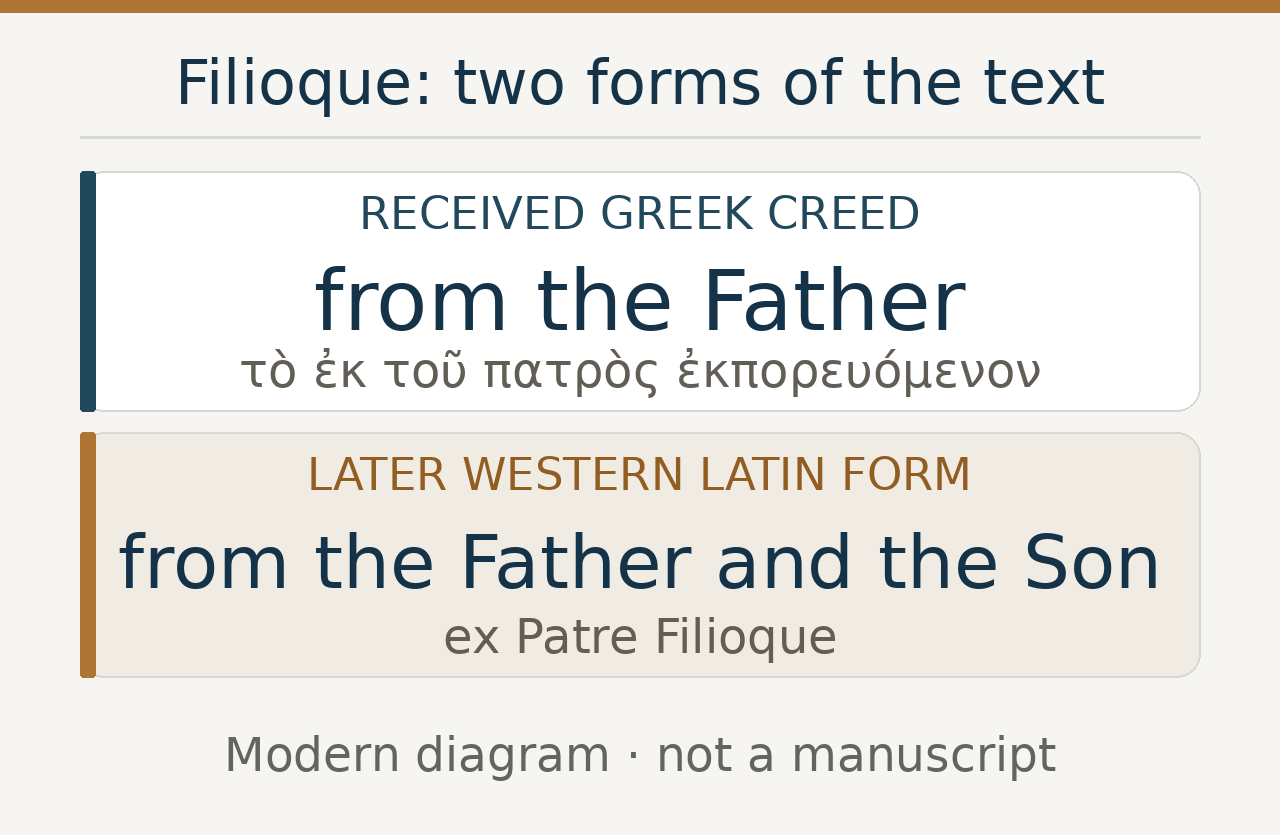
The Latin phrase qui ex Patre Filioque procedit means “who proceeds from the Father and the Son”: the conjunction -que is attached to Filio, while the preposition ex governs the coordinated expression. The Greek creed associated with the council held at ConstantinopleConstantinopleLate antique and medieval city on the historic peninsula of modern Istanbul.Glossary · Click to read the explanation in 381 has no corresponding “and the Son.” Its passage about the Spirit reads as follows in the Greek text printed by the Fourth Century Christianity project, which identifies Giuseppe Luigi Dossetti’s 1967 critical edition as its textual basis. [1][3]
That is, “who proceeds from the Father.” The same passage says that the Spirit is worshipped and glorified with the Father and the Son; shared worship does not grammatically assert procession from both. Nor should the longer Niceno-Constantinopolitan CreedThe Nicene Creed: the 325 text and the form attributed to 381Profession of faith adopted at Nicaea in 325, focused on the Son’s relation to the Father and ending with a short Spirit clause. Distinct from the longer creed associated with 381, also commonly called “Nicene Creed”.Glossary · Click to read the explanation be mistaken for the shorter creed actually adopted at Nicaea in 325. The acts of Constantinople in 381 have not survived, and its received creedal text is securely attested in the acts of Chalcedon in 451. This distinguishes the date conventionally assigned to a formula from the date of an extant documentary witness. [4]
The scriptural argument and its limits
John 15:26 speaks of the Spirit who “proceeds from the Father,” while in the same verse Jesus says he will send the Spirit from the Father. John 16:7, John 20:22 and Galatians 4:6 also connect the Spirit’s mission or designation with the Son. Western interpreters have used these passages together to explain why the Spirit can be called the Spirit of the Son; Eastern interpreters emphasize that sending the Spirit in history need not establish a second eternal cause of his existence. Neither the verb “send” nor the wording of a single verse automatically resolves the later metaphysical question of the Spirit’s origin within the TrinityTrinityChristian formulation of divine unity and Father/Son/Spirit distinction, with a history of debate.Glossary · Click to read the explanation. The distinction between an event in salvation history and an eternal relation is indispensable. [4]
Earlier theology, before the Latin interpolation
The idea expressed by the Western formula is older than its insertion into the creed. TertullianTertullianLatin Christian writer in Carthage around 200 CE. His writings span apology, doctrinal controversy, and religious practice. This entry examines his language of soul, Christ’s flesh, Word, and spirit alongside the limits of biography, textual chronology, and disputed affiliations.Glossary · Click to read the explanation, an early-third-century Latin Christian writer, described the Spirit as coming from the Father through the Son; fourth-century Hilary of Poitiers employed several related formulations. These writers did not thereby insert a new clause into the conciliar creed, which had not yet taken its later form. Eastern authors likewise sometimes spoke of the Spirit as coming or being manifested “through the Son,” but the exact relationship they intended varies by author and context. One must not equate every such formula with the later Latin definition. [6]
Augustine of HippoAugustineFourth- and fifth-century Christian author describing his changing grasp of nonspatial divine presence.Glossary · Click to read the explanation (354–430), a North African Latin theologian, provided a particularly influential account. In On the Trinity, book XV, chapter 26, section 47, he describes a procession from both Father and Son that is without temporal succession, while saying the Father is the Spirit’s source “principally.” In the nineteenth-century English translation available at Christian Classics Ethereal Library, his point appears in this brief sentence: [5]
Augustine does not propose two independent gods or two unrelated sources: for him the Son receives from the Father what is involved in the Spirit’s procession. This is an argument within his theology, not proof that the bishops of 381 adopted the Filioque. The English words quoted here are from a later translation, not a transcription of an Augustine manuscript or a newly consulted Latin critical edition.
Spain: doctrine and the uncertain date of the textual addition
Western credal use is conventionally linked to the Third Council of Toledo in 589, in the context of the Visigothic kingdom’s rejection of Arian Christianity and its affirmation of the Son’s full divinity. Yet affirming a double procession in a theological statement, singing a creed during worship, and putting Filioque into the text of that creed are three different historical claims. The older historical excursus reproduced in the Nicene and Post-Nicene Fathers treats 589 as the decisive point. [2]
A focused manuscript-based reassessment by Shawn C. Smith, published in 2014, argues instead that the earliest attested insertion in the creed belongs to the Eighth Council of Toledo in 653; the study also revisits the authenticity of a letter attributed to Isidore of Seville (d. 636). The available published abstract supports that distinction, but the complete article and its manuscript apparatus were not accessible for this review. Accordingly, 653 is reported as a scholarly argument, not presented here as an independently verified reading of every manuscript. The precise first insertion remains less certain than the broader spread of Western teaching. [7]
Maximus and the first explicit controversy
In the mid-seventh century Maximus the Confessor, a Greek-speaking theologian active in the West, responded to objections to Latin expressions about the Spirit in his Letter to Marinus. As summarized in specialist scholarship and in a later Catholic clarification, he defended a reading under which the Father alone is the ultimate cause (aitia) of the Spirit, while “through the Son” describes a distinct relation of the Spirit to the Son. This is evidence that the dispute was already one of conceptual translation and theological interpretation, before the celebrated confrontations of the ninth century. It is not evidence that Maximus approved every subsequently formulated Latin claim; the letter has been considered here through published discussion, not through direct inspection of its Greek manuscript tradition. [8]
The Franks, Rome, and Constantinople
In the late eighth and early ninth centuries the Frankish court promoted the addition as an expression of correct doctrine amid political rivalry with Byzantium. At Aachen in 809 Frankish theologians endorsed its use. Pope Leo III, who accepted the theological point as he understood it, nevertheless opposed placing the word in the received creed; around 810 he had the unaltered text displayed in Greek and Latin on silver plaques in Rome. This distinction between accepting an interpretation and authorizing a change to a conciliar text is central to the documentary history. [9]
Patriarch Photius of Constantinople condemned the addition in an encyclical of 867, arguing that an eternal origin from both Father and Son threatened the Father’s unique role as cause. The dispute unfolded amid conflicts over Bulgaria and ecclesiastical jurisdiction, not as an isolated dictionary problem. A council at Constantinople in 879–880 reaffirmed the creed without Filioque, but did not conduct an extensive systematic debate on the Latin doctrine. In 1014 the creed with the addition was sung at a papal Mass in Rome, a decisive step in its Roman liturgical reception. [10][11]
During the clashes of 1054, Western and Eastern representatives exchanged narrowly directed excommunications, and the clause was cited as an accusation. The exchanges deepened an estrangement already underway; they did not, on their own, create a single instantly completed schism between all Eastern and Western Christians. Subsequent events, including the sack of Constantinople by crusaders in 1204, changed the scope of that separation. [11]
Three terms that must not be collapsed
The dispute became sharper because Latin procedere can denote “going forth” or procession broadly, whereas Greek ἐκπόρευσις (ekporeusis) acquired a more specific technical use for the Spirit’s origin from the Father as sole hypostatic cause. Greek προϊέναι (proienai, “to come forth”) is broader, and Greek expressions such as διὰ τοῦ Υἱοῦ (“through the Son”) can have more than one theological setting. This is a distinction between customary technical usages, not a claim that every Greek writer always used each word identically. The Catholic clarification of 1995 explicitly recognized the normative Greek formula and the Father’s monarchy. [12]
Terminology explains some historical mutual misunderstanding, but not all of it. Latin theologians came to describe Father and Son as one principle of the Spirit’s eternal procession, with the Father as the ultimate source; many Orthodox theologians restrict the Spirit’s hypostatic origin to the Father alone and interpret “through the Son” in terms of eternal manifestation or the Spirit’s activity and mission, not a second source of hypostatic being. Whether a particular Latin claim can be reformulated without violating the Eastern distinction is the issue to be argued, rather than a translation equivalence one may simply assume. [13]
Two doctrinal arguments, and a question of authority
The classical Western argument links the unity of Father and Son to the Spirit’s eternal relation to both. In its developed scholastic form it insists on one spiration, not two independent acts, and sees the Father as communicating to the Son the capacity involved. The classical Orthodox objection is not merely resistance to Western vocabulary: it asks how the Father can remain the sole personal cause if the Son is also described as a cause of the Spirit’s hypostatic existence. On the Orthodox account, the Son’s indispensable role in the Spirit’s manifestation must not be confused with another hypostatic source. These are intelligible but still contested accounts of the eternal relationships; agreement that the Spirit is divine does not make them identical. [13]
A separate issue is who may alter the liturgical wording of a creed received by the whole Church. Many Orthodox critics regard inserting a word without common conciliar reception as unacceptable even if a compatible interpretation of the theology were possible. Catholic defences appeal to the legitimacy of doctrinal clarification within the Church’s authority, while also recognizing the exceptional normative standing of the Greek creed. This distinction between textual status, doctrinal interpretation and institutional authority prevents either side’s position from being reduced to “one word.” [12][13]
Medieval reunion attempts and their reception
The Second Council of Lyon in 1274 endorsed the Western position within an attempted reunion that did not secure reception among Eastern clergy and faithful. At Blachernae in 1285, the Byzantine church rejected a double hypostatic procession while allowing language of the Spirit’s eternal manifestation through the Son. These were not simply successive copies of one consensus. [14]
At Florence on 6 July 1439, the union decree Laetentur caeli stated that the Spirit proceeds eternally from the Father and the Son, and sought to identify this with “through the Son” in patristic language. The publicly readable Latin decree says: [15]
That is, “as from one principle and by one spiration.” The declaration was a genuine act of conciliar union negotiation, but it cannot be cited as a lasting settlement accepted by the Orthodox Churches: its decisions failed to gain broad Eastern reception and were formally rejected at Constantinople in 1484. The decree’s claim about what earlier fathers meant is itself part of the medieval theological argument, not an uncontested historical finding about every patristic text. [15][14]
A compact chronology
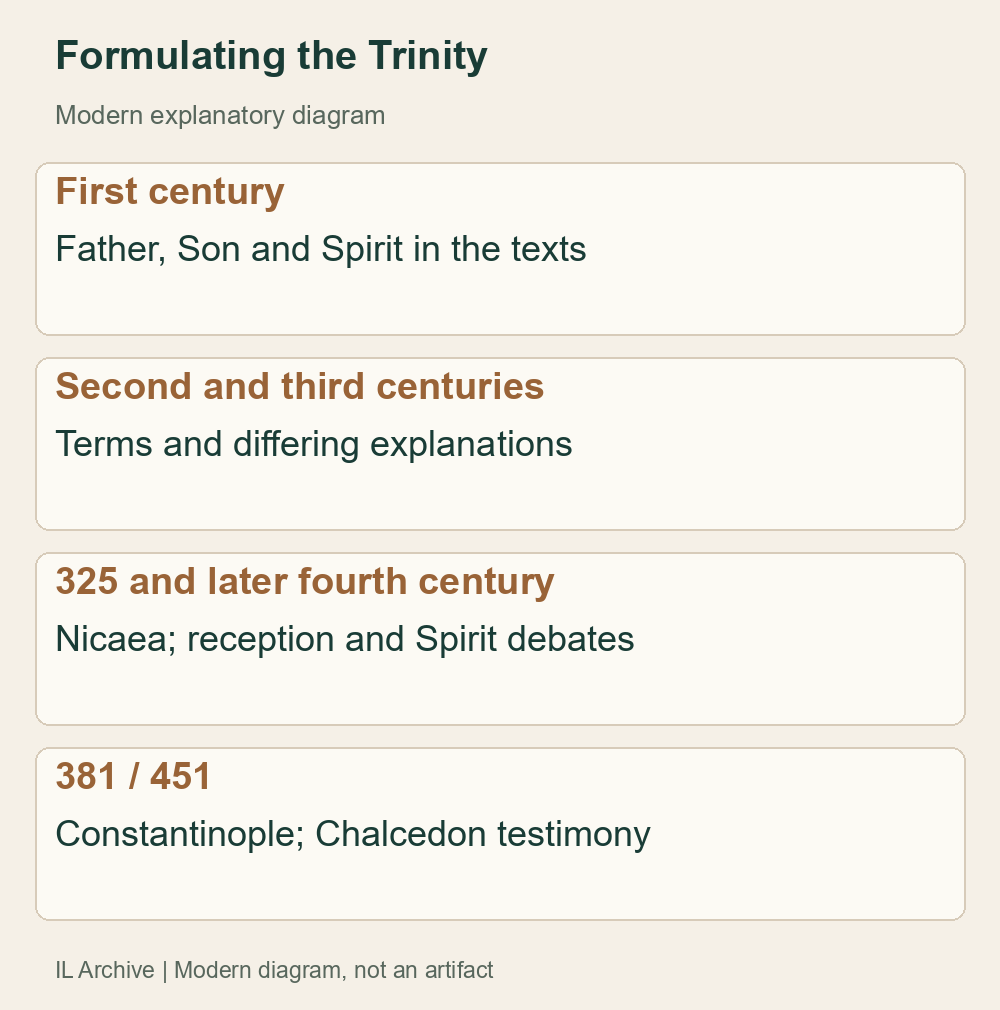
- 325 / 381 / 451: shorter creed at Nicaea; expanded creed associated with Constantinople; later documentary reception at Chalcedon. [4]
- 589–653: traditional attribution of the Western insertion to Toledo in 589, versus a manuscript-based argument for attestation in 653. [2][7]
- Mid-seventh century / 809–810: Maximus explains Latin language; Frankish endorsement and Leo III’s resistance to altering the written creed. [8][9]
- 867 / 879–880 / 1014 / 1054: Photius’s critique; conciliar reassertion of the original creed; Roman liturgical adoption; limited reciprocal excommunications. [10][11]
- 1274 / 1285 / 1439 / 1484: Lyon, Blachernae, Florence and Eastern rejection of the Florentine union. [14][15]
- 1995 / 2003: Catholic clarification of Greek–Latin terminology; a North American Orthodox–Catholic agreed study and recommendations. [12][16]
The present state of the question
In 1995 the Pontifical Council for Promoting Christian Unity acknowledged the ecumenical and irrevocable normative value of the Greek creed of 381 and sought to show how a properly understood Latin theology could honour the Father as the Trinity’s single ultimate source. In 2003 a North American consultation of Orthodox and Catholic theologians urged renewed dialogue and proposed that Catholic translations of the 381 creed for liturgical and catechetical use follow the original Greek text alone. That latter proposal was a recommendation by the consultation, not evidence that the Catholic Church had implemented a universal change. The consultation also urged that the doctrinal and ecclesiological issues be distinguished and that each tradition avoid facile accusations of heresy. [12][16]
The historically secure conclusion is limited but important: Filioque is a Western addition absent from the Greek form of the commonly received creed, and its acceptance developed at different speeds in different churches. The history of the phrase is not identical to the earlier history of ideas about the Spirit, nor to the later dispute over the authority to amend a shared confession. Differences in semantic range illuminate the controversy, but a substantive theological question remains. A responsible comparison therefore keeps original wording, local use, official reception and divergent doctrinal interpretation visible at the same time.
References and notes (16)
- Philip Schaff and Henry R. Percival (eds.), “The Creed of the 150 Fathers,” in Nicene and Post-Nicene Fathers, second series, vol. 14, CCEL. Text and editorial introduction to the received 381 creed and its attestation at Chalcedon (451); older English edition, not a Greek manuscript. Return to the text ↑
- Henry R. Percival, “Historical Excursus on the Filioque,” Nicene and Post-Nicene Fathers, second series, vol. 14, CCEL; older historical account. Historical excursus on Western insertion and conventional Toledo date; not treated as definitive manuscript criticism. Return to the text ↑
- Fourth Century Christianity, “Creed of the Council of Constantinople, 381,” Greek text and English rendering; cites G. L. Dossetti, Il Simbolo di Nicea e di Constantinopoli (Herder, 1967), pp. 243–251. Full Greek creed and webpage editorial note read; Dossetti’s printed critical edition itself was not consulted. Return to the text ↑
- North American Orthodox-Catholic Theological Consultation, The Filioque: A Church-Dividing Issue? An Agreed Statement (25 October 2003), USCCB. PDF pp. 1–4 of 19: scriptural distinctions, Nicaea 325, Constantinople 381, lost acts and Chalcedon 451. Return to the text ↑
- Augustine, De Trinitate XV.26.47, nineteenth-century English translation in Nicene and Post-Nicene Fathers, first series, vol. 3, CCEL. Chapter 26, especially §47, read in the English translation; no critical Latin text inspected. Return to the text ↑
- North American Orthodox-Catholic Theological Consultation (2003), The Filioque: A Church-Dividing Issue?, §II, Latin patristic background. PDF pp. 4–5; secondary discussion of Tertullian and Hilary, not direct readings of each Latin original. Return to the text ↑
- Shawn C. Smith, “The Insertion of the Filioque into the Nicene Creed and a Letter of Isidore of Seville,” Journal of Early Christian Studies 22.2 (2014), 261–286, doi:10.1353/earl.2014.0026. Abstract only (ResearchGate, cross-checked with EBSCO abstract); full study and manuscript evidence NOT accessed; 653 reported as author’s argument. Return to the text ↑
- Edward A. Siecienski, The Filioque: History of a Doctrinal Controversy (Oxford University Press, 2010), ch. 4, “Maximus the Confessor,” pp. 73–86, doi:10.1093/acprof:oso/9780195372045.003.0004. Publisher abstract only; chapter pp. 73–86 and original Greek of Maximus’s Letter to Marinus NOT accessed; cross-checked with 1995/2003 documents. Return to the text ↑
- North American Orthodox-Catholic Consultation (2003), The Filioque: A Church-Dividing Issue?, §II, Franks and Leo III. PDF pp. 5–7: Carolingian controversy, Aachen 809, Leo III’s position and Greek–Latin silver plaques. Return to the text ↑
- North American Orthodox-Catholic Consultation (2003), The Filioque: A Church-Dividing Issue?, Photius and Constantinople 879–880. PDF pp. 7–8: encyclical of 867, Bulgaria, reaffirmation of the creed in 879–880. Return to the text ↑
- North American Orthodox-Catholic Consultation (2003), The Filioque: A Church-Dividing Issue?, reception in Rome and 1054. PDF pp. 8–9: papal liturgical use in 1014, limited 1054 excommunications and the effects of 1204. Return to the text ↑
- Pontifical Council for Promoting Christian Unity, “The Greek and Latin Traditions Regarding the Procession of the Holy Spirit” (1995), complete English statement reproduced by EWTN. Full English reproduction read, especially Greek creed, technical terminology and Maximus; not a critical edition of patristic Greek texts. Return to the text ↑
- North American Orthodox-Catholic Consultation (2003), The Filioque: A Church-Dividing Issue?, §III, “The Substantive Issues.” PDF pp. 14–17: one principle, hypostatic origin, manifestation, conciliar and papal authority. Return to the text ↑
- North American Orthodox-Catholic Consultation (2003), The Filioque: A Church-Dividing Issue?, Lyon II, Blachernae, Florence and reception. PDF pp. 9–10 and 15–16: Lyon 1274, manifestation through the Son in 1285, Florentine reception and 1484 rejection. Return to the text ↑
- Pope Eugenius IV and Council of Florence, union decree Laetentur caeli, 6 July 1439, session VI; Latin document on the Holy See website. Decree’s passage on the Spirit, notably “tanquam ab uno principio et unica spiratione” and “ex Patre per Filium”; published Latin text, not a particular manuscript. Return to the text ↑
- North American Orthodox-Catholic Theological Consultation, The Filioque: A Church-Dividing Issue? An Agreed Statement (2003), §IV, Recommendations. PDF pp. 18–19: proposals for translations of the Greek creed, dialogue and distinctions of authority; recommendations, not binding policy. Return to the text ↑
Suggest a correction · Suggest a source for this record
Cite this record
IL Archive, «Filioque», https://ilarchive.com/en/entities/filioque
Continue reading