Entity · Theological position
Modalism
A reference page linking a name, group, or concept to the materials that discuss it.
Modalism is a later label for early Christian disputes over divine unity and the Father, Son, and Spirit; this entry examines hostile sources and the limits of grouping Noetus, Praxeas, and Sabellius.
Estimated reading time: 6 min Published Last reviewed:
Share article
Text
Introduction
Modalism is a later analytical label applied to Christian accounts of God's unity that, in the judgment of their opponents, insufficiently distinguished the Father, Son, and Holy SpiritHoly SpiritName present in Christian texts and worship, whose relation to Father and Son was defined in Trinitarian formulations.Glossary · Click to read the explanation in the sense developed by later TrinitarianTrinityChristian formulation of divine unity and Father/Son/Spirit distinction, with a history of debate.Glossary · Click to read the explanation formulations. It does not name a single ancient school documented in its own writings: much of what we hear about Noetus, Praxeas, and Sabellius comes from critics. The historical question is not who was right, but how different authors reconciled belief in one God with their claims about Christ and the Spirit, and how much the surviving evidence actually establishes. [2]
A label with several boundaries
In much modern usage, “modalism” describes accounts in which Father, Son, and Spirit are aspects or modes of manifestation of a single divine subject. Adjacent labels are “Sabellianism,” named after SabelliusSabelliusChristian teacher associated with debates on unity and distinction in the early third century.Glossary · Click to read the explanation, and “patripassianism” (the claim that the Father suffered), frequently used as a critical characterization. These names belong to different stages of controversy. Their presence does not establish that their targets adopted them as self-descriptions or believed in a simple sequence of three theatrical “masks.” [2]
“Monarchianism,” by contrast, refers more broadly to the divine monarchy or sole sovereignty. Historians may also place under that umbrella adoptionist or so-called dynamic accounts that explain Jesus' status without identifying him with the Father. Accordingly, monarchianism and modalism are not synonyms. Nor did early Latin persona, Greek prosōpon, or hypostasisHypostasisHypostasis is a Greek term with changing meanings. In later Trinitarian theology it distinguishes Father, Son and Spirit within one divine essence; earlier Greek, biblical and Syriac usages require separate contextual reading.Glossary · Click to read the explanation necessarily mean exactly what these words came to mean in later confessional formulas. The mask analogy conveys one possible criticism; it is not an adequate historical description of every position. [1][2]
The ancient witnesses and their speakers
The work Against Noetus, traditionally ascribed to Hippolytus of Rome but disputed in authorship, attributes the following statement to Noetus of Smyrna. The Greek is from a digital transcription of the text printed in Patrologia Graeca; it has not been newly collated against a manuscript. Crucially, it is an opponent's report, not an independently preserved writing by Noetus. [3]
The author connects that alleged identity with Christ's birth, suffering, and death and then supplies passages of scripture cited by his opponents to uphold the oneness of God. The dispute, on this telling, was not a denial of Christ's divinity, but whether affirming that divinity entailed identifying Christ with the Father. Yet no separate defence by Noetus survives against which to check the report; even the narrative of his examination and expulsion is part of the adversarial account. [3]
In North Africa, TertullianTertullianLatin Christian writer in Carthage around 200 CE. His writings span apology, doctrinal controversy, and religious practice. This entry examines his language of soul, Christ’s flesh, Word, and spirit alongside the limits of biography, textual chronology, and disputed affiliations.Glossary · Click to read the explanation composed his Latin Against Praxeas, probably in the early third century. He addresses an adversary called Praxeas, whose precise identity and representative status remain uncertain. Tertullian represents his opponents as fearing that a distinction between Father, Son, and Spirit introduces multiple gods; he reports their response in these words: [1]
Here monarchia is an argument: those whom Tertullian describes fear dividing the one God. Tertullian answers with the divine “economy” (oikonomia) and a distinction within unity of substance, using a vocabulary not automatically identical to later conciliar definitions. The presence of the Latin sentence in Tertullian's work does not turn his attribution to the opposing party into a written declaration surviving from that party. [1]
Book IX of the Refutation of All Heresies describes a line of teaching from Noetus through Epigonus and Cleomenes to Rome, as well as tensions between Sabellius and the Roman bishop Callistus. It attributes to Callistus both claims about the Father's and Son's unity and a distinction between the suffering Son and the Father. This complicates any attempt to make every figure an exponent of the same rigid formula. The account is openly hostile and attacks its opponents' characters; those attacks are not independent evidence of either their doctrines or the politics behind the dispute. [4]
A chronology of different kinds of evidence
- Late second to early third century: The reported activity of Noetus and Praxeas and the Roman conflicts belong approximately here; the sources do not yield one secure founding date for a comprehensive “modalist movement.” [1][3][4]
- Roughly the first third of the third century: Latin and Greek responses were written, including Against Praxeas, Against Noetus, and portions of the Refutation. Dating and authorship remain partly disputed and should not be flattened into a single school history. [1][3][4]
- Mid-third century: In On the Trinity, the Roman author Novatian defended the distinction between Father and Son while retaining one God. His treatment shows that biblical language about sender and sent, not merely labels, was at issue. [5]
- 341 CE and later: Antiochene formulas transmitted by Athanasius in On the Synods reject the identification of Father, Son, and Spirit and use names such as “Sabellians” and “patripassians.” They witness later use of the labels, not a verbatim record of Sabellius' teaching. The First Council of NicaeaFirst Council of NicaeaChristian council convened by Constantine in 325 at Nicaea; issued a creed on Father and Son and addressed church affairs, with disputes continuing over its reception.Glossary · Click to read the explanation in 325 CE neither initiated these questions nor single-handedly ended the controversy. [6]
- Manuscripts and editions: Surviving transmission of Against Praxeas involves later codices, including fifteenth-century witnesses, and a 1521 printed edition drawing on a subsequently lost manuscript. The Latin consulted here is an edition by Ernest Evans (1948), not a personal collation of the manuscripts. A copyist's or printer's date is not the date of composition. [8]
Competing readings and their evidential weight
The early polemical texts make it plausible that identification of Father and Christ was a real issue in particular disputes, and that their critics sought a distinction without positing two gods. Both the reported Noetus formula and Tertullian's response point that way. But this is a conclusion about the central issue, not a licence to ascribe one sequential set of three appearances to Noetus, Sabellius, Praxeas, and Callistus alike. Some formulas reach us as hostile paraphrases, some through Roman ecclesiastical rivalries, and others through much later categorizations. [1][3][4]
In a peer-reviewed study published in a 2024 journal volume, Xavier Morales argues that projecting the modern idea of “modes of manifestation” onto Noetus, Sabellius, and Praxeas distorts their surviving views. He prefers “theology of identification” for these figures and locates a kind of “functional modalism” in some of their opponents' LogosLogosGreek term for speech, explanation or reason, also used for cosmic rationality. Philo uses it in accounts of creation, while John’s prologue speaks of the Word becoming flesh; its function varies with context.Glossary · Click to read the explanation (“Word”) theology. His argument matters because it asks which authors actually employ concepts of manifestation. It remains a particular scholarly interpretation, not a settled consensus invalidating every earlier historical category. [7]
“Modalism” can thus be retained as a recognizable index heading if its scope is stated: it names a history of disagreements about the TrinityTrinityChristian formulation of divine unity and Father/Son/Spirit distinction, with a history of debate.Glossary · Click to read the explanation and divine unity, not an attested self-description common to all third-century thinkers. Another modern study traces how monarchian disputes affected OrigenOrigenChristian exegete and theologian from Alexandria (c. 185–253), known for biblical textual comparison, commentaries and On First Principles. His works survive in Greek and through later translations and quotations.Glossary · Click to read the explanation's Trinitarian vocabulary, but only the publisher's abstract, not the book chapters, was available for the present revision; it cannot support detailed reconstructions of any individual ancient teacher. [9]
Assessment and limits
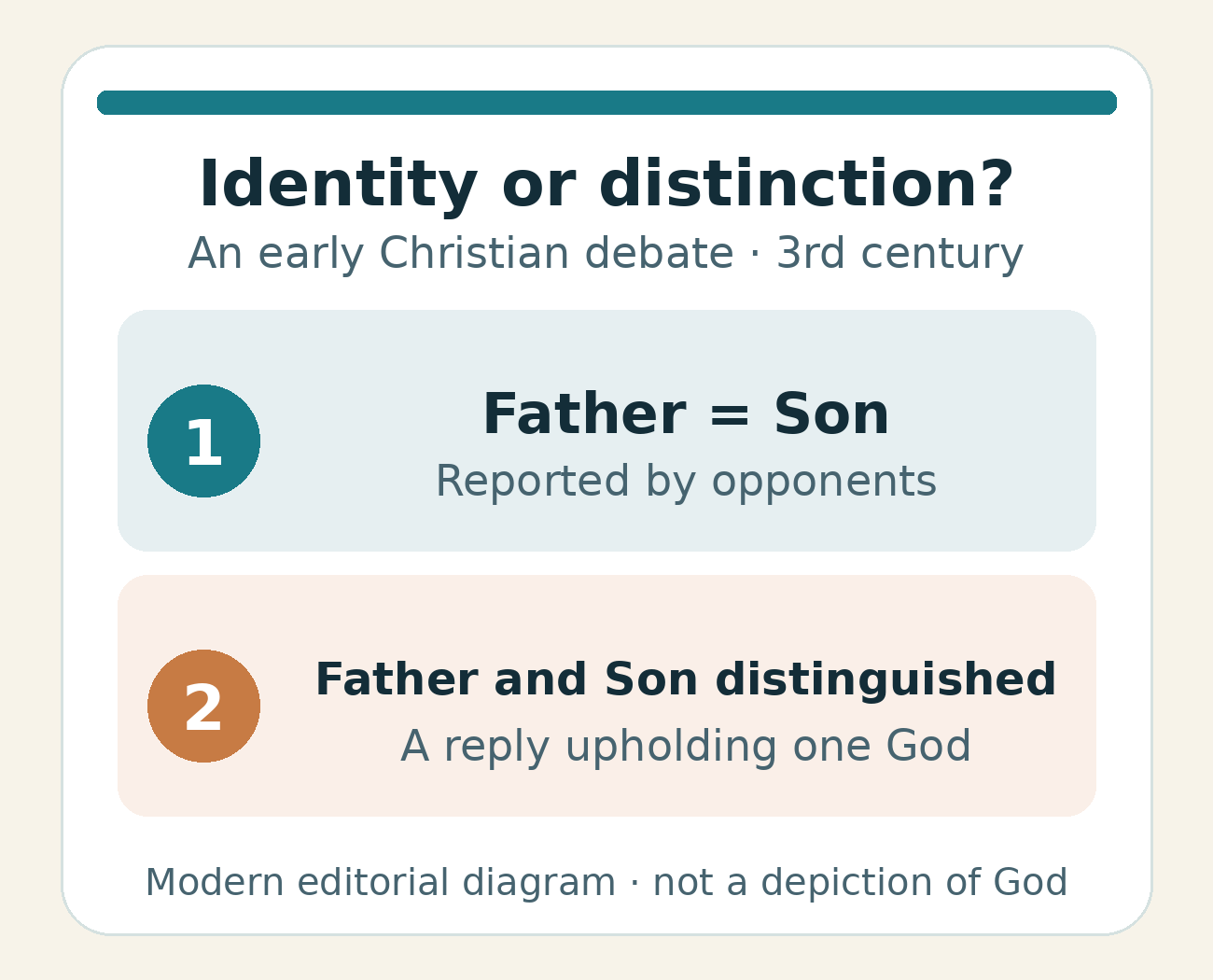
The best-supported account distinguishes what adversaries report about the identity of Father and Son, the scriptural and conceptual answers their critics devised, and the retrospective taxonomies that later grouped those exchanges as “Sabellianism” or “modalism.” We can reconstruct the questions and the disagreements with reasonable confidence. Without independently surviving works of Noetus or Sabellius, we cannot recover a complete and uniform system or their precise intentions. The accompanying image is a modern editorial comparison of two ways of framing the question, not an image of God or an ancient document.
References and notes (9)
- Tertullian, Adversus Praxean, Latin text edited by Ernest Evans (1948), with CCSL (1954) section numbering. Chapters 2–3 and 9; the Latin quotation is at 3.2; adversarial claims are reported by Tertullian. Return to the text ↑
- Dale Tuggy, “Trinity,” Stanford Encyclopedia of Philosophy (revised 2025); Xavier Morales, “The Functional Modalism of the Logoschristologie” (2024). Tuggy §1.3; Morales abstract and introduction; later classifications versus ancient usage. Return to the text ↑
- Against Noetus, traditionally attributed to Hippolytus; PG 10 Greek digitized by Sophia Scriptura (with logged OCR corrections), checked against the old ANF English translation. §§1–3; Greek quotation in §1, PG 10:804a–805a; no manuscript collation; authorship disputed. Return to the text ↑
- Refutation of All Heresies, Book IX, old English Ante-Nicene Fathers translation; traditional attribution to Hippolytus remains debated. Chapters 2 and 6–7; hostile accounts of Noetus, Cleomenes, Sabellius, and Callistus. Return to the text ↑
- Novatian, De Trinitate (On the Trinity), old English Ante-Nicene Fathers translation. Chapters 28 and 30; distinction between Father and Son with monotheism; read in translation, not in Latin. Return to the text ↑
- Athanasius, De Synodis (On the Synods), Antiochene formulary of 341 and later texts in the published English translation. §§23–26, especially §24 and §26, item (6), on later labels “Sabellians” and “patripassians.” Return to the text ↑
- Xavier Morales, “The Functional Modalism of the Logoschristologie,” Teología y Vida 65/4 (2024), doi:10.7764/tyv.654.e1 (online 2025). Full online article accessible; read abstract, introduction, substantial portions of §§2–4, conclusion, and relevant notes on Noetus and the modalist label. Return to the text ↑
- The Tertullian Project, “Adversus Praxean,” manuscript and edition overview, including Evans 1948 and the 1521 edition. “Manuscripts” and “Editions” sections; bibliographical listing only, no direct examination of codices. Return to the text ↑
- Stephen E. Waers, Monarchianism and Origen’s Early Trinitarian Theology, Brill (2022); publisher’s abstract only, no chapters read. Publisher description/abstract only; not used as evidence for textual or chronological details. Return to the text ↑
Suggest a correction · Suggest a source for this record
Cite this record
IL Archive, «Modalism», https://ilarchive.com/en/entities/modalism
Continue reading