Entity · Theological term
Logos
A reference page linking a name, group, or concept to the materials that discuss it.
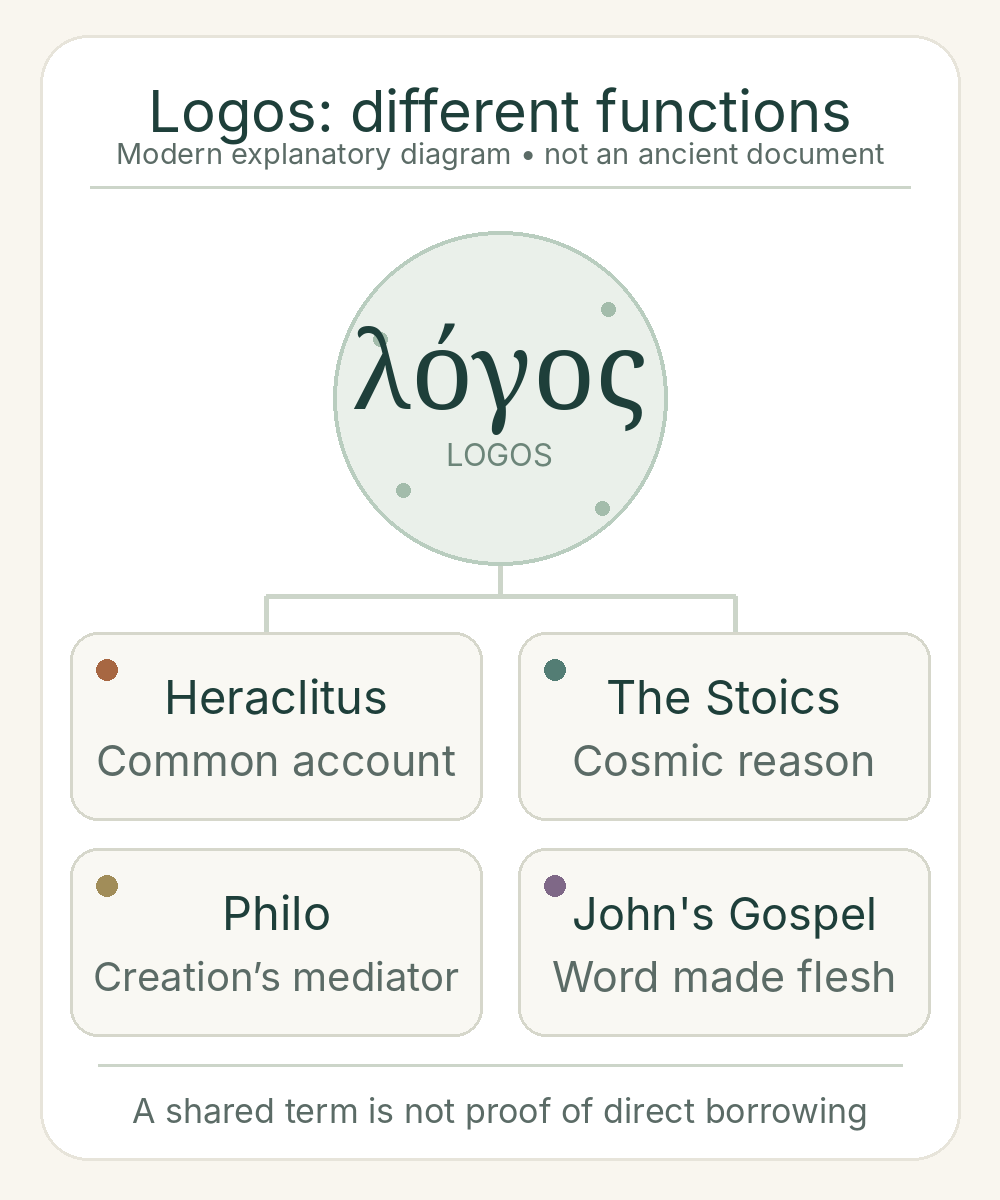
A Greek term ranging from speech and reason to cosmic rationality, creation’s mediation and the Word in John. This entry compares texts without treating shared vocabulary as proof of borrowing.
Estimated reading time: 9 min Published Last reviewed:
Share article
Text
Introduction
Logos (λόγος) is a Greek word that can mean speech, an account, an explanation or reason, depending on context. It does not name a single doctrine that remained unchanged from Greek philosophy to Christianity. Comparing its uses shows how different writers employed the same vocabulary to ask different questions: How can the world's order be understood? How does God act in creation? How does a Christian text describe Jesus' relation to God?
The question becomes particularly important in the opening of the Gospel of JohnGospel of JohnOne of the New Testament Gospels, opening with the Word, creation and the Word becoming flesh.Glossary · Click to read the explanation, where the Word was with God and then “became flesh.” [1] This entry reads that formulation alongside earlier, contemporary and later evidence, distinguishing lexical resemblance from demonstrable historical transmission.
Word, account and argument: the word's range
The noun λόγος belongs to the family of the Greek verb λέγω. The lexicon records senses including speech, narrative, statement, reckoning, explanation and rational relation. “Word” is therefore not an automatic translation in every passage, any more than “reason” is. In PlatoPlatoPlato (approximately 427–347 BCE) was a Greek philosopher who explored goodness, justice and cosmic order through philosophical dialogues.Glossary · Click to read the explanation, the dialogue Theaetetus examines the proposal that knowledge is true belief accompanied by a logos: the speakers variously explore a verbal statement, an enumeration of elements and a distinguishing feature. The inquiry ends without a settled definition. [2] [3]
In the Rhetoric, AristotleAristotleAristotle (384–322 BCE) was a Greek philosopher who studied nature, life and thought. His writings influenced later religious philosophies.Glossary · Click to read the explanation discusses persuasion arising from the argument presented in speech, alongside the speaker's character and the hearer's state of mind. This is a logical and rhetorical use, not the name of a divine being. These different functions warn against treating every occurrence of the term as theological. [4]
Heraclitus and the Stoics: what kind of cosmic reason?
Heraclitus of Ephesus, a Greek thinker active around 500 BCE in the city of Ephesus, employed logos in fragments transmitted by writers who lived centuries after him. A passage preserved as fragment DK 22 B2 reads:
The phrase belongs to a criticism of people who live as though each possessed a wholly private understanding. Fragments B1 and B50 likewise speak of an account that can be heard and understood, and of order that many fail to grasp. Yet calling this a “cosmic law” in a later philosophical sense is not the only interpretation. Mark Johnstone emphasizes the word's link to how the world discloses itself in experience rather than to a self-standing cosmic entity. That is a scholarly proposal, not the fragment's explicit wording. Our witness is an edited text assembled from ancient quotations, not a surviving page of Heraclitus' own book. [5] [6]
StoicismStoicismPhilosophical school founded in Athens around 300 BCE, combining logic, physics and ethics.Glossary · Click to read the explanation, a school originating in Athens around 300 BCE, associates logos or reason with the active principle that orders cosmic matter from within; its thinkers also describe this principle as designing fire or pneuma (“breath” or “spirit”). Later reports portray a divine reason present throughout nature and seminal principles through which things develop. Here logos is an immanent cosmic principle, not a “Word who became a human being.” Reconstructing the founders' exact doctrines calls for caution, since much of their teaching survives through later transmitters such as Diogenes Laertius. [7]
Greek Jewish writings: creative command and wisdom
The Greek Book of GenesisBook of GenesisHebrew book of the Torah containing Noah’s flood, survival offering and covenant with living creatures.Glossary · Click to read the explanation opens with “in the beginning,” and its creation narrative proceeds through God's spoken commands. In the Greek translation of Psalm 32:6, corresponding to Psalm 33:6 in common HebrewHebrewA Northwest Semitic language of the Canaanite group, encompassing Iron Age epigraphy, Biblical, Rabbinic, medieval and Modern Hebrew; its scripts and pronunciations changed over time.Glossary · Click to read the explanation numbering, the noun λόγος explicitly appears:
The psalm is a hymn about the power of God's command, not an explicit definition of a separate person. The Wisdom of Solomon, a Greek Jewish work generally placed in the later Hellenistic period, places creation “by your word” beside the forming of humanity “by your wisdom” in 9:1–2; in 18:15 it portrays “your all-powerful word” as a warrior descending from heaven during the Exodus narrative. This is literary personification serving a narrative purpose, with important conceptual affinities, but personification alone does not establish a distinct hypostasis. Wisdom also speaks in the first person in ProverbsBook of ProverbsThe Book of Proverbs collects wisdom texts in the Hebrew Bible on learning, conduct and social relationships.Glossary · Click to read the explanation 8, where her name is not λόγος. [8] [9] [10]
Philo of Alexandria: the Logos and the pattern of creation
Philo of AlexandriaPhilo of AlexandriaGreek-writing Jewish interpreter in Roman Alexandria (roughly first century CE), who read the Torah philosophically while defending its practices; his works survive through Greek copying and Armenian translation.Glossary · Click to read the explanation was a Jewish thinker active in Roman-period Alexandria, roughly from 20 BCE to the middle of the first century CE. He interpreted the Greek Torah in conversation with Greek philosophy. In On the Creation (De opificio mundi) §§24–25, he describes the intelligible world as a pattern for the perceptible cosmos and connects that pattern to God's Logos, using the analogy of an architect who has the plan of a city in mind before building it. [11]
In On the Confusion of Tongues (De confusione linguarum) §146, he uses the phrase:
The passage goes on to call this Logos the eldest of the angels and an archangel of many names, relating its titles to the divine image and scriptural exegesis. Such mediation within Greek-speaking Judaism makes comparison with John significant. It does not turn Philo into a Christian before Christianity, nor demonstrate that the evangelist directly borrowed from him. Philo's Logos functions within an account of creation and mediation; Philo does not say that this Logos became Jesus of Nazareth. The Greek cited here comes from an edited digital text, not a direct transcription of any particular manuscript. [12]
John: from the Word in the beginning to the Word made flesh
The Gospel's prologue (John 1:1–18) provides the most sustained early Christian treatment of the title. These are brief excerpts from a modern edited Greek text, not transcriptions of lines visible on a particular papyrus:
The prologue attributes existence “in the beginning,” a role in the coming-to-be of all things, and life and light for humanity to the Word; it then relates this Word to Jesus' story in the Gospel. “In the beginning” evokes Genesis, while creation and light connect this passage to Jewish traditions of word and wisdom. In “θεὸς ἦν ὁ λόγος”, theos is a predicate preceding the grammatically identified subject, ho logos. The force and translation of this construction have been debated; the presence or absence of an article cannot by itself supply an entire later doctrinal system. [1]
What most sharply distinguishes John from a philosophical fragment, a psalm and Philo is the statement about becoming flesh and the narrative's direction toward Jesus. Stoicism can illuminate language about reason and life, and Philo offers a nearby Greek Jewish way to speak about mediation in creation, but the functions are not interchangeable: Stoic reason permeates nature, Philo interprets the realm of patterns and Scripture, and John declares that the Word became flesh. [13]
Nor is every New Testament occurrence of λόγος a title for Christ. First John 1:1 speaks of the “word of life” within testimony about hearing and seeing, while Revelation 19:13 calls the rider “the Word of God” in a scene of judgment. These expressions share vocabulary but play distinct roles, unlike the creative and incarnational movement of John 1. [14] [15]
Christian reception: an interpretation that developed
In the middle of the second century CE, Justin Martyr, in First Apology 46, links Christ to a Logos in which human beings have participated. He includes Socrates and Heraclitus in his case for people who lived according to reason before Christ's coming. This is evidence of a later Christian reading of philosophers, not a statement by Heraclitus about Justin's theology. [16]
Later in the second century, Theophilus of AntiochTheophilus of AntiochBishop of Antioch and Greek Christian author of the late second century CE.Glossary · Click to read the explanation, in To Autolycus 2.10 and 2.22, distinguishes the Word within God from the Word brought forth in his account of creation and revelation. In 325 CE the creed of the First Council of NicaeaFirst Council of NicaeaChristian council convened by Constantine in 325 at Nicaea; issued a creed on Father and Son and addressed church affairs, with disputes continuing over its reception.Glossary · Click to read the explanation would use “of one substance with the Father” (homoousios) in a further dispute about the Son. That is subsequent doctrinal vocabulary and reception history: it must not be read back unchanged into Heraclitus, Philo or John's opening verses. [17] [18]
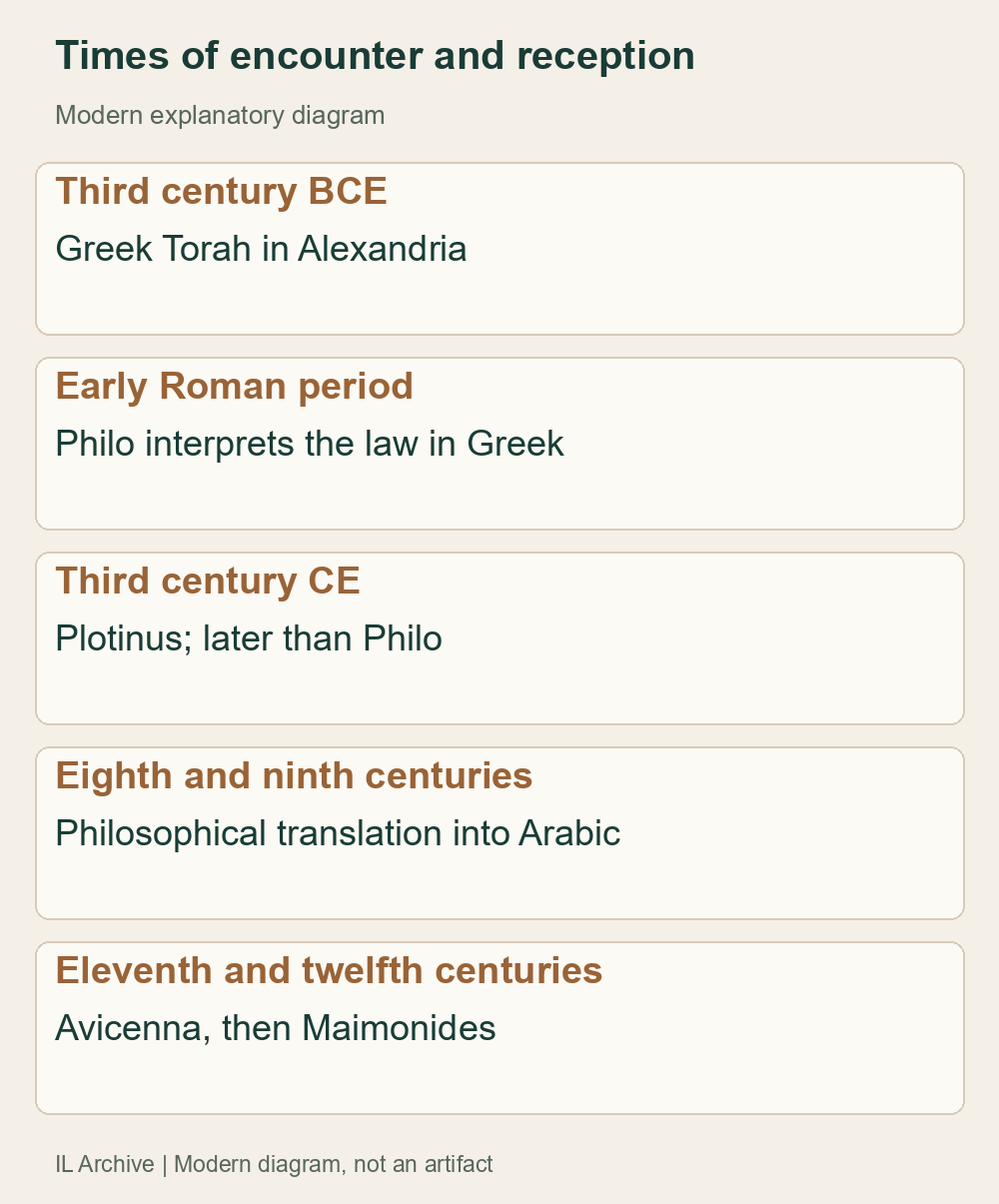
Brief chronology: composition is not manuscript date
- Around 500 BCE: Heraclitus is active; his fragments survive through later quotations, including Sextus Empiricus' testimony for B2.
- Fourth century BCE: Plato and Aristotle discuss account, explanation and argument in different philosophical settings.
- From around 300 BCE: the Stoic school emerges, with its account of cosmic reason developing across generations.
- Later centuries BCE: Jewish writings are composed and translated into Greek over differing periods; the SeptuagintSeptuagintA name for the varied ancient Greek translations and writings associated with Jewish scripture; beginning with the Torah, the texts differ across books and manuscripts.Glossary · Click to read the explanation is not a single book written on one date.
- First century CE: Philo writes; the Gospel of John follows. Many scholars place the Gospel's final form near the end of this century, although earlier dating and editorial layers are proposed.
- Second century CE: Justin and Theophilus develop Christian interpretations of Logos.
- Second–third centuries CE: Bodmer Papyrus II (P66) is an early Greek copy of John that includes its opening. Its approximate date dates the copying, not directly the Gospel's composition; the Greek quotations above follow a modern critical edition rather than a photograph of this papyrus. [19]
- 325 CE: the Nicene Creed marks a later stage of doctrinal formulation.
What does the comparison support?
The clearest directly observable connections in John's opening are the overlapping language of “in the beginning,” creation, word and light in earlier Jewish texts, within a Greek-speaking setting in which philosophical discussions also circulated. Philo offers a close model for using logos in interpreting creation; Stoicism supplies another model of cosmic reason. Troels Engberg-Pedersen has proposed emphasizing the link between Stoic logos and pneuma, while Gitte Buch-Hansen shows that readings of John through Jewish Wisdom, Platonism and Stoicism depend on distinct, sometimes conflicting interpretive assumptions. Both arguments are represented here on the basis of publishers' abstracts only, not a full reading of either chapter. [20] [21]
This entry therefore gives priority to the prologue's place within John's Gospel and its Jewish scriptural intertexts, then examines convergences with Greek philosophy and Philo as genuine comparative contexts. The evidence examined does not attest a direct quotation from Heraclitus or Philo by the evangelist, but that lack of attestation does not rule out influence in a shared culture. Distinguishing shared vocabulary, borrowing a particular text and reworking an idea remains essential to the history of Logos.
References and notes (21)
- Gospel of John, Greek text in the SBL Greek New Testament, ed. Michael W. Holmes (2010). Chapter 1, verses 1–18, especially 1:1–5 and 1:14; quoted from an edited Greek text, not an individual papyrus. Return to the text ↑
- Liddell, Scott and Jones, A Greek–English Lexicon (LSJ), s.v. λόγος, Scaife/Perseus digital edition. Lexical entry for λόγος and its principal senses; only this entry was consulted. Return to the text ↑
- “Plato on Knowledge in the Theaetetus,” Stanford Encyclopedia of Philosophy. Discussion of true judgment with logos, Theaetetus 201c–210a; consulted this scholarly overview, not a complete Greek edition of the dialogue. Return to the text ↑
- Aristotle, Rhetoric 1.2, Greek text edited by W. D. Ross, Perseus. Bekker 1356a, on speech-based persuasion, character and audience; consulted the displayed Greek passage. Return to the text ↑
- Heraclitus, Fragmenta, ed. Hermann Diels (Berlin, 1922), Greek text in Perseus; preserved through Sextus Empiricus. Fragment DK 22 B2, quoted in Sextus Empiricus, Against the Mathematicians VII.133; inspected the Greek quotation and its citation; angle brackets in the wider text mark editorial supplementation. Return to the text ↑
- Mark A. Johnstone, “On ‘Logos’ in Heraclitus,” Oxford Studies in Ancient Philosophy 47 (2014), pp. 1–30. Publisher abstract only, setting out the “world presenting itself” reading of B1, B2 and B50, not the full chapter; relevant parts of the Stanford Encyclopedia of Philosophy entry on Heraclitus were also consulted. Return to the text ↑
- “Stoicism,” Stanford Encyclopedia of Philosophy, with Diogenes Laertius on the school. Relevant sections on physics, the active principle, pneuma and seminal reasons; compared with Diogenes Laertius VII.134–136 in an accessible English version; not a quotation from a surviving Stoic original. Return to the text ↑
- Psalms in the Greek Septuagint, ed. Rahlfs, revised by Hanhart (2006), German Bible Society. LXX Psalm 32:4–9, especially 32:6 (= Hebrew 33:6); consulted the displayed Greek edition, not a manuscript image. Return to the text ↑
- Wisdom of Solomon, Greek Septuagint, Rahlfs–Hanhart text displayed by the German Bible Society. Chapter 9:1–2, ἐν λόγῳ σου and τῇ σοφίᾳ σου; inspected the Greek verses. Return to the text ↑
- Wisdom of Solomon, Greek Septuagint, Rahlfs–Hanhart, German Bible Society. Chapter 18:14–16, especially 18:15, ὁ παντοδύναμός σου λόγος; read the Greek verses in the Exodus setting. Return to the text ↑
- Philo of Alexandria, De opificio mundi (On the Creation), digital Greek text in Gadsden Classics. §§24–25 on the intelligible pattern and the architect/city analogy, read in the surrounding display of §§1–38; no individual manuscript attribution. Return to the text ↑
- Philo of Alexandria, De confusione linguarum (On the Confusion of Tongues), §§146–147; Cohn–Wendland printed Greek as displayed by The Covenant Rendering. Greek §§146–147 consulted, especially τὸν πρωτόγονον αὐτοῦ λόγον; our interpretation does not depend on the host site’s polemical commentary; no Greek manuscript consulted. Return to the text ↑
- John Ashton, “The Transformation of Wisdom: A Study of the Prologue of John’s Gospel,” New Testament Studies (1986), Cambridge University Press. Publisher abstract and public preview only, not the full article; the detailed comparison is also grounded in the examined Philo, Septuagint and John passages. Return to the text ↑
- First Epistle of John 1:1, SBL Greek text as displayed by CNBible. Verse 1:1, περὶ τοῦ λόγου τῆς ζωῆς, in the context of hearing and seeing; opening context inspected. Return to the text ↑
- Revelation 19:13, Greek text as displayed by BibleGateway. Verse 19:13 in the rider vision, ὁ λόγος τοῦ θεοῦ; inspected the designation and context. Return to the text ↑
- Justin Martyr, First Apology, chapter 46, an older English translation at New Advent. Read chapter 46 on the Logos, Socrates and Heraclitus; a translation was consulted, not the original Greek. Return to the text ↑
- Theophilus of Antioch, To Autolycus, book II, chapters 10 and 22, older English translation at New Advent. Read II.10 and II.22 on God’s Word and creation; English translation only, not a critical Greek edition. Return to the text ↑
- Creed of the Council of Nicaea (325), displayed translation and textual comparison at New Advent. The 325 creed’s phrases on the Father’s substance and being of one substance; the creed passage was read, not all conciliar proceedings. Return to the text ↑
- Center for the Study of New Testament Manuscripts (CSNTM), GA P66 / Papyrus Bodmer II catalogue entry. Inspected the institutional catalogue for identification, approximate date and Johannine contents; its image was neither the source of the quoted Greek nor used as the cover. Return to the text ↑
- Troels Engberg-Pedersen, “The Unity of Logos and Pneuma in John 1,” in John and Philosophy (Oxford University Press, 2017), pp. 36–73. Publisher abstract only, not the full chapter; outlines a Stoic logos/pneuma reading of John 1:1–34. Return to the text ↑
- Gitte Buch-Hansen, “The Johannine Literature in a Greek Context,” in The Oxford Handbook of Johannine Studies (Oxford University Press, 2018), pp. 138–154. Publisher abstract only, not the entire chapter; maps differing scholarly uses of Jewish Wisdom, Middle Platonism and Stoicism. Return to the text ↑
Suggest a correction · Suggest a source for this record
Cite this record
IL Archive, «Logos», https://ilarchive.com/en/entities/logos
Continue reading