Entity · Interpretive method
Allegorical exegesis
A reference page linking a name, group, or concept to the materials that discuss it.
A method of reading characters and events for further meanings, examined through Greek philosophy, Philo, Paul, Origen, and Maimonides, with distinctions between original texts, interpretations, and literal practice.
Estimated reading time: 10 min Published Last reviewed:
Share article
Text
Introduction
Allegorical exegesis is a way of reading an existing text in which a character, event, or image is understood—alongside its apparent meaning, or in place of it in a particular passage—to signify another moral, philosophical, or religious idea. The mere presence of metaphor does not make every interpretation allegorical. The central question is how an interpreter moves from the text's wording to a further meaning, and what evidence supports that move.
The examples below have different purposes: philosophical readings of Greek myth, Philo's interpretation of the Torah, Paul's argument, OrigenOrigenChristian exegete and theologian from Alexandria (c. 185–253), known for biblical textual comparison, commentaries and On First Principles. His works survive in Greek and through later translations and quotations.Glossary · Click to read the explanation's Christian exegesis, and MaimonidesMoses MaimonidesJewish jurist, philosopher, and physician (c. 1138–1204). Wrote the Commentary on the Mishnah and Guide in Judeo-Arabic, and the Mishneh Torah in Hebrew; practiced in Egypt.Glossary · Click to read the explanation' analysis of biblical language. They are documented cases, not compulsory stages in a single history or judgments on the truth of the beliefs that motivated their interpreters.
What the term covers—and what it does not
Here “allegorical exegesis” describes the interpretation of a pre-existing text, not a literary composition originally written to encode a set of meanings. Scholars sometimes distinguish “compositional allegory” from “interpretative allegory” or allegoresis. That modern distinction is a useful aid, not a fixed vocabulary shared by all ancient writers: even the Greek hyponoia, associated with underlying meaning, and allēgoria, speaking otherwise, were not invariably synonymous. [9][10]
Interpreters generally propose a relation between a narrative feature and something else: a journey becomes the soul's progress; a divine name represents a force in nature; two women come to stand for two covenants. The strength of a reading depends on more than an attractive resemblance. It depends on the specific wording, the consistency of the correspondences, the literary setting, and the interpreter's argument. An interpreter may retain the plain force of an event or commandment, or challenge it. Consequently, neither every nonliteral reading nor every instance below represents one uniform method.
Myth explained through nature: a Stoic example
In Cicero's On the Nature of the Gods, composed around 45 BCE, Balbus, a Stoic character in a philosophical dialogue, explains the myth of CronusKronosGreek divine figure and Zeus’s father; Hesiod connects his reign with struggles between divine generations.Glossary · Click to read the explanation swallowing his children. Balbus reports a reading in which the deity represents time consuming the years that have passed. He associates the Greek name with a Greek word for time as part of an ancient wordplay. That association is not proof of a modern linguistic etymology, and Balbus' claim should not simply be presented as Cicero's own belief. [4]
The Latin wording, On the Nature of the Gods, Book II, section 64:
Translated here: “He is imagined to have habitually eaten his children, because time consumes stretches of time.” The story describes a god eating his offspring; Balbus' interpretation recasts the eating as time's consumption. He supports the transition with natural philosophy and ancient name-play, not with proof that the original storyteller intended that philosophy. The dialogue also stages competing schools of thought, so the passage does not make Cicero an unqualified spokesman for this interpretation. [4]
Philo: an account of the soul without abandoning observance
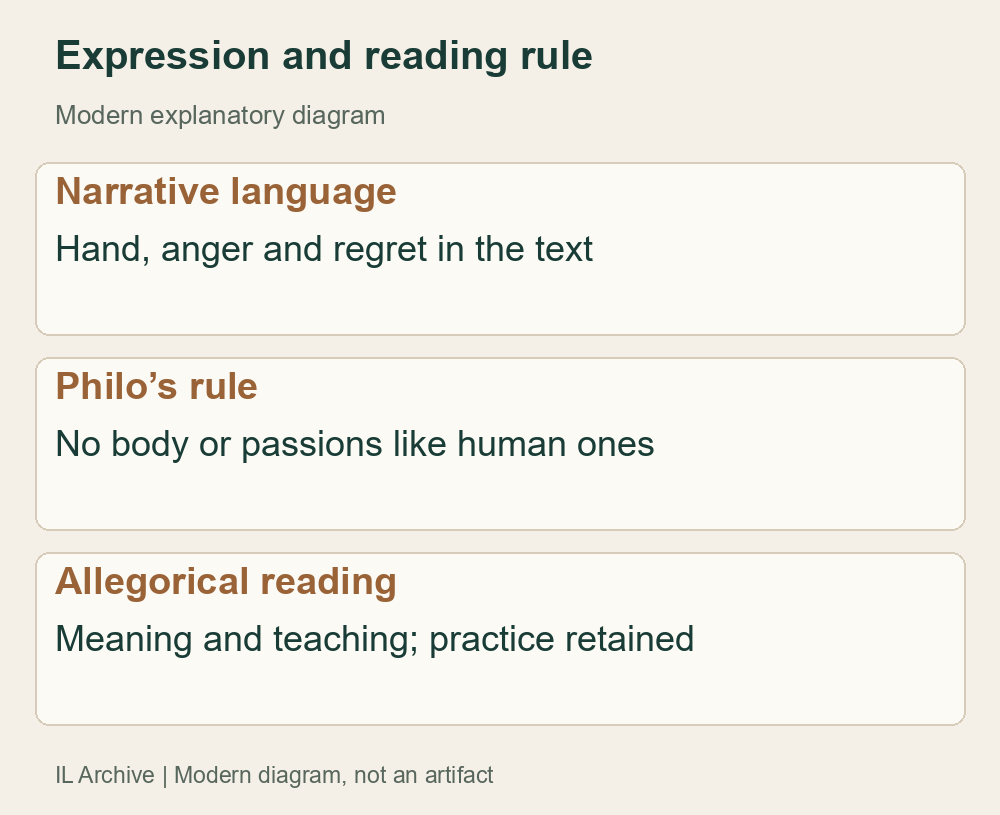
Philo of AlexandriaPhilo of AlexandriaGreek-writing Jewish interpreter in Roman Alexandria (roughly first century CE), who read the Torah philosophically while defending its practices; his works survive through Greek copying and Armenian translation.Glossary · Click to read the explanation was a Jewish thinker writing in Greek in AlexandriaAlexandria (Egypt)Alexandria is a city on Egypt’s Mediterranean coast, founded by Alexander the Great in 331 BCE and an important center of trade and culture.Glossary · Click to read the explanation between the late first century BCE and the middle of the first century CE. In On the Unchangeableness of God, he addresses statements in GenesisBook of GenesisHebrew book of the Torah containing Noah’s flood, survival offering and covenant with living creatures.Glossary · Click to read the explanation that attribute regret and anger to God, especially the decision to destroy humanity in chapter 6. The biblical narrative speaks in the language of emotion. Philo, by contrast, argues that a perfect God has neither human passions nor bodily parts; anthropomorphic wording, in his view, instructs and warns those who need such teaching. This is his philosophical and pedagogical explanation, rather than an explicit claim made by the narrative in its plain sense. [1]
His On the Migration of Abraham gives a more detailed instance. Genesis says that AbrahamAbrahamCentral figure in Genesis, the Qur'an and Jewish, Christian and Islamic traditions; the sacrifice study compares what each text says about him.Glossary · Click to read the explanation was called to leave his land, kindred, and father's house. Philo interprets these three features as body, sense perception, and uttered speech. The Greek below comes from On the Migration of Abraham, section 2, in Paul Wendland's critical edition, volume II (1897), printed page 269: [2][3]
In translation: “The land signifies the body, kinship sense perception, and the father's house speech.” Philo has not changed the words of the original call. Rather, he supplies a new set of correspondences that turns a journey between lands into an exercise in freeing the soul from the rule of bodily appetite, the senses, and words. In section 7 he explicitly says that departure does not mean physical separation or death: the point is freedom of mind from their mastery. That qualification matters. [2][3]
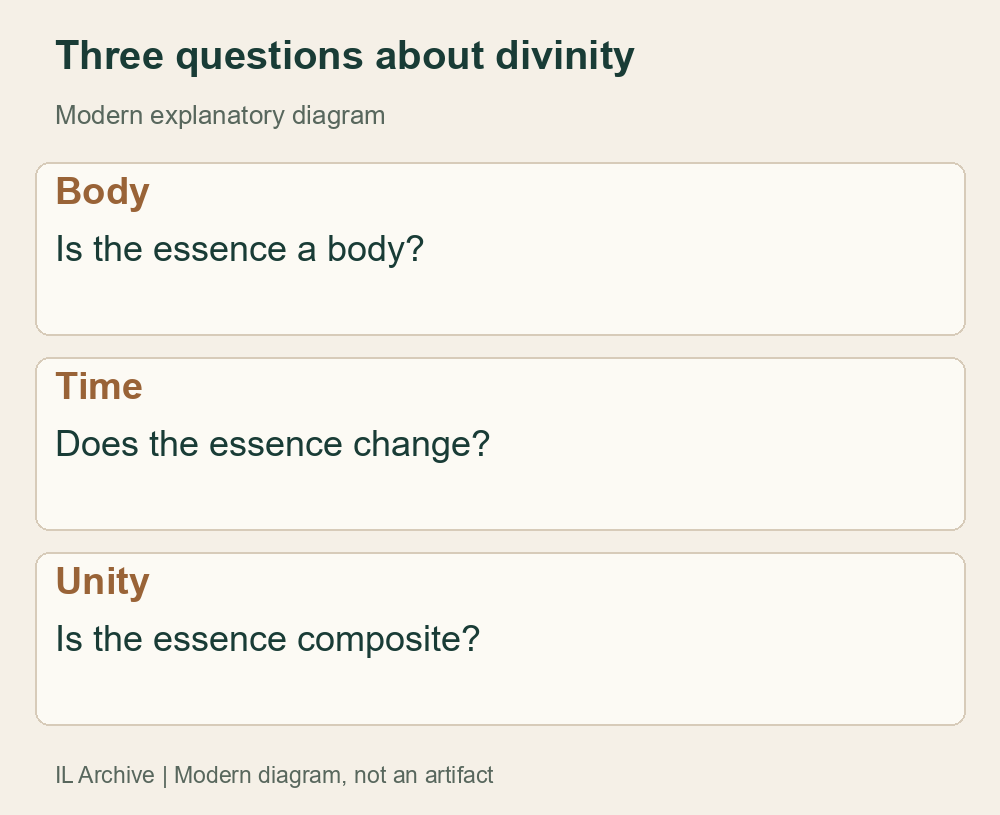
Philo is also explicit that reading commandments symbolically does not annul them. In sections 89–93 he criticizes readers who pursue hidden meanings while neglecting observance. The Sabbath can teach rest and circumcision can symbolize the cutting away of passions, yet neither interpretation authorizes giving up the Sabbath or circumcision in his account. He compares the enacted law to a body and its intellectual significance to a soul, and insists that both be cared for. The accompanying picture is a modern explanatory diagram of this particular stance—not an ancient artifact or a rule governing every Jewish interpreter. [2]
Later in On the Migration of Abraham (sections 180–187), Philo distinguishes the operation of divine powers in the cosmos from the claim that God’s essence is contained in it: speaking of God as being “in heaven and on earth” does not, for him, locate the deity within physical boundaries. This is a further argument about transcendence and providence, not proof that Genesis itself explicitly advances his philosophy. [2]
Paul: two women and an argument about two covenants
In the first-century Letter to the Galatians, Paul the ApostlePaul the ApostlePaul was a first-century CE Christian letter writer whose letters preserve early Christian formulations.Glossary · Click to read the explanation uses the Genesis account of HagarHagarFigure in Genesis: an Egyptian woman in Sarah and Abraham's household and Ishmael's mother; chapters 16 and 21 narrate her flight and later expulsion and survival.Glossary · Click to read the explanation, SarahSarahAbraham's wife and Isaac's mother in Genesis; her story with Hagar and Ishmael appears in chapters 16 and 21, not in the Genesis 22 scene itself.Glossary · Click to read the explanation, and Abraham's sons in a dispute about law, freedom, and membership in the believing community. Genesis relates that Abraham had a son by an enslaved woman and another by a free woman. Paul connects these women with “two covenants”: he associates Hagar with SinaiSinai: peninsula and biblical mountainSinai is a peninsula in eastern Egypt; in the Torah the name also denotes the mountain of revelation to MosesGlossary · Click to read the explanation and the “present JerusalemJerusalemJerusalem is a city of religious importance in Judaism, Christianity and IslamGlossary · Click to read the explanation,” set against the free “Jerusalem above.” These are argumentative correspondences constructed by Paul, not descriptions attached to the women by the Genesis narrative itself. [5]
The Greek text of Galatians 4:24, from the SBL Greek New Testament edition (2010):
Translated here: “These things are interpreted allegorically; for these women represent two covenants.” The verb related to “allegory” is direct evidence for the interpretive move's designation, but it does not settle how Paul's connections to the Torah should be classified in modern scholarship. Are they free-standing symbolism, typological correspondences, or an appeal to textual relationships within the Pentateuch? Matthew Y. Emerson addresses that disagreement and, in his article's accessible abstract, proposes an intertextual reading of the relevant narratives. The full article was not available for examination, so its specific arguments should not be reported beyond what the publisher's abstract supports. Paul's own words, the Genesis narrative, and a modern scholar's reconstruction remain three distinct levels of evidence. [5][6]
Two more recent studies show how much remains disputed. Matthew Thiessen (2016) argues that Paul's concern here particularly involves the circumcision of non-Jews, rather than a wholesale condemnation of Judaism or Jewish law. Courtney J. P. Friesen (2025) compares the opposed pair of women with the Greek and Roman tradition of the “Choice of Heracles.” These are distinct scholarly hypotheses, not descriptions supplied directly by Paul; resemblance in the second case is not itself proof of transmission from a specific Greek story. Only the publisher's and university's abstracts, not the full studies, were accessible for examination. [12][13]
Origen: multiple levels, and a text preserved in layers
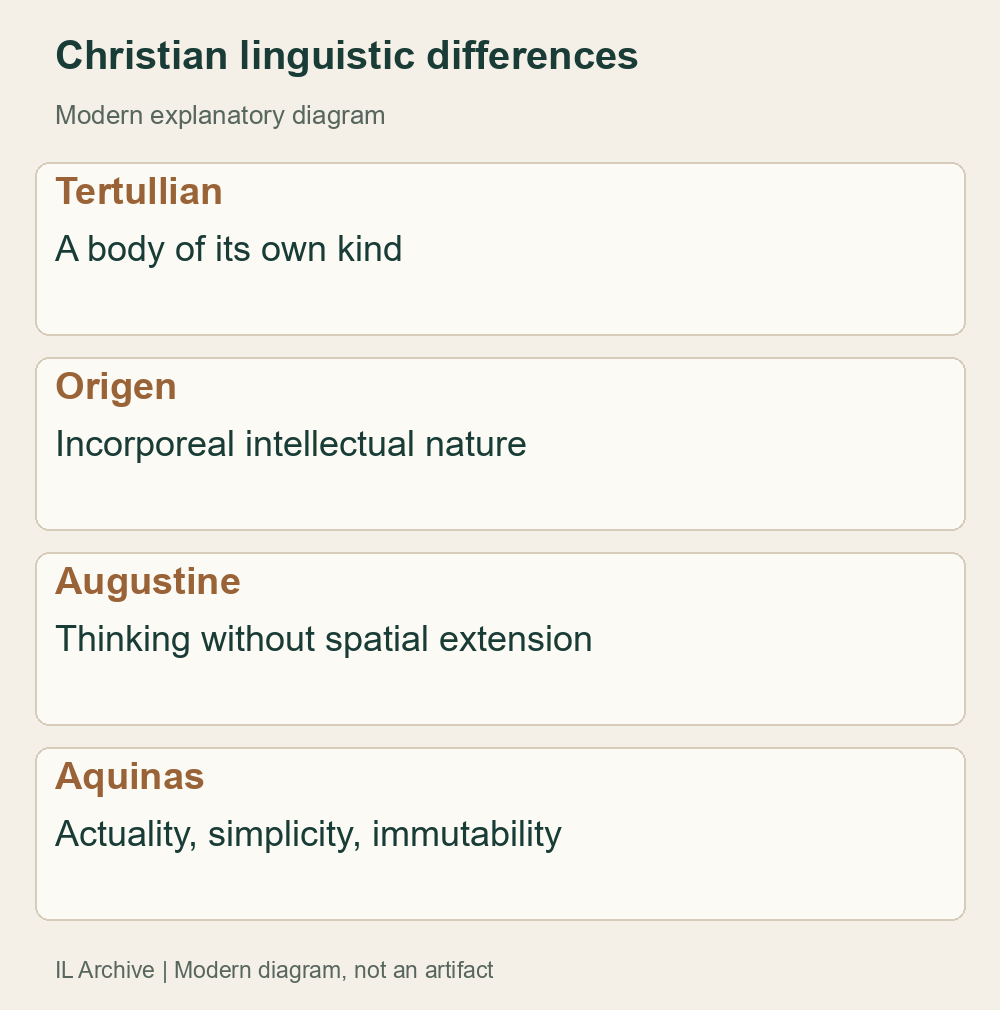
OrigenOrigenChristian exegete and theologian from Alexandria (c. 185–253), known for biblical textual comparison, commentaries and On First Principles. His works survive in Greek and through later translations and quotations.Glossary · Click to read the explanation, the third-century Christian author associated with Alexandria, discusses in Book IV of On First Principles ways of reading scripture that he likens to body, soul, and spirit. His examples include the creation of the first days before the sun exists and the image of God walking in the garden: for him, such passages direct readers beyond a merely sensory picture. He does not claim that every narrated event is unhistorical. Some accounts, he argues, can concern actual events while also bearing a deeper meaning; for other passages, he rejects a literal realization. His approach therefore amounts neither to the abolition of all history nor to a verbatim reproduction of Philo's method. [7][11]
Textual transmission complicates attribution. On First Principles was composed in Greek, but much survives in a later Latin translation by Rufinus of AquileiaRufinus of AquileiaChristian writer and translator, c.345–411 CE, who translated Greek works including Origen’s On First Principles into Latin.Glossary · Click to read the explanation, alongside Greek excerpts and other testimonies. The source page consulted for this entry presents two distinct English translations, one based on Rufinus' Latin and one on surviving Greek material. Reading that page is not the same as personally checking its underlying Greek and Latin; nor can either translation simply be identified with Origen's exact original wording without assessing the witnesses. [7][11]
Maimonides: why the label has limits
In the twelfth century the Jewish philosopher MaimonidesMoses MaimonidesJewish jurist, philosopher, and physician (c. 1138–1204). Wrote the Commentary on the Mishnah and Guide in Judeo-Arabic, and the Mishneh Torah in Hebrew; practiced in Egypt.Glossary · Click to read the explanation composed the Guide for the Perplexed in Judeo-Arabic, Arabic written in HebrewHebrewA Northwest Semitic language of the Canaanite group, encompassing Iron Age epigraphy, Biblical, Rabbinic, medieval and Modern Hebrew; its scripts and pronunciations changed over time.Glossary · Click to read the explanation script. In Part I, chapter 1, he distinguishes the Hebrew ṣelem, “image,” in Genesis 1:26 from a word for bodily appearance. He interprets the human “image” in intellectual rather than physical terms, rejecting the inference that God has a human body. The problem is approached chiefly through a lexical and philosophical distinction. It is useful to compare this with allegorical exegesis, but not accurate to call every semantic distinction in his work “allegory” in precisely Philo's or Paul's sense. The passage was consulted in M. Friedländer's 1904 English translation, not in the original Judeo-Arabic text. [8]
Brief chronology and different dates of evidence
- From the third century BCE onward: Stoic philosophers developed philosophical interpretations of myth. An example attributed to them survives in Cicero's dialogue of around 45 BCE, not necessarily in an original text by each Stoic named by Balbus. [4]
- Late first century BCE to mid-first century CE: Philo lived and wrote in Greek. Abraham's journey and the flood belong to the time of the Genesis narratives; these dates neither establish when those stories happened nor turn the 1897 critical printing of Philo into the date of his composition. [1][2][3]
- Around the middle of the first century CE: Paul wrote Galatians. The Greek wording quoted here comes from a 2010 modern edited text, not an autograph manuscript or a manuscript dated to the letter's composition. [5]
- Third century CE, followed by the late fourth and early fifth centuries: Origen's Greek work predates Rufinus' Latin translation; each textual layer is distinct from its modern English rendering. [7][11]
- Twelfth century, followed by 1904: Maimonides' Judeo-Arabic composition preceded the English translation used for the discussion here by several centuries. [8]
What the evidence establishes—and what it cannot establish
These cases document different interpretive acts that can be described as allegorical, not a single, demonstrable chain of transmission from one school to the next. The strongest examples are those in which the interpreter identifies and explains the proposed connections: Philo spells out body, sensation, and speech, while restricting their practical implications; Paul declares his two-covenant reading; Balbus provides a physical explanation of the myth. Whether one author borrowed a method from another, what an earlier storyteller intended, and where each practice originated remain separate historical questions, not conclusions licensed by superficial similarity. [2][4][5][10]
A responsible reading therefore asks: What does the earlier text actually say? What did the ancient interpreter add, and on what grounds? What has the present writer personally examined: the original language, a critical edition, a translation, or merely a study's abstract? Does the further meaning coexist with the plain sense or displace it? Questions such as these make allegorical exegesis a subject for historical comparison rather than a label for every metaphor or a verdict on the truth or falsity of a religious position.
References and notes (13)
- Philo of Alexandria, On the Unchangeableness of God (Quod Deus sit immutabilis), English translation by C. D. Yonge, hosted by Early Jewish Writings. Sections 51–54 and 67–71; repentance, passion, and pedagogical divine language. Return to the text ↑
- Philo of Alexandria, On the Migration of Abraham (De migratione Abrahami), English translation by C. D. Yonge, hosted by Early Jewish Writings. Sections 1–7 (body, sense, speech), 89–93 (meaning and observance), and 180–187 (divine powers and transcendence). Return to the text ↑
- Philo, De migratione Abrahami, Greek critical text in Paul Wendland, ed., Philonis Alexandrini Opera quae supersunt, vol. II (Berlin, 1897), displayed by Scaife ATLAS. Section 2 within the section-1–5 display; printed p. 269, not a PDF page; the quotation joins text across a page break. Return to the text ↑
- Cicero, De natura deorum, Book II, Latin text at The Latin Library; checked against H. Rackham’s English translation, Loeb Classical Library (1933). Sections 63–70, especially 64; speech of the Stoic character Balbus; the online Latin page does not identify its critical base. Return to the text ↑
- Paul, Letter to the Galatians, Greek text of the SBL Greek New Testament, ed. Michael W. Holmes (2010); SBLGNT licensed CC BY 4.0; brief excerpt. Galatians 4:21–31; quoted text at 4:24; an edited Greek text, not a single manuscript. Return to the text ↑
- Matthew Y. Emerson, “Arbitrary Allegory, Typical Typology, or Intertextual Interpretation? Paul’s Use of the Pentateuch in Galatians 4:21–31,” Biblical Theology Bulletin 43/1 (2013); publisher abstract only. Published abstract (18 January 2013), not the restricted full paper; Galatians 4:21–31. Return to the text ↑
- Origen, On First Principles (De principiis), Book IV; New Advent presents separate English translations of Rufinus’ Latin and Greek excerpts. English translation of Greek-excerpt section 11–17; Latin-version headings and textual distinction checked; underlying ancient Greek and Latin not read directly here. Return to the text ↑
- Moses Maimonides, Guide for the Perplexed, Part I, ch. 1; M. Friedländer’s 1904 English translation, via Christian Classics Ethereal Library. Part I, chapter 1, discussion of ṣelem, toʾar and demut; English translation, not Judeo-Arabic source. Return to the text ↑
- Michael Herren, The Anatomy of Myth: The Art of Interpretation from the Presocratics to the Church Fathers, ch. 6, “The Beginnings of Allegory,” Oxford University Press (2017); publisher abstract only. Publisher abstract for chapter 6, pp. 73–82 by publisher metadata; chapter itself not read. Return to the text ↑
- “Philo of Alexandria,” Stanford Encyclopedia of Philosophy, substantive revision 16 August 2022; section 4.1, “Allegory.” Section 4.1; terminology, allegorical method, and retention of literal observance. Return to the text ↑
- “Origen,” Stanford Encyclopedia of Philosophy, substantive revision 21 July 2026; consulted passages on exegesis and the transmission of On First Principles. Passages on Greek witnesses, Rufinus’ translation, and levels of scriptural meaning; not the complete entry. Return to the text ↑
- Matthew Thiessen, Paul and the Gentile Problem, ch. 3, “Do You Not Hear the Law?”, Oxford University Press (2016); publisher abstract only. Chapter 3 abstract, pp. 73–102 in publisher metadata; full chapter not read. Return to the text ↑
- Courtney J. P. Friesen, “Hagar on Sinai: The Choice of Heracles, Mountain Women, and Pauline Allegory in Galatians,” Journal of Biblical Literature 144/3 (2025), 535–555; university-hosted abstract only. University of Arizona abstract; page span supplied as bibliography, not pages personally examined. Return to the text ↑
Suggest a correction · Suggest a source for this record
Cite this record
IL Archive, «Allegorical exegesis», https://ilarchive.com/en/entities/allegorical-exegesis
Continue reading