Entity · Concept
The Enclosed Nations
A reference page linking a name, group, or concept to the materials that discuss it.
How did the motif of peoples confined behind a barrier until an appointed time develop? A comparison of Ezekiel, Revelation, the Syriac Alexander Legend and the Quran that distinguishes the sources from their interpretations.
Estimated reading time: 4 min Published Last reviewed:
Share article
Text
Introduction
How did threatening peoples imagined at the edges of the world become nations confined behind a barrier until a final, appointed release? This entry examines the enclosed nations as a literary and apocalyptic motif, not as a stable ethnic designation that can be plotted on one map. It compares specific passages from Ezekiel, Revelation, the SyriacSyriacAn Aramaic literary language rooted in Edessa, first attested in non-Christian inscriptions and later prominent in Christian writing, scholarship, translation and liturgy.Glossary · Click to read the explanation Alexander Legend and the QuranThe QuranThe central scripture of Islam, consisting of 114 Arabic surahs; its study distinguishes Quranic discourse from manuscript history, reading traditions, and historical inference.Glossary · Click to read the explanation.
These witnesses do not all tell the same story: some do not mention a barrier at all. The presence of Gog and Magog in a text must therefore be distinguished from the construction of a gate and from later attempts to read the narrative as history or geography. [1][10][15]
Names and motif: why the witnesses differ
In Ezekiel 38–39, Gog of the land of Magog is an enemy leader whose forces advance against Israel in a prophetic scene of conflict and judgment. The north is mentioned, but these chapters do not describe Alexander or the building of a barrier to imprison Gog or his army. In the Book of RevelationBook of RevelationChristian apocalypse commonly dated in its present form to the late first century CE, reusing earlier scriptural imagery.Glossary · Click to read the explanation 20:7–10, “Gog and Magog” designate nations gathered by Satan from the “four quarters of the earth” for a final battle after the thousand years. Here, too, the construction of a metal gate is absent. [1][17]
The term enclosed nations therefore applies most precisely to traditions that add a material enclosure and a future opening. That detail should not be read back into every occurrence of Gog and Magog. The development of the names is addressed separately under Gog and MagogGog and MagogNames used differently for Magog in Genesis, Gog the invader in Ezekiel, end-time nations in Revelation, and peoples behind a barrier in Syriac and Qur’anic traditions; not a modern ethnic identification.Glossary · Click to read the explanation.
The gate in the Syriac Alexander Legend
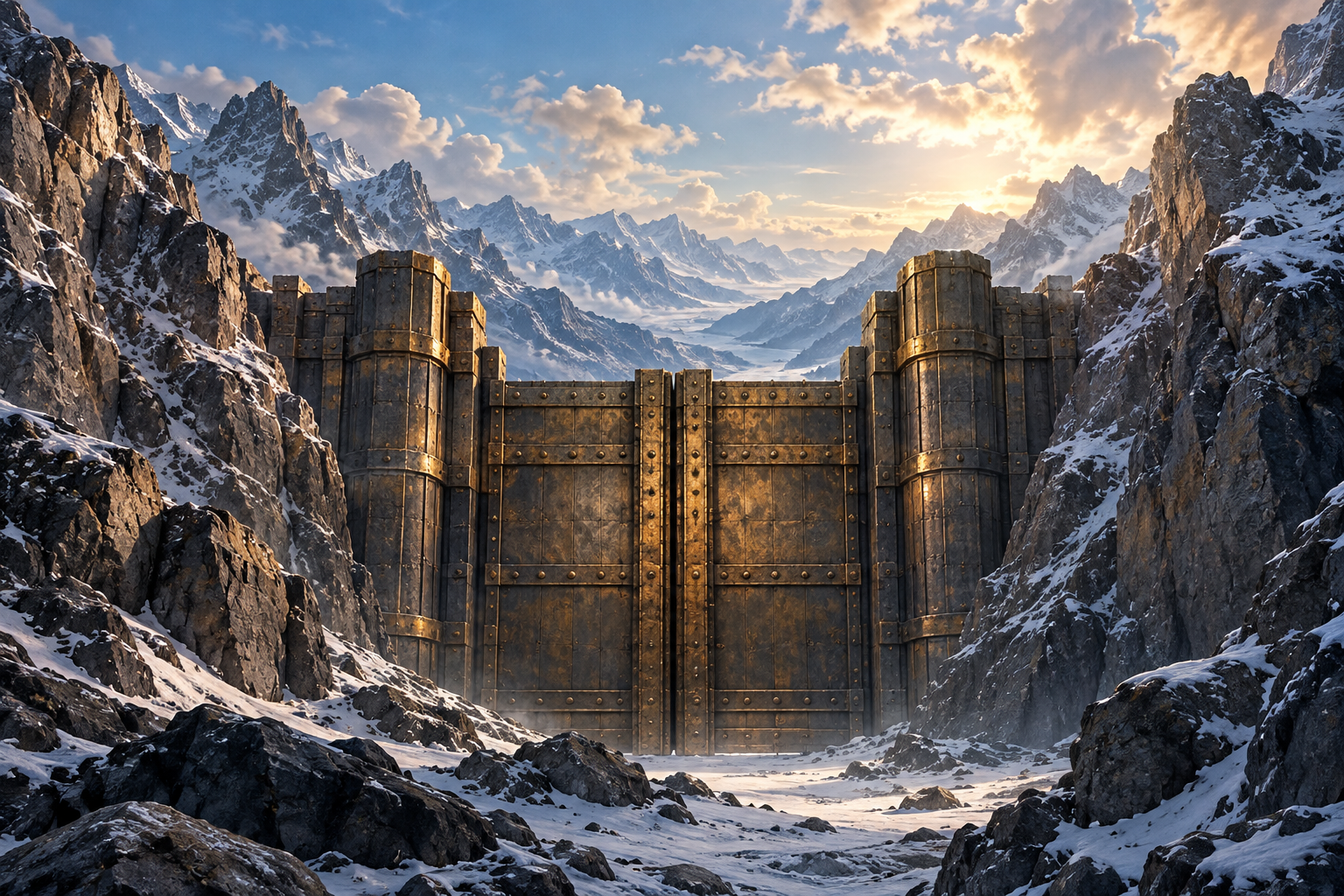
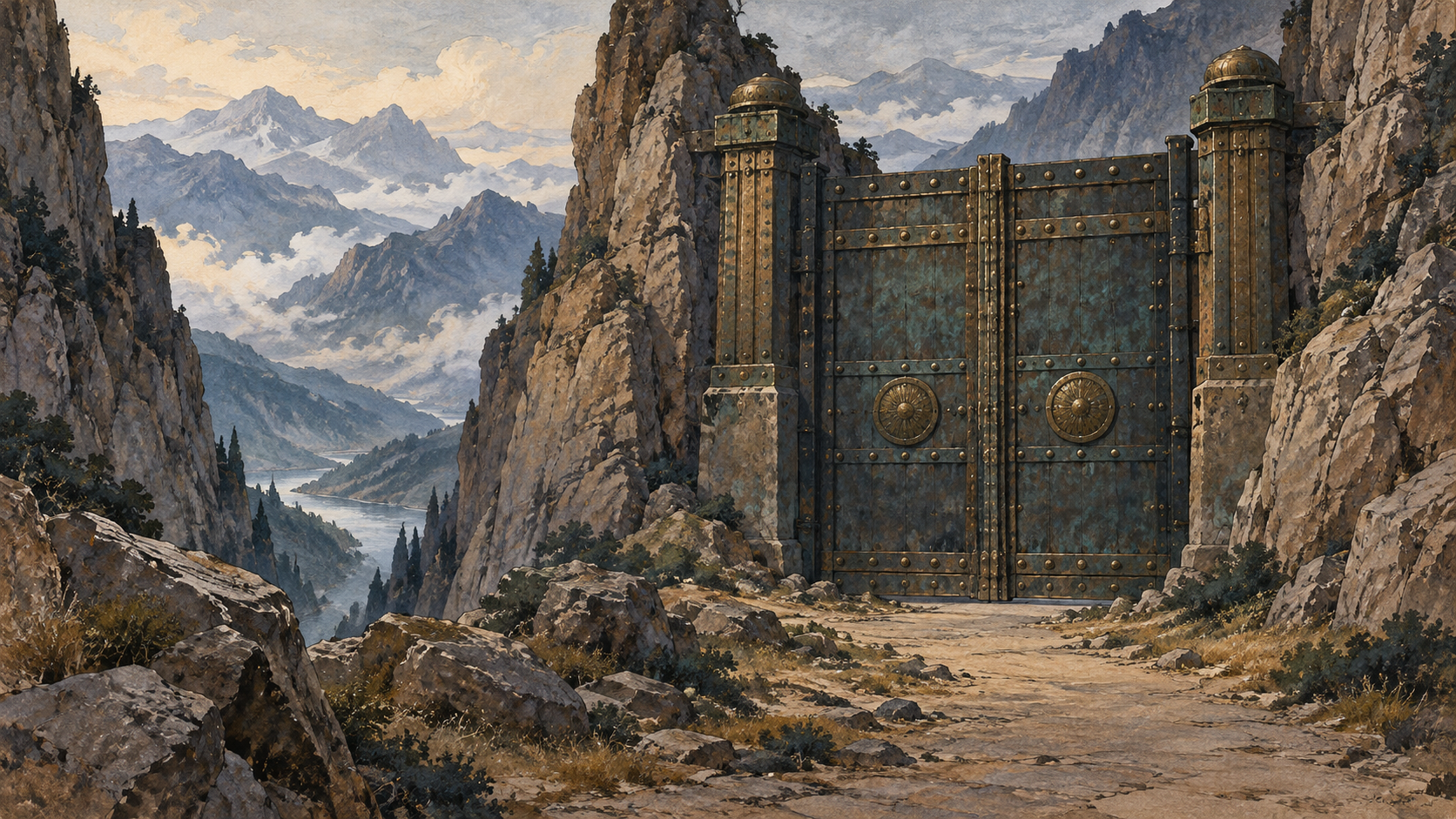
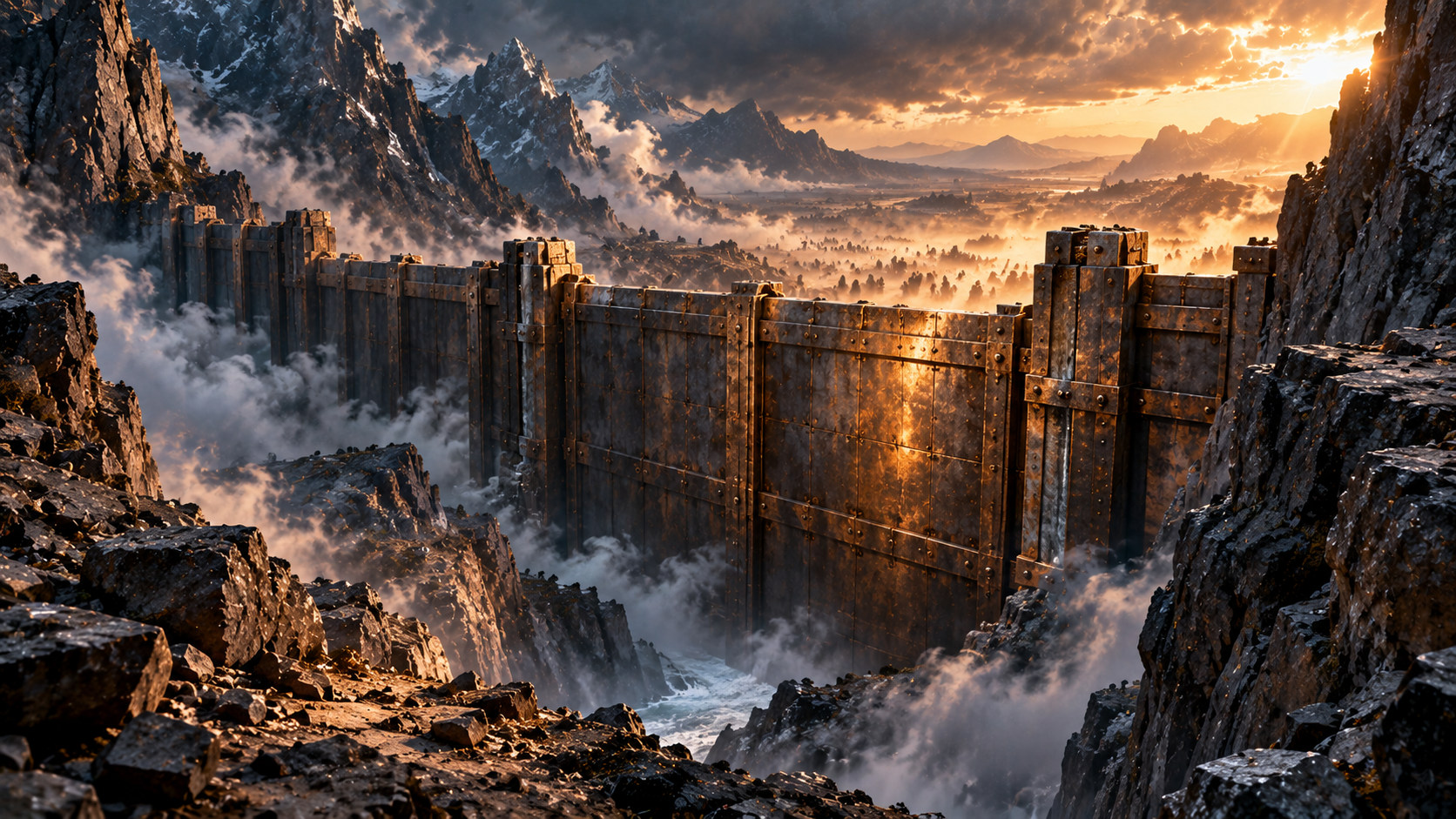
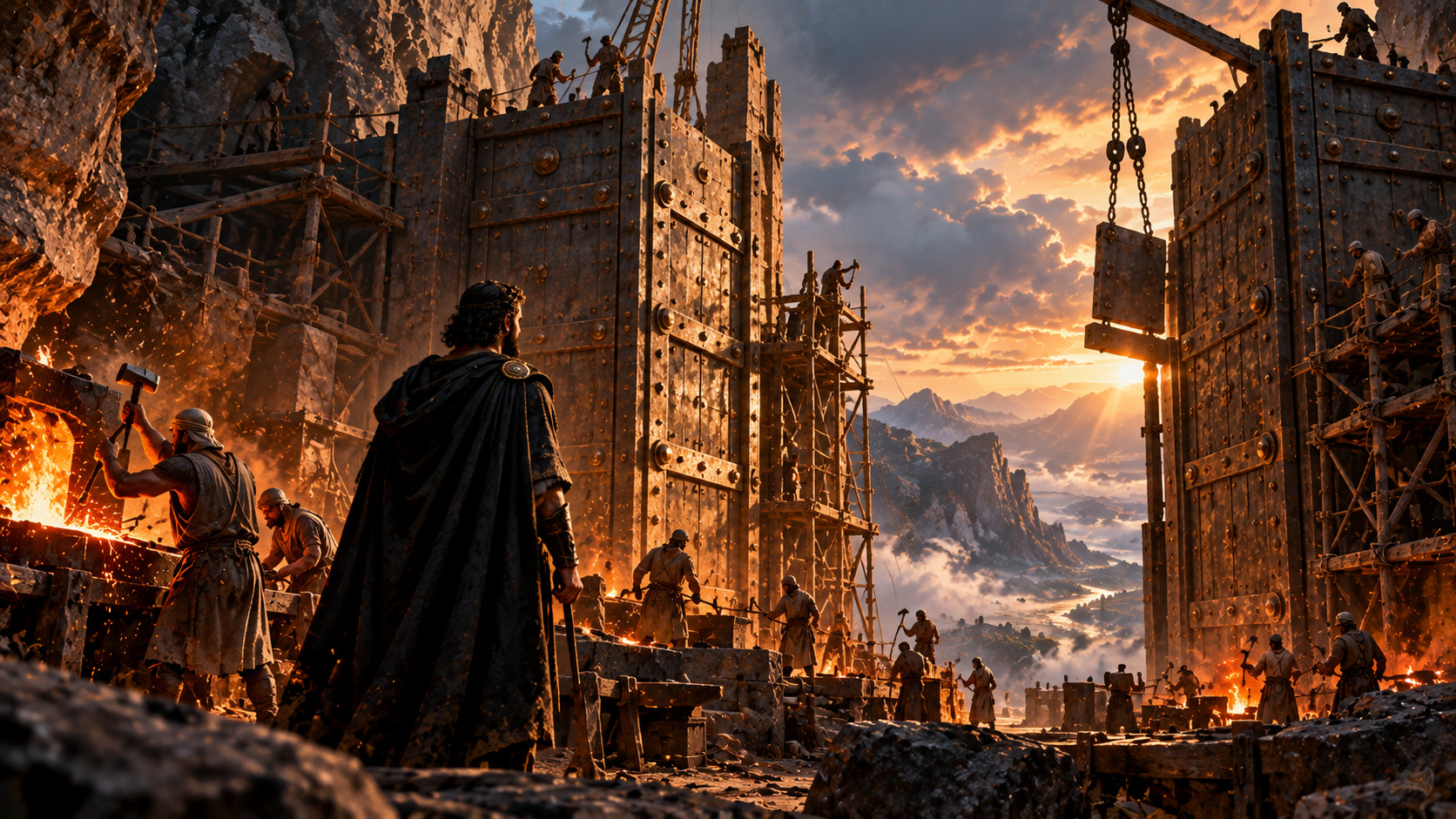
In the Christian Syriac Alexander LegendSyriac Christian Alexander LegendAnonymous Syriac Christian prose work about Alexander’s journeys and barrier against northern peoples, with Roman-Persian prophecies. Distinct from the long Syriac Romance and the metrical Poem; a sixth-century core and seventh-century revision remain debated.Glossary · Click to read the explanation, known as the Neṣḥānā, AlexanderAlexander the GreatMacedonian king who lived from 356 to 323 BCE and became a hero of stories in different languages and traditions after his death.Glossary · Click to read the explanation reaches a mountain pass and hears of peoples whom the narrative places in the north, including groups called Gog and Magog. He then has an iron-and-bronze gate made and anchored into the rock. The work also foretells the gate’s destruction by divine command and the release of multitudes in an end-time setting. These details belong to a Christian literary narrative as conveyed by the English translation published in 1889; they are not a field report on a geographically verified structure. [10]
The short Syriac Legend must be distinguished from the longer Alexander Romance and the later Syriac poem. Some editions bound these works together, but they do not thereby become one text. The use of SyriacSyriacAn Aramaic literary language rooted in Edessa, first attested in non-Christian inscriptions and later prominent in Christian writing, scholarship, translation and liturgy.Glossary · Click to read the explanation does not itself establish that every feature of the transmitted versions was composed at the same moment. [10][16]
Dhul-Qarnayn’s barrier in the Quran
In al-Kahf 18:92–99, Dhul-Qarnayn reaches a place between two natural barriers. A people asks him to erect a barrier against Gog and Magog. He uses pieces of iron and molten copper, and declares that the structure will be levelled when his Lord’s promise comes. Al-Anbiya 21:96 speaks of Gog and Magog emerging from every elevation. The Quran calls the builder Dhul-Qarnayn; the verses do not name him “Alexander” or supply coordinates for the barrier. [15][18]
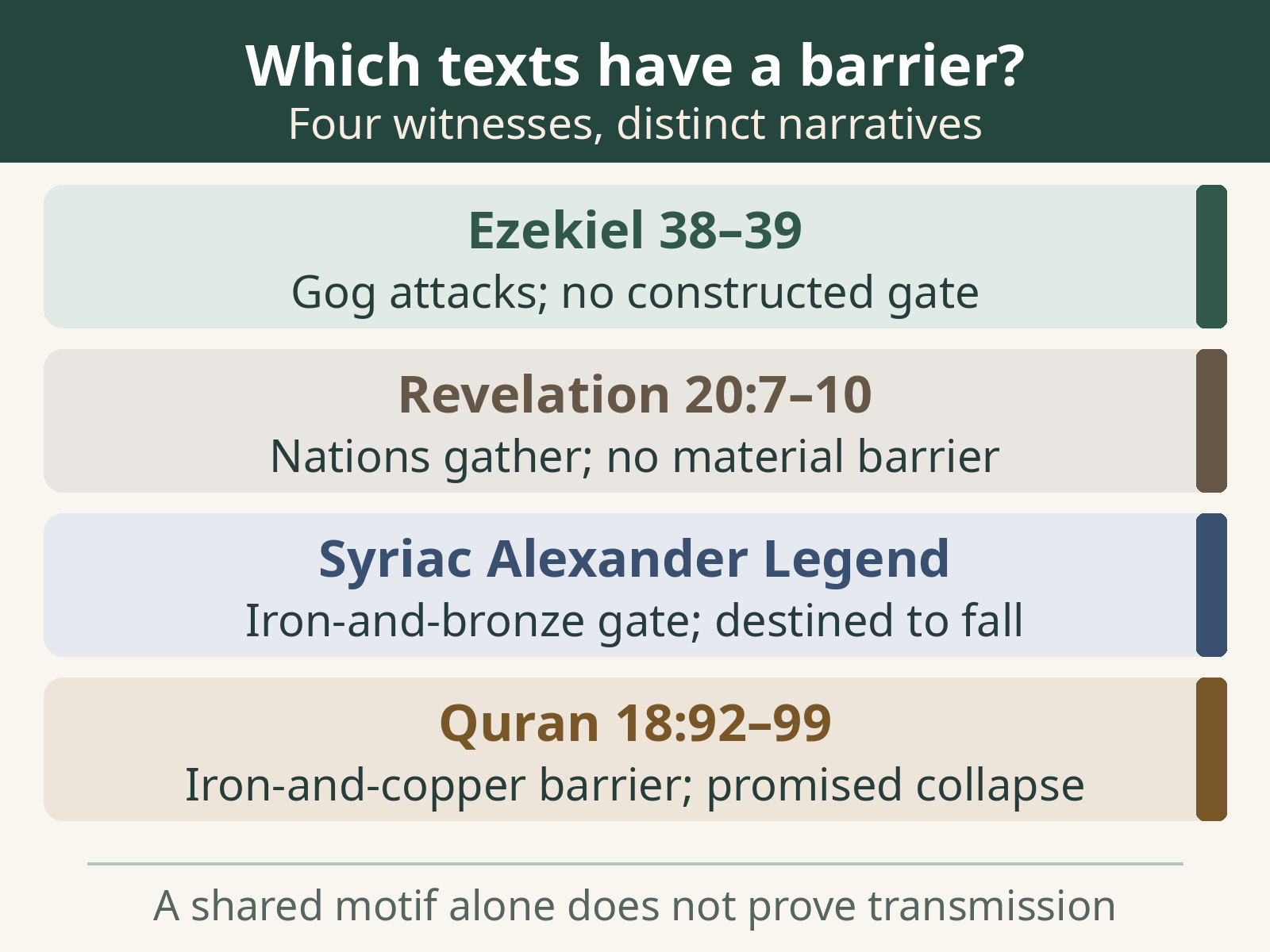
The construction of a metal barrier and its promised removal are clear narrative parallels between the Quranic passage and the Syriac Legend. Yet the construction details, narrative purposes and depictions of release are not identical; resemblance alone cannot establish a specific chain of direct textual borrowing. [10][15][16]
Dates, versions and later reception
The Syriac Legend has often been dated to the seventh century CE, within the context of Byzantine–Sasanian conflict. In a study published in 2023, Tommaso Tesei instead argues for an earlier core dating to Justinian’s reign, alongside later layers. The dating and editorial history remain subjects of scholarship. These arguments concern textual witnesses and historical setting; they do not establish the narrated building project as a historical event. [16]
Later art attests to the story’s reception, not to its factual occurrence. An illustrated folio of the Great Mongol Shahnama, produced in Tabriz around 1330–1340 CE and now held by the Smithsonian’s National Museum of Asian Art (S1986.104), depicts Iskandar directing construction of the rampart. This is evidence of medieval Persian visual imagination, not contemporary evidence for Alexander or the barrier. [19]
Limits of the evidence
In this entry, “enclosed nations” names a narrative pattern in which groups are held beyond a boundary until an appointed release. The passages examined here do not establish a single ethnic identity for all named groups or pinpoint an archaeological structure to which all four texts refer. Responsible comparison identifies each work’s wording, genre and editorial history before assessing possible connections, rather than treating similarity as proof of transmission. [1][10][15][16]
References and notes (7)
- The Bible, Genesis 10:1–5, Ezekiel 38–39 and Revelation 20:7–10, King James Version (KJV), compared for their distinct contexts; Ezekiel does not narrate the construction of a gate. Genesis 10:1–5; Ezekiel 38–39; Revelation 20:7–10, KJV Return to the text ↑
- E. A. Wallis Budge, The History of Alexander the Great (1889), “A Christian Legend concerning Alexander”: consulted the accessible English transcription of the gate-building and prophecy passages, not the Syriac original or the entire volume. Budge (1889), Christian Legend, pp. 144–158; English transcription, gate and prophecy Return to the text ↑
- Quran, al-Kahf 18:92–99, especially iron, molten copper and the future levelling of the barrier; consulted the available Sahih International English rendering alongside the passage, distinguishing translation from commentary. al-Kahf 18:92–99, especially 18:94–99 Return to the text ↑
- Tommaso Tesei, The Syriac Legend of Alexander’s Gate, Oxford University Press (2023): book abstract and public abstract of the dating chapter consulted, not the paywalled chapter or whole book. Book abstract; ch. 2 “Debates about Dating and Context” abstract, pp. 21–29 Return to the text ↑
- Revelation 20:7–10, King James Version (KJV): nations from the four quarters of the earth; no constructed barrier in this passage. Revelation 20:7–10, KJV Return to the text ↑
- Quran, al-Anbiya 21:96: Gog and Magog are released and surge from every elevation; consulted the verse and displayed translation, without treating glosses as Quranic wording. Quran 21:96 Return to the text ↑
- Smithsonian National Museum of Asian Art, folio showing Iskandar building the iron rampart, Great Mongol Shahnama, Tabriz, ca. 1330–1340, S1986.104; consulted museum catalogue, not the physical object. S1986.104, recto; Ilkhanid Tabriz, ca. 1330–1340 Return to the text ↑
Suggest a correction · Suggest a source for this record
Cite this record
IL Archive, «The Enclosed Nations», https://ilarchive.com/en/entities/enclosed-nations
Continue reading