Ancient text
Syriac Christian Alexander Legend
A text for line-by-line reading, with transliteration, translation, and resources.
Christian prose narrative of Alexander’s journeys and the gate restraining nations; distinct from Romance and Poem, with debated dating.
Metadata
These are descriptive fields, not conclusions.
- Edition
- 2
Text
A SyriacSyriacA literary form of Aramaic, with an extensive Christian heritage and earlier non-Christian attestations.Glossary · Click to read the explanation prose work, also called the Neṣḥānā, portraying Alexander as a Christian king who builds a gate of iron and another metal and predicts enclosed nationsEnclosed nationsNarrative motif of peoples beyond a barrier until their release, not a fixed ethnic name.Glossary · Click to read the explanation’ future. Budge’s1889 English translation occupies144–158. Distinguish it from the Poem and long Pseudo-Callisthenes narrative. [3] [7]
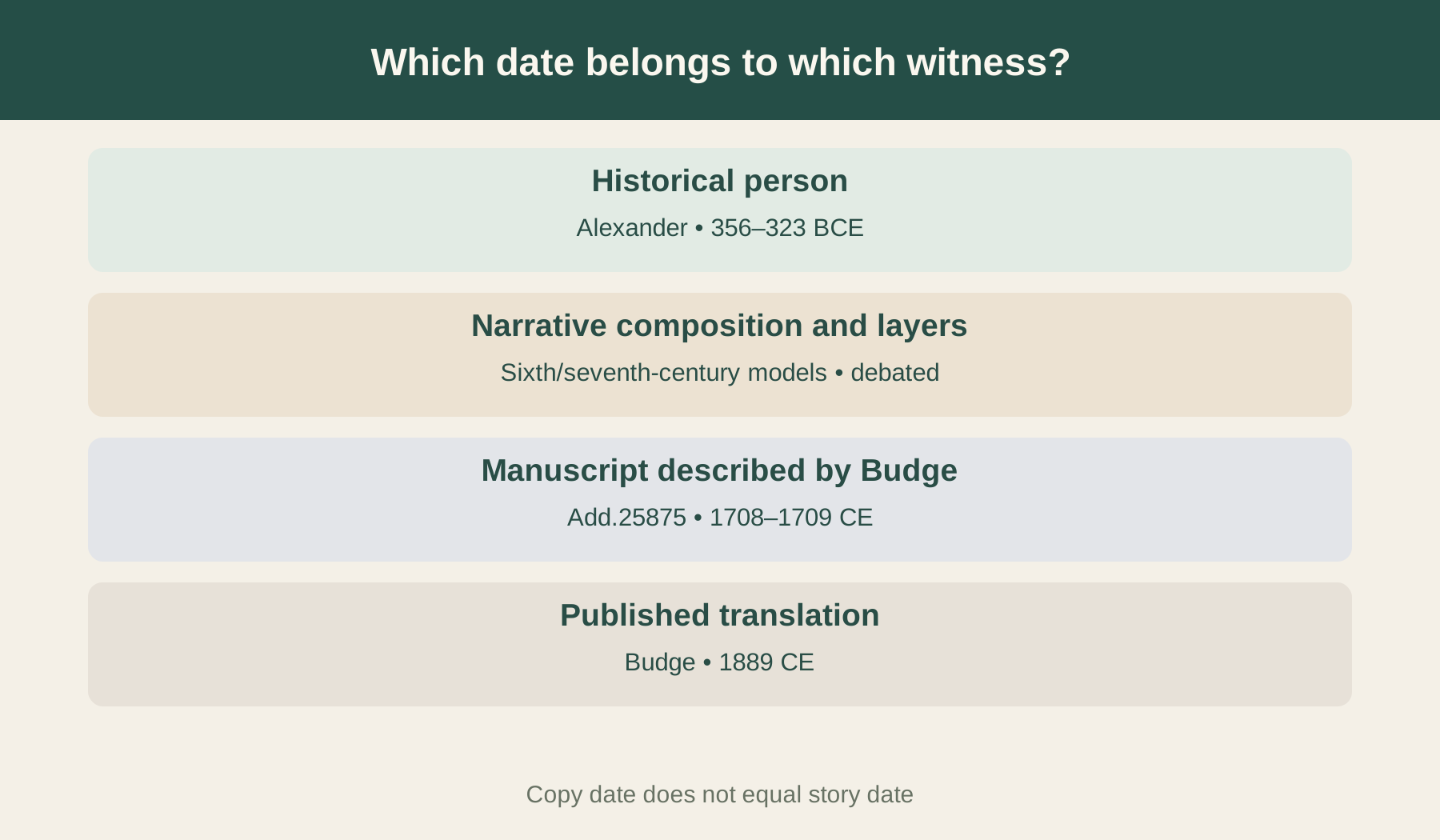
A dating model places it after629–630; Tesei proposes an earlier Justinianic version with later additions. A late copy does not date all layers. The modern diagram distinguishes dates and is not an ancient manuscript. [4] [8] [9]
References and notes
- Complete English translation of this text; critical passages checked against scans. No direct Syriac collation. E. A. Wallis Budge, The History of Alexander the Great (1889), Christian Legend, pp. 144–158; PDF 264–278 Return to the text ↑
- Date of one manuscript,not narrative composition. Budge (1889), Introduction, p. i; manuscript Add. 25875; PDF 23 Return to the text ↑
- Brock entry: distinct works and dating model. Van Bladel’s thesis reported through it; full study unread. Sebastian P. Brock, Alexander Cycle, Gorgias Encyclopedic Dictionary of the Syriac Heritage (2011), electronic entry Return to the text ↑
- Publisher abstract only; earlier Justinianic version attributed to author. Tommaso Tesei, The Syriac Legend of Alexander’s Gate; online 19 October 2023, print 3 November 2023, copyright 2024; abstract Return to the text ↑
- Chapter abstract only; interpolated940prophecy within earlier version is Tesei’s interpretation. Tesei, chapter 3, The 940 ag Prophecy, pp. 30–44; DOI 10.1093/oso/9780197646878.003.0004; abstract Return to the text ↑
Research history
Substantive changes are retained here. Minor copy edits remain in the internal operational log.
-
Substantive record update
Archive records may be reviewed and refined as better evidence or sources become available. Suggest a correction
Suggest a correction · Suggest a source for this record
Cite this record
IL Archive, «Syriac Christian Alexander Legend», Edition 2, https://ilarchive.com/en/texts/syriac-alexander-legend