Site · Historic city
Derbent
- Region
- Dagestan / Russian Federation
At Derbent, the Caucasus approaches the western Caspian shore. Sasanian walls cross the passage that later writers associated with Alexander’s gates.
Estimated reading time: 3 min Published Last reviewed:
Share article
Text
Introduction
Derbent lies on the western shore of the Caspian Sea in Dagestan, within modern Russia. The slopes of the Caucasus and the sea leave a narrow passage along the coast. The citadel and walls were built to control that passage. UNESCO dates the historic system of fortifications to the fifth and sixth centuries CE, during the Sasanian period. Later writers also attached to the place a story about a barrier built by Alexander. [1][2]
A citadel and walls across a passage
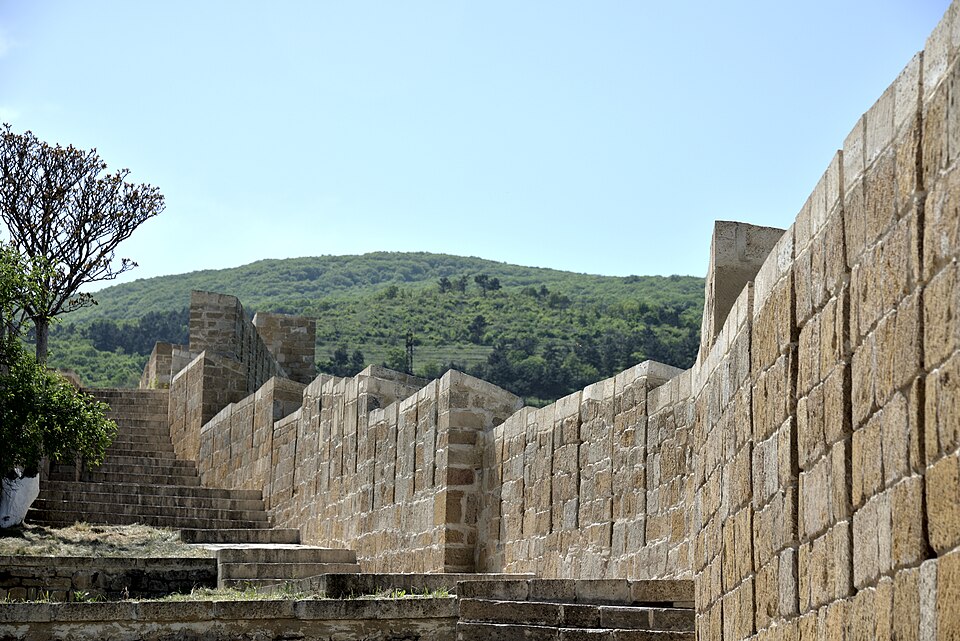
The citadel stands on a hill. According to Encyclopaedia Iranica, the northern and southern city walls ran roughly 350 to 450 metres apart and extended east to the Caspian shore, enclosing the harbour. The city sits at the entrance to a narrow pass, about 3 to 3.5 kilometres wide, between the Caucasus foothills and the sea. A traveller moving along the coast had to go through that strip, so a fortified line across it protected the town and also controlled the route. The defences were rebuilt and extended over time: battlements and extra gates were added later, and fourteen gates survived as late as 1720. The photograph on the page shows a stretch of the walls. [1][2]
The entry in Encyclopaedia Iranica reviews evidence for several stages of Sasanian construction. It discusses work dated to Kavād I’s second reign and large-scale stone rebuilding that extended towards the end of the reign of Ḵosrow I. The wall studied there has a core of rough stone blocks and a facing of limestone slabs. Arab historians often linked the walls to Ḵosrow I, while archaeologists describe a sequence of building phases. [2]
What the inscriptions add
The same study records twenty-five Middle Persian inscriptions identified in the walls by 1985. It describes them as measurements associated with construction. The vertical format of the writing is clearly late Sasanian, which fits an attribution to Ḵosrow I. The readings of the dated inscription, numbered 3 in the discussion, remain controversial, and the dates proposed for it vary between the fifth and sixth centuries. A wall can thus preserve measures and marks left by its builders as well as the shape of the fortification. Together the evidence gives an approximate historical setting for the construction. [2]
Alexander and the barrier
Medieval writers credited Alexander the GreatAlexander the GreatMacedonian king who lived from 356 to 323 BCE and became a hero of stories in different languages and traditions after his death.Glossary · Click to read the explanation with closing the passage at Derbent against Gog and Magog. The association belongs to the history of how the walls were understood by later readers. In Qur’an 18:94 people offer Dhul-Qarnayn a payment so that he will set up a barrier between them and Gog and Magog. The verse does not name a place. Derbent is therefore a place where the barrier story was applied to a visible landscape. The walls document a real defended pass, but they do not identify the Qur’anic barrier or show construction by Alexander. Their construction and inscriptions give the surviving fortifications a separate Sasanian chronology. [2][3]
References and notes (3)
- UNESCO World Heritage Centre, Citadel, Ancient City and Fortress Buildings of Derbent, property 1070 Description and brief synthesis: western Caspian setting, Sasanian fortifications of the fifth and sixth centuries CE. Return to the text ↑
- Encyclopaedia Iranica, “Darband, i. Ancient City” Sections on the citadel, the two walls and the pass, Sasanian building under Kavād I and Ḵosrow I, the masonry phases, the twenty-five Middle Persian inscriptions and the disputed reading of inscription no. 3, later additions to the gates, and the medieval attribution to Alexander. Return to the text ↑
- Quranic Arabic Corpus, Qur’an 18:94 Seven English translations of the verse in which people offer Dhul-Qarnayn a payment to set a barrier between them and Gog and Magog; no place is named. Return to the text ↑
Suggest a correction · Suggest a source for this record
Cite this record
IL Archive, «Derbent», https://ilarchive.com/en/sites/derbent