Site · Ancient kingdom
Saba: the ancient South Arabian kingdom
- Region
- Marib and Sanaa region / South Arabia / modern Yemen
Saba was an ancient kingdom in present-day Yemen. Its inscriptions and the Sheba of the Bible and the Qur’an belong to two different kinds of record.
Estimated reading time: 2 min Published Last reviewed:
Share article
Video
The Name No One Owns | The Road of El
More than four thousand years ago a palace burned at Ebla, and one small word waited in its clay: ʾl, El. We follow it through names and inscriptions, from Ebla, Mari and Ugarit to the kings of Samʾal, Karatepe and Saba and the stones of the basalt desert, then set the Torah's names and the Arabic question side by side. Some scenes are AI-generated illustrations.
The YouTube player loads only when you press play. Watch on YouTube
Text
Introduction
Saba was an ancient South Arabian kingdom and people associated with the regions of Marib and Sanaa in present-day Yemen. The Metropolitan Museum’s chronology places it broadly between the beginning of the first millennium BCE and the first centuries CE. These are approximate bounds, not a precisely documented foundation date. Sabaean inscriptions preserve part of its written record, while the Bible and the Qur’an give Saba, or Sheba, a place in a different kind of record. [1][2][3][4]
A short inscription on a portable object
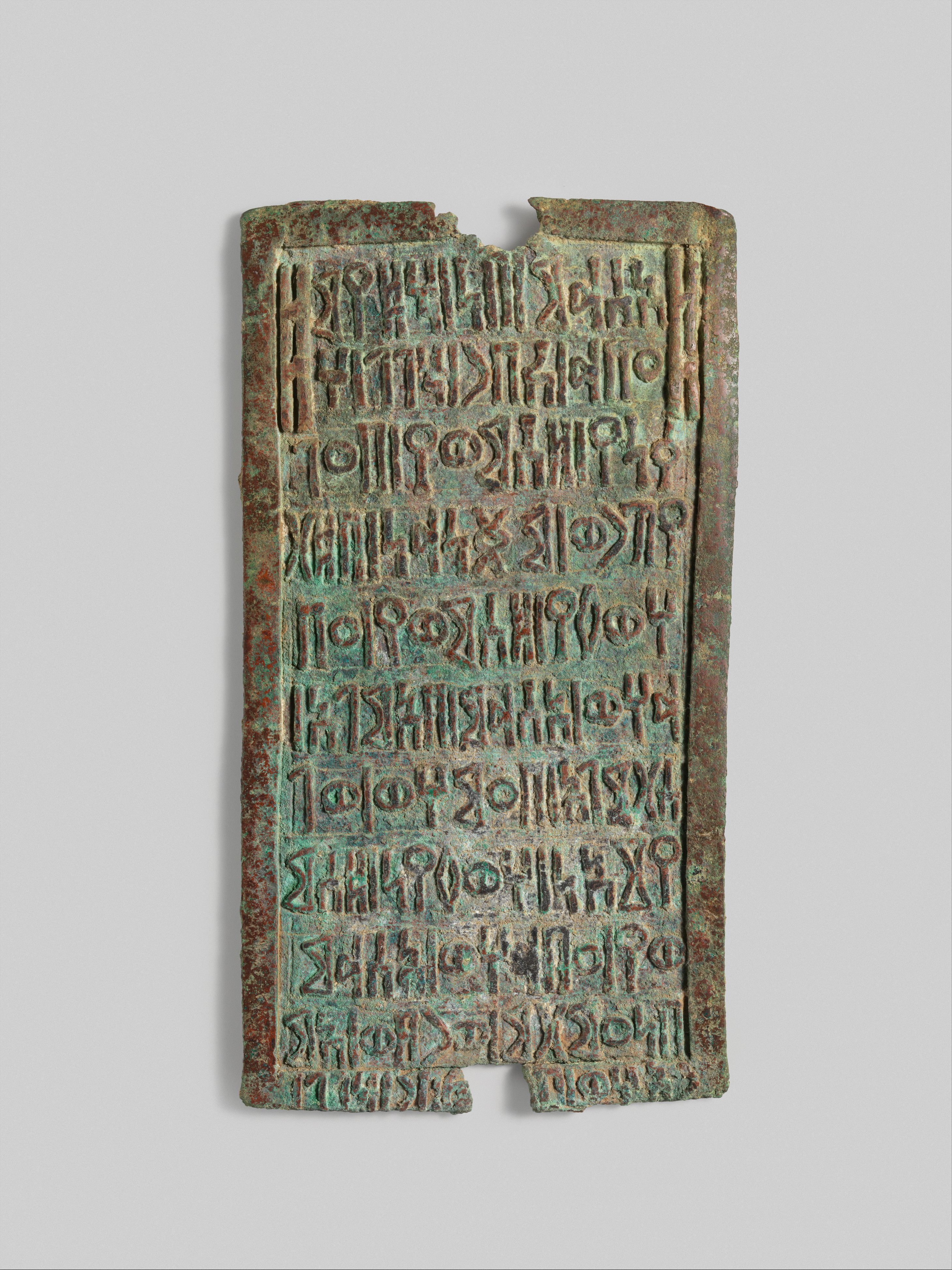
The Metropolitan Museum holds a votive plaque inscribed with a Sabaean dedication, accession number 1993.169. It is made of copper alloy and measures about 27.6 by 15.2 centimetres. The museum dates it to the late first millennium BCE and gives its region as south-western Arabia. A dedication of this kind shows how writing was used in the act of giving an object to a god, and it is a small, portable piece of the written record that Sabaean inscriptions preserve. [2]
Sheba in the biblical and Qur’anic accounts
In 1 Kings 10:1–13, the Queen of Sheba comes to Solomon to test him with hard questions. She arrives with a large retinue and brings spices, gold and precious stones. Solomon answers all her questions, and when she sees his wisdom, his house and his court, the account says it took her breath away. She praises him and his God, gives him a large gift, and in the end returns to her own land with her servants. [3]
In Qur’an 27:22 the hoopoe returns with news and says that it has come from Saba with certain news. Qur’an 34:15 speaks of a sign for the people of Saba in their homeland: two gardens, one on the right and one on the left, and a call to eat from their Lord’s provision and be grateful. [4][5]
What each kind of evidence can show
These passages give Sheba or Saba a place in the stories and teachings of their respective texts, and they matter for the history of religious memory. The inscriptions and objects, such as the plaque in the museum, are evidence for a kingdom and its people and for how they used writing. The two kinds of record answer different questions. The plaque does not supply a personal name or a biography for the queen in the biblical and Qur’anic accounts, and the kingdom’s attestation does not, on its own, document her life. [2][3][4][5]
References and notes (5)
- Metropolitan Museum of Art, “Arabian Peninsula, 1000 B.C.–1 A.D.,” Heilbrunn Timeline of Art History Regional description and key events on Saba and the South Arabian kingdoms, approximate dates, and the regions around Marib and Sanaa. Return to the text ↑
- Metropolitan Museum of Art, Votive plaque inscribed with Sabaean dedication, 1993.169 Object record (read through the museum’s open-access data): title, accession number 1993.169, date “ca. late 1st millennium BCE”, copper alloy, southwestern Arabia, dimensions 27.6 × 15.2 × 1.3 cm, Pfeiffer Fund, 1993. Return to the text ↑
- First Kings 10:1–13, NRSV Updated Edition Entire passage on the Queen of Sheba: her hard questions, retinue and gifts, Solomon’s answers, her response, and her return to her land. Return to the text ↑
- Quranic Arabic Corpus, Qur’an 27:22 Word-by-word entry for the word Saba in the hoopoe’s report, with an English translation of the verse. Return to the text ↑
- Quranic Arabic Corpus, Qur’an 34:15 Seven English translations of the verse about the people of Saba, their two gardens and the call to gratitude. Return to the text ↑
Suggest a correction · Suggest a source for this record
Cite this record
IL Archive, «Saba: the ancient South Arabian kingdom», https://ilarchive.com/en/sites/saba-ancient-kingdom