Ancient text · Rabbinic compilation
Babylonian Talmud
A text for line-by-line reading, with transliteration, translation, and resources.
- Region
- Late-antique Mesopotamia
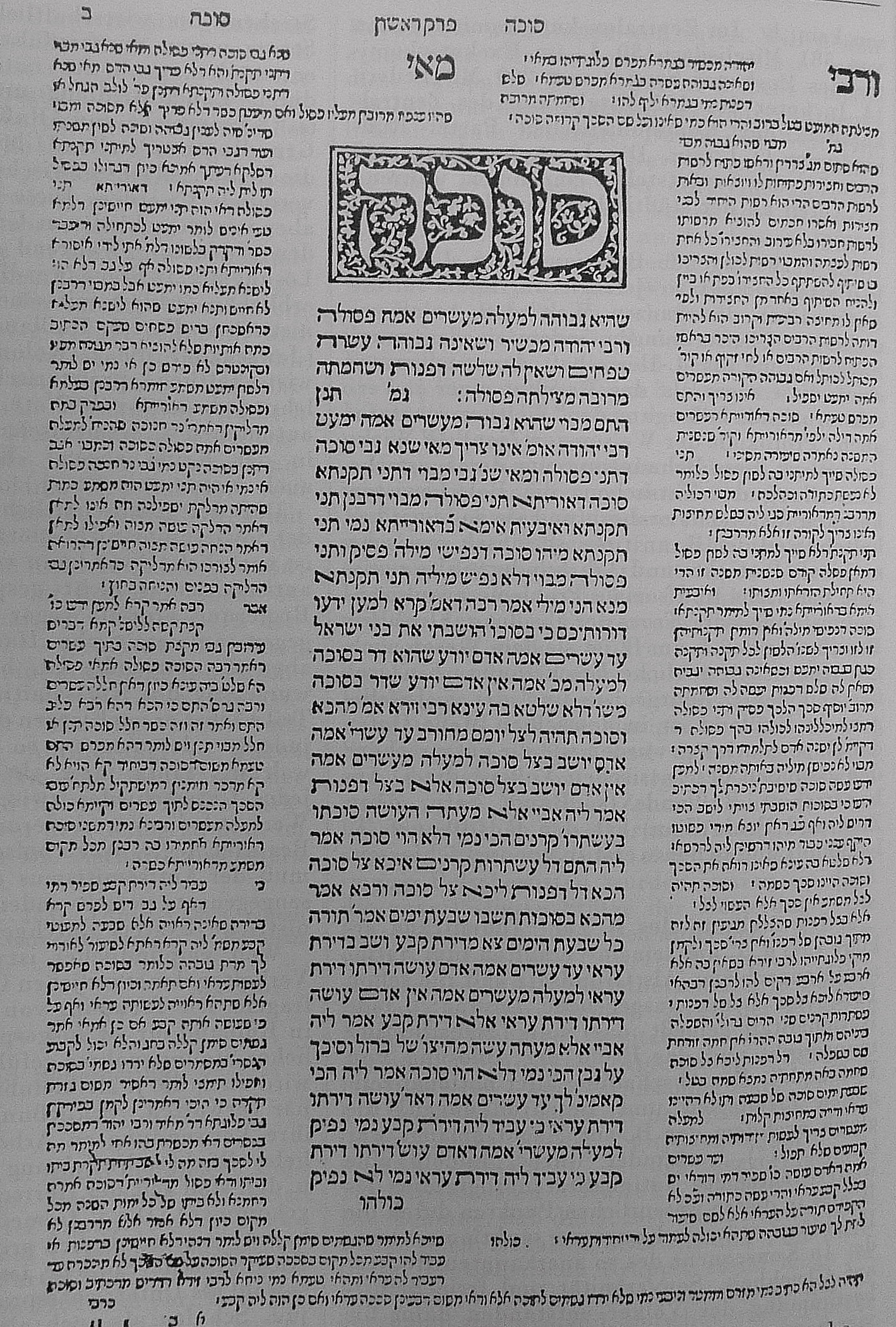
The Babylonian Talmud pairs the Mishnah with rabbinic discussion in Hebrew and Aramaic. Its opening tractate asks when the evening Shema should be recited. A Munich manuscript and a Venetian printed edition show how the work was transmitted.
Estimated reading time: 3 min Published Last reviewed:
Share article
Text
Introduction
In its opening tractate, the Babylonian Talmud asks when the evening Shema should be recited. The Mishnah gives a starting point and records disagreement over the deadline. The discussion that follows asks why the evening comes first and looks for answers in two passages of the Torah. The exchange shows how the Talmud turns a practical rule into a question about the way a text is read. [1][3]
The Mishnah and the Gemara
The Babylonian Talmud, or Bavli, developed among Jewish communities in late antique MesopotamiaMesopotamiaHistorical region associated with the Tigris and Euphrates: Uruk, Ur, Eridu, cuneiform, Sumer, Akkad, Babylon and Assyria, their languages and cults, and the limits of archaeological evidence.Glossary · Click to read the explanation. Its rabbis worked in an environment shaped by Iranian rule, including that of the Sasanian Empire. The work brings together teachings from different generations in HebrewHebrewA Northwest Semitic language of the Canaanite group, encompassing Iron Age epigraphy, Biblical, Rabbinic, medieval and Modern Hebrew; its scripts and pronunciations changed over time.Glossary · Click to read the explanation and AramaicAramaicNorthwest Semitic language varieties documented since the early first millennium BCE, including Old and Imperial Aramaic, Syriac, Jewish dialects, and living Neo-Aramaic forms.Glossary · Click to read the explanation. The process by which they became a single work remains a subject of scholarly debate. [1][2]
The Mishnah, compiled around 200 CE, lies at the base of the work, and each of its passages is followed by Gemara. The Gemara questions the Mishnah’s statements, compares them with other teachings and draws on biblical passages. An individual discussion is called a sugya. It can bring together earlier teachings from the period of the Mishnah, explanations attributed to later rabbis and anonymous questions that connect one part of the argument to the next. The text also preserves stories alongside rules and interpretations. [1][4]
How Berakhot 2a develops a rule
The first mishnah in Berakhot says the time for the evening Shema begins when priests may eat their allocated share of produce, known as terumah. Rabbi Eliezer sets the limit at the end of the first watch of the night. The sages give midnight as the limit, and Rabban Gamliel gives dawn. The passage explains the sages’ limit as a safeguard against missing the appointed time. [3]
The Gemara asks why the tractate begins with the evening recitation. One answer cites Deuteronomy 6:7, where lying down precedes rising. Another cites the sequence of evening and morning in Genesis 1:5. The discussion also asks why the Mishnah gives the priests’ meal as the marker. It connects the meal with the appearance of the stars. In the Gemara’s reading, the verses account for the order of the passage, and the discussion of the priests’ meal clarifies the hour. [3]
From manuscript to printed page
The Bavarian State Library holds the Munich manuscript, shelfmark Cod. hebr. 95. Its two colophons suggest it was probably completed in France in 1342. The library describes it as the only medieval manuscript that preserves the Babylonian Talmud almost in full. [4]
Daniel Bomberg printed an edition of the Talmud in Venice, which the Library of Congress lists as 1520–1523. [5]
Quick answers
Why is it called the Babylonian Talmud? It developed among Jewish communities in Babylonia, in late antique Mesopotamia. The JerusalemJerusalemJerusalem is a city of religious importance in Judaism, Christianity and IslamGlossary · Click to read the explanation Talmud is a parallel compilation of the Mishnah and rabbinic discussion. [2][4]
What is a sugya? It is a unit of discussion in the Gemara. It may put earlier teachings next to named explanations and anonymous questions. [1]
References and notes (5)
- Judith Hauptman, “Layered Structure of the Babylonian Talmud,” Jewish Theological Seminary One-page study. Opening paragraphs and discussion of the Mishnah, the Gemara and the successive layers of a sugya. Return to the text ↑
- Yaakov Elman, “Talmud ii. Rabbinic Literature and Middle Persian Texts,” Encyclopaedia Iranica Opening section on Jews and Persians. Babylonian rabbis and the change from Parthian to Sasanian rule. Return to the text ↑
- Babylonian Talmud, “Berakhot 2a,” William Davidson Talmud, Sefaria Berakhot 2a:1–14. Opening Mishnah, three deadlines, safeguards, Deuteronomy 6:7, Genesis 1:5 and the appearance of the stars. Return to the text ↑
- Bavarian State Library, Munich Digitization Center, “Babylonian Talmud” Collection description. Mishnah and Gemara, the two Talmuds, and the near-complete 1342 manuscript, probably copied in France. Return to the text ↑
- Library of Congress, “List of Talmudim,” Sixteenth-Century Hebrew Books at the Library of Congress Entry “Babylonian Talmud” for Daniel Bomberg’s 1520–1523 Venice edition. The catalogue lists later Bomberg editions separately. Return to the text ↑
Archive records may be reviewed and refined as better evidence or sources become available. Suggest a correction
Suggest a correction · Suggest a source for this record
Cite this record
IL Archive, «Babylonian Talmud», https://ilarchive.com/en/texts/babylonian-talmud
Continue reading