Entity
Kinsman-Redeemer in Ruth
A reference page linking a name, group, or concept to the materials that discuss it.
- Names
- גֹּאֵל
A kinsman-redeemer (go’el) is a relative with first claim to recover an interest in family land. In Ruth 4 a nearer relative withdraws; Boaz redeems it and marries Ruth, Mahlon’s widow, though not Mahlon’s brother.
Estimated reading time: 7 min Published Last reviewed:
Share article
Text
Introduction
The Book of RuthBook of RuthHebrew narrative whose ending joins land, redemption, marriage and name preservation.Glossary · Click to read the explanation tells how a family exposed to the loss of land and descendants finds a future in Bethlehem. At the end of the story a relative has the prior opportunity to redeem an interest in family property, yet relinquishes it; BoazBoaz in RuthKinsman-redeemer who marries Ruth, not her deceased husband Mahlon’s brother.Glossary · Click to read the explanation then takes the initiative and marries RuthRuth, biblical characterMahlon’s widow and Naomi’s daughter-in-law, marrying Boaz in Ruth.Glossary · Click to read the explanation, a Moabite widow. Who is this “kinsman-redeemer”? What connects the land transaction to marriage, and why is a sandal removed in the presence of the town elders? [3]
Ruth is a narrative, not a freestanding law code. It draws on kinship, inheritance and public procedures to examine practical loyalty in a vulnerable household. The regulations for the redemption of land and for a deceased brother's widow help explain the setting, but they are not the same rule. Even the crucial wording of Ruth 4:5, at the point where land and marriage converge, is disputed in textual criticismTextual criticismComparison of written witnesses and ancient translations to explain variant readings and textual transmission, distinguishing attested text from restorations and inferred ancestors.Glossary · Click to read the explanation and interpretation. [1][2][5]
A household without its men
The story is set “in the days when the judges ruled”; this is the time assigned to its events, not a secure date of composition. Famine takes Elimelech, his wife NaomiNaomi in RuthRuth’s mother-in-law, linking land redemption with household continuity.Glossary · Click to read the explanation and their two sons from Bethlehem in Judah to Moab. Elimelech and the sons die. Naomi returns to Bethlehem accompanied by Ruth, the Moabite widow of MahlonMahlon in RuthRuth’s deceased husband, named in the marriage scene of chapter 4.Glossary · Click to read the explanation, who chooses solidarity with her mother-in-law despite the uncertainties facing an immigrant widow. [4]
Boaz is identified as a relative of Elimelech, Naomi's deceased husband. Neither Boaz nor the unnamed relative who precedes him is represented as Mahlon's brother. Their kinship gives the opportunity to protect a family interest; it does not automatically place either man under the specific law governing a surviving brother. Nor does the narrative supply an independent land register showing exactly how title and possession passed to Naomi. [3]
The meaning of go'el and the distinct laws
The HebrewHebrewA Northwest Semitic language of the Canaanite group, encompassing Iron Age epigraphy, Biblical, Rabbinic, medieval and Modern Hebrew; its scripts and pronunciations changed over time.Glossary · Click to read the explanation root gʾl underlies gōʾēl, often translated “redeemer” or “kinsman-redeemer”: a family member acting to recover or protect a relative's interest. In LeviticusLeviticusA Torah book concerning offerings, priesthood, and purity; chapter 16 describes sanctuary purification and a living goat carrying iniquities away.Glossary · Click to read the explanation 25:25–28, when poverty forces someone to alienate a portion of inherited land, a relative may redeem it under rules related to the remaining years of use. The land is not treated as property permanently severed from its household. [2]
DeuteronomyBook of DeuteronomyTorah book presenting commandments in Moses’ discourse and grounding Sabbath rest in slavery and liberation from Egypt.Glossary · Click to read the explanation 25:5–10 addresses a different circumstance: brothers associated with the same household, one of whom dies without a son. The surviving brother is called upon to marry the widow so that his deceased brother's name might continue; the widow has a specified public recourse if he refuses. This is levirate marriageLevirate MarriageA defined kinship arrangement in which a man marries his deceased brother’s widow; obligations, refusal procedures and offspring attribution vary among traditions.Glossary · Click to read the explanation. Both this law and Ruth concern continuity within a family, but the resemblance does not make Boaz Mahlon's brother or establish that every land-redeemer must marry a widow. [1]
From gleaning to a request for protection
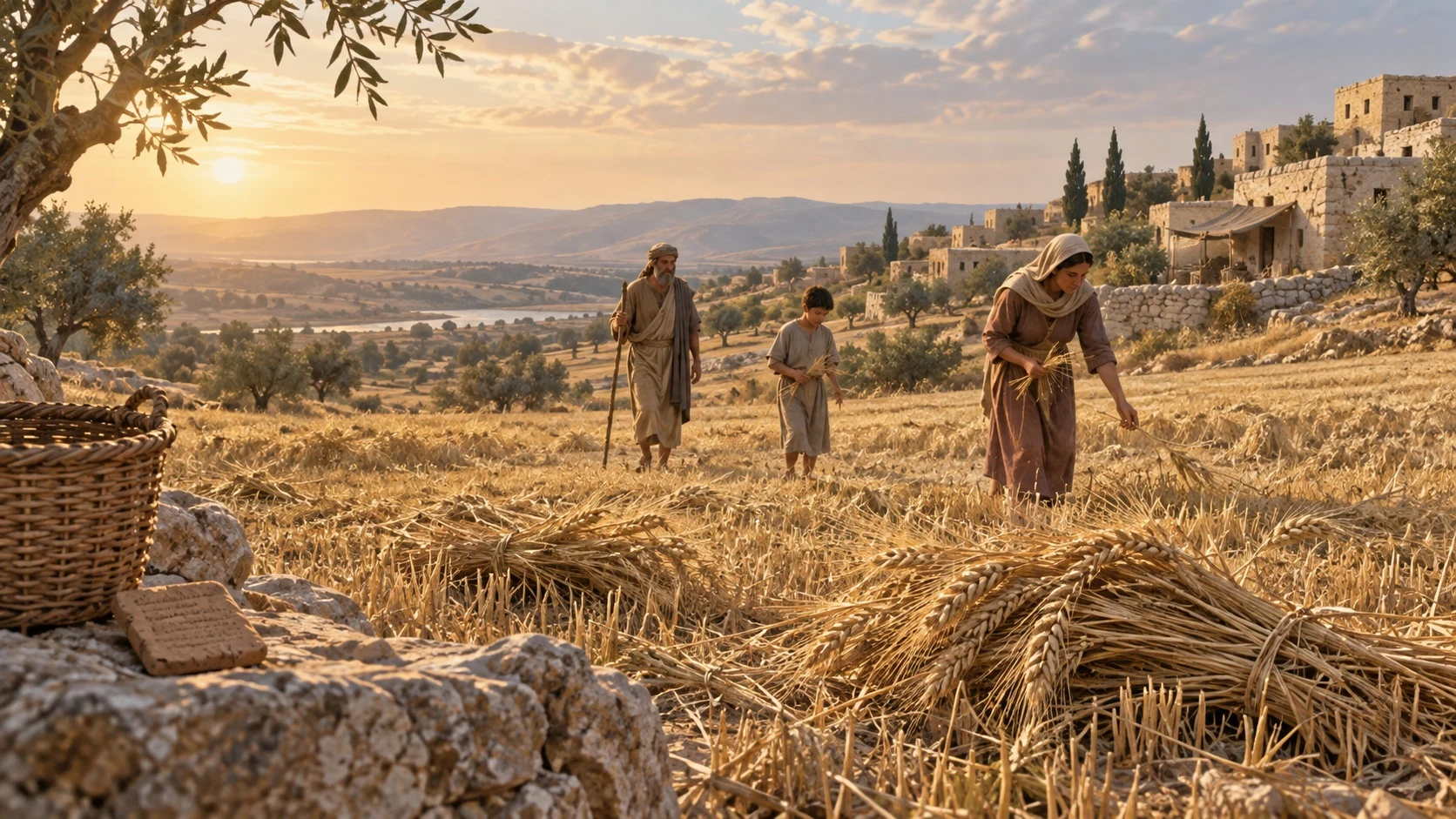
In Ruth 2, Ruth gathers grain left during the harvest and happens upon Boaz's field. He offers food and water and tells the workers to protect her. Naomi, learning whose field Ruth has entered, identifies Boaz as one of the relatives able to help them through redemption. The recognition of kinship thus precedes the property discussion at the city gate. [4]
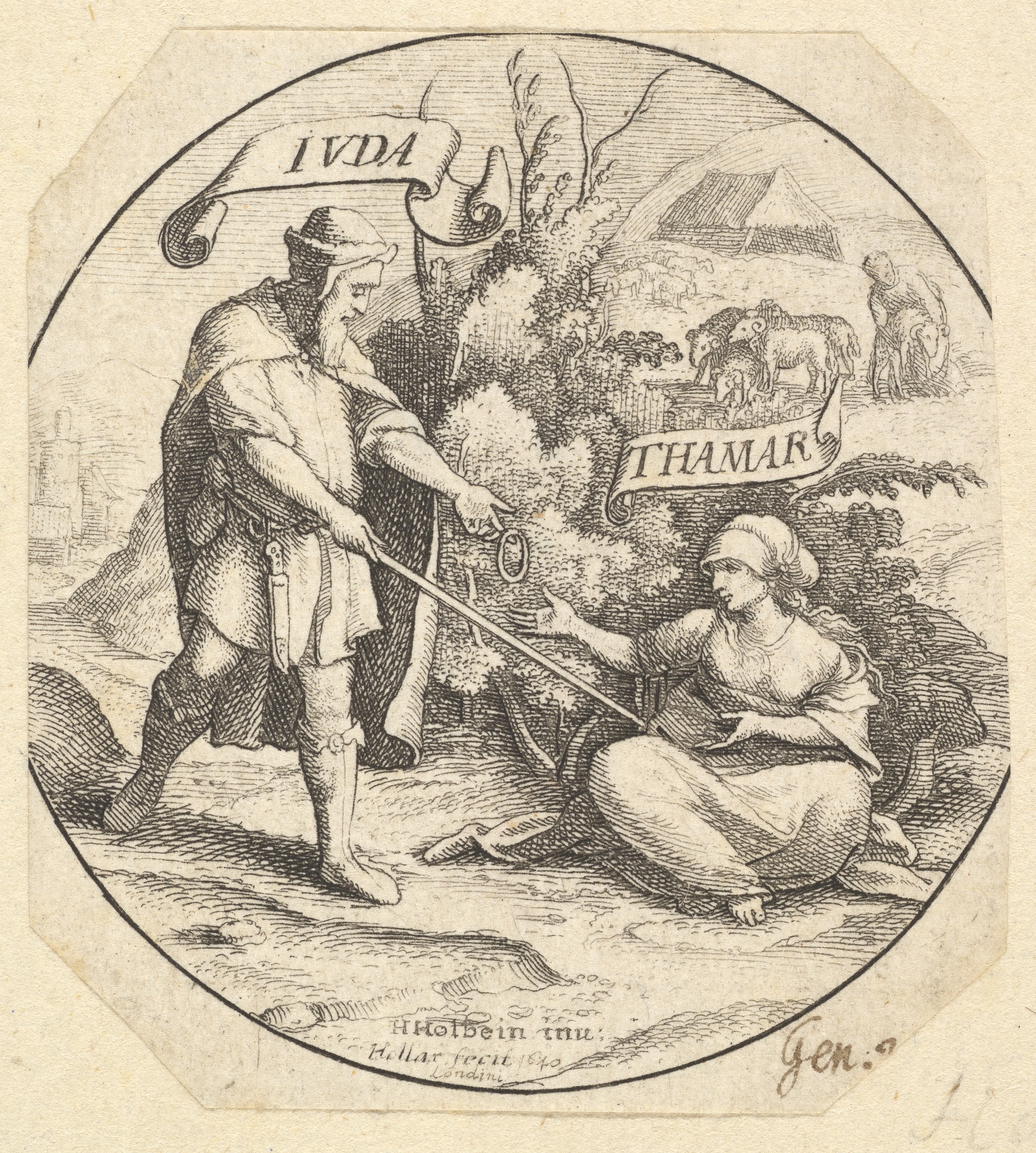
At the threshing floor in Ruth 3, Ruth asks Boaz to spread his garment or “wing” over her, explicitly invoking his status as a redeemer. Boaz replies that another relative is nearer and must receive the first opportunity. The narrator does not present this private conversation as the completion of a marriage; rather, the next public scene determines what is to happen. Some scholars have suggested sexual implications for the threshing-floor scene, but these remain interpretations, not events explicitly reported in the narrative. [4][8]
The negotiation at Bethlehem's gate
Boaz sits at the city gate, a place for public transactions, and gathers the nearer relative together with ten elders. He first raises the acquisition of a land interest associated with Elimelech and Naomi. The other relative initially agrees to redeem it. Boaz then connects the matter to Ruth and the perpetuation of the deceased man's name in his inheritance; the other man withdraws, saying that he might endanger his own inheritance. The text does not disclose his household circumstances or financial calculation, and we cannot establish a single precise motive for his refusal. [3]
Before witnesses Boaz declares that he has acquired the property associated with Elimelech and his sons Chilion and Mahlon from Naomi, and Ruth, Mahlon's widow, as his wife, so that the dead man's name will not disappear from his inheritance. This is the narrative's reported transaction. A separate surviving deed of conveyance or a contemporaneous local statute establishing the exact scope of the marriage obligation is not provided. [3][6]
The textual difficulty in Ruth 4:5
In this pivotal verse the Masoretic ketiv (written text) and qere (traditional reading) differ. The written form can be understood as first person, “I have acquired,” whereas the marginal reading addresses the relative, “you acquire.” The construction involving “from Ruth the Moabite” is also difficult. Consequently, translations and interpretations differ over who performs the acquisition and precisely how the widow's marriage is tied to the land. [5]
Raanan Eichler proposes a textual emendation which makes the acquisition of Ruth alongside the land more straightforward, supported by syntactic considerations and the Latin version. It is a scholarly reconstruction, not a newly discovered manuscript. Gary A. Rendsburg offers a different grammatical account preserving the written form, linked to a controversial reading of the threshing-floor episode. Milda de Vaal-Stanton discusses the legal problem in terms of land-use rights and social practice. These explanations cannot simply be combined as established facts. The soundest distinction is between Boaz's publicly stated actions in Ruth 4:9–10 and the unresolved question whether redemption legally required such a marriage. [5][6][8]
The sandal: transfer of a right, not public humiliation
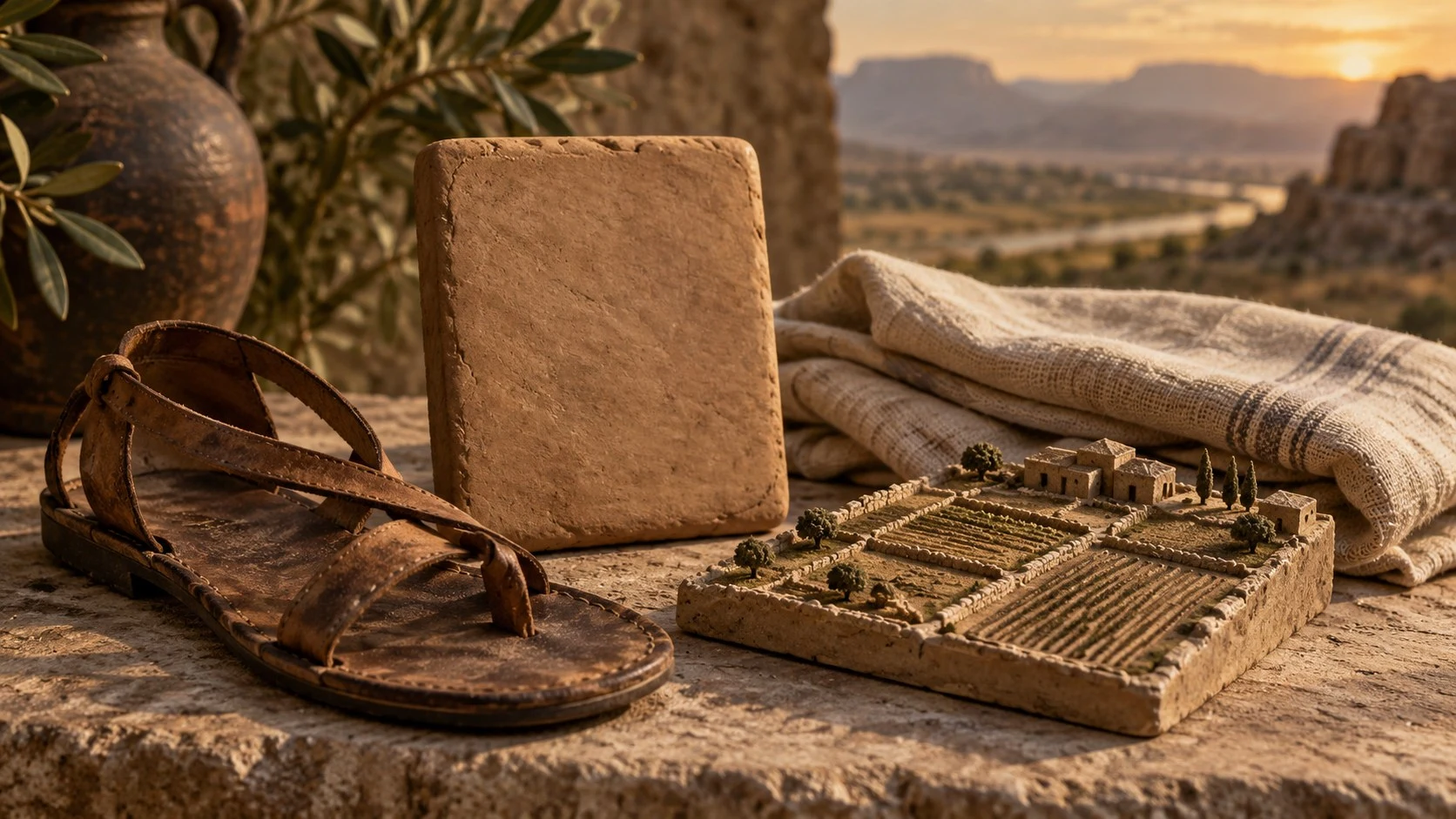
Ruth 4:7–8 explains a customary sign associated with redemption and exchange. In this scene the nearer relative removes his own sandal to confirm the arrangement before other people. There is no widow taking off his footwear, no spitting, and no public formula pronouncing shame upon the man. The narrator marks the relinquishment of an opportunity and its transfer to Boaz. [3]
Deuteronomy 25:9–10 depicts something different: when a brother refuses the prescribed marriage, the widow removes his sandal and spits in his presence before the elders. The symbols resemble one another, but their actors and functions differ. Scholars have also explored how the gate scene could bring together legal transaction and ritualized public action. That is an interpretative account of this literary scene, not proof of one universally uniform ancient ceremony. [1][7]
A child and the continuation of a name
Ruth bears a son, Obed, after her marriage to Boaz. The women of Bethlehem celebrate Naomi's restored future, and the book ends by tracing a line from Obed to Jesse and David. This is the genealogy articulated by the narrative; it does not, by itself, fix the historical date of a particular encounter at the gate. [3][9]
The child is not literally called Mahlon, although Boaz has said that he wishes to sustain the deceased man's name. In this story “raising up a name” is associated with remembrance and continuity in a family inheritance rather than a requirement to replicate a personal name. The women's language of a “redeemer” in connection with Naomi's restored household expresses relief, support and hope for the future; it is not a separate conveyance document demonstrating that the infant himself acquired land. [3]
Historical limits and the ethics of loyalty
Although the story locates itself in the time of the judges, scholars propose differing periods for its literary formation. They weigh genealogical framing, style, and possible engagement with later discussions of foreign marriage and community membership. Such arguments do not transform Ruth 4 into the verbatim minutes of a datable legal hearing. Ruth is a valuable witness to the representation of familial obligations and public customs, even where their precise historical scope remains uncertain. [9]
The Moabite Ruth's dedication to Naomi and Boaz's willingness to take responsibility for the threatened household are illuminated by the Hebrew idea of ḥesed: concrete, enduring loyalty and kindness. Some interpreters stress the voluntary character of Boaz's marriage rather than an automatic enforcement of the brother-in-law statute; others give more weight to customary land rights. These are different questions about law, negotiation and narrative purpose, not necessarily incompatible answers. [6][10]
In brief
The kinsman-redeemer in Ruth is a relative with an opportunity to recover an interest associated with a family's inheritance. The opportunity is first offered to a nearer kinsman and then taken by Boaz, who combines the land transaction with marriage to Ruth and an express intention to preserve the deceased man's name. The sandal signifies a witnessed transfer of the right, distinct from the widow's gesture in Deuteronomy 25. The exact legal connection in Ruth 4:5 remains debated; the story's larger movement is from family insecurity toward a future made possible by kinship, loyalty and choice. [3][5]
References and notes (10)
- Deuteronomy 25:5–10, Hebrew with JPS (1917) at Mechon-Mamre; surviving brother, widow, sandal and spitting. This is not the identical legal procedure of Ruth 4. Deuteronomy 25:5–10; Hebrew and JPS 1917, complete cited passage Return to the text ↑
- Leviticus 25:23–28, Hebrew and older JPS at Mechon-Mamre; family land redemption and calculation by remaining use years. Leviticus 25:23–28; Hebrew and JPS 1917, cited verses Return to the text ↑
- Ruth 4:1–17, Hebrew and JPS (1917) at Mechon-Mamre: public hearing, priority, sandal, Boaz’s declaration and genealogy; this literary witness is not an excavated property deed. Ruth 4:1–17; Hebrew and JPS 1917, complete chapter, especially 4:1–12, 13–17 Return to the text ↑
- Ruth 1–3, Hebrew and JPS (1917) at Mechon-Mamre; individual chapter pages checked: https://mechon-mamre.org/p/pt/pt2901.htm and https://mechon-mamre.org/p/pt/pt2902.htm as well as the linked chapter 3. Key passages: 1:1–5, 2:1–20, 3:9–13. Ruth 1:1–5, 1:11–18; 2:1–20; 3:9–13, Hebrew/JPS 1917; main link chapter 3 Return to the text ↑
- Raanan Eichler, “Acquiring Ruth with the Land: A Text-Critical Solution for Ruth 4:5,” TheTorah.com (2016); inspected his printed discussion of ketiv/qere and the proposed textual emendation, which is not a new manuscript witness. Article, “The Problem” and proposed solution; Ruth 4:5 Return to the text ↑
- Milda de Vaal-Stanton, “The Meaning and Implications of Ruth 4:5: A Grammatical, Socio-cultural and Juridical Investigation,” Old Testament Essays 28/3 (2015), 674–693, DOI 10.17159/2312-3621/2015/v28n3a7; abstract and relevant syntactic/legal sections inspected, including the proposed usufruct interpretation. Abstract and sections A, B, E, F; bibliographic references not individually verified Return to the text ↑
- B. E. J. H. Becking and A. M. Wetter, “Boaz in the Gate (Ruth 4,1–12): Legal Transaction or Religious Ritual?”, Zeitschrift für altorientalische und biblische Rechtsgeschichte 19 (2013), 253–265. University publication metadata and an indexed excerpt near p. 256 only; full article not retrieved. Utrecht metadata and indexed excerpt near p. 256; full pp. 253–265 not read Return to the text ↑
- Gary A. Rendsburg, “Boaz Married Ruth at the Threshing Floor: A Grammatical Solution to Ruth 4:5,” TheTorah.com (2020); inspected the proposed enclitic-mem analysis and speculative interpretation of the threshing-floor episode. Article, opening and grammatical solution to Ruth 4:5; reading of Ruth 3 Return to the text ↑
- E. Allen Jones III, “The Book of Ruth: Origin and Purpose,” Bible and Interpretation (hosted by the University of Arizona), November 2017; inspected the sections assessing divergent dates and purposes, not a full dating consensus. Online essay: “Framing the Problem,” “Framing the Solutions,” “Evaluating the Evidence” Return to the text ↑
- Damian O. Odo and Collins I. Ugwu, “I Will Marry Ruth So That the Name of the Dead Will Not Be Blotted Out: Exploring ḥesed in Ruth 4:1–13,” Verbum et Ecclesia 43/1 (2022), a2471, DOI 10.4102/ve.v43i1.2471; introduction, close reading and conclusion inspected, including their voluntary-loyalty argument. Article: introduction, close reading of Ruth 4:1–13, conclusion Return to the text ↑
Suggest a correction · Suggest a source for this record
Cite this record
IL Archive, «Kinsman-Redeemer in Ruth», https://ilarchive.com/en/entities/kinsman-redeemer
Continue reading