Artifact · Tablet
YBC 7289: An Old Babylonian Square and Its Diagonal
An object record bringing together its image, metadata, rights, and context.
- Timeline
- From 1900 BCE to 1600 BCE
- Region
- Mesopotamia
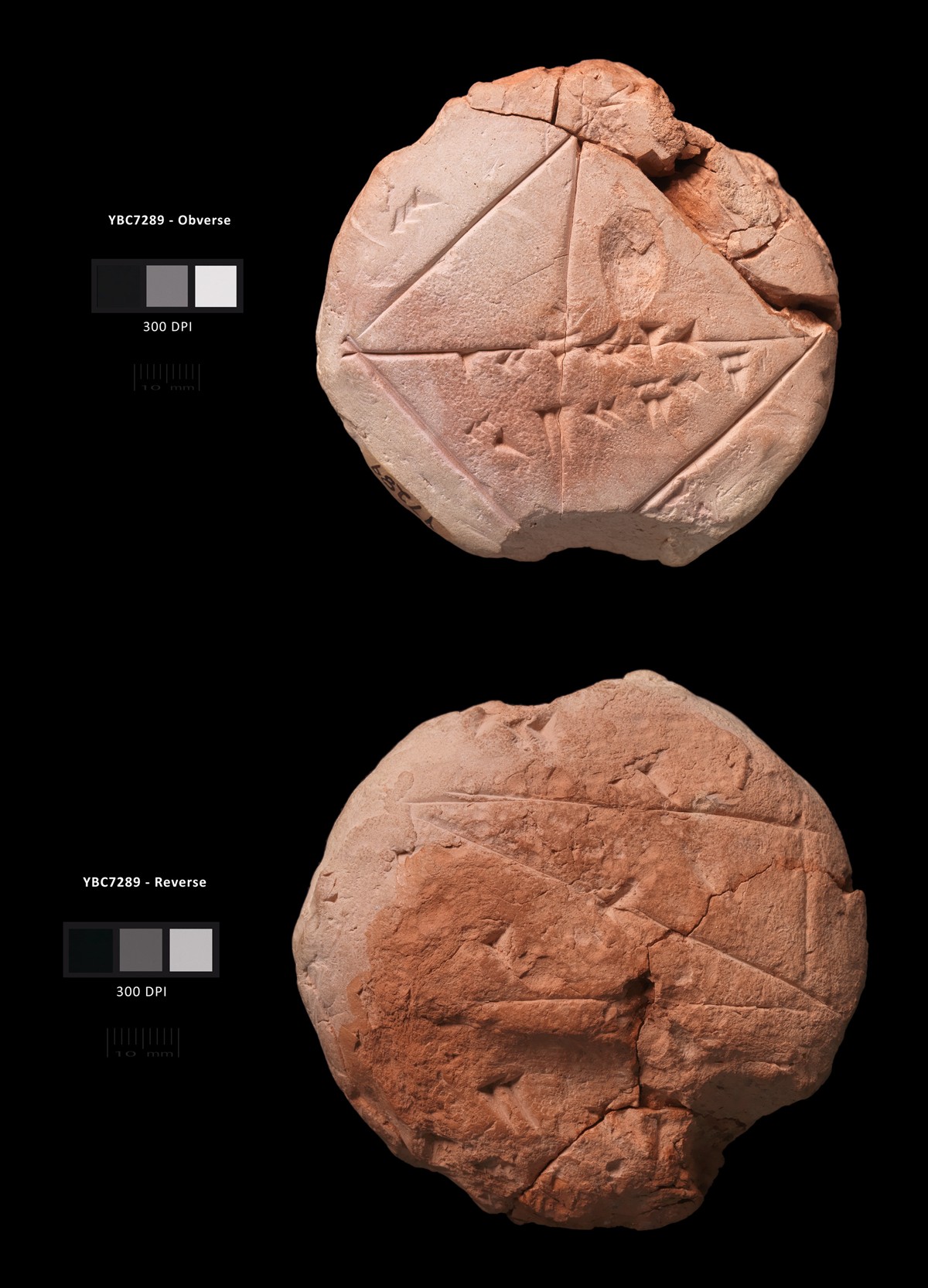
An Old Babylonian clay tablet shows how to find the diagonal of a square. Three groups of cuneiform numerals record the side, a remarkably close approximation of the square root of two, and the resulting diagonal.
Estimated reading time: 4 min Published Last reviewed:
Share article
Photograph
Photographs by A. Urcia, Yale Peabody Museum. Composite by Theodor Langhorne Franklin, via Wikimedia Commons. CC0 1.0.
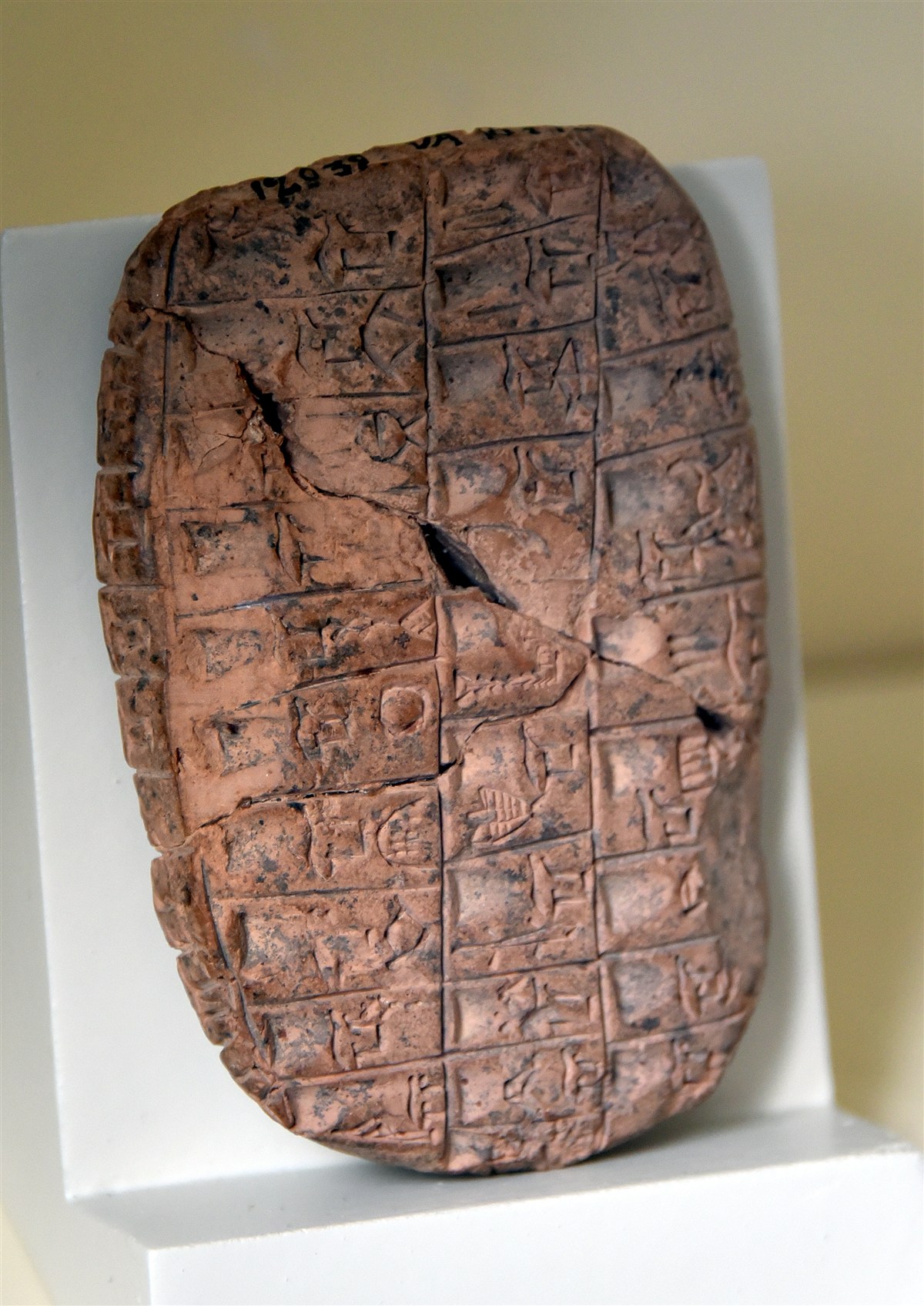
Both faces of YBC 7289. The obverse, at the top, shows the square and the three numeral groups
License · Image sourceObject details
- Title
- YBC 7289: An Old Babylonian Square and Its Diagonal
- Timeline
- From 1900 BCE to 1600 BCE
- Region
- Mesopotamia
- Rights
- CC0
Text
Introduction
On the front of a small clay tablet in the Yale Babylonian Collection, two diagonal lines cross a square. Three groups of cuneiformCuneiformWriting with wedge-shaped signs, developed from Mesopotamian recording traditions and used for several languages from the third millennium BCE.Glossary · Click to read the explanation numerals give the length of one side, the factor used to calculate the diagonal and the result. The factor, written as `1;24,51,10` in modern base-60 notation, is an approximation of the square root of two. The tablet dates to about 1900–1600 BCE. [1][2]
A drawing in clay
YBC 7289 is roughly round and measures 72 × 72 × 28 mm. Its museum number is 021354. The Cuneiform Digital Library Initiative lists the findspot as uncertain. In a collection highlight, Klaus Wagensonner names Larsa in southern MesopotamiaMesopotamiaHistorical region associated with the Tigris and Euphrates: Uruk, Ur, Eridu, cuneiform, Sumer, Akkad, Babylon and Assyria, their languages and cults, and the limits of archaeological evidence.Glossary · Click to read the explanation as a possible place of origin. The reverse is harder to make out. The digital edition tentatively identifies traces of an erased exercise with a right triangle. [1][4]
The diagram on the front puts the number 30 next to a side. Along one diagonal are two more strings of numerals. The first reads `1,24,51,10` and the second `42,25,35`. Their positions connect the numbers to the lines they describe. Together, the drawing and the numbers give enough information to check a calculation. [1][2]
Reading the three numbers
The scribes used a place-value system based on 60. Moving one place to the right divides the value by 60. A modern transcription uses a semicolon to mark the boundary between units and fractions. The coefficient `1;24,51,10` is therefore one plus 24 sixtieths, 51 parts in 3600 and 10 parts in 216000. In decimal notation it starts 1.41421296. The square root of two starts 1.41421356. The difference is about six ten-millionths. The gap is less than half the step of 1/216000 between successive values with four base-60 places. [1][2][7]
With the side read as 30 units, multiplying it by this coefficient gives `42;25,35`, or 42 plus 25 sixtieths and 35 parts in 3600. That works because the diagonal of any square is its side multiplied by the square root of two. The tablet's result uses the approximation preserved just above it. [1][2][3]
The original signs have no separator to fix the scale. The side can also be read as `0;30`, or one half, and the lower number as `0;42,25,35`. The same multiplication works at that scale, and the result then approximates the reciprocal of the square root of two. [1][2][7]
A likely exercise for a trainee scribe
The compact, rounded form is typical of hand tablets used in scribal education for short tasks. David Fowler and Eleanor Robson interpret YBC 7289 as an exercise in using a known coefficient. The same value occurs in the Old Babylonian coefficient list YBC 7243. A pupil could use such a list as a reference when a problem called for a length or area. The three numeral groups on YBC 7289 preserve the application of the coefficient. Its original derivation has to be investigated through other evidence. [2][3][7][8]
The tablet came to Yale in 1909 as part of J. Pierpont Morgan's donation of cuneiform tablets. Yale's Institute for the Preservation of Cultural Heritage has since published a three-dimensional scan of the object, so both faces can be examined alongside the drawing and numeric transcription. [5][6]
Quick answers
What is YBC 7289?
It is an Old Babylonian clay tablet with a diagram and calculations for the diagonal of a square. [1][2]
How close is its value to the square root of two?
Its base-60 coefficient works out to about 1.41421296. The square root of two is about 1.41421356. [1][2]
Was it a school exercise?
Fowler and Robson interpret it as a likely exercise by a trainee scribe who used a coefficient from a reference list. [3]
Where is the tablet kept?
It is in the Yale Babylonian Collection at the Yale Peabody Museum under the number 021354. [1][4][6]
References and notes
- Cuneiform Digital Library Initiative, “MCT 042 YBC 07289” (P255048) Artifact record and digital edition, obverse 1.a–1.b.2 and reverse. Dating, uncertain findspot, museum number and three numeral groups. Return to the text ↑
- Alexander Jones, Numbers on Clay, Institute for the Study of the Ancient World, New York University, 2010 Cover, “A Place-Value System” and object 12. Hand tablets, base-60 notation, drawing and decimal comparison. Return to the text ↑
- David Fowler and Eleanor Robson, “Square Root Approximations in Old Babylonian Mathematics: YBC 7289 in Context,” Historia Mathematica 25, no. 4 (1998), pp. 366–378 Abstract. Identifies the object as a likely exercise in using an approximation from a list of coefficients. Return to the text ↑
- Klaus Wagensonner, “Finding the Diagonal of a Square,” Yale Babylonian Collection highlights CDLI collection highlight 104. Dimensions, clay, museum number and tentative attribution to Larsa. Return to the text ↑
- Patrick Lynch, “A 3,800-year journey from classroom to classroom,” Yale News, 2016 Paragraphs on the tablet's use in teaching, imaging and J. Pierpont Morgan's 1909 donation. Return to the text ↑
- Yale Institute for the Preservation of Cultural Heritage Digitization Lab, The Diagonal of a Square Tablet Yale's published scan and its object description, inventory BC.021354. Return to the text ↑
- Martin J. Gander, Philippe Henry and Gerhard Wanner, “Landmarks in the History of Iterative Methods,” SIAM Review 68, no. 1 (2026) Section 1.1 and eq. (1.1). The decimal error, two readings of the scale and the occurrence of the value in a coefficient list. Return to the text ↑
- Cuneiform Digital Library Initiative, “MCT 136” (P255045) Catalogue entry for the Old Babylonian mathematical coefficient list YBC 7243. Return to the text ↑
Archive records may be reviewed and refined as better evidence or sources become available. Suggest a correction
Suggest a correction · Suggest a source for this record
Cite this record
IL Archive, «YBC 7289: An Old Babylonian Square and Its Diagonal», https://ilarchive.com/en/artifacts/ybc-7289-square-diagonal
Continue reading