Artifact · Tablet
Plimpton 322: An Old Babylonian Table of Numbers
An object record bringing together its image, metadata, rights, and context.
- Timeline
- From 1820 BCE to 1762 BCE
- Region
- Mesopotamia
Four columns of numbers on a broken Babylonian tablet preserve exact relationships between the sides and diagonals of rectangles. Their purpose remains debated, from scribal exercises to a study related to surveying.
Estimated reading time: 4 min Published Last reviewed:
Share article
Photograph
Photographer unidentified. Wikimedia Commons, Public domain Mark 1.0.
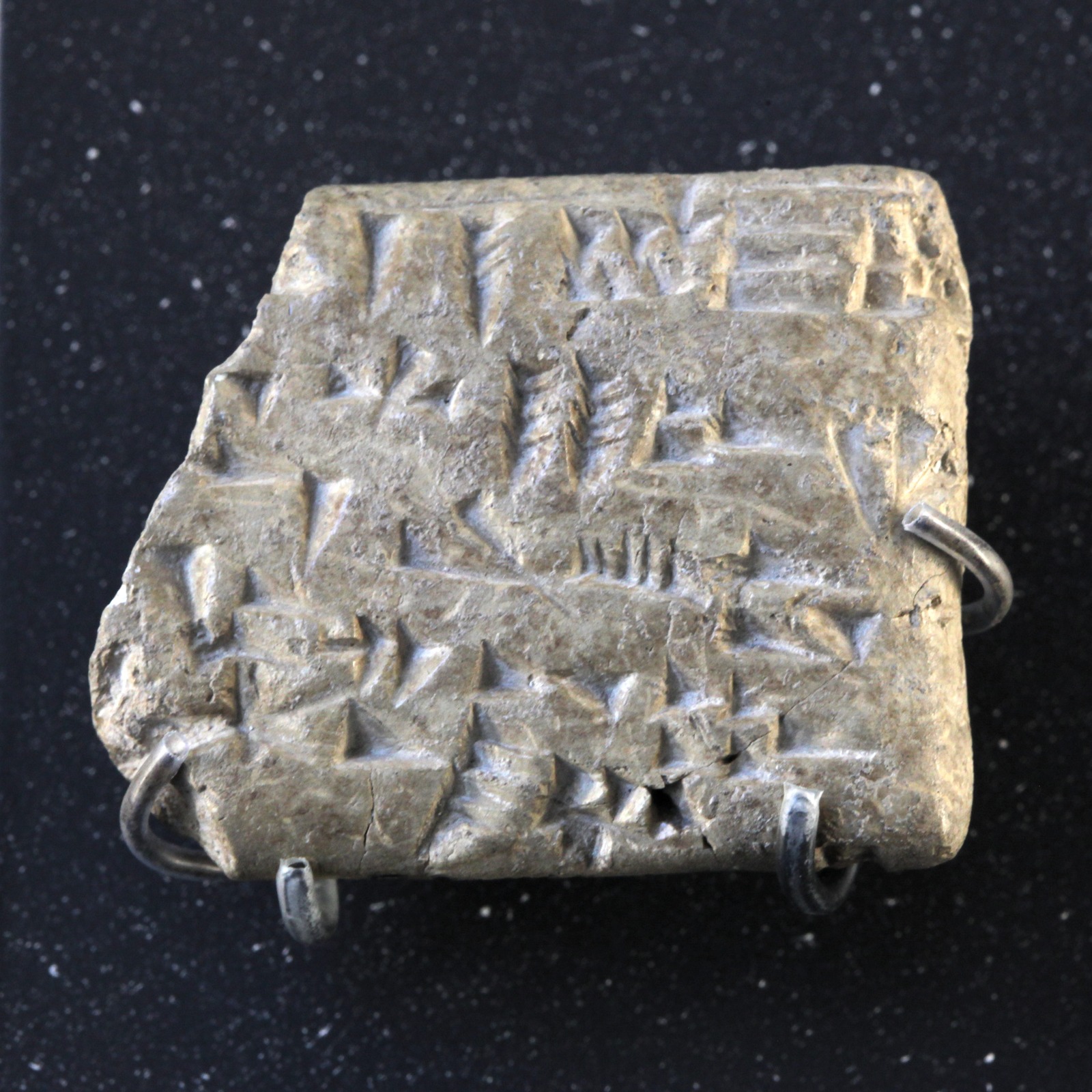
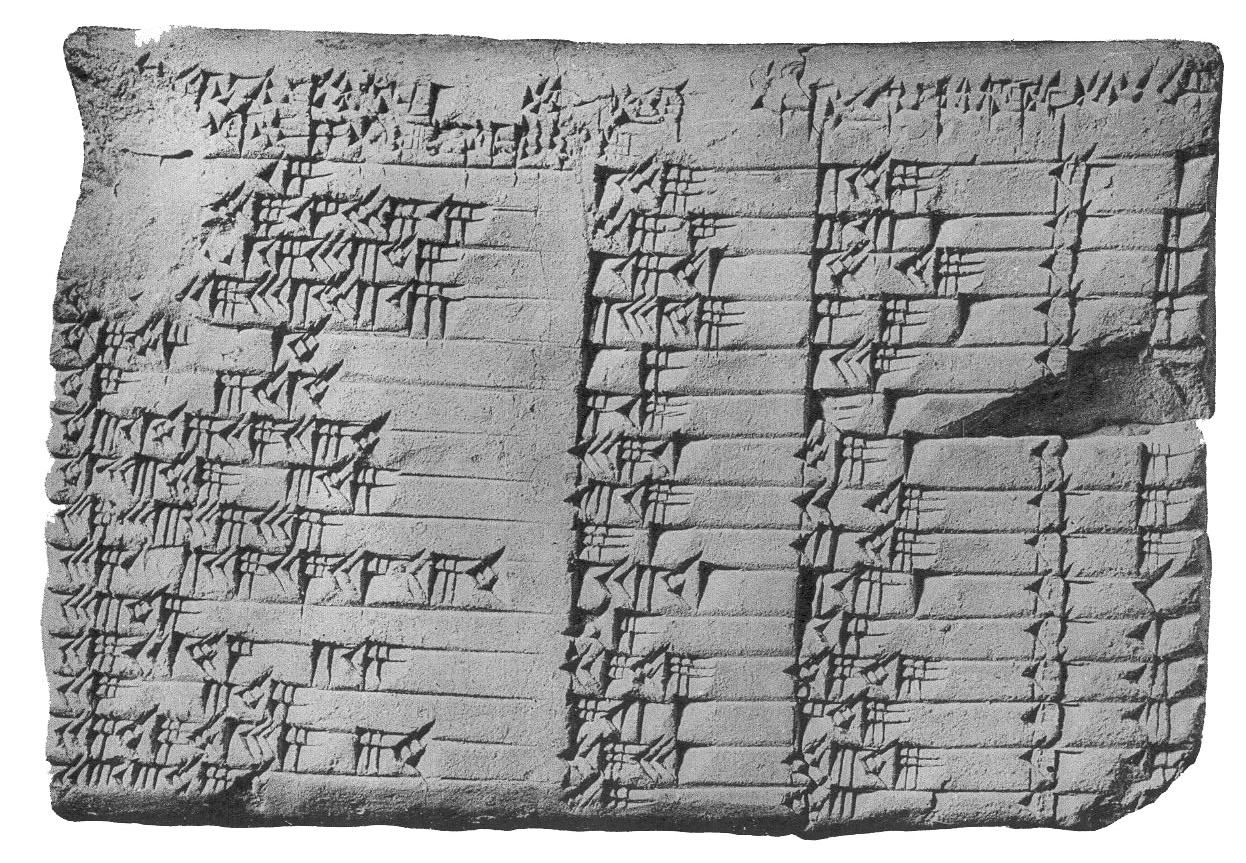
The surviving face of Plimpton 322. The left edge is broken and four ruled columns remain
License · Image sourceObject details
- Title
- Plimpton 322: An Old Babylonian Table of Numbers
- Timeline
- From 1820 BCE to 1762 BCE
- Region
- Mesopotamia
- Rights
- Public domain
Text
Introduction
Plimpton 322 is a mathematical clay tablet whose surviving face carries 15 rows in four columns of cuneiformCuneiformWriting with wedge-shaped signs, developed from Mesopotamian recording traditions and used for several languages from the third millennium BCE.Glossary · Click to read the explanation. It is kept in the Rare Book and Manuscript Library at Columbia University under the name of the collector George Arthur Plimpton. Columbia places it around 1820–1762 BCE. The Cuneiform Digital Library Initiative gives the wider Old Babylonian range of about 1900–1600 BCE and marks the attribution to Larsa as uncertain. [1][2][3][6]
The break in the clay and the surviving columns
The attribution to Larsa in southern MesopotamiaMesopotamiaHistorical region associated with the Tigris and Euphrates: Uruk, Ur, Eridu, cuneiform, Sumer, Akkad, Babylon and Assyria, their languages and cults, and the limits of archaeological evidence.Glossary · Click to read the explanation goes back to the dealer Edgar Banks, who sold the tablet to Plimpton. Eleanor Robson also compares its format and heading conventions with documents from Larsa. The assignment therefore has a basis in the dealer’s account and the tablet’s appearance, while a recorded excavation context is lacking. The left edge is broken, so the four surviving columns may be part of a wider table. What stood to their left remains a matter of reconstruction. [1][2][3][4][6]
The last column numbers the rows. The headings of the two middle columns refer to the short side and the diagonal, with a technical term traditionally rendered as “square-side”. Daniel Mansfield keeps that term partly open because it has other uses in Babylonian mathematics. In a widely used reading of the damaged first column, its numbers give the square of the diagonal after the long side has been scaled to 1. Subtracting 1 gives the square of the short side on that scale. The reading draws on both the surviving signs of the heading and the relationships among the numbers. [3][4][6]
Reading one row
The numbers are written in base 60. Values in successive places differ by powers of 60, though the tablet gives no sign fixing the absolute scale in the way a modern decimal point does. In a modern reading of the first row, the two recorded side entries give a short side of 119 and a diagonal of 169. Read as a rectangle on that scale, they imply a long side of 120. The relationship can be written as 119² + 120² = 169². The 120 in this example comes from the calculation. The surviving columns give the short side and the diagonal. [3][5][6]
Otto Neugebauer and Abraham Sachs identified these relationships in their 1945 edition. Mathematicians call such sets of three whole numbers Pythagorean triples. The term describes the relationship in modern vocabulary. The tablet is consequently evidence for working with these numbers in the Old Babylonian period. Its damaged heading and the occasional inconsistent entry also matter. For instance, Mansfield reads the short side in row 9 as 9:01 in sexagesimal notation, where the pattern suggests 8:01, and attributes the difference to copying. Such cases help scholars test proposed ways of generating the table. [1][3][4][6]
What might the scribe have used it for?
Robson proposed that the table helped a teacher prepare problems involving right triangles and pairs of numbers that multiply to 1. In her Oberwolfach report, Christine Proust presents the proposal she developed with John P. Britton and Steve Shnider. They read the table alongside other Old Babylonian rectangle problems and suggest that the scribe was looking for all the diagonals obtainable under certain rules. [3][4]
Daniel Mansfield and Norman Wildberger proposed a form of exact, ratio-based trigonometry in which the table is interpreted through the sides of rectangles, without the use of measured angles. In a later study, Mansfield emphasized rectangles with sides whose reciprocals have finite representations in base 60 and suggested a connection with land measurement. The surviving fragment preserves numerical relationships and headings. Its intended use still has to be inferred by comparing those features with other ancient mathematical texts. [4][5][6]
Quick answers
What is Plimpton 322?
It is a fragment of an Old Babylonian mathematical clay tablet with 15 rows of base-60 numbers in four surviving columns. [2][3][6]
Where is Plimpton 322 kept?
It is held by the Rare Book and Manuscript Library at Columbia University. [1][2]
Does the tablet contain Pythagorean triples?
Its numbers preserve side and diagonal relationships that correspond to such triples, including the first row’s 119, 120 and 169 in modern reconstruction. [3][5][6]
Was it a trigonometric table?
That is one published interpretation, based on ratios of sides. Other scholars interpret the table through teaching or the study of rectangles. [3][4][5][6]
References and notes
- Columbia University Libraries, ‘Cuneiform Tablet, Plimpton Cuneiform 322’, Our Tools of Learning exhibition Exhibition entry. Collection, approximate date and attribution to Larsa, early mathematical analysis and the proposed teaching function. Return to the text ↑
- Cuneiform Digital Library Initiative, ‘MCT 038, Plimpton 322’, P254790 Catalogue and administrative metadata. Accession, dating and uncertain provenance. Return to the text ↑
- Eleanor Robson, ‘Neither Sherlock Holmes nor Babylon: A Reassessment of Plimpton 322’, Historia Mathematica 28 (3), 2001, pp. 167–206 Pp. 171–176 and 200–202. Provenance, column headings, row 1 in table II and the teacher’s-aid interpretation. Return to the text ↑
- Christine Proust, “On the Nature of the Table Plimpton 322”, Oberwolfach Reports 8 (1), report 12/2011, pp. 662–665 Pp. 662–665. Larsa attribution, headings, first-row numbers and the search for possible diagonals. Return to the text ↑
- Daniel F. Mansfield and Norman J. Wildberger, ‘Plimpton 322 Is Babylonian Exact Sexagesimal Trigonometry’, Historia Mathematica 44 (4), 2017, pp. 395–419 Pp. 395–397 and 412–413. Ratio-based trigonometry using side lengths, and the numerical table including row 1. Return to the text ↑
- Daniel F. Mansfield, ‘Plimpton 322: A Study of Rectangles’, Foundations of Science 26, 2021, pp. 977–1005 Sections 3–5, especially tables 8 and 9. Headings, row 9 and its proposed error, regular sides and possible ties to surveying. Return to the text ↑
Archive records may be reviewed and refined as better evidence or sources become available. Suggest a correction
Suggest a correction · Suggest a source for this record
Cite this record
IL Archive, «Plimpton 322: An Old Babylonian Table of Numbers», https://ilarchive.com/en/artifacts/plimpton-322
Continue reading