Artifact · Inscription
The Yehimilk Inscription from Byblos (KAI 4)
An object record bringing together its image, metadata, rights, and context.
- Region
- The Levant
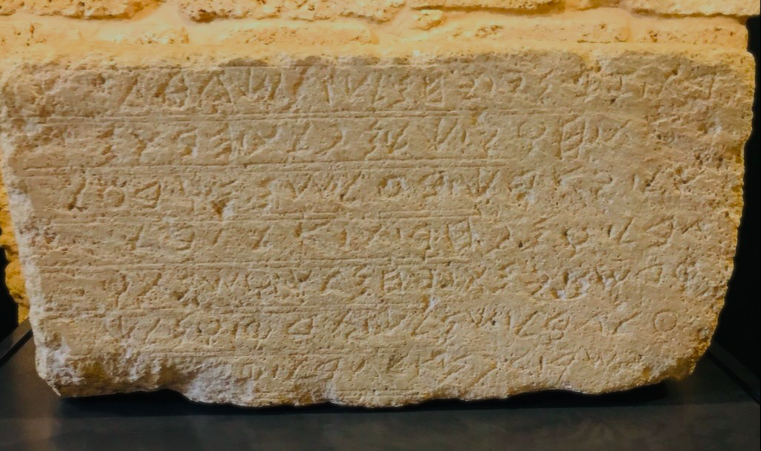
Seven lines on a limestone block tell how Yehimilk, king of Byblos, restored ruined temples and asked the city’s gods for a long reign. The stone also preserves clues that it may have carried an earlier inscription.
Estimated reading time: 4 min Published Last reviewed:
Share article
Photograph
Onceinawhile / Wikimedia Commons, CC BY-SA 4.0.
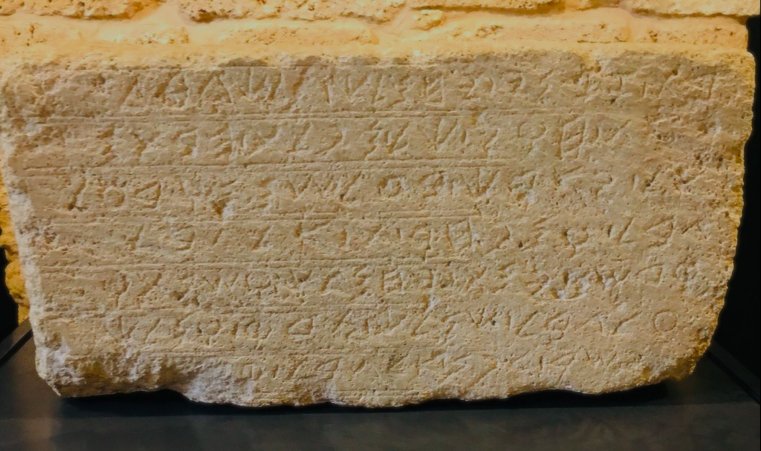
The seven-line Phoenician inscription of Yehimilk (KAI 4) on display in the museum of Byblos Castle, Lebanon
License · Image sourceVideo
The First Letter: How a Picture of an Ox Became Your Alphabet
The letter A began as a picture: the head of an ox, scratched into the rock of the Sinai desert perhaps close to four thousand years ago. Along the way we say plainly which answers are firm and which are still argued: when the alphabet was born, and whether miners or scribes made it. Some scenes are AI-generated illustrations.
The YouTube player loads only when you press play. Watch on YouTube
Object details
- Title
- The Yehimilk Inscription from Byblos (KAI 4)
- Region
- The Levant
- Rights
- CC BY-SA
Text
Introduction
The first line of the Yehimilk inscription mentions a temple and names the king who built it. The next lines say that Yehimilk restored the city’s ruined temples, then ask its gods to prolong his reign. The seven lines are cut in Phoenician on a limestone block found at ByblosByblos / JbeilByblos, or Jbeil, is a coastal city in Lebanon north of Beirut.Glossary · Click to read the explanation in 1929 and now kept in the museum of Byblos Castle in Lebanon. Maurice Dunand published the text in 1930. It is catalogued as KAI 4 and as no. 6 in John C. L. Gibson’s edition of Phoenician inscriptions. [1][2]
The stone and the traces underneath
The lettering follows horizontal registers. Wallenfels notes that short vertical strokes divide words here and in several other early inscriptions from Byblos. The right margin shifts inward near the damaged lower corner. On the reading presented in the DEAPS catalogue, the stone had already broken away from a larger block when the Phoenician text was cut. The shape of a stone can therefore help establish the sequence of work even when the dates of the individual stages are unknown. [1][2]
Malachi Martin identified traces of an earlier inscription in the writing conventionally called the Byblos script, or Byblian pseudo-hieroglyphic. Juan-Pablo Vita and José-Ángel Zamora point to apparent signs near the ends of some lines beyond the Phoenician letters, and to older ruling lines that survive only in part. Their photograph and Martin’s drawing help locate the marks. Benjamin Sass noted that the surface is worn and pitted, and reported difficulty confirming the supposed signs himself. The proposed earlier layer would make the stone a palimpsest, a surface written on more than once. The surviving marks do not yield a readable earlier dedication. [1][3][4]
The building and the prayer
Gibson reads the opening as a reference to building or rebuilding a temple. In line 2, Yehimilk takes credit for restoring the ruins of several temples. Aaron Schade calls attention to how the two statements are arranged. The first starts with the temple and leads to Yehimilk’s name and title. The second starts with the person who did the work and ends with the temples. The reversal places the title of king at the centre of the passage and gives prominence to the change from a single temple to several. [1][5]
Starting in line 3, the text asks BaalshaminBaalshaminCelestial deity attested in the Palmyrene region of Syria; depicted with Aglibol and Malakbel in a Louvre relief.Glossary · Click to read the explanation, a second deity and the assembly of the holy gods of Byblos to extend Yehimilk’s days and years over the city. The second name is written bʿl gbl, literally “Lord of Byblos”. Schade retains that reading. Gibson translates “Mistress of Byblos”, taking the missing final t in bʿlt as a stonecutter’s omission. The feminine form is written out in Šipitbaal’s inscription, KAI 7. The closing lines of Yehimilk’s text present him as a just and upright king in the eyes of the city’s gods. [1][5][7]
The king’s family and the date
The stone itself names no parent. The Louvre’s reading of the Phoenician dedication on the Egyptian bust of Osorkon I, KAI 6, identifies its dedicator Elibaal as Yehimilk’s son. KAI 7 names both Elibaal and Yehimilk in Šipitbaal’s line of descent. Some scholars have read the omission on KAI 4 and its emphasis on rightful rule as signs that Yehimilk may have founded a dynasty. His own inscription gives neither the circumstances of his accession nor the length of his reign. [1][5][6][7]
DEAPS assigns KAI 4 a date of 950–920 BCE based on the shapes of its letters. The wider group of early royal Byblian inscriptions has also been dated later. Wallenfels points out that the reigns of the Egyptian pharaohs depicted on reused objects provide the earliest possible dates for the Phoenician inscriptions added to those objects. The Egyptian dates alone cannot show how soon the Phoenician texts were carved, and KAI 4 is on a separate block. Sass also argues for a lower chronology for the early corpus. [1][2][4][6]
Quick answers
What is the Yehimilk inscription?
It is a seven-line Phoenician inscription in which Yehimilk, king of Byblos, recalls work on temples and asks the city’s gods for a long reign. [1]
Where is the stone today?
The stone is kept in the museum of Byblos Castle in Lebanon. [1]
When was it carved?
DEAPS dates the inscription to 950–920 BCE from its letterforms. Later dates have been proposed for the group of early royal inscriptions from Byblos. [1][2][4]
Is this the Yehawmilk stele?
The Yehawmilk stele is a separate monument from Byblos. The Louvre catalogues it as AO 22368 and KAI 10 and dates it to around 450 BCE. [8]
References and notes
- James D. Moore and Cody Beasley, ‘KAI 004’, Digital Editions of Aramaic and Phoenician Sources, The Ohio State University Catalogue and textual notes, with John C. L. Gibson’s edition and translation, lines 1–7. Return to the text ↑
- Ronald Wallenfels, ‘Redating the Byblian Inscriptions’, Journal of the Ancient Near Eastern Society 15 (1983) Pp. 85–89 and plate VI. Limestone block, discovery, word dividers and the limits of the dates supplied by the Egyptian statues. Return to the text ↑
- Juan-Pablo Vita and José-Ángel Zamora, ‘The Byblos Script’, Studi micenei ed egeo-anatolici, n.s., suppl. 1 (2018), pp. 75–102 Pp. 87–88, especially fig. 18 and n. 5. Possible traces of Byblos script and the earlier ruling. Return to the text ↑
- Benjamin Sass, ‘The Pseudo-Hieroglyphic Inscriptions from Byblos, Their Elusive Dating, and Their Affinities with the Early Phoenician Inscriptions’, in Philippe Abrahami and Laura Battini (eds.), Cultures et sociétés syro-mésopotamiennes, Archaeopress, 2019, pp. 157–180 Pp. 170–172, especially fig. 21 and n. 17. Condition of the stone, difficulty confirming an earlier text and the later chronology proposed for the royal inscriptions. Return to the text ↑
- Aaron Schade, ‘The Syntax and Literary Structure of the Phoenician Inscription of Yeḥimilk’, Maarav 13 (1), 2006, pp. 119–122 Pp. 120–122, especially n. 7. The order of words in the opening, the reading ‘Lord of Byblos’ and the interpretation of the closing description of the king. Return to the text ↑
- Musée du Louvre, ‘Statue d’Osorkon Ier’, AO 9502, KAI 6 Catalogue and Phoenician dedication. Egyptian statue and the identification of Elibaal as son of Yehimilk. Return to the text ↑
- James D. Moore and Cody Beasley, ‘KAI 007’, Digital Editions of Aramaic and Phoenician Sources, The Ohio State University Gibson’s edition and translation, lines 1–5. Šipitbaal’s ancestry and the written feminine form of the title of the Mistress of Byblos. Return to the text ↑
- Musée du Louvre, ‘Stèle de Yehawmilk’, AO 22368, KAI 10 Catalogue. Identification and approximate date of the later stele. Return to the text ↑
Archive records may be reviewed and refined as better evidence or sources become available. Suggest a correction
Suggest a correction · Suggest a source for this record
Cite this record
IL Archive, «The Yehimilk Inscription from Byblos (KAI 4)», https://ilarchive.com/en/artifacts/yehimilk-inscription-kai4
Continue reading