Artifact · Inscription
The Ur-Namma Stela from Ur (Penn Museum B16676)
An object record bringing together its image, metadata, rights, and context.
- Timeline
- From 2112 BCE to 2004 BCE
- Region
- Mesopotamia
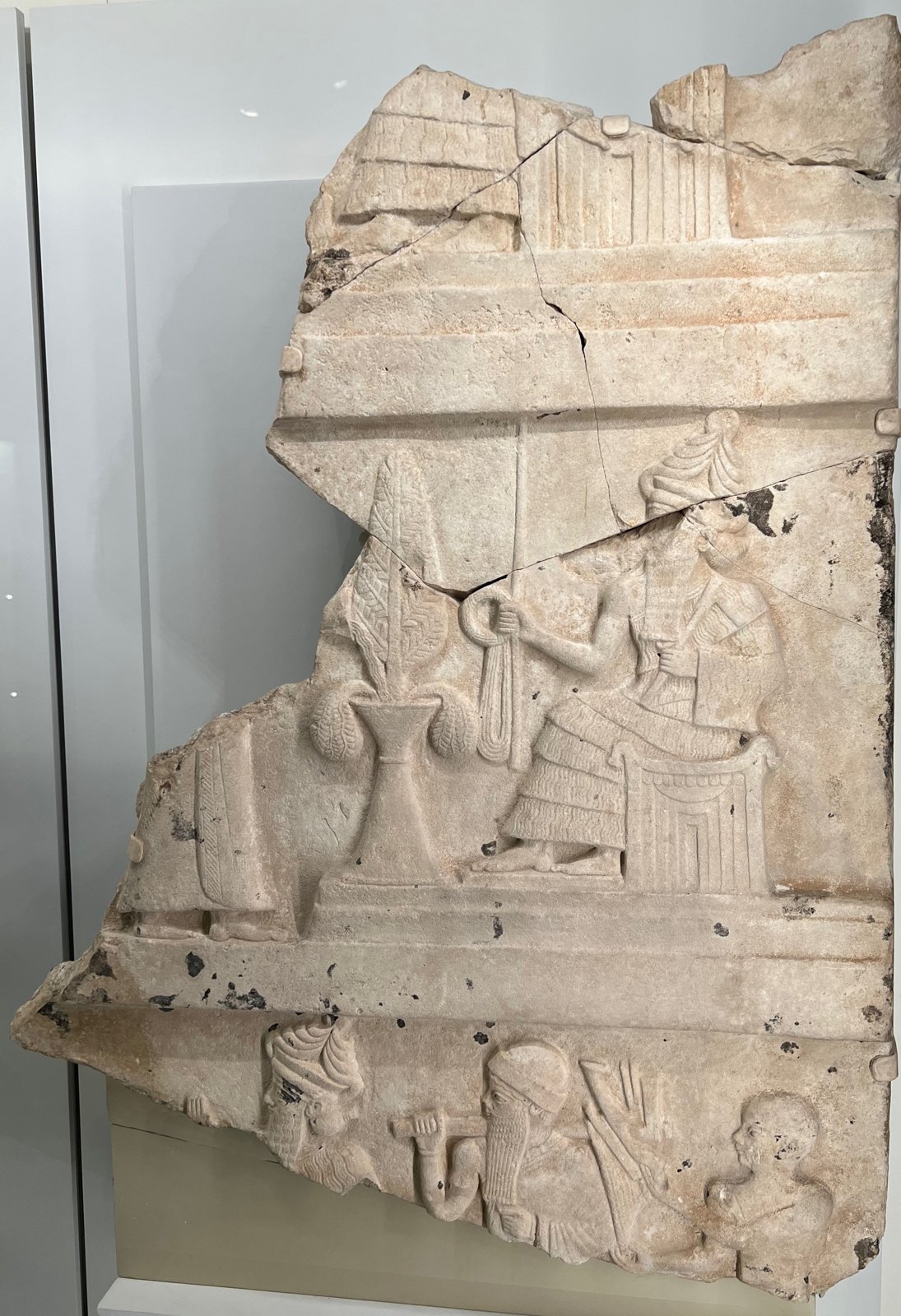
A king pours an offering before an enthroned god on a broken limestone monument from Ur. Excavation records and successive reconstructions show how scholars recovered its scenes and why the royal patron remains uncertain.
Estimated reading time: 4 min Published Last reviewed:
Share article
Photograph
Onceinawhile, via Wikimedia Commons, CC BY-SA 4.0. Cropped by Zunkir and resized.
Fragment of the Ur-Namma Stela, showing the enthroned deity identified as Nanna (Penn Museum B16676.14)
License · Image sourceObject details
- Title
- The Ur-Namma Stela from Ur (Penn Museum B16676)
- Timeline
- From 2112 BCE to 2004 BCE
- Region
- Mesopotamia
- Rights
- CC BY-SA
Text
Introduction
A seated deity and the remains of a royal figure face each other on a limestone fragment from ancient UrUr of the ChaldeansCity named in Genesis’s account of Abraham’s family, commonly associated with archaeological Ur near Nasiriyah in southern Iraq.Glossary · Click to read the explanation. The fragment, now displayed at the Penn Museum as B16676.14, preserves part of the monument conventionally called the Ur-Namma Stela. Its reliefs show a ruler making offerings and taking part in construction. Separate fragments, worn surfaces and a damaged inscription have left room for different reconstructions of the scenes and for debate over who commissioned the monument. [1][2][3][4][5]
Finding the pieces and reassembling the stela
The joint expedition of the British Museum and the University Museum in Philadelphia, directed by Leonard Woolley, recovered the pieces at Ur in the 1920s. Canby places the discovery of most fragments in March 1925, in deposits near the shrine and lawcourt of E-dublal-mah and the zigguratZigguratZiggurat: a monumental stepped or terraced cult structure of ancient Mesopotamia. Not every raised temple platform was a ziggurat, and the form and specific use of lost upper stages often remain uncertain.Glossary · Click to read the explanation. Most came from much later Kassite levels. Some had been reused in masonry, and one was found under a Kassite temple pavement. Its position shows that the monument was already broken before that floor was laid. Its original position is still a matter of reconstruction. [3][4]
The 1920s restoration set selected fragments into plaster. Canby examined pieces that had remained in storage, using the positions of broken edges and the different condition of the two carved faces to decide where they could fit. Some of the plaster covered evidence needed to test those joins. The earlier assembly stood about three metres high. Hafford describes the original as an arch-topped slab nearly four metres high, with five registers on each face. These figures refer to different stages of reconstructing the monument. The museum’s 2019 gallery companion describes how laser scans of the surviving fragments in the early 2000s helped produce a life-size reconstruction. [2][3][4]
Offerings and building work
The Penn fragment B16676.14 is 97 centimetres high, 72.5 wide and 15 deep. The seated deity in the well-preserved offering scene is identified as NannaNanna / Su’en / SinMesopotamian moon god known as Nanna, Su’en and Sîn/Sin. Worshipped especially at Ur and Harran, he is associated with the crescent and lunar cycle; names and myths have different histories.Glossary · Click to read the explanation, the moon god of Ur, in the museum’s gallery companion. A plant rises from a vessel between the god and the damaged figure of the king. In the upper scenes, hovering female figures carry vessels from which water flows. Léon Legrain called the monument the “Stela of the Flying Angels” in his 1927 account, taking the title from those figures. [1][2][3][4]
Woolley read the scenes as closely symmetrical. Canby proposed several different episodes across the upper bands. In the lower construction scene, broken pieces preserve brickwork, sections of ladders and people at work. Canby argued that the remains of two ladders slanting in different directions required moving a ladder from its place in the first reconstruction. She also proposed that a sloping wall and a recessed doorway could belong to two separate structures shown in the same scene. One Penn fragment, B16676.18, is catalogued as a figure at the top of a ladder. [3][6]
The name and the royal patron
Legrain attached a small piece bearing Ur-Namma’s name to the reconstruction of the royal garment, while acknowledging uncertainty about its position. Hafford explains that the inscribed fragment was later assigned to another monument. The incomplete text on the stela itself mentions canal construction. Hafford notes that the Sumerian verb ba-al, “to dig”, occurs chiefly in texts of Ur-Namma. The text connects the monument to the king’s building works, and its carving and archaeological context point to the Third Dynasty of Ur. [2][3][4]
The Penn catalogue dates fragment B16676.14 to about 2112–2095 BCE, within the wider range of about 2112–2004 BCE for the Third Dynasty of Ur. Legrain already considered the possibility that Ur-Namma’s son and successor Shulgi had erected the monument, and Irene Winter favours Shulgi as the commissioner. In her reading, the front shows the king serving the gods, while a damaged scene on the reverse may show a royal figure receiving a libation. The identities of the figure and the commissioner remain open. [1][2][4][5][7]
Quick answers
What is the Ur-Namma Stela?
It is a fragmentary, two-sided limestone monument from Ur, carved with scenes of royal offerings and building work. [2][3][4]
Where is the photographed fragment?
Fragment B16676.14 is on display in the Penn Museum’s Middle East Galleries in Philadelphia. [1]
Who commissioned the stela?
The monument is conventionally named after Ur-Namma. Shulgi, his son and successor, is another proposed patron. [2][4][5]
Why is it called the Stela of the Flying Angels?
Léon Legrain chose that title for the hovering female figures with vessels in the upper scenes. [2][3]
References and notes
- Penn Museum, ‘Ur-Namu Stele’, B16676.14 Catalogue entry. Fragment number, provenance, dimensions, attributed date and gallery location. Return to the text ↑
- Léon Legrain, ‘The Stela of the Flying Angels’, The Museum Journal 18 (1), 1927, pp. 74–98 Pp. 74–86. Limestone and dimensions of the reconstruction, hovering figures, early placement of the inscribed fragment and the question of the patron. Return to the text ↑
- Jeanny Vorys Canby, ‘A Monumental Puzzle: Reconstructing the Ur-Nammu Stela’, Expedition 29 (1), 1987, pp. 54–64 Sections on the discovery, new restoration and upper and lower registers. Kassite deposits, surface condition, shifts in the placement of fragments and the building scene. Return to the text ↑
- William B. Hafford, ‘The Ur-Namma Stele’, in Steve Tinney and Karen Sonik (eds.), Journey to the City: A Companion to the Middle East Galleries at the Penn Museum, 2019, pp. 93–96 Pp. 93–95 and figs. 4S3.1–4S3.4. Reassignment of the name fragment, canal inscription, original size, modern reconstruction and proposed location. The relief is also discussed in the chapter’s section on temples. Return to the text ↑
- Irene J. Winter, ‘Touched by the Gods: Visual Evidence for the Divine Status of Rulers in the Ancient Near East’, in Nicole Brisch (ed.), Religion and Power: Divine Kingship in the Ancient World and Beyond, Oriental Institute Seminars 4, 2008, pp. 75–101 Pp. 77–78 and figs. 5.2–5.3. Shulgi as possible commissioner, the scenes of royal service and the interpretation of the damaged scene on the reverse. Return to the text ↑
- Penn Museum, ‘Ur-Namu Stele’, B16676.18 Catalogue description of the fragment showing a figure at the top of a ladder. Return to the text ↑
- The Metropolitan Museum of Art, ‘Inscribed brick’ of Bur-Sin, collection record 324913 Catalogue commentary giving the conventional range of the Ur III period. Return to the text ↑
Archive records may be reviewed and refined as better evidence or sources become available. Suggest a correction
Suggest a correction · Suggest a source for this record
Cite this record
IL Archive, «The Ur-Namma Stela from Ur (Penn Museum B16676)», https://ilarchive.com/en/artifacts/ur-namma-stela-b16676
Continue reading