Artifact
The Seated Statue of Gudea (Metropolitan Museum of Art 59.2)
An object record bringing together its image, metadata, rights, and context.
- Region
- Mesopotamia
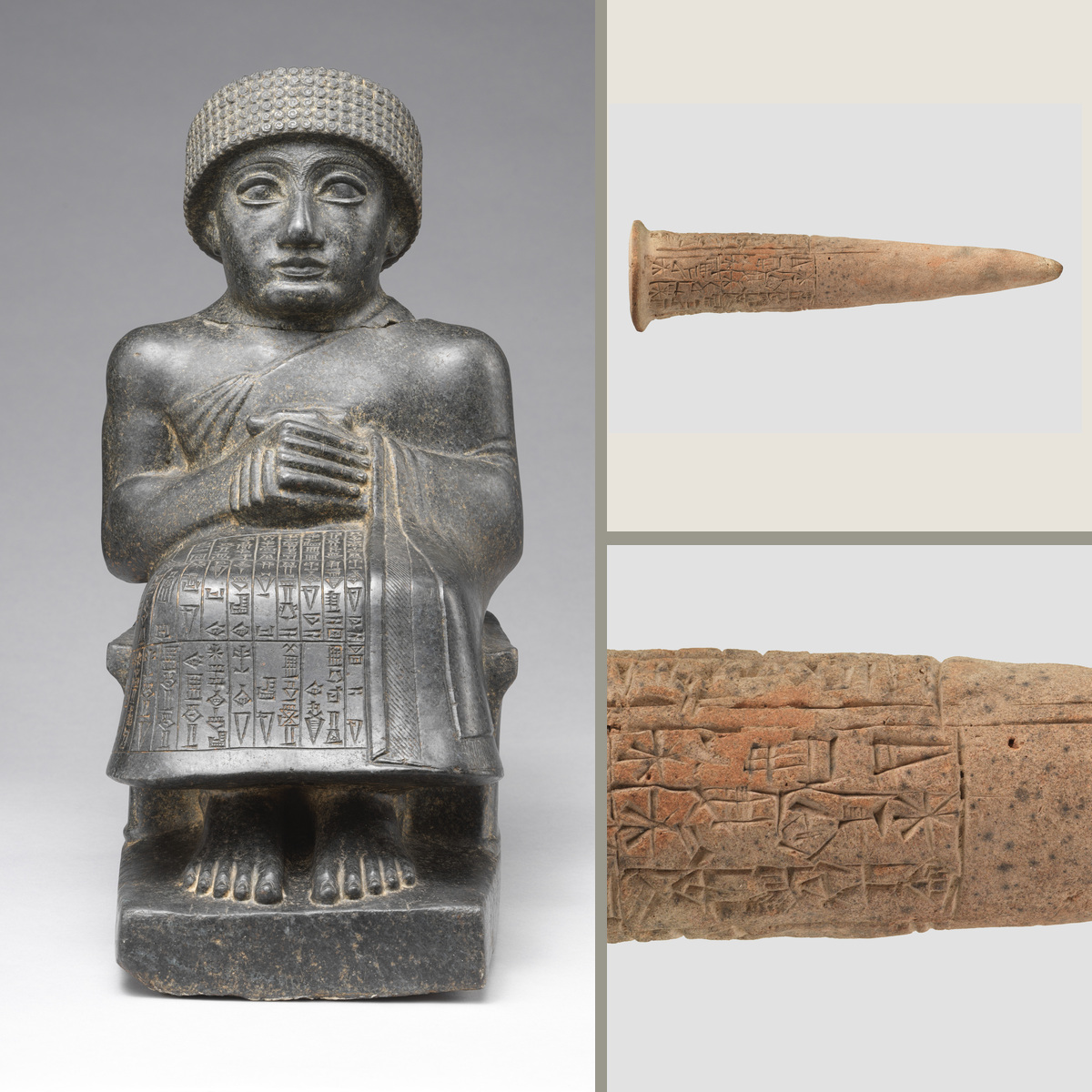
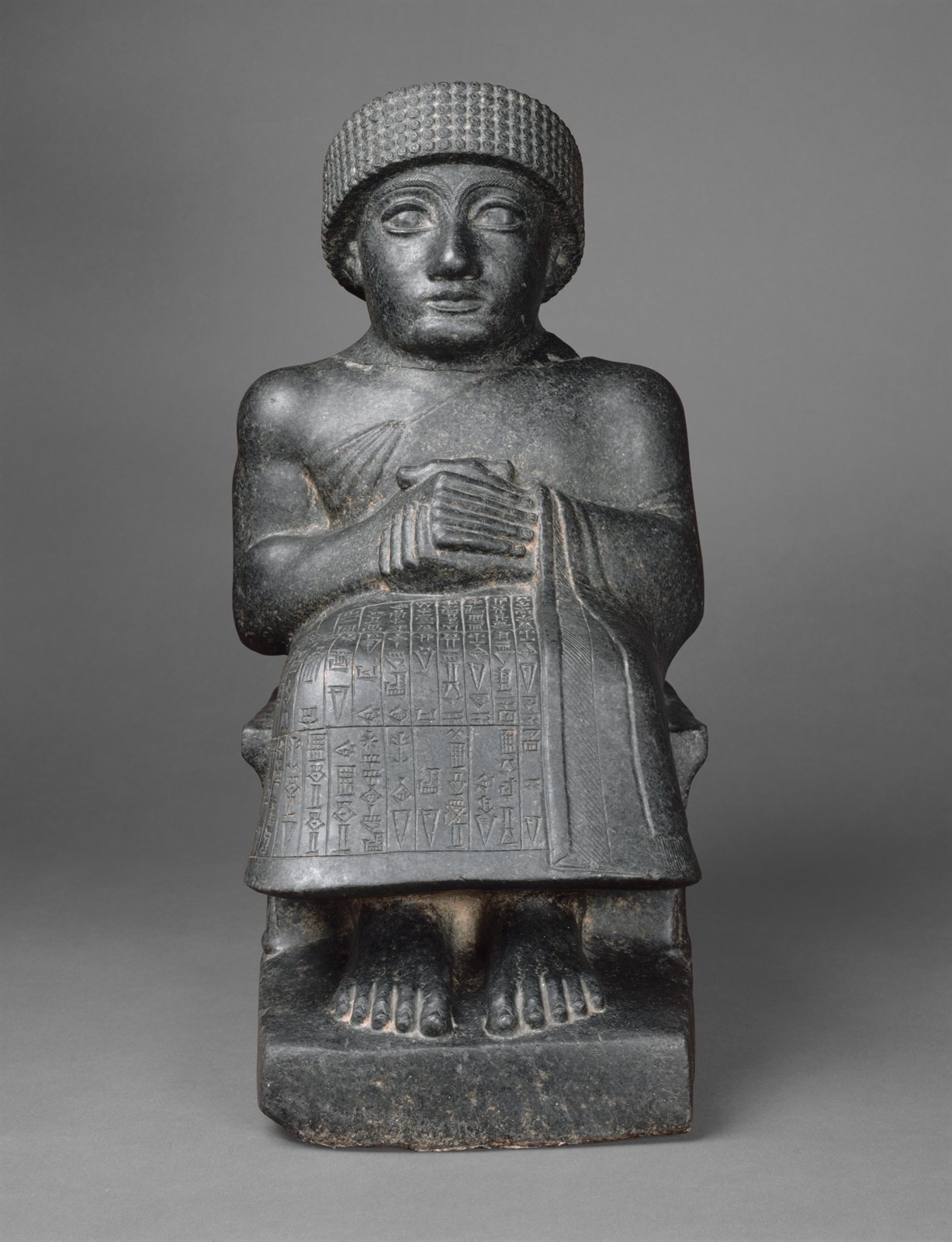
A seated figure of Gudea bears a Sumerian inscription that names temples and asks for the ruler’s long life. The Met dates the sculpture to about 2090 BCE, while several scholars have argued that it is a later imitation.
Estimated reading time: 4 min Published Last reviewed:
Share article
Photograph
The Metropolitan Museum of Art / Wikimedia Commons, CC0 1.0. Image resized.
Seated diorite figure of Gudea with hands joined and a Sumerian inscription across the garment (Metropolitan Museum of Art 59.2)
License · Image sourceObject details
- Title
- The Seated Statue of Gudea (Metropolitan Museum of Art 59.2)
- Region
- Mesopotamia
- Rights
- CC0
Text
Introduction
The seated figure of GudeaGudeaRuler of Lagash in the late third millennium BCE, whose inscriptions document temple construction and the name Anunna.Glossary · Click to read the explanation at the Metropolitan Museum of Art wears a rounded cap and brings his hands together in front of his chest. Columns of cuneiformCuneiformWriting with wedge-shaped signs, developed from Mesopotamian recording traditions and used for several languages from the third millennium BCE.Glossary · Click to read the explanation cover the front of his garment. The Met lists the diorite sculpture as 59.2 and dates it to about 2090 BCE. The inscription resembles those on two other statues of Gudea so closely that several scholars have questioned the date of this sculpture. [1][2][3][4]
The figure and its catalogue date
The museum records the sculpture as 44 centimetres high, 21.5 wide and 29.5 deep. Gudea’s robe crosses his chest, leaving one shoulder bare, and falls over his knees. Both bare feet rest on the base. The Met suggests Girsu, modern Tello in IraqIraqIraq is a modern country encompassing much of ancient MesopotamiaGlossary · Click to read the explanation, as the probable place of origin. It acquired the statue in 1959, with the Harris Brisbane Dick Fund. The Cuneiform Digital Library Initiative catalogues it as P232288, the object called Statue P in editions of Gudea’s royal inscriptions. [1][2]
In the Met’s interpretation, Gudea’s statues were intended to keep his image before the gods in their temples. Claudia E. Suter discusses this purpose for the series as a whole. She distinguishes the temples to which the inscriptions dedicate the statues from the settings in which some were eventually found. A statue’s dedication therefore gives information about its intended setting. [1][4]
The temples and the statue’s name
The inscription presents Ningirsu as the warrior of EnlilEnlilEnlil/Ellil: a major Mesopotamian god associated with destinies, kingship, and Ekur at Nippur, already prominent in third-millennium god lists. His name’s origin and cult beginnings remain debated.Glossary · Click to read the explanation and refers to Ningishzida as the son of Ninazu. It describes Ningirsu providing a place in the city and agricultural land for Ningishzida. Gudea appears as ruler of Lagash, favoured by his personal god. His title appears as ensi₂ in the transliteration, in column II, line 5, immediately after his name. The text credits him with building the Eninnu and another structure for Ningirsu. Column II, line 13, contains the numeral seven, which the Met renders in its translation of the building phrase as “heptagon”. The passage then refers to Nanše’s Sirara temple, to temples for the gods of Lagash, and to Ningishzida’s temple in Girsu. [1][2]
In the final column, Gudea has a statue of himself made and brought into Ningishzida’s temple. The inscription gives the image a name that asks for a long life for Gudea, the builder of the temple. That formula gives the statue a role within the dedication. The carving and its inscription present the ruler before the god, and the long-life wish is part of the name by which the image is identified. [1][2][3]
Why scholars compare Statues I, C and P
Horst Steible compares Statue P with Statue I, another small diorite figure in a seated pose. He gives their heights as 44 and 43 centimetres, respectively. He finds that the inscriptions are verbally parallel apart from the statue’s name. The wording of that name on P matches the wording on Statue C. Steible takes the two correspondences together as evidence that P was made in imitation of the ancient statues. [2][3]
Suter considers the possibility that a later inscription could have been carved on an ancient sculpture. In this case she also finds that Statue P resembles Statue I exceptionally closely as a sculpture, with differences in execution that reinforce her doubts. Walther Sallaberger discusses the assessment that P copies Statues I and C in his commentary on Statue I. The Met’s catalogue continues to assign the sculpture a Neo-Sumerian date of about 2090 BCE. The date of the carved object is the point at issue, even though the parallels in the Sumerian text can be located in the published editions. [1][3][4][5]
Quick answers
Where is the Seated Statue of Gudea?
The Metropolitan Museum of Art in New YorkNew York CityNew York City is in the United States and houses the Metropolitan Museum of ArtGlossary · Click to read the explanation holds it as 59.2. It is known as Statue P in editions of the royal inscriptions. [1][2]
What is the statue made of?
The Met lists its material as diorite and gives a height of 44 centimetres. [1][2]
What does the statue’s name ask for?
It asks that the life of Gudea, the temple-builder, be long. [1][2][3]
Why is the date disputed?
Steible finds the inscription closely follows Statue I, while its name matches Statue C. Suter also points to the sculpture’s resemblance to Statue I and differences in its execution. The Met dates it to about 2090 BCE. [1][3][4][5]
References and notes
- The Metropolitan Museum of Art, Statue of Gudea, 59.2 Collection record and translation of the inscription. Museum number, dimensions, material, attributed date and probable provenance. Return to the text ↑
- Cuneiform Digital Library Initiative, P232288, RIME 3/1.01.07 St P Museum number and material. Columns I–V, especially II 4–6, II 13 and V 3–6. Return to the text ↑
- Horst Steible, ‘Versuch einer Chronologie der Statuen des Gudea von Lagaš’, Mitteilungen der Deutschen Orient-Gesellschaft 126 (1994), pp. 81–104 Pp. 96–97 and n. 34. Comparison of Statues I, P and C and the proposal of modern imitation. Return to the text ↑
- Claudia E. Suter, ‘Gudea of Lagash: Iconoclasm or Tooth of Time?’, in Natalie Naomi May (ed.), Iconoclasm and Text Destruction in the Ancient Near East and Beyond, Oriental Institute Seminars 8, 2012 Pp. 67–70, especially p. 69 on Statue P, the sculpture’s style and the relationship of the figure to the inscription. Return to the text ↑
- Walther Sallaberger, Sumerisch: Eine Einführung in Sprache, Schrift und Texte. Band 3: Die Texte in Bearbeitung, Glossar, PeWe-Verlag, 2023 T.23, commentary following the text of Statue I. Parallels with Statues P and C. Return to the text ↑
Archive records may be reviewed and refined as better evidence or sources become available. Suggest a correction
Suggest a correction · Suggest a source for this record
Cite this record
IL Archive, «The Seated Statue of Gudea (Metropolitan Museum of Art 59.2)», https://ilarchive.com/en/artifacts/gudea-statue-met592
Continue reading