Artifact
The Standard of Ur: War and Peace on a Box from the Royal Cemetery (British Museum 1928,1010.3)
An object record bringing together its image, metadata, rights, and context.
- Timeline
- From 2600 BCE to 2400 BCE
- Region
- Mesopotamia
A hollow box inlaid with shell, lapis lazuli and red limestone shows a battle on one side and a banquet on the other. Found in a plundered tomb at Ur, its use is unknown; "standard" is only a nickname.
Estimated reading time: 6 min Published Last reviewed:
Share article
Photograph
Photo: LeastCommonAncestor (derived from a photo by Geni), CC BY-SA 3.0, via Wikimedia Commons; object: British Museum
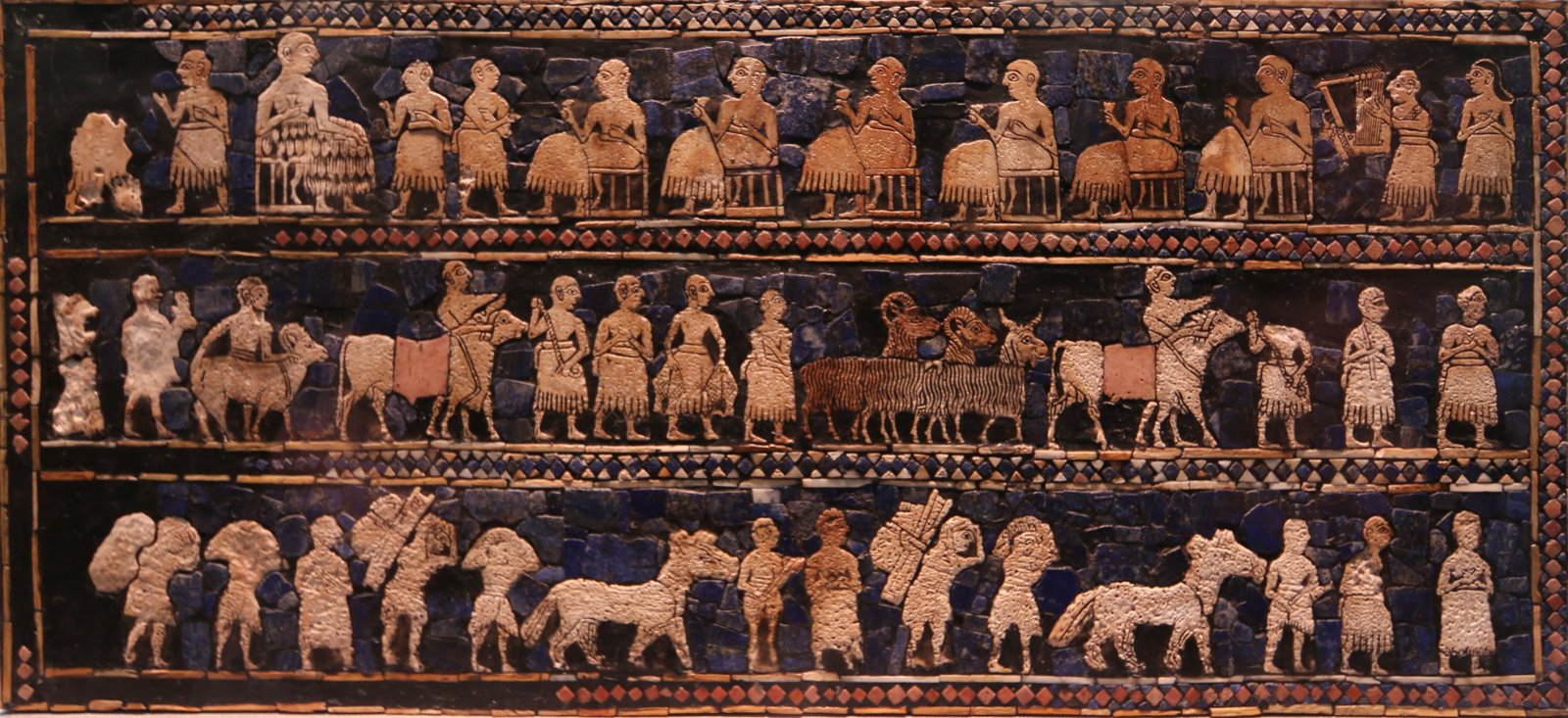
The 'Peace' side of the Standard of Ur, a hollow box about 22 cm high and 50 cm long in the British Museum (1928,1010.3), inlaid with shell, lapis lazuli and red limestone: three rows with a banquet and a lyre player at the top and men bringing animals, fish and goods below
License · Image sourceObject details
- Title
- The Standard of Ur: War and Peace on a Box from the Royal Cemetery (British Museum 1928,1010.3)
- Timeline
- From 2600 BCE to 2400 BCE
- Region
- Mesopotamia
- Rights
- CC BY-SA
Text
Introduction
Around 4,500 years ago, someone in the Sumerian city of Ur made a small wooden box and covered its two long sides with tiny pictures cut from shell and set in blue stone. One side shows soldiers, chariots and prisoners. The other shows a feast, with a musician and men bringing food and animals. It is among the best-known objects from ancient IraqIraqIraq is a modern country encompassing much of ancient MesopotamiaGlossary · Click to read the explanation, and it is called the "Standard of Ur".
This entry is about the object: what it is made of, where it was found, what the two sides show, and why nobody can say what it was for. We keep apart what is visible on the inlay, what the excavation and the museum record, and what scholars only suggest.
The object
The Standard is kept in the British Museum under the registration number 1928,1010.3. It is a hollow box with end panels shaped like trapezoids, wider at the bottom than at the top. The museum gives its size as about 22 cm high and 50 cm long. [1][2] It was made of wood, which has not survived. What remains is the decoration: figures engraved on shell, and a background of small pieces of lapis lazuli (a deep blue stone), with red limestone and more shell, all stuck on with bitumen, a natural tar. [1][2][3] The date is given as about 2600–2400 BCE by one source, and about 2550 BCE by another; the museum's description puts it in the Early Dynastic III period, c. 2600–2300 BCE. [1][2][3] In plain words, it belongs to the time of the early city-states of southern MesopotamiaMesopotamiaHistorical region associated with the Tigris and Euphrates: Uruk, Ur, Eridu, cuneiform, Sumer, Akkad, Babylon and Assyria, their languages and cults, and the limits of archaeological evidence.Glossary · Click to read the explanation, long before the empires.
Where it was found
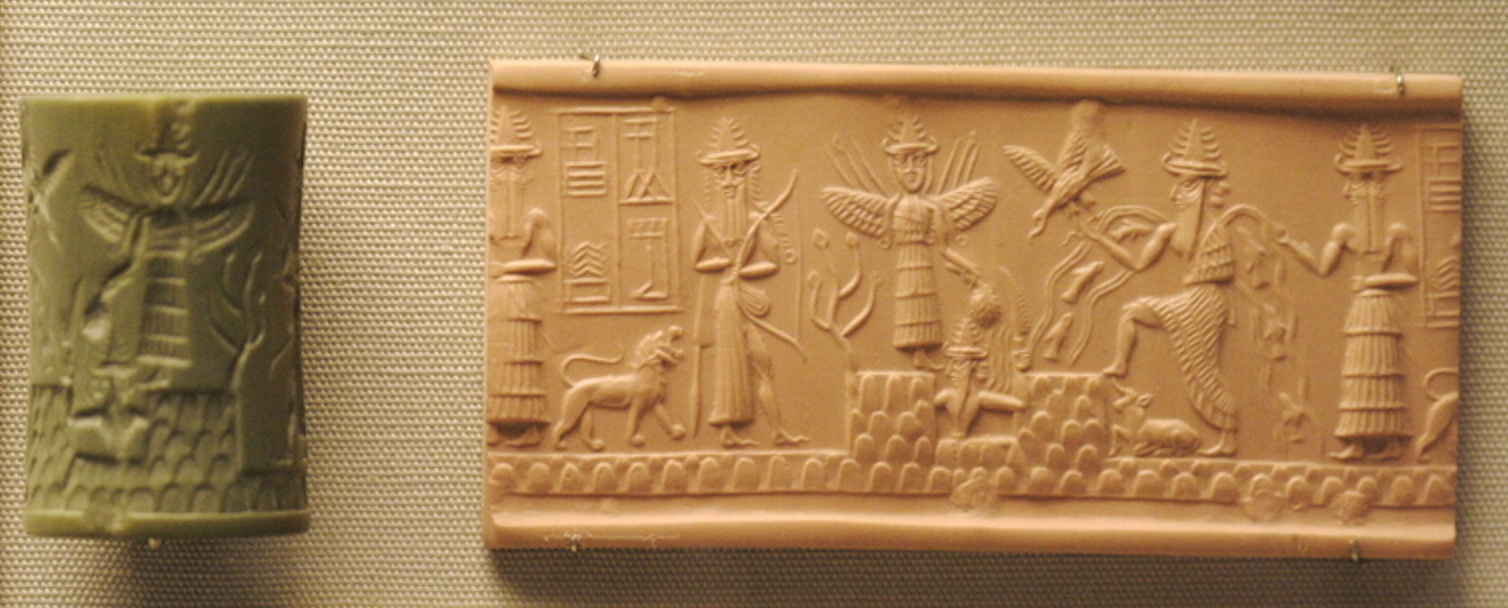
The Standard was found by Leonard Woolley's expedition at UrUr of the ChaldeansCity named in Genesis’s account of Abraham’s family, commonly associated with archaeological Ur near Nasiriyah in southern Iraq.Glossary · Click to read the explanation, in the cemetery he called the "Royal Cemetery". The excavation ran from 1922 to 1934 and was a joint project of the British Museum and the University Museum of Pennsylvania. [3] According to the museum, the Standard came from a chamber of grave PG 779, a tomb that had been thoroughly robbed in antiquity. [1] Wikipedia adds that it was found in 1927–1928, that a workman saw shell inlay in the last chamber, and that it lay in a corner near the shoulder of a man, who may have carried it. [2] Another text says it lay above the man's right shoulder. [3] A shell cylinder sealCylinder sealSmall engraved cylinder rolled over soft clay to leave an extended image. Used to secure, document and identify administrative actions; its pictures do not automatically constitute writing.Glossary · Click to read the explanation with the name "é-zi" was found with the same body. [2] A cylinder seal is a small stone or shell roller, carved with a picture and a name, which was rolled over wet clay to leave an impression; see our entry on the cylinder sealCylinder sealSmall engraved cylinder rolled over soft clay to leave an extended image. Used to secure, document and identify administrative actions; its pictures do not automatically constitute writing.Glossary · Click to read the explanation.
The box was crushed. The wood rotted, the soil pressed on it, the bitumen glue failed and the end panels broke. [2][3] The excavators lifted the inlaid pieces with wax and treated them with paraffin in 1928, which later damaged them; the object was taken apart and rebuilt in 1973. [2] The museum states that the arrangement of the inlay on the end panels is speculative. [1] So the shape we see today is a careful best guess.
The "War" side
The two long sides are called "War" and "Peace" for convenience. The pictures run in three rows.
On the "War" side, the bottom row shows four-wheeled wagons, each pulled by four animals. The animals begin at a walk and move faster from wagon to wagon, and the last ones trample enemies under their hooves. [2][3] In the middle row, soldiers in cloaks and helmets carry spears, strike enemies with axes, and lead away prisoners. [2][3] In the top row, naked prisoners are brought before a taller figure with a spear, usually taken to be the king, who stands near his wagon. [2][3] The king is drawn larger than the others; the more important a figure is, the bigger it is. [2]
The "Peace" side
On the "Peace" side, the bottom row shows men carrying goods or leading animals. In the middle row, men in fringed skirts bring animals, fish and other goods in a line. [2][3] In the top row, a banquet is under way: a larger figure, seated on a stool, and other seated men raise cups, while a lyre player and a singer perform. [2][3] Here too the seated figure, taken to be the king, is the largest. The lyre fits the setting of the cemetery, where lyres were also found; our source on the Royal Cemetery describes the "Queen's Lyre" from another grave. [3]
One story or two?
The museum says the two sides probably show consecutive episodes of one story: the end of a victorious battle led by a king of Ur, followed by a banquet or ritualRitualAn organised or distinguished practice meaningful to a community; it may leave traces, but its form alone does not reveal an associated doctrine.Glossary · Click to read the explanation celebration. [1] Wikipedia says the same idea has been compared with a literary device in Sumerian, in which two opposites together stand for a whole. [2] This is a reading, not a fact. Nothing is written on the box that explains the scenes.
Scholars have also debated who the non-royal figures are: Sumerians, people from the north, or people from outside the Mesopotamian plain. [2] The picture does not say.
What was it for?
Woolley thought the box was carried on a pole in front of an army, like a banner, and this gave it the name "standard". [1][2][3] This is now thought unlikely. [2] Other proposals are that it was the soundbox of a musical instrument, or a chest for storing funds, as Paola Villani suggested. [2][3] The museum says its original function is unknown. [1] We have to say the same: the name "standard" is a nickname that stayed.
The tomb itself adds to the uncertainty. Woolley believed the graves in the cemetery belonged to kings and queens, and another suggestion is that they belonged to high priestesses. [3] Some graves held many bodies that were probably sacrificed. [3] Andrew Cohen has argued that such attendants may have shared a final meal before they died. [2] These are interpretations of the graves, and the Standard cannot settle them.
Why it matters
The Standard is one of the earliest large "stories in pictures" we have. It shows how an early Mesopotamian city could present rule: a ruler who wins, and a ruler who feeds and is served. It tells us about dress, chariots, music and the way important people were drawn bigger than others. It does not tell us the king's name, the enemy, or the reason it was buried. The pictures speak, but not in words.
Photograph
The photograph shows the "Peace" side of the Standard in the British Museum. It was taken by LeastCommonAncestor, derived from a photograph by Geni with the distortion removed, and is published on Wikimedia Commons under the Creative Commons Attribution-ShareAlike 3.0 licence. [4]
References and notes
- Google Arts & Culture, 'The Standard of Ur' (British Museum record text: registration 1928,1010.3, dimensions, date, materials, description, provenance) Whole asset page: 21.7-22 x 50.4 cm, Early Dynastic III c. 2600-2300 BCE, shell, limestone, lapis lazuli, bitumen, consecutive episodes of one story, end-panel arrangement speculative, Woolley's pole idea, function unknown, Royal Tomb PG 779 thoroughly robbed Return to the text ↑
- Wikipedia, 'Standard of Ur' (secondary summary citing Woolley, Zettler, Collon, Villani, Renette, Margueron, Cohen) Whole article via page fetch: discovery 1927-28, PG 779, materials, size, condition and 1928/1973 conservation, War and Peace registers, interpretations of function, scholarly debates Return to the text ↑
- SUNY Nassau CC art history course text, 'The Standard of Ur and other Objects from the Royal Graves at Ur' (Lumen Learning) Whole chapter via page fetch: Woolley expedition 1922-34, Royal Cemetery, position of the Standard in the grave, scenes, function theories, uncertainty about kings or priestesses, Queen's Lyre Return to the text ↑
- Wikimedia Commons, file 'Standard of Ur - Peace.jpg' (LeastCommonAncestor, CC BY-SA 3.0) File metadata via the Commons API: author, licence, description, size 4312 x 1975 px Return to the text ↑
Archive records may be reviewed and refined as better evidence or sources become available. Suggest a correction
Suggest a correction · Suggest a source for this record
Cite this record
IL Archive, «The Standard of Ur: War and Peace on a Box from the Royal Cemetery (British Museum 1928,1010.3)», https://ilarchive.com/en/artifacts/standard-of-ur
Continue reading