Artifact
The Burney Relief ("Queen of the Night"): Who Is the Winged Goddess?
An object record bringing together its image, metadata, rights, and context.
- Timeline
- From 1800 BCE to 1750 BCE
- Region
- Mesopotamia
A baked-clay plaque shows a winged, bird-footed woman with two owls and two lions. Where it comes from is unknown, and her name is still debated: Ishtar, her sister Ereshkigal, or a demon. What the object shows and what is uncertain.
Estimated reading time: 7 min Published Last reviewed:
Share article
Photograph
Photo: Osama Shukir Muhammed Amin, CC BY-SA 4.0, via Wikimedia Commons; object: British Museum
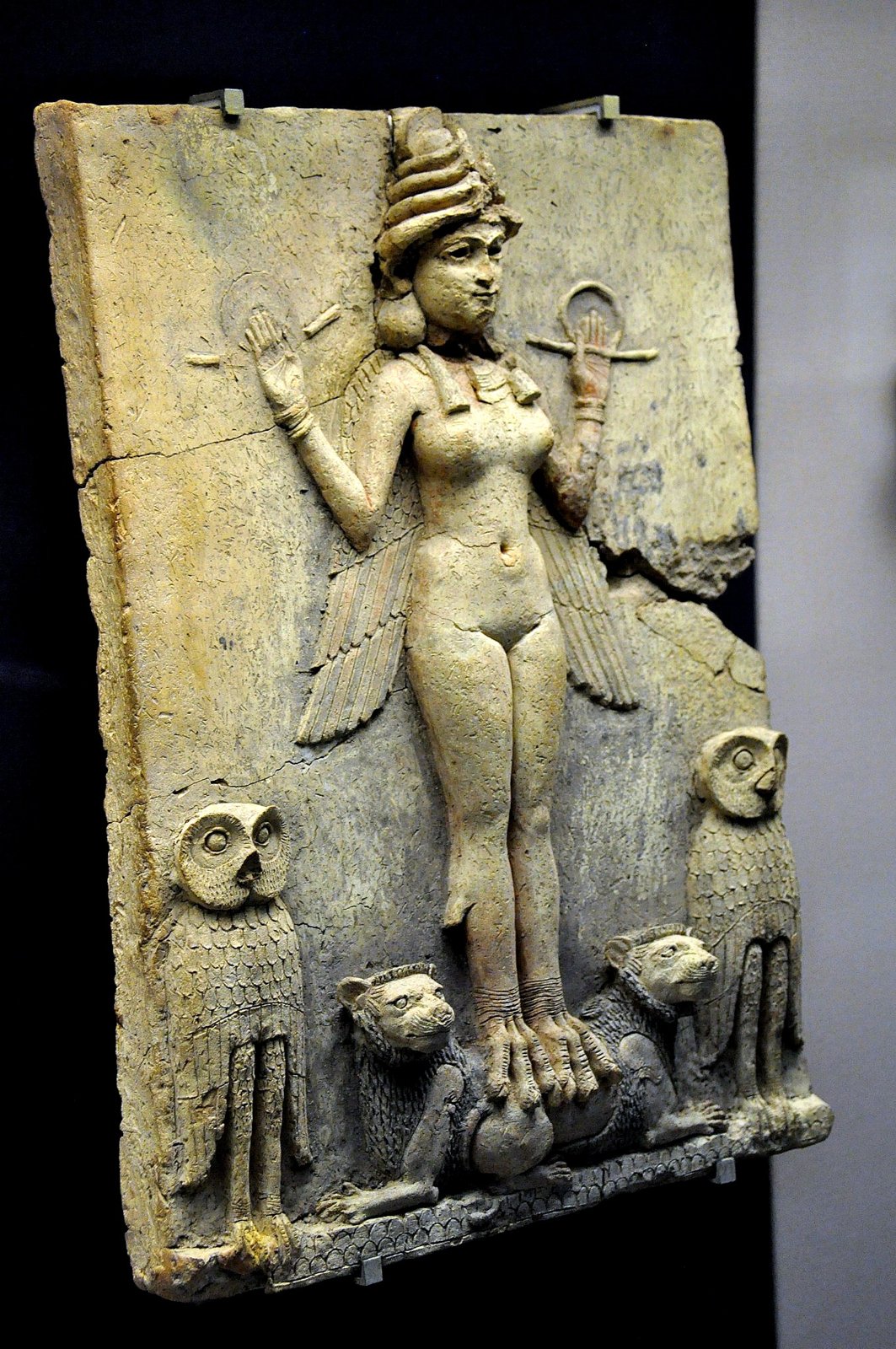
The Burney Relief (Queen of the Night), a fired-clay plaque about 49.5 cm high in the British Museum (2003,0718.1): a winged, bird-footed woman with a horned cap, rod and ring, standing on two lions between two owls. Seen from an angle
License · Image sourceObject details
- Title
- The Burney Relief ("Queen of the Night"): Who Is the Winged Goddess?
- Timeline
- From 1800 BCE to 1750 BCE
- Region
- Mesopotamia
- Rights
- CC BY-SA
Text
Introduction
Few objects from ancient IraqIraqIraq is a modern country encompassing much of ancient MesopotamiaGlossary · Click to read the explanation are as striking as this one: a nude woman with wings, the legs of a bird of prey, and a tall horned cap, standing on two lions, with an owl on each side. It is on display in the British Museum, where it is called the "Queen of the Night". An older name, the "Burney Relief", comes from a London dealer who once owned it.
This entry is about the plaque itself: what it is made of, how it came to light, what can be seen on it, and why scholars still argue about who she is. We keep apart what is visible on the clay, what the museum states, and what is only proposed.
The object
The plaque is kept in the British Museum under the registration number 2003,0718.1; before the museum bought it, it was on loan as "Loan 1238". It is a rectangle of fired clay, about 49.5 cm high, 37 cm wide and 4.8 cm thick, with the figure modelled in high relief. [1][2] The museum dates it to about 1800–1750 BCE, in the Old Babylonian period, and says it was probably made in southern MesopotamiaMesopotamiaHistorical region associated with the Tigris and Euphrates: Uruk, Ur, Eridu, cuneiform, Sumer, Akkad, Babylon and Assyria, their languages and cults, and the limits of archaeological evidence.Glossary · Click to read the explanation. [1][2] Wikipedia says the style fits the Isin-Larsa period or the early Old Babylonian period, the years around the rise of HammurabiHammurabiKing of Babylon in Mesopotamia, reigning around 1792–1750 BCE. A celebrated legal text preserved on a stele and cuneiform copies bears his name.Glossary · Click to read the explanation. [2] The clay was mixed with chaff (straw) as a binder, and the figure was apparently moulded, then modelled, burnished and incised by hand. [2] The plaque reached the museum in three pieces plus fragments; some cracks remain and a piece at the right edge is missing. [2]
What the relief shows
The woman faces the viewer with both arms raised. Her arms are bent at the elbow, and each hand holds a "rod and ring", a pair of signs often seen in the hands of gods and kings. The museum suggests they were originally measuring tools (a rod and a coil of rope) that came to stand for divinity and justice. [1] On her head is a cap of stacked horns, the usual sign that a figure is divine. Her wings are not spread wide but hang down, and her legs end in the talons of a bird of prey. [1][2]
She stands on two lions, which look out at the viewer, and an owl stands on each side of her. [1][2] Under the lions, a pattern of scales stands for mountains. [1] The owls are a puzzle in themselves: Wikipedia notes that owls are not otherwise clearly known in Mesopotamian pictures in this setting, and that the species cannot be pinned down. [2]
Traces of colour
The relief was once painted. Wikipedia reports that red ochre covered the body of the goddess, and that black (lamp black) and white (gypsum) were identified by Raman spectroscopy, a method that identifies a pigment by the way it scatters light. The feathers of the wings and the owls alternate red, black and white; the background was black, which the museum thinks may represent the night, and this is the basis of the museum's name for the piece. [1][2] The lions' bodies were white. The horns, necklace and bracelets are assumed to have been yellow, but no yellow pigment survives. [2]
Where it came from: a find with no record
The plaque was never excavated, and its exact place of discovery is unknown. [2] The accounts of its path differ in details. Wikipedia says that a Syrian dealer may have acquired it in southern Iraq in 1924, that it was examined at the British Museum in 1933, and that the museum declined to buy it in 1935. [2] The museum's own page says it may have reached England as early as 1924 and was brought to the museum in 1933 for scientific testing. [1] A feature in World Archaeology instead gives 1924 for the refusal to buy and 1935 for Burney's purchase, so the sources do not agree on these dates. [3]
What is common to all the accounts is the later history. The London dealer Sidney Burney acquired it, and it became known by his name after it was published in The Illustrated London News in 1936. [1][2] After passing through other private hands, including that of Norman Colville, it was bought at auction by a Japanese collector, Goro Sakamoto, but an export licence was refused. [2] It was on loan to the British Museum from 1980 to 1991. The museum bought it in 2003, with help from funds and donors, as its main acquisition for its 250th anniversary. [1][2] The price Wikipedia gives is £1,500,000. [2]
Is it genuine?
Because the plaque appeared on the antiquities market without a find-spot, some scholars doubted it. Wikipedia lists the main steps: it was accepted in 1936, Henri Frankfort concluded in 1937 that it was genuine, and Pauline Albenda later (1970, 2005) called it "a pastiche of artistic features" and challenged it. [2] Thermoluminescence dating, which measures how long ago clay was last fired, gave results consistent with ancient firing, but the method is imprecise without samples of the soil in which the object lay. [2] The World Archaeology feature says the tests indicate a date around 1765 BCE. [3] The scientific analysis was published by John Curtis and Dominique Collon in 1996, and it helped persuade the museum to buy the piece. [2] Collon, in a 2007 reply to Albenda, argued that the relief was made as a single unit and is "a real work of art of the Old Babylonian period". [2] The museum treats it as genuine. [1] A careful reader will note that this is a considered judgement and not a proof, because there is no excavation record.
Who is she? Three proposals
The museum states that the figure "cannot be definitely identified". [1] Three answers are discussed.
- IshtarInanna / IshtarA prominent Mesopotamian goddess whose Sumerian name Inanna became associated with Akkadian Ishtar across diverse traditions. She was associated with desire, war, royal authority and Venus, while local forms and genealogies varied among texts.Glossary · Click to read the explanation. The first identification, in 1936, was the goddess Inanna / IshtarInanna / IshtarA prominent Mesopotamian goddess whose Sumerian name Inanna became associated with Akkadian Ishtar across diverse traditions. She was associated with desire, war, royal authority and Venus, while local forms and genealogies varied among texts.Glossary · Click to read the explanation, goddess of love and war, who is linked with lions. [1][2] Thorkild Jacobsen defended it later, pointing to the lions, the mountains and the rod and ring, and arguing that a demon would not have been given a cult image of this kind. [2]
- EreshkigalEreshkigalMesopotamian goddess ruling the netherworld; Inanna’s sister in descent texts, with varying accounts of her relationship with Nergal.Glossary · Click to read the explanation. Edith Porada proposed EreshkigalEreshkigalMesopotamian goddess ruling the netherworld; Inanna’s sister in descent texts, with varying accounts of her relationship with Nergal.Glossary · Click to read the explanation, Ishtar's sister and rival, who ruled the underworld, and Elisabeth von der Osten-Sacken supported this in 2002. [2] The hanging wings and the black ground are read as signs of the underworld, and the museum names her as the second possibility. [1][2] On the underworld journey in which the two sisters meet, see our entry on katabasisKatabasis: descent to the underworldGreek for descent; in literary criticism, a purposeful journey to the realm of the dead, distinct from necromancy and resurrection.Glossary · Click to read the explanation.
- A demon (Lilitu). In the 1930s the figure was connected with the female demon Lilitu, and through her with the later figure Lilith, because of the wings, the owls and the bird's feet. [2] Wikipedia notes that Cyril Gadd, who first translated the related texts, said that owls were never linked with this demon in Babylonian myth, and that the identification is now questioned. [2] The World Archaeology feature also points out that neither goddess is shown nude in Mesopotamian art otherwise, which keeps the demon proposal alive. [3] For the wider category see demonologyDemonologyStudy or organization of harmful powers, names, origins and roles within specific traditions; no single doctrine or claim about existence beyond the text is assumed.Glossary · Click to read the explanation.
None of the three is proved. The relief carries no inscription that names her.
What was it for?
The plaque is small for a major temple. Wikipedia says its size suggests a shrine, perhaps set into a mud-brick wall, in a private or domestic setting. [2] Jacobsen speculated that it might have been a house altar in a brothel, which is a guess and not a finding. [2] Since the find-spot is unknown, its function can only be argued from its form.
Why it matters
The relief shows how much an object can carry and how little it can settle by itself. We can see the wings, the talons, the rod and ring, the lions and the owls, and we know how the plaque was made and painted. We do not know where it lay, who commissioned it, or what name its makers gave the woman. Some of the best-known pictures of Mesopotamia are of this kind: striking, and without words to explain them. For the goddess Inanna / Ishtar in texts, see our study "Inanna and Ishtar's Descent: What Changes between the Narratives?"; for another famous Old Babylonian image, see our entry on the Code of Hammurabi stele.
Photograph
The photograph shows the relief from an angle in its display in the British Museum. It was taken by Osama Shukir Muhammed Amin and is published on Wikimedia Commons under the Creative Commons Attribution-ShareAlike 4.0 licence. [4]
References and notes
- Google Arts & Culture, 'The Queen of the Night' (British Museum record text: registration 2003,0718.1, dimensions, date, materials, description, identification statement, provenance) Whole asset page: 49.5 x 37 x 4.8 cm, 1800-1750 BCE, red/black/white paint, 'cannot be definitely identified', Ishtar or Ereshkigal, 1924/1933 history, 2003 purchase from Goro Sakamoto Return to the text ↑
- Wikipedia, 'Burney Relief' (secondary summary citing Collon 2003/2007, Frankfort 1937, Albenda, Jacobsen 1987, Porada 1980, von der Osten-Sacken 2002, Curtis and Collon 1996 and others) First 100,000 characters: object, provenance, construction, painting traces, iconography, identifications, authenticity, function; used as a pointer to the scholarship Return to the text ↑
- World Archaeology, 'Monsters, virgins and femme fatales' (feature on the relief) Passages on the Queen of the Night: naming, three identifications, nudity argument, authenticity and thermoluminescence, provenance dates Return to the text ↑
- Wikimedia Commons, file 'Queen of the Night relief (also Burney relief), 1800-1750 BC, from Iraq. The British Museum, London.jpg' (Osama Shukir Muhammed Amin, CC BY-SA 4.0) File metadata via the Commons API: author, date 2014-01-29, licence CC BY-SA 4.0, description, size 1361 x 2048 px Return to the text ↑
Archive records may be reviewed and refined as better evidence or sources become available. Suggest a correction
Suggest a correction · Suggest a source for this record
Cite this record
IL Archive, «The Burney Relief ("Queen of the Night"): Who Is the Winged Goddess?», https://ilarchive.com/en/artifacts/burney-relief
Continue reading