Study
Why Is Seven Sacred? The Number Seven from the Stars of Ancient Iraq to Our Week
An extended study of a topic, with evidence and references.
- Region
- The Near East and the Mediterranean
Stars linked with seven gods, demons and guardians called "the Seven", Ugarit's seventh day, our week and the scriptures: a guide to the number seven, and to why the evidence gives clues, not proof.
Estimated reading time: 15 min Published Last reviewed:
Share article
Video
Why Is Seven Sacred? What the Clay Tablets of Ancient Iraq Reveal
Our fourth documentary follows the number seven through the clay tablets of ancient Iraq and its neighbours, then reads the scriptures in their own words and with respect. Some scenes are AI-generated illustrations.
The YouTube player loads only when you press play. Watch on YouTube
Text
Introduction
Seven is an awkward number. A perfect seven-sided figure cannot be drawn with compass and ruler alone, and an hour of sixty minutes will not divide evenly by seven. Yet across the ancient Near EastAncient Near EastModern scholarly label for ancient societies of Mesopotamia, the Levant, Anatolia and Iran, sometimes extending to Egypt and other neighbours depending on the study; not one civilization or religion.Glossary · Click to read the explanation this number keeps returning: in the stars, in the names of gods, in poems, in the calendar and, much later, in the scriptures of Jews, Christians and Muslims. Why?
This gateway article follows our film Why Is Seven Sacred? What the Clay Tablets of Ancient IraqIraqIraq is a modern country encompassing much of ancient MesopotamiaGlossary · Click to read the explanation Reveal chapter by chapter; each section links to the detailed study where the sources are read line by line. We keep apart what a text says, what scholars infer, and what remains open. The scriptures come last, each read in its own words and with respect.
The hour that will not divide
With compass and ruler you can draw a perfect triangle, square, pentagon or hexagon, but not a perfect seven-sided figure: Pierre Wantzel completed the proof in 1837, building on Carl Friedrich Gauss. [1]
An hour's sixty minutes, a remnant of the way the scribes of ancient Iraq counted in sixties as we count in tens, divide cleanly by every number up to six. Divided by seven, the answer never ends: 8 minutes, 34 seconds and 17 sixtieths of a second, then 8, 34, 17 again and again. [2] And yet this is the number that the clay tablets keep placing at the edge of the sky, at the door of the house and at the end of every count.
The stars: "the seven great gods"
On a clear night you can find a small, misty cluster in Taurus: the Pleiades. In cuneiformCuneiformWriting with wedge-shaped signs, developed from Mesopotamian recording traditions and used for several languages from the third millennium BCE.Glossary · Click to read the explanation its usual name was MUL.MUL. MUL is the sign for "star", so the doubled form simply means "the Stars". In AkkadianAkkadianAn ancient East Semitic language written in cuneiform from the third millennium BCE; its varieties include Babylonian and Assyrian, and it served in international diplomacy.Glossary · Click to read the explanation it was zappu, "the Bristle", the tuft of hair on the back of the Bull of Heaven. Most people see only about six of its stars. [3]
So where does seven come from? From scholarship. The Babylonian star compendium MUL.APIN, probably compiled around 1000 BCE, says of the cluster: "The Stars, the seven great gods." [3] [4] The Pleiades were not called "the Seven"; scholars identified them with seven gods, and the tablets do not say which ones. The cluster also served as a calendar clock, reappearing at dawn in the spring month of Ayyaru. [3]
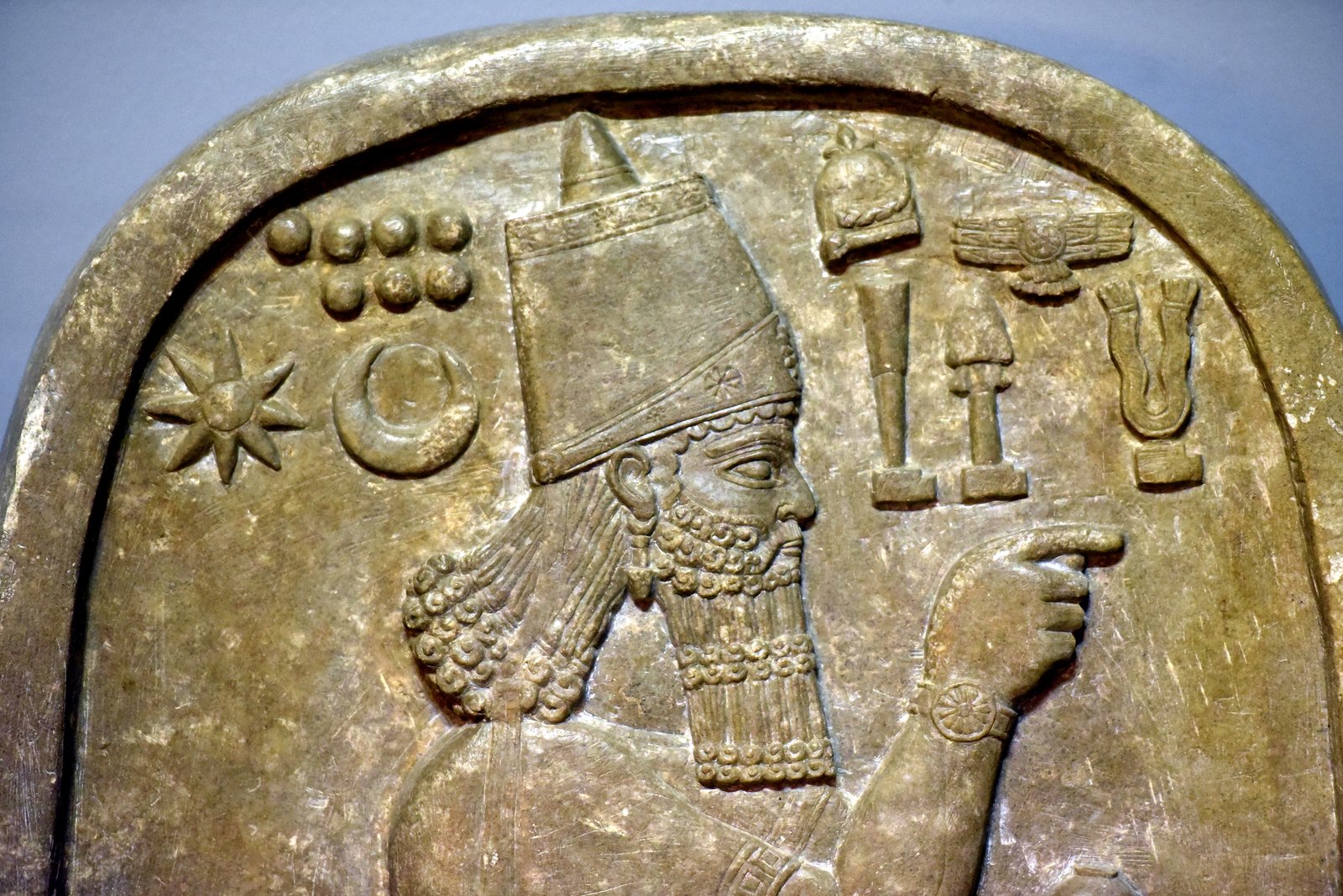
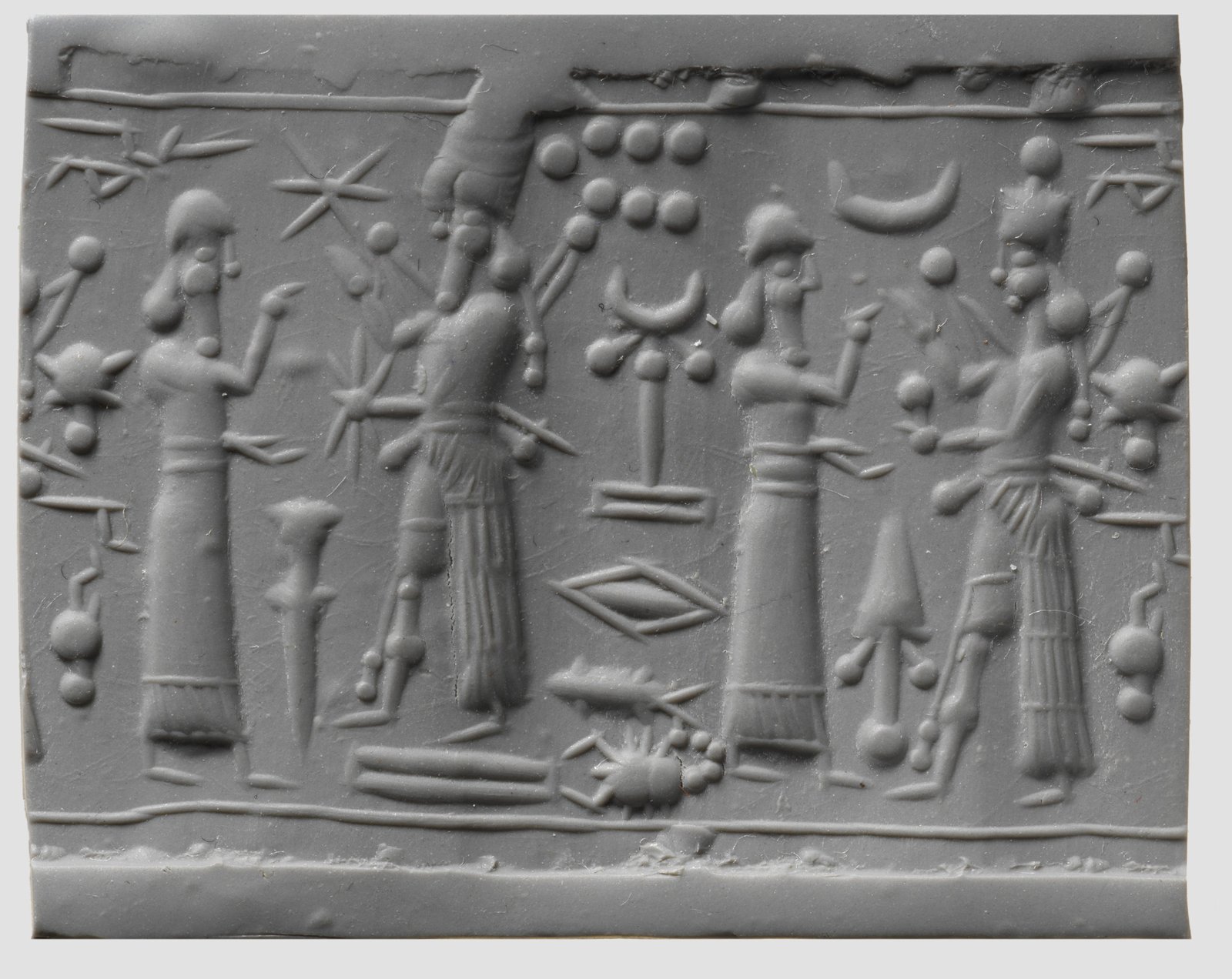
On Assyrian seals, boundary stones and stelae, seven dots often stand among the emblems of the great gods. Lorenzo Verderame notes that they are found especially on cylinder sealsCylinder sealSmall engraved cylinder rolled over soft clay to leave an extended image. Used to secure, document and identify administrative actions; its pictures do not automatically constitute writing.Glossary · Click to read the explanation, like the one shown here, and that they are read as the Seven, whose form in the sky was the Pleiades; the reading is firm in late tablets and probable for Assyrian monuments, which never label the dots. [3] On the stele of King Adad-nirari III (810–783 BCE) from Tell al-Rimah in northern IraqIraqIraq is a modern country encompassing much of ancient MesopotamiaGlossary · Click to read the explanation, seven dots, four above three, sit behind the king's crown. [5]
Did the stars make seven special, or did a number already special find its way into the stars? The evidence is in The Pleiades and the Seven Gods: Stars, Seven Dots and Assyrian Symbols.
The Seven: demons and guardians
One Mesopotamian group of gods had no other name: they were simply "the Seven", in Akkadian Sebettu. And they had two faces. Exorcists, healers who fought the demons blamed for illness, recited spells against them:
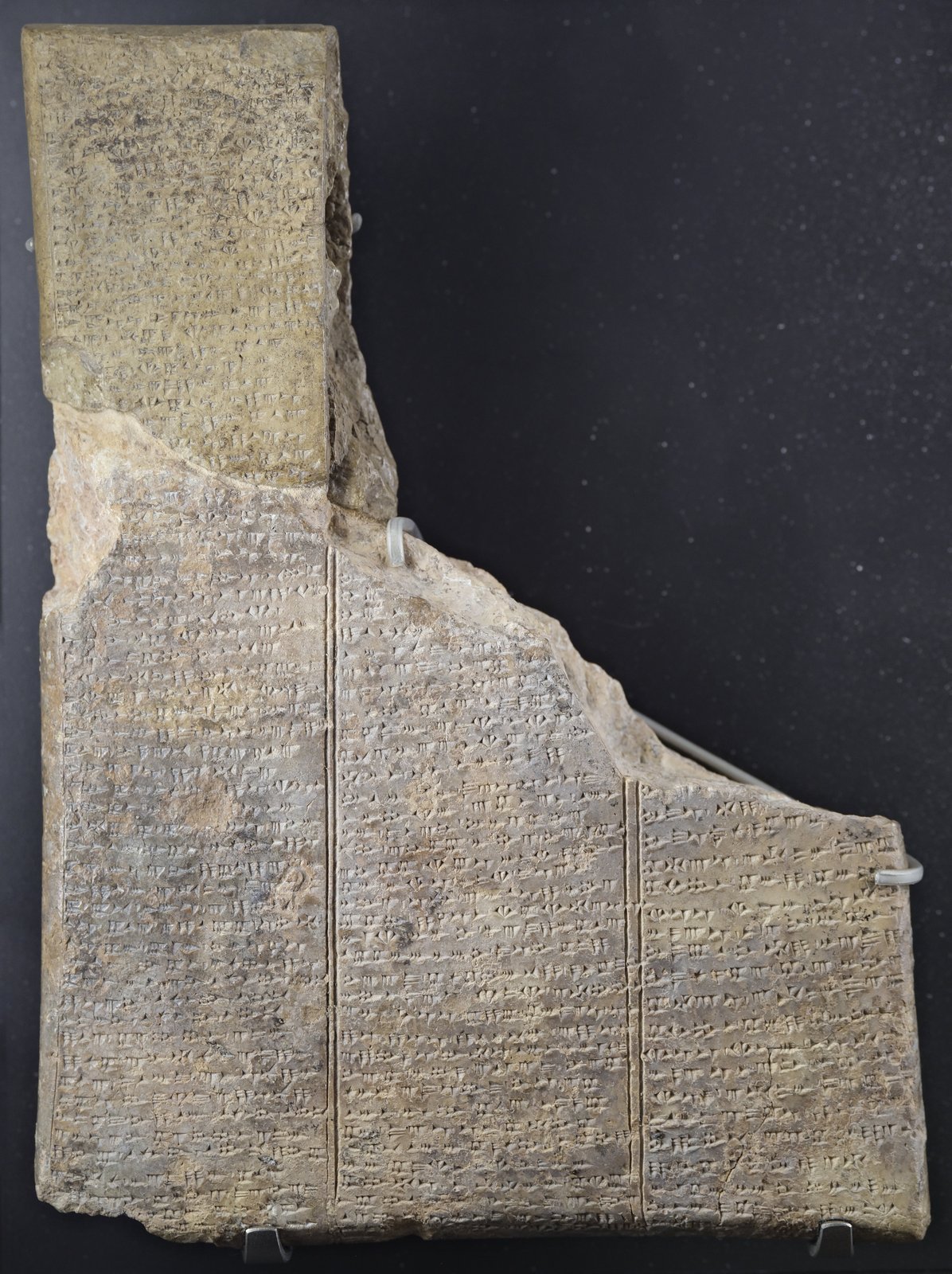
Udug-hul ("Evil Demons") Tablet 5, lines 167–175 (selected), translated by M. J. Geller (2016). [6]
Yet the same Seven protected the house. A household ritualRitualAn organised or distinguished practice meaningful to a community; it may leave traces, but its form alone does not reveal an associated doctrine.Glossary · Click to read the explanation, one copy of which was written in 750 BCE, tells the exorcist to carve seven statues of the Sebettu from tamarisk wood, horned and armed with a bronze hatchet and a dagger, and to bury them at the gate to keep evil out. [7] According to Gina Konstantopoulos, Assyrian kings named them in their inscriptions from the thirteenth century BCE, and Sargon IISargon IISargon II was an Assyrian king of the late eighth century BCE; ORACC dates his reign about 721–705 BCEGlossary · Click to read the explanation calls them the ones "who go before the gods". [8] At Khorsabad, Sargon's capital, Iraqi archaeologists found a temple of the Seven; eight of its inscribed altars stand today in the courtyard of the Mosul Museum. [9] For the ancient exorcist, a force no one could withstand was a reason to fear it in a spell and to trust it at the door. Read The Sebettu: "the Seven" as Demons and as Protectors in Mesopotamia.
The Seven of Erra
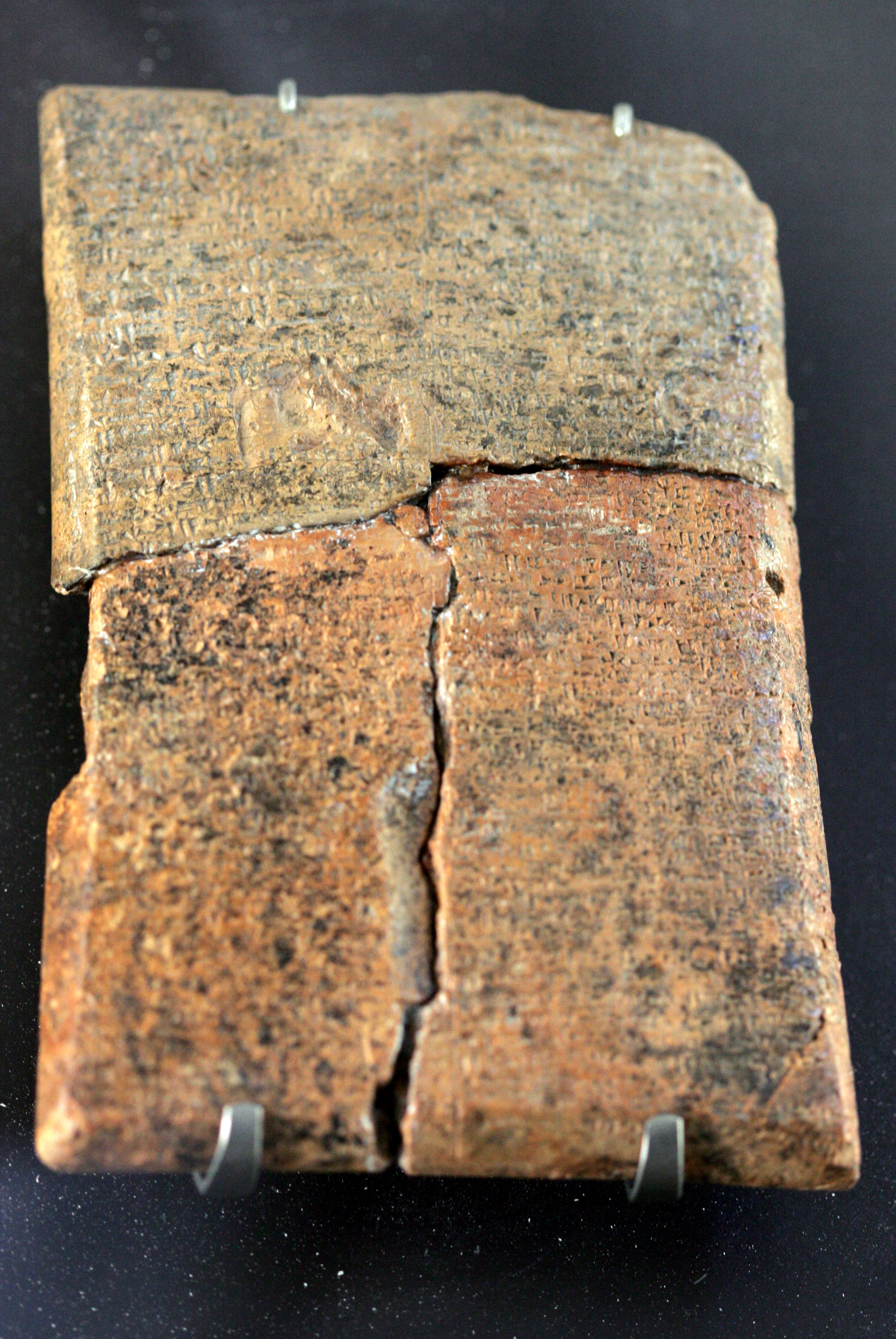
Texts give the Seven different parents, but one Babylonian poem tells their birth. Erra and Ishum, five tablets long and probably composed in the eighth century BCE (the date is debated), was copied very widely: a recent edition lists 44 manuscripts. [10]
Erra and Ishum I 28–29, translated by E. Jiménez, electronic Babylonian Library. [11]
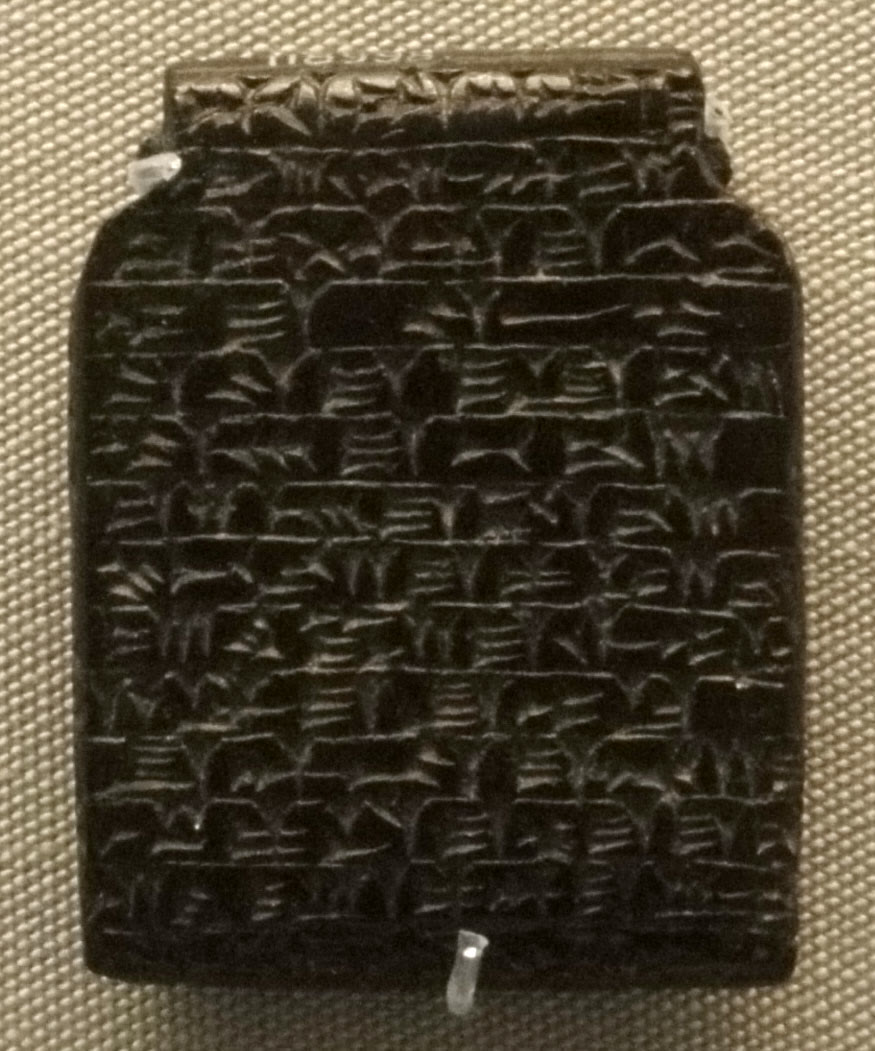
AnuAn / AnuAn is the Sumerian sky god, called Anu in Akkadian. The sign AN by itself does not identify him: it also denotes sky or divinity.Glossary · Click to read the explanation gives each a deadly destiny and hands all seven to the warrior god Erra: "Let these be your wrathful weapons, that they march at your flank!" [11] Roused by the Seven, Erra brings war on Babylonia until his adviser Ishum calms him. The poem is about war rather than plague, yet it promises that where the tablet is kept, even if "the (Divine) Heptad slaughter", the sword will not come near, and lines from it were copied on small amulets. [10] See Erra and Ishum: the Babylonian Poem of the Seven, of War and of Protection from Plague.
Seven gates, seven mountains, seven terrors
Older still are the poems of Sumer, the oldest poetry we can read, mostly known from tablets of about 2100 to 1650 BCE. [12] Their word for seven, imin, is sometimes said online to mean "all"; the electronic Pennsylvania Sumerian Dictionary gives it the single meaning "seven" in all 327 instances it counts. [13]
In the poem of InannaInanna / IshtarA prominent Mesopotamian goddess whose Sumerian name Inanna became associated with Akkadian Ishtar across diverse traditions. She was associated with desire, war, royal authority and Venus, while local forms and genealogies varied among texts.Glossary · Click to read the explanation's descent, the goddess takes "the seven divine powers", and EreshkigalEreshkigalMesopotamian goddess ruling the netherworld; Inanna’s sister in descent texts, with varying accounts of her relationship with Nergal.Glossary · Click to read the explanation, queen of the underworld, orders: "Let the seven gates of the underworld be bolted." At each gate an item of Inanna's finery is taken, at the seventh her dress, and she stands stripped before "the AnunaAnunna / AnunnakiAnunna/Anunnaki is a collective designation for Mesopotamian gods whose scope varies by text and period; it is not a group with one fixed membership or number.Glossary · Click to read the explanation, the seven judges". [14] Retellings often say she gave up one divine power at each gate; the poem never says so. In Gilgamesh and Huwawa the hero finds the cedars only after crossing the seventh mountain range, and the guardian Huwawa gives up his terrors, the first and then at once the seventh. [15] Another poet's messenger "traversed five mountains, six mountains, seven mountains. He lifted his eyes as he approached Aratta." [16]
In these poems seven is a named set, the last step of a rising count and a turning point; but the poems never say why seven. Read Seven in Sumerian Poetry: Gates, Terrors, Mountains and Judges.
The seventh day at Ugarit
At UgaritUgaritAncient city and kingdom at Ras Shamra on the Syrian coast, flourishing between the fourteenth and early twelfth centuries BCE and preserving multilingual archives.Glossary · Click to read the explanation, on the Syrian coast, poets of the fourteenth to early twelfth centuries BCE counted time in pairs: a day and a second, a third and a fourth, a fifth and a sixth. Then the seventh breaks the rhythm. In the Baal CycleBaal CycleA group of Late Bronze Age Ugaritic religious texts recounting Baal’s conflicts, relationships with the gods and the building of his palace.Glossary · Click to read the explanation a fire burns inside BaalBaalUgaritic storm god and warrior king who defeats Yamm, builds his palace with El’s consent and confronts Mot. References to El and Dagan as fathers do not define a single genealogy.Glossary · Click to read the explanation's new palace for six days; on the seventh it leaves the house, the silver turned into plates and the gold into bricks. [17] In the Tale of KirtaTale of KirtaUgaritic poetic narrative in three tablets about King Kirta, his family and a vow; KTU1.16 names Ilimilku, without proving he invented all its traditions.Glossary · Click to read the explanation, ElElEl is a senior deity in Late Bronze Age Ugaritic texts, portrayed as father of the divine family and a council authority, alongside his consort Athirat. This entry does not cover every linguistic use of El.Glossary · Click to read the explanation tells the king to reach the city of Udum on the seventh day; when the march is told, Kirta stops on the third day to make a vow he will not keep, a break that one scholar reads as a warning. [18] In the Tale of AqhatTale of AqhatUgaritic poetic narrative in three tablets about Aqhat, Danel’s son; attribution to Ilimilku relies on comparison, with his name restored in a damaged colophon.Glossary · Click to read the explanation, Danel feeds the gods for six days, and on the seventh, at Baal's plea, El grants him a son. [19]
Each count completes a single action; none speaks of rest or of a weekly day. See Six Days, Then the Seventh: The Seven-Day Pattern in Ugaritic Epic.
Egypt offers a contrast. Seven is there: the Seven Hathors announce a person's fate in New Kingdom tales, and Queen Nefertari's tomb shows seven cows and their bull from the Book of the Dead. [20] But when Egypt ordered its gods it used a Nine and an Eight. [21] Seven was strong in one connected world, not everywhere. See The Seven Hathors and Other Sevens in Ancient Egypt.
Our week: not from Babylon
In ancient Iraq the month followed the moon, and scribes kept lists, called hemerologiesMesopotamian HemerologyMesopotamian hemerologies assess dates for ritual, food, marriage, travel and other activities. The entry studies their witnesses, courtly examples and reception, and explains why cautionary dates are neither a universal calendar nor weekly rest days.Glossary · Click to read the explanation, that judged each day favourable or risky. One list, for a rare extra month, sets apart the 7th, 14th, 21st and 28th days, when the king was not to change his robes, ride his chariot or offer sacrifice; but it also marks the 19th, it bound only the king and a few others, and such days began again with every month. [22] Days counted within a month are not a week. Ilaria Bultrighini and Sacha Stern, in the most detailed recent study of the ancient week, find no continuous seven-day cycle in the records of MesopotamiaMesopotamiaHistorical region associated with the Tigris and Euphrates: Uruk, Ur, Eridu, cuneiform, Sumer, Akkad, Babylon and Assyria, their languages and cults, and the limits of archaeological evidence.Glossary · Click to read the explanation or Egypt. [23]
The names of our days come from Italy. At Pompeii someone scratched on a column a date that the consuls fix as 6 February 60 CE, and called it dies Solis, "the day of the Sun". By our count that day was a Wednesday: the planetary names were in use, but the week was not yet fixed. [24] [23] Why the order Saturn, Sun, Moon, Mars, Mercury, Jupiter, Venus? Cassius Dio, in the early third century, explained it by giving each hour to the seven moving lights in turn, so that the first hour names the day; he said the custom came from the Egyptians, yet admitted that its adoption was "comparatively recent". [25] Bultrighini and Stern find "no evidence of a planetary week" in Egypt, Mesopotamia or the Hellenistic world before the second century CE, and place its first appearance in Italy in the second half of the first century BCE. [26] The case is strong, not closed: Egypt knew much earlier of gods who ruled particular days of the month. [27]
Our week joins two streams: Roman planetary names and the seven-day cycle itself, which belongs to the scriptures. In 321 the emperor Constantine IConstantine IRoman emperor, reigning in 306–337 CE, who convened Nicaea in 325.Glossary · Click to read the explanation ordered judges, city people and all crafts to rest "on the venerable day of the Sun". [28] Read Where Did the Planetary Week Come From? From "Babel und Bibel" to a Pompeii Graffito.
Berlin, 1902: "Babel und Bibel"
On 13 January 1902 the Assyriologist Friedrich Delitzsch lectured in Berlin on "Babel and Bible", with Kaiser Wilhelm II in the audience. [29] He argued that the Babylonians "also had their Sabbath day", pointing to the king's special days, and that there could be "scarcely the shadow of a doubt" that we owe our day of rest to BabylonBabylonBabylon is an ancient city in central present-day Iraq, south of BaghdadGlossary · Click to read the explanation. [30]
The evidence answered. Critics noted that the list also marked the nineteenth day and that these were days of caution, not a weekly rest. [30] In 1904 T. G. Pinches showed that šapattu, the Babylonian word that sounds like Sabbath, was the fifteenth day, the full moon, and contracts were still dated on it. [31] Whether the HebrewHebrewA Northwest Semitic language of the Canaanite group, encompassing Iron Age epigraphy, Biblical, Rabbinic, medieval and Modern Hebrew; its scripts and pronunciations changed over time.Glossary · Click to read the explanation Sabbath and the Akkadian šapattuAkkadian ŠapattuŠapattu is an Akkadian term attested for the lunar mid-month day or a half-month in time reckoning. A historical derivation of the weekly Hebrew Sabbath from it remains contested.Glossary · Click to read the explanation are linked at all is still debated, as Sabbath and Šapattu: Similar Names, Different Calendars explains.
In the scriptures
Only now do we turn to the scriptures of Judaism, Christianity and Islam, each read in its own words and with respect.
The Hebrew Bible. The word for seven, shevaʿ, and the verb "to swear an oath", nishbaʿ, share the same three consonants. [32] At a well AbrahamAbrahamCentral figure in Genesis, the Qur'an and Jewish, Christian and Islamic traditions; the sacrifice study compares what each text says about him.Glossary · Click to read the explanation sets apart seven ewe lambs as a witness, and the place is called Beer-sheba, "well of seven" or "well of the oath" (Genesis 21:30–31). After six days of creation, "God blessed the seventh day, and hallowed it" (Genesis 2:3). The sanctuary lampstand has seven lamps (Exodus 25:37), the people circle JerichoJericho / Tell es-SultanArchaeological mound near present-day Jericho in Palestine’s Jordan Valley, preserving early Neolithic settlement and Bronze Age layers.Glossary · Click to read the explanation seven times on the seventh day (Joshua 6), and after seven times seven years comes the Jubilee (Leviticus 25). [33] For historians of the week, the Hebrew Bible is the only early source of a continuous seven-day week. [23] See Seven in the Hebrew Bible: Oath, Completion and Holy Time.
The New Testament. Peter asks whether he should forgive his brother seven times, and Jesus answers: "I don't tell you until seven times, but, until seventy times seven" (Matthew 18:22). [34] The Greek echoes Lamech's boast of vengeance "seventy-seven times", and many read the answer as forgiveness without limit. [35] Revelation is built on seven: seven assemblies, lampstands and spirits, and series of seven seals, trumpets and bowls; at the seventh seal "there was silence in heaven for about half an hour" (8:1). [36] Most scholars read these sevens as completeness, not as a code. [37] See Seven in the New Testament: from "Seventy-Seven Times" to the Seven Seals.
How many heavens? The texts do not agree. An Assyrian tablet describes three heavens of different stones; [38] Jewish and Christian writings around the turn of the era count three, five, seven or ten; [39] the Talmud keeps two views side by side, two firmaments or seven. [40] See Seven Heavens: What Ancient Texts Say about the Layers of the Sky.
The Qur'an. The Qur'anThe QuranThe central scripture of Islam, consisting of 114 Arabic surahs; its study distinguishes Quranic discourse from manuscript history, reading traditions, and historical inference.Glossary · Click to read the explanation speaks of seven heavens: "[And] who created seven heavens in layers. You do not see in the creation of the Most Merciful any inconsistency" (67:3, Saheeh International), and of "seven heavens and of the earth, the like of them" (65:12). [41] Most commentators, following a report from the Prophet, read "seven of the often repeated [verses]" (15:87) as the seven verses of al-Fatiha, recited in every unit of prayer. [42] It speaks of seven gates of Hell (15:44), of the seven fat and seven lean cows of the king's dream in the sura of Yusuf (12:43), and of seven more seas of ink (31:27), where Ibn Kathir explains that seven means a great many. [41] [43]
Seven also shapes worship through the practice of the Prophet MuhammadMuhammad, prophet of IslamMuhammad is the prophet of Islam, living about 570–632 CE in the setting of Islam’s seventh-century emergenceGlossary · Click to read the explanation, as his Companions reported it: seven circuits around the Kaʿba, three brisk and four at a normal pace; [44] seven rounds between al-Safa and al-Marwa; [45] seven pebbles at each pillar in Mina. [46] The rounds recall HagarHagarFigure in Genesis: an Egyptian woman in Sarah and Abraham's household and Ishmael's mother; chapters 16 and 21 narrate her flight and later expulsion and survival.Glossary · Click to read the explanation, who went between the two hills seven times seeking water for her son IshmaelIshmaelSon of Hagar and Abraham in Genesis; later Muslim interpretation identified him with the unnamed son in Qur'an 37's sacrifice scene.Glossary · Click to read the explanation. [45] Yet no verse calls seven sacred or says why it was chosen. See Seven in the Qur'an and in Islamic Worship.
Two readings, side by side. For believers, the meaning of seven in scripture comes from God, who blessed the seventh day and set the heavens in layers: it speaks of completeness and of a holy order in time and worship. For historians, seven belonged to a symbolic language shared across the ancient Near East, and each scripture spoke it with its own meaning. A shared number is not, by itself, evidence that one tradition took it from another, as Resemblance Does Not Establish Borrowing explains. The two readings answer different questions, and many people hold both.
Why seven? Clues, not proof
Scholars have proposed several answers. Tested one by one, none settles the question.
- The moon. A quarter of a lunar month is a little over seven days. The special days 7, 14, 21 and 28 probably followed its phases, roughly; a continuous week cannot. [22]
- The seven moving lights, the Sun, the Moon and five planets. Babylonian scholars did not usually treat them as one family of seven, and groups of seven gods appear in Sumerian texts long before the late rituals that count the lights together. A possible contributor; as the origin, unproven. [47] [2]
- The Pleiades. A real link with seven gods, but Verderame notes that seven was already a Mesopotamian symbol of "perfection and completeness". As the cause, unproven. [3]
- Sixty. Kazuo Muroi proposed that the scribes' trouble dividing sixty by seven set the number apart. The arithmetic is certain, but no ancient text takes the step to a sacred number, and Muroi himself finds no mysticism of seven in Babylonian mathematics. Unproven. [2]
- Completion. Poets counted up to seven as the climax: strongly supported as usage, but it shows how seven worked once it was special, not why it became special.
- The "magical number seven" of modern psychology, a memory limit later revised to about four, explains nothing about the ancient world. [48]
No ancient text tells us why seven was chosen. Perhaps the moon, the sky and the habits of poets strengthened one another, but that too is a possibility, not a finding. Scholars have clues, and no proof; and for believers, the meaning of seven in their scriptures does not wait on this question. See Why Seven? What Scholars Can Explain and What Remains Unknown.
Watch the film and read further
The story is also told in our documentary Why Is Seven Sacred? What the Clay Tablets of Ancient Iraq Reveal. The detailed studies behind each chapter:
- The Pleiades and the Seven Gods: Stars, Seven Dots and Assyrian Symbols
- The Sebettu: "the Seven" as Demons and as Protectors in Mesopotamia
- Erra and Ishum: the Babylonian Poem of the Seven, of War and of Protection from Plague
- Seven in Sumerian Poetry: Gates, Terrors, Mountains and Judges
- Six Days, Then the Seventh: The Seven-Day Pattern in Ugaritic Epic
- The Seven Hathors and Other Sevens in Ancient Egypt
- Where Did the Planetary Week Come From? From "Babel und Bibel" to a Pompeii Graffito
- Seven in the Hebrew Bible: Oath, Completion and Holy Time
- Seven in the New Testament: from "Seventy-Seven Times" to the Seven Seals
- Seven Heavens: What Ancient Texts Say about the Layers of the Sky
- Seven in the Qur'an and in Islamic Worship
- Why Seven? What Scholars Can Explain and What Remains Unknown
References and notes
- "Constructible polygon" (section Gauss–Wantzel theorem) and "Heptagon" (section Construction), Wikipedia, citing C. F. Gauss, Disquisitiones arithmeticae (1801) and P. Wantzel (1837) Both articles read on 12 Nov 2026: Gauss's sufficient condition, Wantzel's full proof of necessity in 1837; the regular heptagon is not constructible with compass and straightedge. Used only for this mathematical fact Return to the text ↑
- Kazuo Muroi, "The Origin of the Mystical Number Seven in Mesopotamian Culture: Division by Seven in the Sexagesimal Number System", arXiv:1407.6246 [math.HO] (2014), preprint Full preprint read on 12 Nov 2026: sexagesimal division by seven, groups of seven ("seven gods") in mid-third-millennium Sumerian texts, the author's proposal and §4 "there is no mysticism concerning the number 7 in Babylonian mathematics in itself"; the base-60 arithmetic (60/7 = 8;34,17 repeating) was also checked by hand Return to the text ↑
- Lorenzo Verderame, "Pleiades in Ancient Mesopotamia", Mediterranean Archaeology and Archaeometry 16/4 (2016), pp. 109-117 (open access) Article PDF re-read on 12 Nov 2026 (first read in full for the study on the Pleiades and the Seven Gods): MUL.MUL and zappu, VAT 7851, the six visible stars, MUL.APIN I i 44 "The Stars (Pleiades), the seven great gods", the calendar, the seven dots "particularly on cylinder seals", the debate on which seven gods, and seven as "a symbolical number, expressing perfection and completeness" Return to the text ↑
- "MUL.APIN", Wikipedia, citing H. Hunger and D. Pingree, MUL.APIN: An Astronomical Compendium in Cuneiform (1989) and later studies Date section read on 12 Nov 2026 (earliest copy 686 BCE; most scholars place the compilation around 1000 BCE); used only for this general dating Return to the text ↑
- A. K. Grayson, Assyrian Rulers of the Early First Millennium BC II (858-745 BC) (RIMA 3), Toronto 1996, A.0.104.7, as presented in Oracc RIAo (Adad-narari III 07) Reused from the IL Archive study "The Pleiades and the Seven Gods" (record 1181): introduction to text no. 7 (find-spot, relief) and lines 1-9; the seven dots (four above three) were checked there on the full-resolution Commons photograph of the stele Return to the text ↑
- Markham J. Geller, Healing Magic and Evil Demons: Canonical Udug-hul Incantations (Die babylonisch-assyrische Medizin in Texten und Untersuchungen 8; Boston and Berlin: De Gruyter, 2016), open access Reused from the IL Archive study "The Sebettu" (record 1183): Tablet 5, lines 167-180, translation pp. 211-213; the quotation here is a selection of lines 167-175 as quoted in that study Return to the text ↑
- F. A. M. Wiggermann, Mesopotamian Protective Spirits: The Ritual Texts (Cuneiform Monographs 1; Groningen: Styx, 1992), open digital copy in the Ancient World Digital Library Reused from the IL Archive study "The Sebettu" (record 1183): ritual "to block the entry of the enemy in someone's house", colophon of the 750 BCE manuscript, description of the seven tamarisk statues and their burial at the gate Return to the text ↑
- Gina Konstantopoulos, "Migrating Demons, Liminal Deities, and Ancient Assyria's Western Campaigns", Advances in Ancient, Biblical, and Near Eastern Research 1/1 (2021), pp. 129-148, DOI 10.35068/aabner.v1i1.788 Reused from the IL Archive study "The Sebettu" (record 1183): passages on the Sebettu in royal inscriptions from Tukulti-Ninurta I onward and Sargon II's phrase "who go before the gods"; the article was read in part Return to the text ↑
- Ministère de la Culture (France), Mosul Cultural Museum documentation, page "Khorsabad" (English version) Reused from the IL Archive study "The Sebettu" (record 1183): the temple of the Sibitti excavated from 1957, its limestone altars with an inscription naming the Sibitti, eight altars in the museum courtyard and a ninth untraceable Return to the text ↑
- Kynthia Taylor, The Erra Song: A Religious, Literary, and Comparative Analysis, PhD dissertation, Harvard University, 2017 Reused from the IL Archive study "Erra and Ishum" (record 1180): Appendix A (list of 44 manuscripts, including amulets; edition of Tablet V, lines 42-44 and 54-59), Chapter 6 on the date (eighth century most likely, no single reign provable) and her remark that plague plays no major role in the plot Return to the text ↑
- Enrique Jiménez, "Erra and Išum Chapter I", with contributions by Z. J. Földi, A. Hätinen, T. D. N. Mitto and G. Rozzi, translated by E. Jiménez, electronic Babylonian Library (LMU Munich), 2023 Tablet I, lines 26-44, read on the eBL website on 12 Nov 2026: lines 28-29 (birth of the Seven) and line 44 ("Let these be your wrathful weapons, that they march at your flank!") Return to the text ↑
- ETCSL project, "About the project: a brief overview", The Electronic Text Corpus of Sumerian Literature, University of Oxford Reused from the IL Archive study "Seven in Sumerian Poetry" (record 1182): statement that Sumerian literature is the oldest readable poetry and that its main corpus dates from about 2100 to 1650 BCE Return to the text ↑
- Electronic Pennsylvania Sumerian Dictionary, 2nd edition (ePSD2), Oracc, entry imin [SEVEN] (NU) Entry re-checked on 12 Nov 2026: one sense, "seven", 327 instances Return to the text ↑
- J. A. Black, G. Cunningham, E. Flückiger-Hawker, E. Robson and G. Zólyomi, The Electronic Text Corpus of Sumerian Literature (ETCSL), Oxford 1998-: "Inana's descent to the nether world" (ETCSL 1.4.1), translation Translation re-read on 12 Nov 2026: lines 14-25 (the seven divine powers and nine items of finery), 114-128 ("Let the seven gates of the underworld be bolted"), 129-172 (items removed at the gates; "The Anuna, the seven judges") Return to the text ↑
- J. A. Black et al., The Electronic Text Corpus of Sumerian Literature (ETCSL), Oxford 1998-: "Gilgamesh and Huwawa, version A" (ETCSL 1.8.1.5), translation Reused from the IL Archive study "Seven in Sumerian Poetry" (record 1182): lines 34-47 (seven warriors), 62-67 (the seventh mountain range), 145-151 (the first and seventh terror) with ETCSL's notes on the manuscripts Return to the text ↑
- J. A. Black et al., The Electronic Text Corpus of Sumerian Literature (ETCSL), Oxford 1998-: "Enmerkar and the lord of Aratta" (ETCSL 1.8.2.3), translation Translation re-read on 12 Nov 2026: the repeated line "He traversed five mountains, six mountains, seven mountains. He lifted his eyes as he approached Aratta" (lines 160-175 and 500-514) Return to the text ↑
- KTU 1.4 VI, the building of Baal's palace, English reading text on intertextual.bible (translator not named on the page); line division after M. S. Smith and W. T. Pitard, The Ugaritic Baal Cycle II (Brill, 2009) Reused from the IL Archive study "Six Days, Then the Seventh" (record 1184): the six days of fire and the seventh day, silver turned into plates and gold into bricks, and the banquet Return to the text ↑
- Shirly Natan-Yulzary, "Reading Ugaritic Narrative-Poetry: The Epic Description of Kirta's Expedition to Udum in KTU 1.14", Journal of the Ancient Near Eastern Society 35 (2021), pp. 82-120 Reused from the IL Archive study "Six Days, Then the Seventh" (record 1184): KTU 1.14 III 2-4, the double seven-day pattern, and her reading of the vow on the third day as a warning of Kirta's misfortune Return to the text ↑
- KTU 1.17 I, English reading text of the Tale of Aqhat on intertextual.bible (translator not named on the page) Reused from the IL Archive study "Six Days, Then the Seventh" (record 1184): Danel's six days of offerings and Baal's plea to El on the seventh day Return to the text ↑
- John K. McDonald, House of Eternity: The Tomb of Nefertari (Los Angeles: The Getty Conservation Institute and the J. Paul Getty Museum, 1996); with E. F. Wente's translations of the Two Brothers and the Doomed Prince in W. K. Simpson (ed.), The Literature of Ancient Egypt (3rd ed., 2003) Reused from the IL Archive study "The Seven Hathors and Other Sevens in Ancient Egypt" (record 1187): McDonald's description of the Book of the Dead 148 scene (seven cows and the bull) in QV 66, and Wente's note that seven Hathor goddesses determined a child's fate at birth Return to the text ↑
- Global Egyptian Museum, glossary entry "Ennead" Reused from the IL Archive study "The Seven Hathors and Other Sevens in Ancient Egypt" (record 1187): the Ennead as nine gods, nine as "all" the gods because plurality was expressed with three Return to the text ↑
- C. H. W. Johns, "The Babylonian and Assyrian Sabbath", section 6 of the article "Sabbath", Encyclopaedia Britannica, 11th edition (1911), Wikisource transcription Section 6 re-read on 12 Nov 2026: the hemerology for the intercalary Elul (days 7, 14, 21, 28 and 19; no change of clothes, no sacrifice, no chariot for the king), abstentions "for the king and a few other persons", and the remark that the 7th fits the half moon while the 21st and 28th "fall away considerably from the moon's phases" Return to the text ↑
- Ilaria Bultrighini and Sacha Stern, "The seven-day week in the Roman Empire: origins, standardization, and diffusion", in S. Stern (ed.), Calendars in the Making (Leiden: Brill, 2021), pp. 10-79 Reused from the IL Archive study "Where Did the Planetary Week Come From?" (record 1188), read there in the authors' accepted manuscript: no seven-day cycle in the Egyptian and Mesopotamian sources, the Hebrew Bible as "the only early source" of the seven-day week, and the discussion of the Pompeii graffito Return to the text ↑
- August Mau (ed.), Corpus Inscriptionum Latinarum IV, Supplementum pars 2 (Berlin, 1909), no. 4182 Reused from the IL Archive study "Where Did the Planetary Week Come From?" (record 1188): the graffito from a column of the peristyle of the House of the Silver Wedding, Pompeii, dated by the consuls to 6 February 60 CE and calling the day dies Solis Return to the text ↑
- Cassius Dio, Roman History, book 37, chapters 18-19, trans. Earnest Cary (Loeb Classical Library, 1914), on LacusCurtius Chapters 37.17-19 re-read on 12 Nov 2026: the custom of naming days after the planets "instituted by the Egyptians" but adopted "comparatively recent", and the explanation by planetary hours Return to the text ↑
- Ilaria Bultrighini, "The origins of the planetary week", ZODIAC blog, Freie Universität Berlin, 2 May 2022 Whole post read on 12 Nov 2026: "no evidence of a planetary week in Egypt, Mesopotamia, the Hellenistic world, or anywhere further east, before the second century CE"; first appearance in Italy in the second half of the first century BCE Return to the text ↑
- Roland Färber, review of S. Stern (ed.), Calendars in the Making, Plekos 24 (2022), pp. 255-267 Reused from the IL Archive study "Where Did the Planetary Week Come From?" (record 1188): the reviewer's remark that Egypt knew much earlier of gods ruling particular days of the lunar month Return to the text ↑
- Codex Justinianus 3.12.2 (Constantine to Helpidius, 3 March 321), Latin text in The Latin Library Latin text re-checked on 12 Nov 2026: "Omnes iudices urbanaeque plebes et artium officia cunctarum venerabili die solis quiescant", with the exception for farmers; the English rendering follows the study on the planetary week (record 1188), which used the translation by F. H. Blume Return to the text ↑
- Staatliche Museen zu Berlin, Vorderasiatisches Museum, exhibition page "The Babel/Bible Conflict" Reused from the IL Archive study "Where Did the Planetary Week Come From?" (record 1188): Delitzsch's lecture of 13 January 1902 at the Berlin Singakademie in the presence of Kaiser Wilhelm II Return to the text ↑
- Friedrich Delitzsch, Babel and Bible: Two Lectures, also Embodying the Most Important Criticisms and the Author's Replies, trans. T. J. McCormack and W. H. Carruth (Chicago: Open Court, 1903) Full text re-checked on 12 Nov 2026 (archive.org): the passage on the Sabbath ("The Babylonians also had their Sabbath day"; "scarcely the shadow of a doubt"), and the appended opinions of J. Halévy (the omitted 19th day) and C. H. Cornill (days of fear, not a weekly rest) Return to the text ↑
- Theophile J. Meek, "The Sabbath in the Old Testament (Its Origin and Development)", Journal of Biblical Literature 33 (1914), pp. 201-212, reporting T. G. Pinches, Proceedings of the Society of Biblical Archaeology 26 (1904) Reused from the IL Archive study "Where Did the Planetary Week Come From?" (record 1188): šapattu attested for the fifteenth day only, and contracts dated on that day; Pinches 1904 cited through Meek Return to the text ↑
- F. Brown, S. R. Driver and C. A. Briggs, A Hebrew and English Lexicon of the Old Testament (Oxford: Clarendon Press, 1906), digital edition on Sefaria (root שבע) Reused from the IL Archive study "Seven in the Hebrew Bible" (record 1185): the number shevaʿ and the verb nishbaʿ from the same consonants, and the two explanations of the name Beer-sheba Return to the text ↑
- The Holy Scriptures according to the Masoretic Text: A New Translation (Philadelphia: Jewish Publication Society, 1917; public domain), via Sefaria Genesis 2:2-3 and Exodus 25:31-37 re-read on 12 Nov 2026; Genesis 21:30-31, Joshua 6:4 and 15-16, and Leviticus 25:3-10 as read for the study "Seven in the Hebrew Bible" (record 1185) Return to the text ↑
- World English Bible (public domain), read through bible-api.com Matthew 18:21-22 re-read on 12 Nov 2026 Return to the text ↑
- SIL International, Translator's Notes on Matthew 18:22 (tips.translation.bible) Reused from the IL Archive study "Seven in the New Testament" (record 1189): the Greek hebdomēkontakis hepta, its use in the Septuagint of Genesis 4:24 for seventy-seven, and the point of a very large number of times Return to the text ↑
- World English Bible (public domain), read through bible-api.com Revelation 8:1 re-read on 12 Nov 2026; Revelation 1:4, 1:20, 5:1, 8:2 and 15:1 as read for the study "Seven in the New Testament" (record 1189) Return to the text ↑
- Michael Kuykendall, "Numerical Symbolism in the Book of Revelation", Themelios 47.3 (2022) Reused from the IL Archive study "Seven in the New Testament" (record 1189): seven as connoting completeness and totality, and the cautions of other scholars about over-reading the numbers Return to the text ↑
- Alasdair Livingstone, Court Poetry and Literary Miscellanea (State Archives of Assyria 3; Helsinki, 1989), no. 39 "Mystical Miscellanea (KAR 307)", online edition SAAo/Oracc Reused from the IL Archive study "Seven Heavens" (record 1190): obverse lines 30-33, the upper, middle and lower heavens of three different stones Return to the text ↑
- R. H. Charles (ed.), The Apocrypha and Pseudepigrapha of the Old Testament in English, vol. 2 (Oxford: Clarendon Press, 1913): Testament of Levi, 2 Enoch and 3 Baruch, with Charles's introductions Reused from the IL Archive study "Seven Heavens" (record 1190): three or seven heavens in the manuscripts of the Testament of Levi, seven (and in one recension ten) in 2 Enoch, five in 3 Baruch Return to the text ↑
- Babylonian Talmud, Chagigah 12b, William Davidson Edition (Koren Noé Talmud, commentary by Rabbi Adin Even-Israel Steinsaltz), via Sefaria Reused from the IL Archive study "Seven Heavens" (record 1190): the views of Rabbi Yehuda (two firmaments) and Reish Lakish (seven, named) Return to the text ↑
- The Qur'an, Arabic text (Uthmani) and English translation by Saheeh International, Al Quran Cloud API 67:3 and 65:12 re-read on 12 Nov 2026; 15:44, 15:87, 12:43 and 31:27 as read for the study "Seven in the Qur'an and in Islamic Worship" (record 1186) Return to the text ↑
- Muhammad ibn Jarir al-Tabari, Jamiʿ al-bayan ʿan taʾwil ay al-Qurʾan, Arabic text on Quran.com, commentary on 15:87; with the two reports in Sahih al-Bukhari, Book of Commentary Reused from the IL Archive study "Seven in the Qur'an and in Islamic Worship" (record 1186): al-Tabari's list of views on al-sabʿ al-mathānī and his choice of the Fatiha on the strength of the report from the Prophet Return to the text ↑
- Ismaʿil ibn ʿUmar Ibn Kathir, Tafsir al-Qurʾan al-ʿazim, abridged English translation on Quran.com, commentary on 31:27 Reused from the IL Archive study "Seven in the Qur'an and in Islamic Worship" (record 1186): seven here indicates a large amount and is not meant literally Return to the text ↑
- Sahih Muslim, Book of Pilgrimage, hadith of Jabir ibn ʿAbd Allah on the Prophet's pilgrimage (no. 1218); English translation by ʿAbd al-Hamid Siddiqi, checked against the Arabic Reused from the IL Archive study "Seven in the Qur'an and in Islamic Worship" (record 1186): three circuits at a brisk pace and four at a normal pace around the Kaʿba Return to the text ↑
- Sahih al-Bukhari, Book of Pilgrimage (report of Ibn ʿUmar) and Book of Prophets (report of Ibn ʿAbbas on Hagar); English translation by M. Muhsin Khan Reused from the IL Archive study "Seven in the Qur'an and in Islamic Worship" (record 1186): seven rounds between al-Safa and al-Marwa, and Hagar going between the two hills seven times Return to the text ↑
- Sahih al-Bukhari, Book of Pilgrimage, chapters on the stoning of the jamarat; English translation by M. Muhsin Khan Reused from the IL Archive study "Seven in the Qur'an and in Islamic Worship" (record 1186): seven pebbles at each of the three pillars, with Allāhu akbar at every throw Return to the text ↑
- Gennady E. Kurtik, Susanne M. Hoffmann, Wayne Horowitz et al., "UDU.IDIM", All Skies Encyclopaedia (CC BY 4.0), citing F. Thureau-Dangin, Rituels accadiens (1921) and M. J. H. Linssen, The Cults of Uruk and Babylon (2004) Reused from the IL Archive study "Why Seven?" (record 1191): the Akkadian term for the planets, used above all for some of the five planets, and late Uruk rituals that set tables for the planets, the Sun and the Moon Return to the text ↑
- Nelson Cowan, "The magical number 4 in short-term memory: A reconsideration of mental storage capacity", Behavioral and Brain Sciences 24 (2001), pp. 87-185; responding to G. A. Miller, Psychological Review 63 (1956) Reused from the IL Archive study "Why Seven?" (record 1191): Cowan's view that Miller's seven was a rough estimate and that the real limit is about four chunks Return to the text ↑
Suggest a correction · Suggest a source for this record
Cite this record
IL Archive, «Why Is Seven Sacred? The Number Seven from the Stars of Ancient Iraq to Our Week», https://ilarchive.com/en/studies/why-is-seven-sacred
Continue reading