Entity
Akkadian Šapattu
A reference page linking a name, group, or concept to the materials that discuss it.
Šapattu is an Akkadian term attested for the lunar mid-month day or a half-month in time reckoning. A historical derivation of the weekly Hebrew Sabbath from it remains contested.
Estimated reading time: 8 min Published Last reviewed:
Share article

Text
Introduction
Šapattu (also written šabattu) is a term in AkkadianAkkadianAn ancient East Semitic language written in cuneiform from the third millennium BCE; its varieties include Babylonian and Assyrian, and it served in international diplomacy.Glossary · Click to read the explanation, the ancient language of MesopotamiaMesopotamiaHistorical region associated with the Tigris and Euphrates: Uruk, Ur, Eridu, cuneiform, Sumer, Akkad, Babylon and Assyria, their languages and cults, and the limits of archaeological evidence.Glossary · Click to read the explanation, associated with the middle of a lunar month. Lexical lists and commercial contracts attest it as the fifteenth day or a period of approximately half a month. Beyond defining the word, the historical questions are whether it designated a weekly cessation of labour and whether it can be connected to the origins of the Hebrew SabbathSabbath, the weekly rest daySacred seventh day in Jewish traditions, linked by commandments to household rest, creation and liberation.Glossary · Click to read the explanation.
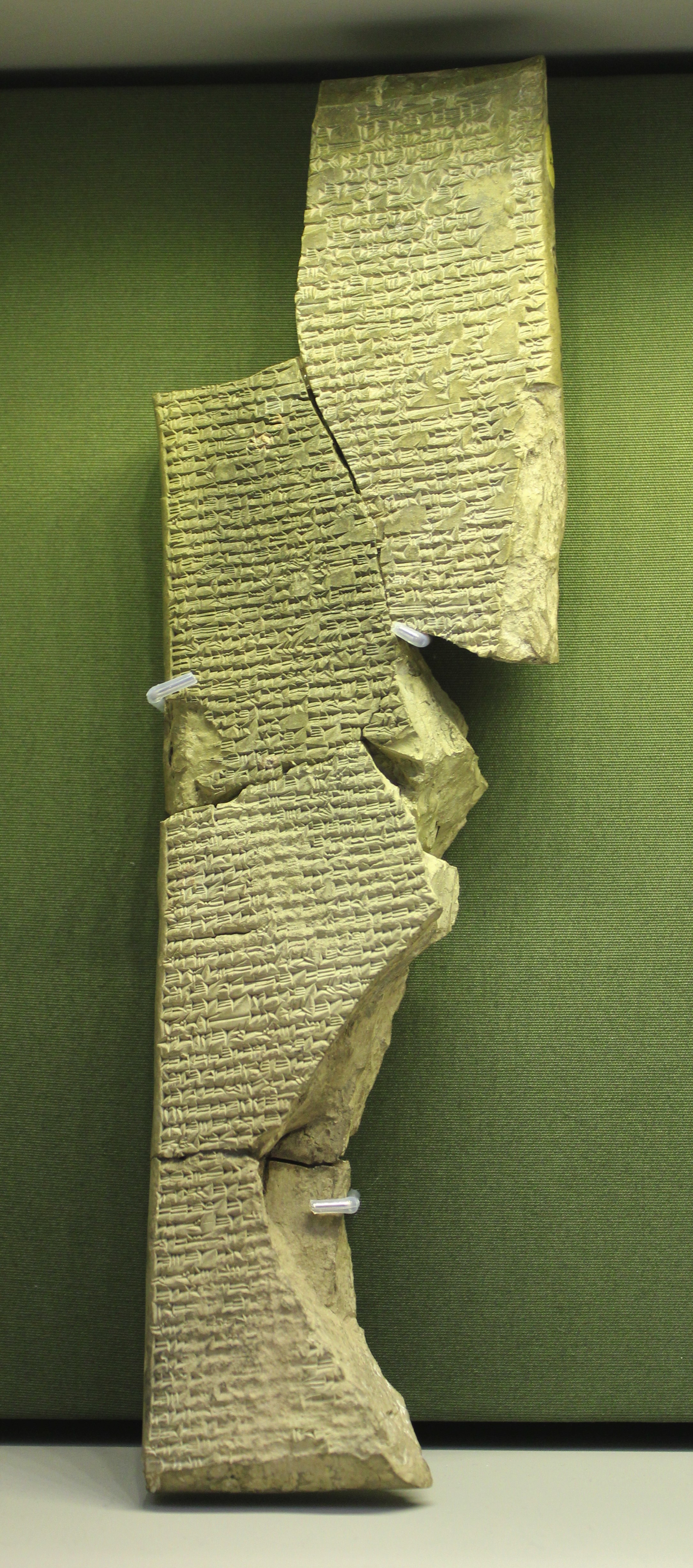
We investigate these questions through specific cuneiformCuneiformWriting with wedge-shaped signs, developed from Mesopotamian recording traditions and used for several languages from the third millennium BCE.Glossary · Click to read the explanation witnesses, the lunar passage of the Babylonian poem Enūma ElišEnuma ElishA seven-tablet Babylonian creation poem in Akkadian, recounting Marduk’s rise, victory over Tiamat, cosmic ordering and human creation, and culminating in praise through fifty names. Its composition date is debated; later manuscripts and recitation traditions preserve it.Glossary · Click to read the explanation, and biblical texts alongside competing modern interpretations. A distinction must be maintained between what a document actually calls something and what scholars infer through comparison. [1][3][13][14]
The word and its ancient spellings
A Sumerian–Akkadian lexical equivalence indexed in the ORACC project matches “the fifteenth day” with the Akkadian šapattu. Syllabic spelling varies between witnesses: one list has ša₂-pat-tum, while part of the second form is restored in square brackets. The passages below follow the published indexed transcription; the tablet images and original editions have not been independently collated for this review. [1]
The first equation equates the fifteenth day with šapattu. In the second, the brackets mean that “pat-tu₂” has been reconstructed rather than preserved in its entirety; the question mark in the first indicates uncertainty in the damaged numeral. These lists support a calendrical meaning but do not themselves command people to stop working. An accessible Akkadian dictionary distinguishes the “fifteenth day of the month” from a “period of fifteen days”, also listing šapattu as a variant of šabattu. [1][4]
Šapattu in the calendar of Assyrian merchants
Old Assyrian loan contracts from Kaneš, modern Kültepe in AnatoliaAnatoliaAnatolia is the region occupying the Asian part of present-day TurkeyGlossary · Click to read the explanation, where merchants from Aššur operated in approximately the nineteenth and eighteenth centuries BCE, provide a more direct test of usage. The Assyriologist Cécile Michel identified around thirty references to šapattum in the documents she examined. Sometimes it is a fixed point at mid-month, when the moon god has reached fullness; elsewhere it serves as a half-month unit for calculating loans, repayment dates, and interest. [3]
Michel publishes the following Akkadian phrase from loan document Kt 93/k 531, lines 37–39. It is her Latin-script transliteration, not a fresh reading of the tablet surface; the English translation here is a concise contextual rendering based on her discussion. [3]
DINGIR is a cuneiform sign meaning “god”. Identifying the deity as the moon god depends on the surrounding text and the editor's interpretation; the short phrase does not spell out the word “moon”. Contract Kt b/k 651, which Michel cites through an earlier publication, places ša-pá-tim alongside eight units of ḫamuštum when calculating interest. This is evidence of a period that could be counted and added to another unit, not of a prescribed day of religious rest. [3]
Ḫamuštum itself is a named unit used to date merchants' transactions. On the basis of interest calculations and an almanac reconstructable as some fifty to fifty-two entries in a year, the scholarship reviewed by Michel favours a seven-day duration. Such a cycle in Old Assyrian society is historically important; it does not mean that this unit was called šapattu. The documents use two distinct names, and they do not show that each seven-day unit was a general day off. [3]
The moon in Enūma Eliš
Enūma ElišEnuma ElishA seven-tablet Babylonian creation poem in Akkadian, recounting Marduk’s rise, victory over Tiamat, cosmic ordering and human creation, and culminating in praise through fifty names. Its composition date is debated; later manuscripts and recitation traditions preserve it.Glossary · Click to read the explanation is a Babylonian Akkadian creation poem in seven tablets. After the god MardukMardukBabylon’s leading god, worshipped at Esagil and elevated in the Akkadian Enūma eliš. His symbols include a spade and mušḫuššu dragon. His earliest origins remain obscure; Nibiru is no evidence of a planetary homeland.Glossary · Click to read the explanation's victory, it depicts his organisation of the cosmos; the moon's placement belongs to the mythic narrative, not to a dated record of the calendar's invention. In Tablet V, lines 12–22, Marduk assigns the moon god Nannar the regulation of days. In the translation by Assyriologist Wilfred G. LambertWilfred G. LambertAssyriologist and cuneiform scholar associated with Birmingham who translated Enūma Eliš.Glossary · Click to read the explanation, the moon's appearance is half-sized on the seventh day and opposite the sun on the fifteenth; the twenty-ninth and thirtieth days are mentioned as well. [2]
This is poetic ordering of lunar phases, not a schedule of days off. Crucially, line 18 in the Lambert translation actually checked says “the fifteenth day” without explicitly giving the word šapattu. Some commentators insert that name in parentheses to explain the date; their interpolation should not be attributed verbatim to the ancient line. Lambert's critical edition is also an edited text drawing upon multiple manuscript witnesses and recording supplementary readings in its apparatus. Its composite translation is not proof that every extant tablet preserved precisely the same words. [2][6]
Composition of the poem in something like its familiar form is commonly placed toward the end of the second millennium BCE, although its more exact dating is debated. Surviving cuneiform copies from Aššur and NinevehNineveh and KuyunjikNineveh is an ancient Assyrian city near Mosul in northern Iraq; Kuyunjik is one of its archaeological moundsGlossary · Click to read the explanation come from later periods, including around the beginning of the first millennium and the seventh century BCE. These dates are different from the undatable mythic actions described in the story, and from the publication of Lambert's modern edition in 2013. [7][8]
Ritual restrictions and the supposed weekly rest
In Ottilia Lukács's discussion of the word's history, a ritualRitualAn organised or distinguished practice meaningful to a community; it may leave traces, but its form alone does not reveal an associated doctrine.Glossary · Click to read the explanation passage quoted from the Chicago Assyrian Dictionary associates the start of a month and its seventh and fifteenth days with acts of purification and washing. Another proposed interpretation calls šapattu ūm nuḫ libbi, a “day for the resting of the heart”, which some scholars explain as rituals directed toward calming the gods. Here the available reading is Lukács's presentation of the text and dictionary, not a direct examination of the cuneiform manuscript or the cited dictionary page. Neither expression automatically establishes a collective suspension of human labour. [14]
Lukács also reviews earlier attempts to derive a regular “Babylonian week” from special day lists, and objections to reading the numerals as a recurring seven-day calendar. One must distinguish the existence of dates with religious significance or particular restrictions in Mesopotamia from a generally observed rest day occurring every seven days under the name šapattu. The cited evidence can support the former without demonstrating the latter. This does not erase the distinct, commercially attested Old Assyrian seven-day ḫamuštum period. [3][14]
Is the Hebrew Sabbath derived from šapattu?
Scholars compare šapattu/šabattu with HebrewHebrewA Northwest Semitic language of the Canaanite group, encompassing Iron Age epigraphy, Biblical, Rabbinic, medieval and Modern Hebrew; its scripts and pronunciations changed over time.Glossary · Click to read the explanation šabbāt (שַׁבָּת). The words resemble one another in their consonants, and the Akkadian variants themselves show an alternation between p and b. An argument for borrowing would nevertheless have to explain the phonological and morphological details, the passage between linguistic communities, the chronology, and the shift from a lunar mid-month point to a recurring seventh day. In addition, the Hebrew root š-b-t means to cease or desist and offers material for internal Hebrew explanations. Neither lexical resemblance nor an isolated root settles the historical derivation. [6][14]
In texts such as AmosBook of AmosHebrew prophetic book criticizing exploitation of the poor and merchants impatient for new moon and Sabbath to pass.Glossary · Click to read the explanation 8:5, HoseaBook of HoseaHebrew prophetic book listing new moon and Sabbath among festivals whose cessation is announced.Glossary · Click to read the explanation 2:13, and 2 Kings 4:23, the New Moon and Sabbath are paired. The biblical scholar Jacob L. WrightJacob L. WrightHebrew Bible scholar at Emory University studying Sabbath formation and Mesopotamian relationships.Glossary · Click to read the explanation interprets the ordering as a trace of an Israelite lunar celebration predating the joining of the Sabbath's name to the seven-day rest cycle. The pairing, together with the similarity to šapattu, strengthens the possibility of a lunar background; yet listing two occasions together does not in itself locate them at the two ends of a half-month or prove the borrowing of a word. [5][6]
The merchants' words in Amos include the following short Hebrew phrase, reproduced in Wright's study. The English rendering here is independent and condensed rather than a quotation of his English translation. [5]
The contexts matter. Amos depicts grain merchants impatient for the New Moon and Sabbath to end so they can resume trading. Exodus 23:12, by contrast, instructs landowners to stop work on the seventh day, allowing dependants and animals to recover. In NehemiahBook of NehemiahHebrew book presenting Nehemiah’s reforms in Persian-period Judah, including regulation of Sabbath commerce.Glossary · Click to read the explanation 13:15–22, the narrative set in Persian-period JerusalemJerusalemJerusalem is a city of religious importance in Judaism, Christianity and IslamGlossary · Click to read the explanation describes attempts to stop trading and carrying loads on the Sabbath. That is detailed evidence concerning a collective or weekly observance, but it cannot be inferred from a single Akkadian word in a debt contract. Nor does the fifth-century BCE setting of Nehemiah's account determine the date of composition of every passage in the edited biblical book. [5][13]
Against Wright's proposed shift from lunar to weekly observance, Tova Ganzel and Jan Safford argue that a direct linguistic link remains elusive and that known šapattu usage offers no exact equivalent to the Hebrew institution. They also examine Judean personal names derived from Sabbath found in cuneiform documentation of Babylonia under Persian rule, notably during the sixth and fifth centuries BCE. Such names demonstrate the word's currency in Judean communities, not the borrowing of a Sabbath rest practice from a Babylonian festival. The lunar hypothesis draws strength from calendrical pairing and phonetic similarity; a decisive origin narrative is weakened by the different periodicities and obligations and the lack of a text documenting the alleged transfer. [13][14]
Chronology and conclusion
- Approximately nineteenth–eighteenth centuries BCE: Old Assyrian traders' documents use šapattum for the full moon or a half-month and treat ḫamuštum as another unit of time. [3]
- Probably late second millennium BCE: the likely milieu in which Enūma Eliš took its familiar form, with a continuing debate over precise dating; its narrated events belong to mythic time. [7][8]
- First millennium BCE: surviving cuneiform copies of the poem and lexical-list traditions; a particular copy's date is not necessarily the date when its terminology was coined. [1][7][8]
- Persian period, particularly the fifth century BCE: texts and personal names associated with the Sabbath among Judeans; the documentary dates should not be conflated with stages of editing biblical books. [13]
The strongest evidence examined here is for a calendrical meaning of šapattu: a mid-month date or a half-month period. Its resemblance to the Hebrew Sabbath raises a serious linguistic and historical question, but the proposed transfer of a name and institution, or a development from lunar observance to weekly rest, remains a reconstruction requiring more than resemblance alone. [1][3][13][14]
References and notes (10)
- ORACC ePSD2 lexical equivalence index, Sumerian–Akkadian lists; only search-indexed excerpts were accessible, not the complete original entry. ud 15-kam = ša₂-pat-tum: Iraq 6, p. 23, obv. i′ 3′; ud 15-kam₂ = ša₂-[pat-tu₂]: CT 19, pl. 10, K 05434B+, obv. ii′ 12′; indexed transcription only Return to the text ↑
- W. G. Lambert, Babylonian Creation Myths (Eisenbrauns, 2013); edited translation of Enūma Eliš, checked passage only. Tablet V:12–22; printed p. 99; PDF page 23 (zero-based index 22). Return to the text ↑
- Cécile Michel, “The Day Unit within the Old Assyrian Calendar,” in Şevket Dönmez (ed.), Studies Presented in Honour of Veysel Donbaz (Ege Yayınları, 2010). Article and cited loan transliterations read. pp. 217–224, esp. 220–223, §§2.1–2.2, nn. 12–23; Kt 93/k 531, ll. 37–39; Kt b/k 651. Return to the text ↑
- Assyrian Languages, online Akkadian Dictionary, entry šabattu with variant šapattu; dictionary result entry only. Entry šabattu, senses 1 (“fifteenth day”), 2 (“fifteen-day interval”), and variants. Return to the text ↑
- Jacob L. Wright, “Shabbat of the Full Moon,” TheTorah.com (2015; updated 8 October 2026); relevant discussions and quoted Hebrew biblical passages read. “New Moon and Then Shabbat,” “Shabbat of Full Moon,” “The Oldest Requirements for Seventh-Day Rest”; Amos 8:5, Hos 2:13, 2 Kgs 4:23, Exod 23:12. Return to the text ↑
- Jacob L. Wright, “How and When the Seventh Day Became Shabbat,” TheTorah.com (2015); sections proposing a lunar-to-weekly shift and šapattu comparison, including Wright’s parenthetical insertion. “Full Moon and the Cessation of Labor” and “Shabbat and šapattu: Full Moon Holidays”; (šap/battu) beside day 15 is authorial gloss. Return to the text ↑
- Adrian Cornelius Heinrich, “Babylonian Epic of Creation,” Oxford Classical Dictionary (21 August 2024); publisher abstract only, not the full entry. Publisher abstract: likely late-second-millennium BCE composition, under Nebuchadnezzar I. Return to the text ↑
- Alexander Heidel, The Babylonian Genesis: The Story of Creation, 2nd ed. (University of Chicago Press, 1951); passages on copy dates and uncertain composition reviewed; its composition hypothesis is historically dated. Printed pp. 1 and 13, esp. “The Date of Composition” p. 13 (PDF page 23, zero-based index 22). Return to the text ↑
- Tova Ganzel and Jan Safford, “Shabbat, Mid-Fifth Century B.C.E.,” TheTorah.com (2026); full article and pertinent footnotes, distinguishing names from the historical institution. Introduction; “When Did Shabbat Become Significant?”; “Shabbataya in Babylonia, Nippur, and Susa”; relevant nn. 1–5, 17–24. Return to the text ↑
- Ottilia Lukács, Sabbath in the Making: A Study of the Inner-Biblical Interpretation of the Sabbath Commandment (Peeters, 2020); publisher preview only, not the whole book; CAD material accessed only as quoted there. Chapter 1, printed pp. 5–11, esp. 6–7 and 10; nn. 15–19 and p. 10 n. 33; page images 6 and 10 visually inspected. Return to the text ↑
Suggest a correction · Suggest a source for this record
Cite this record
IL Archive, «Akkadian Šapattu», https://ilarchive.com/en/entities/akkadian-shapattu
Continue reading