Study
Why Seven? What Scholars Can Explain and What Remains Unknown
An extended study of a topic, with evidence and references.
- Region
- The Near East
Why is seven so prominent from Mesopotamia to the Qur'an? The closing study of the series tests each scholarly explanation, from the lunar month to the seven visible planets, against the sources.
Estimated reading time: 10 min Published Last reviewed:
Share article
Video
Why Is Seven Sacred? What the Clay Tablets of Ancient Iraq Reveal
Our fourth documentary follows the number seven through the clay tablets of ancient Iraq and its neighbours, then reads the scriptures in their own words and with respect. Some scenes are AI-generated illustrations.
The YouTube player loads only when you press play. Watch on YouTube
Text
Introduction
Throughout this archive's series on the number seven, one question has kept returning: why seven? Why did Sumerian poets stop their counts at seven, and why do the seventh day and seven heavens appear in the scriptures of Jews, Christians and Muslims?
This closing study first gathers what the series found, then takes the explanations that scholars have proposed one by one: the phases of the moon, the seven moving lights of the sky, the Pleiades, the base-60 number system, the habits of poetic language and a famous result of modern psychology. For each it asks what evidence supports it and what it leaves out, and states plainly what is known and what is not.
What the series found
Seven is not equally strong everywhere, and that is the first fact any explanation has to meet.
In MesopotamiaMesopotamiaHistorical region associated with the Tigris and Euphrates: Uruk, Ur, Eridu, cuneiform, Sumer, Akkad, Babylon and Assyria, their languages and cults, and the limits of archaeological evidence.Glossary · Click to read the explanation it is everywhere. A group of gods was called simply "the Seven", feared as demons in incantations and placed as protectors at the gates of houses, as The Sebettu: "the Seven" as Demons and as Protectors in Mesopotamia shows; Erra and Ishum: the Babylonian Poem of the Seven, of War and of Protection from Plague gives them a birth from Anu and Earth. Seven in Sumerian Poetry: Gates, Terrors, Mountains and Judges follows counts of gates, mountain ranges, terrors and judges that climb and stop at seven. The Pleiades and the Seven Gods: Stars, Seven Dots and Assyrian Symbols shows astronomers linking a star cluster with "the seven great gods".
At UgaritUgaritAncient city and kingdom at Ras Shamra on the Syrian coast, flourishing between the fourteenth and early twelfth centuries BCE and preserving multilingual archives.Glossary · Click to read the explanation narrative poems count six days in pairs and turn the story on the seventh (Six Days, Then the Seventh: The Seven-Day Pattern in Ugaritic Epic). In Israel's scriptures seven marks the blessed seventh day, the sabbatical year and Jubilee, oaths, purification and the number seventy (Seven in the HebrewHebrewA Northwest Semitic language of the Canaanite group, encompassing Iron Age epigraphy, Biblical, Rabbinic, medieval and Modern Hebrew; its scripts and pronunciations changed over time.Glossary · Click to read the explanation Bible: Oath, Completion and Holy Time). The New Testament uses it for forgiveness without limit and for the series of seals, trumpets and bowls in Revelation (Seven in the New Testament: from "Seventy-Seven Times" to the Seven Seals). The Qur'an speaks of seven heavens, "seven of the oft-repeated", seven gates and seven years in a king's dream, and seven shapes the rites of Hajj (Seven in the Qur'an and in Islamic Worship). Even here counts vary: Seven Heavens: What Ancient Texts Say about the Layers of the Sky shows an Assyrian tablet with three heavens.
EgyptEgyptEgypt lies mainly in northeastern Africa and includes the Sinai Peninsula in AsiaGlossary · Click to read the explanation is the useful exception. Seven is present there, in the Seven Hathors who announce a fate and the seven cows of Book of the Dead spell 148, but the groups that order the gods are a Nine and an Eight (The Seven Hathors and Other Sevens in Ancient Egypt). Nine could stand for "all" the gods because Egyptians expressed plurality with three.[1] Seven, then, is regional, not universal: prominent in a connected Near Eastern world, not a law of human nature.
The quarters of the moon
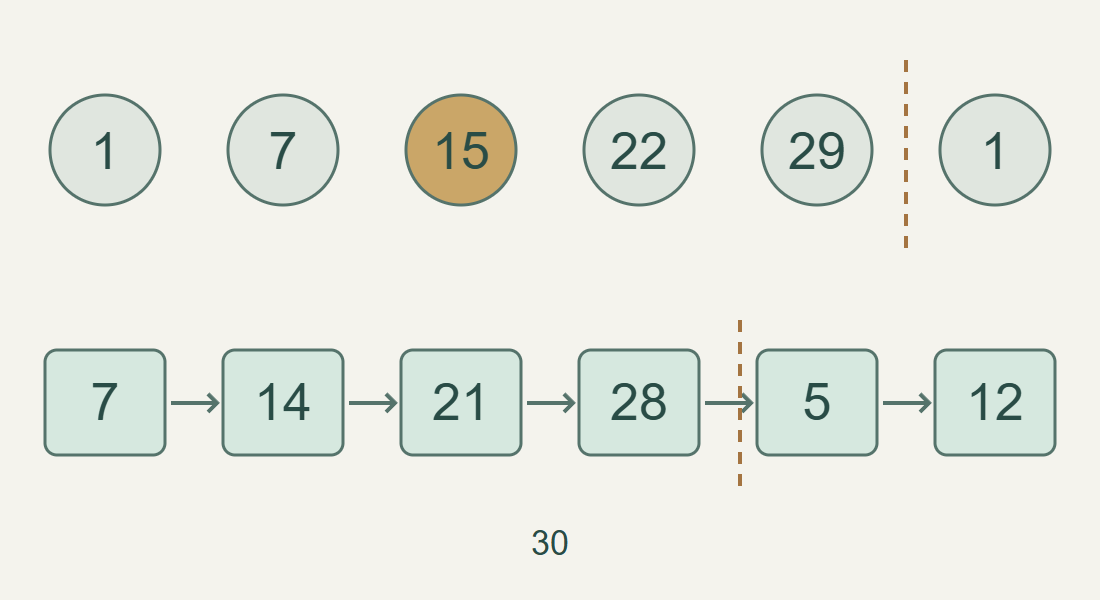
The mean synodic month, from new moon to new moon, lasts 29.53059 days.[2] A quarter of that is about 7.4 days, so a count of seven days roughly follows the moon from new to half to full.
This fits one body of evidence well. In Mesopotamian hemerologiesMesopotamian HemerologyMesopotamian hemerologies assess dates for ritual, food, marriage, travel and other activities. The entry studies their witnesses, courtly examples and reception, and explains why cautionary dates are neither a universal calendar nor weekly rest days.Glossary · Click to read the explanation, lists that judge days favourable or risky, the 7th, 14th, 21st and 28th days of a month "seem to have been systematically unfavourable", and an essay from the University of Hamburg's Centre for the Study of Manuscript Cultures notes that they corresponded to the phases of the moon.[3] The lunar explanation is therefore probable for these special days.
It is weak for a continuous week. C. H. W. Johns observed in 1911 that if the 15th was the full moon, the 7th fits the half moon well, but the 21st and 28th "fall away considerably from the moon's phases"; the same lists also mark the 19th, which breaks the pattern and is only explained by a modern guess that it was the 49th day from the start of the previous month.[4] These days started again with each month. A week that runs on regardless of the moon cannot keep step with it: four weeks make 28 days, a month about 29½. The Hebrew Bible is the earliest witness to such a continuous week, as Where Did the Planetary Week Come From? From "Babel und Bibel" to a Pompeii Graffito explains, and the SabbathSabbath, the weekly rest daySacred seventh day in Jewish traditions, linked by commandments to household rest, creation and liberation.Glossary · Click to read the explanation is tied there to creation and rest, not to the moon. The moon may lie behind some Mesopotamian sevens, not all.
Seven moving lights
Seven bodies move against the fixed stars to the naked eye: the Sun, the Moon, Mercury, Venus, Mars, Jupiter and Saturn. Seven is often said to be sacred because of them.
Babylonian scholars observed all seven, but they did not usually treat them as one family. In the great omen series Enūma Anu EnlilEnlilEnlil/Ellil: a major Mesopotamian god associated with destinies, kingship, and Ekur at Nippur, already prominent in third-millennium god lists. His name’s origin and cult beginnings remain debated.Glossary · Click to read the explanation the Moon, the Sun and the weather each have their own sections before the stars and planets.[5] The AkkadianAkkadianAn ancient East Semitic language written in cuneiform from the third millennium BCE; its varieties include Babylonian and Assyrian, and it served in international diplomacy.Glossary · Click to read the explanation word for "planet", bibbu (written UDU.IDIM, "wild sheep"), was used above all for Mars, Mercury and Saturn; only lists that add the Sun and the Moon reach seven, such as late temple ritualsRitualAn organised or distinguished practice meaningful to a community; it may leave traces, but its form alone does not reveal an associated doctrine.Glossary · Click to read the explanation from UrukUrukAncient city at Warka in southern Iraq, a major urban centre around 3200 BCE that preserved early writing and accounting tablets.Glossary · Click to read the explanation that set seven golden tables for the planets, the Sun and the Moon.[6] Kazuo Muroi, a specialist in Babylonian mathematics, also cites a bilingual phrase that he renders "the seven planets (sun, moon, and five planets)".[7] So the seven lights could be counted together, at least in some texts.
What is missing is any text that derives the importance of seven from them. Muroi lists groups of seven, including "seven gods", in Sumerian texts of the mid-third millennium BCE, long before the late Uruk rituals cited above.[7] The planetary week, often offered as proof, is Roman. Ilaria Bultrighini and Sacha Stern find "no evidence of a planetary week" in Egypt, Mesopotamia or the Hellenistic world before the second century CE, and trace its first appearance to Italy in the later first century BCE; in their view it was not founded on any astronomical principle.[8] The seven lights are a possible contributor; as the origin of seven they are unproven.
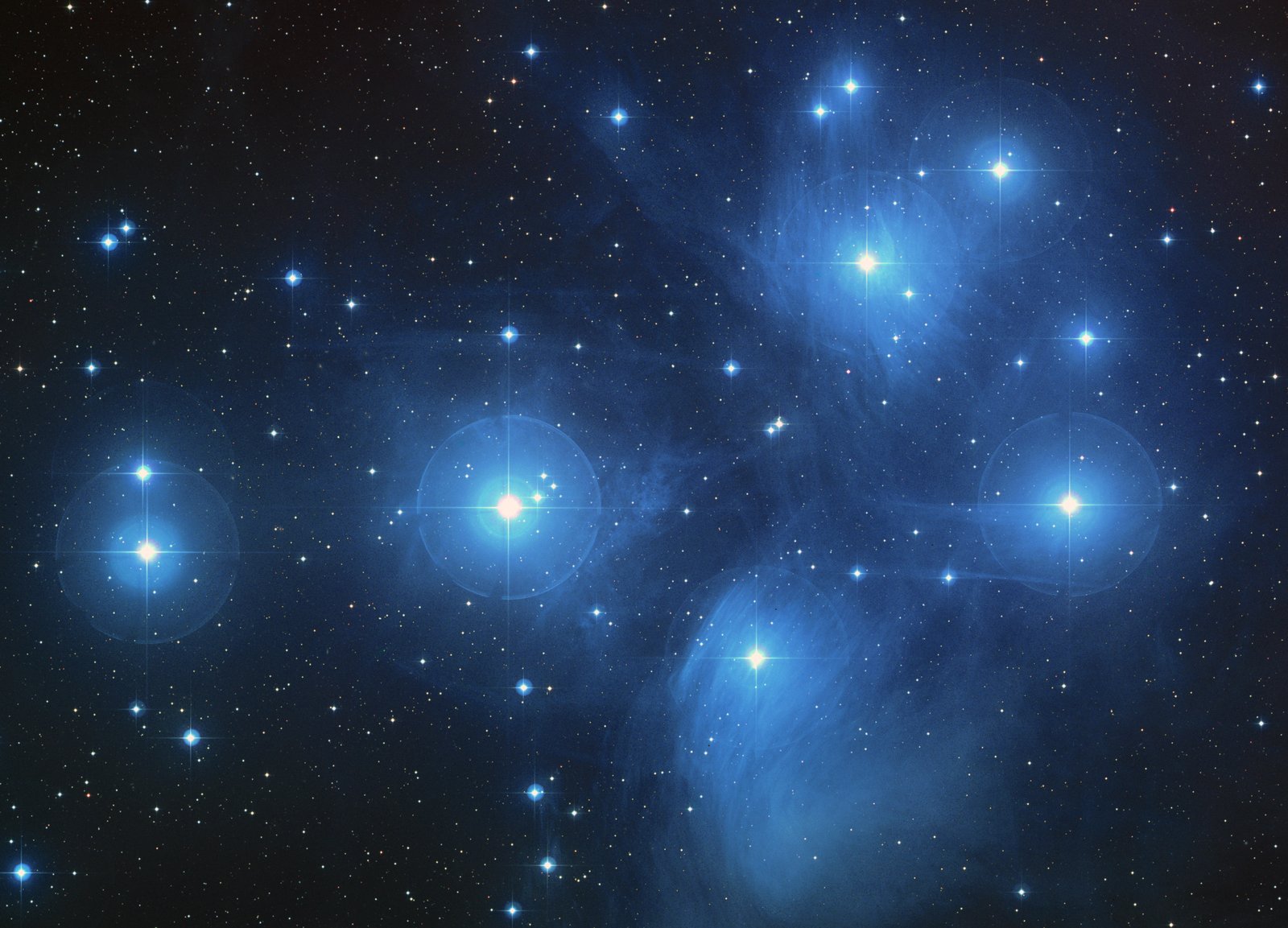
The Pleiades
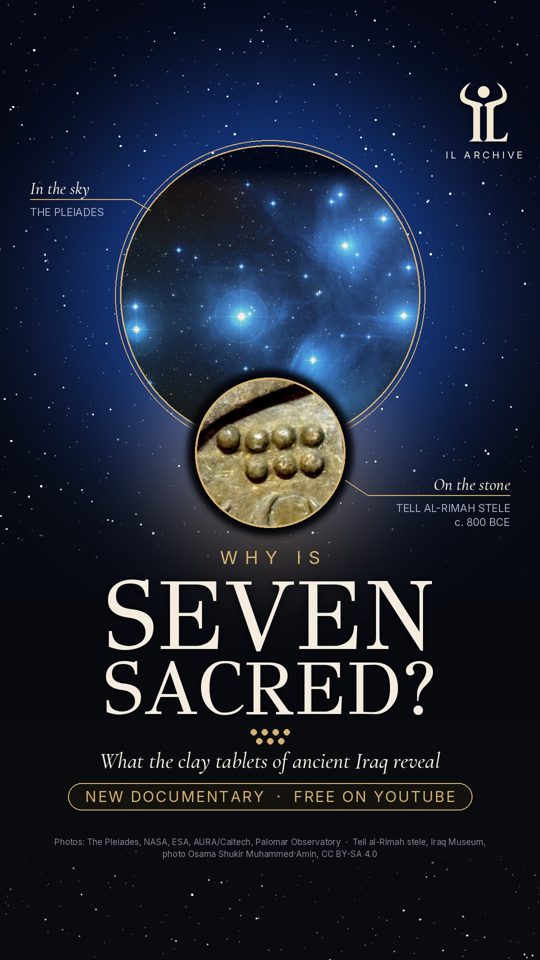
The Pleiades, the small cluster in Taurus, show about six stars to the naked eye. In cuneiformCuneiformWriting with wedge-shaped signs, developed from Mesopotamian recording traditions and used for several languages from the third millennium BCE.Glossary · Click to read the explanation their usual name was MUL.MUL, "the Stars", not "the Seven"; the astronomical compendium MUL.APIN adds that they are "the seven great gods". Lorenzo Verderame shows that this link was real and important, with the cluster identified with two different groups of seven divine beings.[9]
But he also notes that in Mesopotamia seven was already "a symbolical number, expressing perfection and completeness", so that many divine groups were counted as seven.[9] The cluster may have been drawn into a number that was already special rather than having made it special. The association is confirmed; the Pleiades as the cause of seven are unproven.
Base 60: why an hour cannot be split into seven
Mesopotamian scribes counted in base 60: their numbers were built on sixty, as ours are built on ten. We still use what is left of it every day, since an hour has 60 minutes and a minute 60 seconds. Sixty divides cleanly in many ways: an hour split into 2, 3, 4, 5 or 6 parts gives a whole number of minutes (30, 20, 15, 12 and 10). Split into seven, it never comes out even: 8 minutes, 34 seconds and 17 sixtieths of a second, then 8, 34, 17 again without end. Seven is the first whole number that sixty cannot be divided by with a result that ends, however small the units become.
In a paper posted on arXiv in 2014, Muroi proposed that Sumerian scribes noticed this in the third millennium BCE and that it made seven "the representative of their number mysticism". He points to an early division problem from Shuruppak that divides barley by seven, and to the Sumerian story of Gilgamesh crossing six mountain ranges until "the seventh" reveals the cedars.[7]
The arithmetic is certain. The step from a hard fraction to a sacred number is not stated in any ancient text, and Muroi himself stresses that "there is no mysticism concerning the number 7 in Babylonian mathematics in itself".[7] The proposal explains why scribes might have noticed seven, not why it gained religious weight. It is one author's argument: unproven.
Seven as completion: what language shows
The clearest pattern is in how seven is used. Poets count up to it as a climax: "He traversed five mountains, six mountains, seven mountains" in the Sumerian poem Enmerkar and the Lord of Aratta;[10] at Ugarit a fire blazes "for a fifth day, then a sixth" and "on the seventh day" leaves Baal's palace;[11] in Proverbs, "There are six things which YahwehYahwehThe proper name of Israel’s deity, written יהוה (YHWH), the Tetragrammaton. Its exact ancient pronunciation is not directly preserved; texts and inscriptions witness its history.Glossary · Click to read the explanation hates; yes, seven which are an abomination to him".[12] Seventy works the same way in the Hebrew Bible, and Ibn Kathir explains the "seven seas" of Qur'an 31:27 as a sign of a large amount, as the Qur'an study of this series reports.
Even the Sumerian word for seven should be handled carefully. The Pennsylvania Sumerian Dictionary gives imin one sense, "seven", for all 327 instances it counts; only a much later word list sets it beside the Akkadian kiššatu, "totality".[13]
Seven as completion is strongly supported as usage. But it explains how seven worked once it was special, not why it became so: saying that seven was chosen because it meant completeness turns the answer into the question.
These proposals are not new. In 1906 the Jewish Encyclopedia reported that some found the origin of seven's sacredness in its factors three and four, others in the number of the planets, others in a sacred six plus one.[14] More than a century later the list is longer, but none has been proven.
Miller's "magical number seven" is not an explanation
In 1956 the psychologist George A. Miller published "The Magical Number Seven, Plus or Minus Two", on the limits of short-term memory and judgement in laboratory tasks. He ended by listing the seven seas, the seven deadly sins and other sevens, and suspected that it was "only a pernicious, Pythagorean coincidence".[15] Later research revised the limit itself. Nelson Cowan wrote in 2001 that Miller's figure was "more as a rough estimate and a rhetorical device than as a real capacity limit", and that the real limit is three to five chunks, about four.[16]
This is a modern result about modern experiments, and a limit shared by all human brains could not explain why seven was central in Mesopotamia and much less so in Egypt. It is not an explanation of ancient seven.
What can honestly be said
- Confirmed: seven is frequent and prominent in Mesopotamia, Ugarit, the Hebrew Bible, the New Testament and the Qur'an, and present but less central in Egypt.
- Probable: the lunar quarters lie behind the Mesopotamian special days 7, 14, 21 and 28.
- Confirmed as associations, unproven as causes: the Pleiades and the seven moving lights.
- Unproven: the base-60 explanation, one author's proposal.
- Strongly supported as usage, not as origin: seven as completion and as the climax of a count.
- Not an explanation: Miller's magical number.
No ancient text explains why seven was chosen. The Sumerian poems, the Egyptian sources and the Qur'an, as the studies of this series note, use seven without saying why it was chosen. Several factors may have reinforced one another, the moon, the sky and the habits of poets, but that too is a possibility, not a finding. Scholars have clues, and no proof.
Seven in scripture
For believers, the meaning of seven in their scriptures does not wait on this historical question. In Genesis, "God blessed the seventh day, and made it holy";[17] in the Qur'anThe QuranThe central scripture of Islam, consisting of 114 Arabic surahs; its study distinguishes Quranic discourse from manuscript history, reading traditions, and historical inference.Glossary · Click to read the explanation, God "created seven heavens in layers", and the hearer is invited to look again and find no flaw.[18] The classical commentators explained each such verse in its own context and recorded their differences without building a theory of numbers. Historians can describe how a number was used across a region and over centuries; they cannot supply or replace the meaning that the texts give it for those who read them as scripture. The two kinds of reading answer different questions, and both are best served by letting each text speak in its own words.
References and notes
- Global Egyptian Museum, glossary entry "Ennead" Whole entry read: enneads as groups of nine gods; nine as a symbolic number that could stand for 'all' the gods; plurality expressed by three; the fifteen gods of the Theban ennead Return to the text ↑
- Fred Espenak, "Eclipses and the Moon's Orbit", NASA Goddard Space Flight Center, Eclipse Web Site Section on the synodic month read: mean length 29.53059 days (29d 12h 44m 03s) and its variation Return to the text ↑
- Centre for the Study of Manuscript Cultures, University of Hamburg, "Every day has its own activity" (26 February 2025) Essay read: the 7th, 14th, 21st and 28th days as systematically unfavourable and corresponding to the phases of the moon; the unfavourable days of Nisan, including the 19th Return to the text ↑
- C. H. W. Johns, "Sabbath" (Babylonian section), Encyclopaedia Britannica, 11th edition (1911), Wikisource transcription Babylonian section read: the 7th, 14th, 19th, 21st and 28th days of the intercalary Elul; the fit of the 7th with the half moon and the drift of the 21st and 28th from the moon's phases; the 19th as the 49th day; no definite proof of a Babylonian seven-day week Return to the text ↑
- Enrique Jiménez, introduction to CCP 3.1.u91 "Enūma Anu Enlil Šamaš and Adad", Cuneiform Commentaries Project (2014); with the overview in Wikipedia, "Enūma Anu Enlil" CCP introduction read (Šamaš section EAE 23-36, Adad section EAE 37-49); Wikipedia 'Contents' section read only for the general order of the series (moon tablets first, stars and planets in the final tablets) Return to the text ↑
- Gennady E. Kurtik, Susanne M. Hoffmann, Wayne Horowitz et al., "UDU.IDIM", All Skies Encyclopaedia (CC BY 4.0), citing F. Thureau-Dangin, Rituels accadiens (1921) and M. J. H. Linssen, The Cults of Uruk and Babylon (2004) Entry read: bibbu (UDU.IDIM, 'wild sheep') as a generic term for planets, used mainly for Mars, Mercury and Saturn and reaching seven only in lists that include the Sun and the Moon; Uruk temple rituals (RAcc. 79:29-34, 119:22-24) with seven golden tables for the planets, the Sun and the Moon Return to the text ↑
- Kazuo Muroi, "The Origin of the Mystical Number Seven in Mesopotamian Culture: Division by Seven in the Sexagesimal Number System", arXiv:1407.6246 [math.HO] (2014), preprint Whole paper read (13 pages): early examples of seven (Early Dynastic proverbs and UD.GAL.NUN texts), the Shuruppak division problem, 1/7 = 0;8,34,17 recurring, Gilgamesh and Huwawa B, the list of later sevens including example 40 'the seven planets (sun, moon, and five planets)' cited from CAD S, the remark that Babylonian mathematics itself has no mysticism of seven, and the conclusion Return to the text ↑
- Ilaria Bultrighini, "The origins of the planetary week", zodiacblog, Freie Universität Berlin (2 May 2022), summarising I. Bultrighini and S. Stern, "The seven-day week in the Roman Empire", in S. Stern (ed.), Calendars in the Making (Brill, 2021) Blog post read: no evidence of a planetary week in Egypt, Mesopotamia or the Hellenistic world before the second century CE; first appearance in Italy in the second half of the first century BCE; the week not founded on any astronomical principle; planetary hours. The book chapter itself was not read for this study Return to the text ↑
- Lorenzo Verderame, "Pleiades in Ancient Mesopotamia", Mediterranean Archaeology and Archaeometry 16/4 (2016), pp. 109-117 (open access) Abstract, section 2 'The Pleiades and the number seven' (2.1 the divine heptad; MUL.APIN I i 44; Astrolabe B) and section 5 'Conclusions' read Return to the text ↑
- Electronic Text Corpus of Sumerian Literature (ETCSL), Enmerkar and the Lord of Aratta, c.1.8.2.3, English translation Lines 160-175 and 500-514 read Return to the text ↑
- KTU 1.4 VI, the building of Baal's palace, translation as presented by intertextual.bible (after KTU, Cuneiform Texts from Ugarit) Passage read: fire in the house on the fifth and sixth day, departing on the seventh (KTU 1.4 VI, around line 31) Return to the text ↑
- World English Bible (public domain), read through bible-api.com Proverbs 6:16-19 Return to the text ↑
- Electronic Pennsylvania Sumerian Dictionary (ePSD2), entry imin "seven" Entry read: single sense 'seven' (327 instances); lexical equation imin = kiššatu 'totality' in K 2054 (CT 18 pl. 29-30) Return to the text ↑
- Executive Committee of the Editorial Board and Caspar Levias, "Numbers and Numerals", Jewish Encyclopedia (1906) Section on seven read: 'the most sacred number', its sanctity enhanced by the Sabbath, and the explanations then proposed (factors three and four, the planets, a sacred six plus one) Return to the text ↑
- George A. Miller, "The Magical Number Seven, Plus or Minus Two: Some Limits on Our Capacity for Processing Information", Psychological Review 63 (1956), pp. 81-97 (Classics in the History of Psychology transcription) Opening paragraph and the closing paragraph on the 'magical number seven' read Return to the text ↑
- Nelson Cowan, "The magical number 4 in short-term memory: A reconsideration of mental storage capacity", Behavioral and Brain Sciences 24 (2001), pp. 87-185 Abstract and section 1 (introduction) read Return to the text ↑
- World English Bible (public domain), read through bible-api.com Genesis 2:2-3 Return to the text ↑
- The Qur'an, Saheeh International translation, read through the alquran.cloud API (edition en.sahih) Qur'an 67:3 Return to the text ↑
Suggest a correction · Suggest a source for this record
Cite this record
IL Archive, «Why Seven? What Scholars Can Explain and What Remains Unknown», https://ilarchive.com/en/studies/why-seven-scholarly-explanations
Continue reading