Ancient text
Erra and Ishum: the Babylonian Poem of the Seven, of War and of Protection from Plague
A text for line-by-line reading, with transliteration, translation, and resources.
- Names
- Erra Epic · Erra and Ishum · Erra and Išum · Song of Erra
- Timeline
- From 900 BCE to 700 BCE
- Region
- Mesopotamia
An Akkadian poem in five tablets: the warrior god Erra, roused by the Seven, brings war and ruin on Babylon until Ishum calms him, and the poem itself was used as protection against plague.
Estimated reading time: 8 min Published Last reviewed:
Share article
Video
Why Is Seven Sacred? What the Clay Tablets of Ancient Iraq Reveal
Our fourth documentary follows the number seven through the clay tablets of ancient Iraq and its neighbours, then reads the scriptures in their own words and with respect. Some scenes are AI-generated illustrations.
The YouTube player loads only when you press play. Watch on YouTube
Text
Introduction
Many Mesopotamian poems about gods tell of creation, a flood or a hero's journey. Erra and Ishum tells of something closer to its audience: a god restless in peacetime, who listens to seven warlike companions and lets the cities of Babylonia tear themselves apart. This AkkadianAkkadianAn ancient East Semitic language written in cuneiform from the third millennium BCE; its varieties include Babylonian and Assyrian, and it served in international diplomacy.Glossary · Click to read the explanation poem also names the scholar who put it together, and it promises to protect the house where it is kept.
This card explains what the poem is, who the Seven are inside it, how far its date can be fixed, and why its lines were copied onto amulets. For the number seven, it is a key text: here the Seven are not a vague group but characters with a birth, a commission and a voice.
The work and its copies
The poem is written in Standard Babylonian Akkadian on five tablets. Ancient scribes called it the "Erra series" or used its opening words, "King of all settlements". Modern names vary: the Erra Epic, the Song of Erra, Erra and Ishum. The text itself calls itself a "song" in its final tablet. [1]
It circulated widely in the first millennium BCE. Luigi Cagni, whose edition of 1969 and later studies are the usual starting point, judged that not even the Epic of GilgameshEpic of GilgameshA Babylonian literary work with multiple recensions, preceded by separate Sumerian poems on Uruk’s king and Enkidu. Its standard form explores friendship, death, the flood and the limits of seeking eternal life.Glossary · Click to read the explanation had such a circulation in that period. [2] Kynthia Taylor's 2017 edition lists 44 manuscripts from Sultantepe near ancient HarranHarranHistoric city in southeastern Türkiye, south of Şanlıurfa; Genesis places Abraham’s family there on its journey towards Canaan.Glossary · Click to read the explanation, NinevehNineveh and KuyunjikNineveh is an ancient Assyrian city near Mosul in northern Iraq; Kuyunjik is one of its archaeological moundsGlossary · Click to read the explanation, AshurAshur, Qal’at SherqatAncient Tigris city in Iraq, an Assyrian political and religious centre.Glossary · Click to read the explanation, Tarbiṣu, Mê-Turna, SipparSippar: Abu HabbahSippar is an ancient Babylonian city in present-day Iraq, identified with Tell Abu Habbah.Glossary · Click to read the explanation, BabylonBabylonBabylon is an ancient city in central present-day Iraq, south of BaghdadGlossary · Click to read the explanation and Ur, with a few of unknown origin. Several are school exercise tablets with short extracts; a few are amulets. Tablets II and III are still incomplete. [3]
The first fragments were published by George Smith in 1876 as "The Exploits of Lubara", using an early reading of Erra's name. [4] An updated edition is being prepared by the electronic Babylonian Library (eBL), which has already published Tablet I with a translation by Enrique Jiménez. [5]
Who is who
Erra is a warrior god, associated with war and sometimes with plague, and treated as a form of Nergal, the god of the netherworld worshipped at Cuthah. Ishum is his adviser and vanguard, a protective god who walks before him. MardukMardukBabylon’s leading god, worshipped at Esagil and elevated in the Akkadian Enūma eliš. His symbols include a spade and mušḫuššu dragon. His earliest origins remain obscure; Nibiru is no evidence of a planetary homeland.Glossary · Click to read the explanation, the god of Babylon, appears as the king of the gods. [4]
The Seven (Akkadian Sebettu, older reading Sibitti) are introduced early in Tablet I. Their divinity is "quite another", their breath is death, and people dare not come near them. Then the poem gives their origin:
Erra and Ishum I 28–29, translation E. Jiménez, eBL. [5]
AnuAn / AnuAn is the Sumerian sky god, called Anu in Akkadian. The sign AN by itself does not identify him: it also denotes sky or divinity.Glossary · Click to read the explanation gives each of the seven a destiny of destruction: one to rage without rival, one to burn like fire, one to wear a lion's face, one to blow like the wind, the seventh to "finish all life" with viper's venom. Then he hands all seven to Erra with a short instruction: "Let these be your wrathful weapons, that they march at your flank!" (I 44). The next line says that the Seven themselves raise their weapons. In this poem, then, the Seven are at once Erra's weapons and warriors with their own will. [5]
Taylor notes that the scene echoes incantations, which tell how hostile forces were born in order to control them, and that the Seven are drawn in the colours of demons. Yet the poem gives them a place in the cosmic order: their violence can, in theory, be put to use. She also re-examines the often repeated claim of two mirror groups of Seven, one good and one evil, by checking how the group is spelled and described in each text. [6]
The story in outline
At the opening, Erra lies in bed "like a sleepless man", unable to decide whether to rise. The Seven mock him for living in the city like an old man and a child, and urge him to march: their bows have stiffened, their swords are rusting, and the noise of mankind keeps the AnunnakiAnunna / AnunnakiAnunna/Anunnaki is a collective designation for Mesopotamian gods whose scope varies by text and period; it is not a group with one fixed membership or number.Glossary · Click to read the explanation awake. Erra is pleased, Ishum protests, and Erra goes to EsagilEsagil, Marduk’s templeEsagil, also written Esagila, is Marduk’s temple in ancient Babylon, in present-day Iraq, and a central sanctuary of the city’s god.Glossary · Click to read the explanation, Marduk's temple in Babylon. [7]
There he persuades Marduk to leave his throne so that his tarnished image can be restored. Marduk recalls that once before, when he left his seat, the Flood came, and that he sent the craftsmen down to the Apsû. One line asks where are "the seven sages of the Apsû, pure carps", the apkalluApkalluAn Akkadian term for a sage or expert. Specific texts describe seven primordial sages; rituals use related protective figures. Neither the titles nor the depicted forms are always identical.Glossary · Click to read the explanation of Mesopotamian tradition. Erra promises to keep order while Marduk is away. [7]
He does not. Marduk leaves his seat, and violence spreads through Babylonia. In Tablet IV Ishum reproaches Erra for what he did in Babylon:
Erra and Ishum IV 3–4, translation E. Tadmor (2025). [8]
Ishum's speech goes on to describe citizens stirred to revolt, the governor driven to massacre the people of Babylon, and gods turning against their own cities; Sippar, UrukUrukAncient city at Warka in southern Iraq, a major urban centre around 3200 BCE that preserved early writing and accounting tablets.Glossary · Click to read the explanation, Dur-Kurigalzu and Der are struck as well. At last Ishum turns Erra's fury toward Babylonia's enemies. In Taylor's edition of Tablet V: "But Ishum his adviser calmed him down and he left some as a remnant" (V 42). Erra pronounces a blessing on Babylon and its future, and returns to his own throne. [9] [2]
The poem does not say that plague drives the story. Taylor points out that plague plays no major role in the plot, against early interpretations of the poem as a description of an epidemic. The main subject is war, civil strife and the breakdown of order. [10]
The composer and his dream
Near the end, the poem names the man who put it together:
Erra and Ishum V 43–44, translation K. Taylor (2017). [9]
The next line adds that he did not add a single line, and Erra and Ishum approve the text. Kabti-ilani-Marduk is also known from a catalogue of texts and authors from the library of AshurbanipalAshurbanipalAshurbanipal was an Assyrian king of the seventh century BCE, reigning about 668–631 BCEGlossary · Click to read the explanation. [2] He claims to have received the song, not to have invented it, so Taylor reads him as a scribe of the gods rather than an author in the modern sense. [11]
A song that protects
Erra then blesses those who use the song. The singer who chants it "will not die in the plague" (V 54); the scribe who learns it will escape from the enemy's land. And:
Erra and Ishum V 58–59, translation K. Taylor (2017). [9]
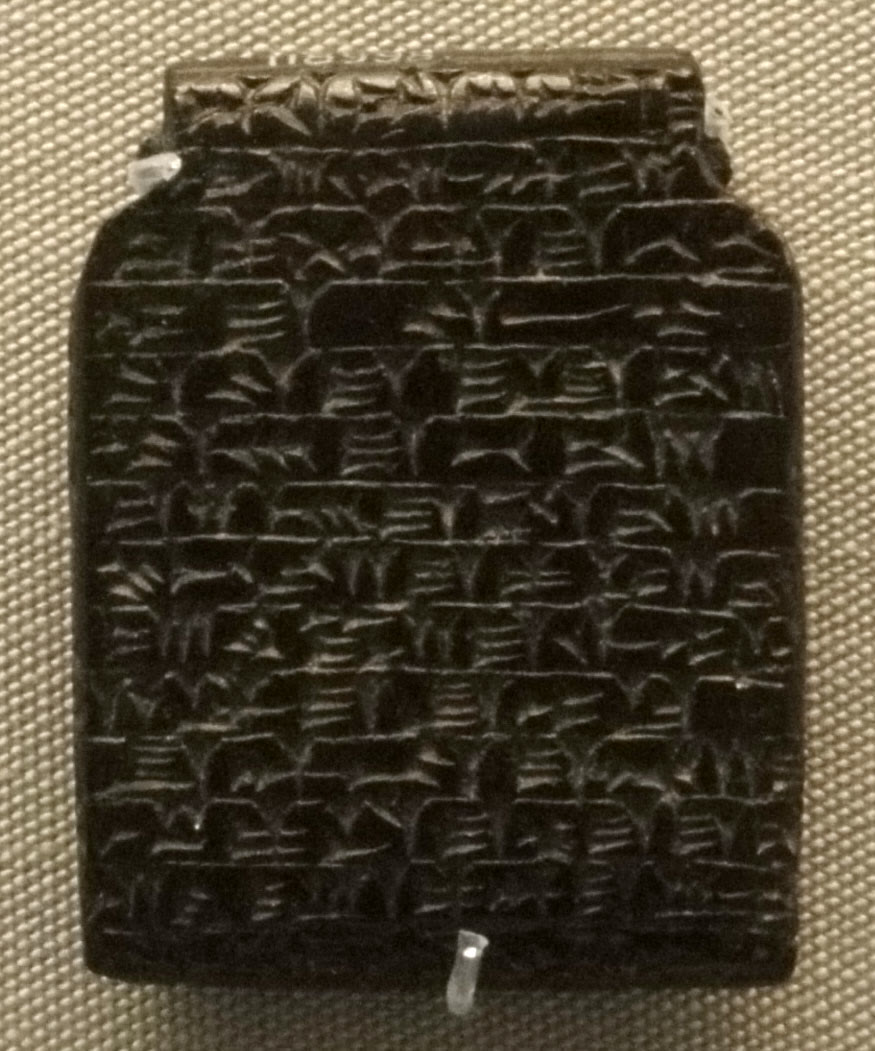
This is why the poem had a second life. Taylor's list includes an amulet with an excerpt from Tablet III (copy O, British Museum 118998), two amulet tablets from Nineveh with parts of Tablet V, and a tablet from Ashur that holds the whole text and could itself serve as an amulet. L. W. King published the two Nineveh pieces in 1896, and Erica Reiner discussed such pieces in "Plague Amulets and House Blessings" (1960). [3]
The amulet shown here is British Museum 118998: a small black stone, about 4.6 cm long, with part of the copper pin by which it hung. The museum description reproduced on its Wikimedia Commons page calls the text a quotation from the Erra Epic "thought suitable to ward off plague" and gives Ashur as its findspot; Taylor's list marks its provenance as uncertain, possibly Nineveh. [12]
When was it composed?
The date is debated. Modern proposals range from the twelfth to the seventh century BCE. Taylor sets a lower limit in the eleventh century, because the Suteans, whose attacks on Babylonia are attested from the eleventh to the ninth centuries, play a central part, and an upper limit in the seventh century, given by the Sultantepe copy (dated between 718 and 612 BCE). Within that range she finds the eighth century, or slightly earlier, most likely: a mid-eighth-century inscription appears to quote the poem's line V 59, a late-eighth-century inscription of Marduk-apla-iddina II quotes another, and the Dabibi family name is attested from the eighth century. She warns that no single reign can be proven. [10] Scott Noegel likewise places it in the ninth to eighth centuries and calls the question debated. [2]
Some scholars read the destruction in Tablet IV as a memory of real events. Peter Machinist wrote that the poem appears to be a "mythologization" of a specific historical event or period. Eli Tadmor has recently proposed, "tentatively and speculatively" in his own words, that Erra's "human form" in IV 3 may point to a usurper who rose against King Adad-apla-iddina (ruled 1064–1043 BCE). [8]
Three dates should be kept apart: the mythic time of the story, the probable but debated eighth-century composition, and the surviving copies, which are all late, from the Neo-Assyrian period onward.
Why it matters
In this cuneiformCuneiformWriting with wedge-shaped signs, developed from Mesopotamian recording traditions and used for several languages from the third millennium BCE.Glossary · Click to read the explanation poem the Seven have a whole literary life: born of Anu and Earth, each given a deadly destiny, handed to Erra as his weapons, and finally named in the blessing as a threat the song can turn away. The same poem uses seven for a group of sages. And its Babylonian poet reflects on war and the survival of a remnant, while his words were copied onto amulets to protect the house.
References and notes
- Kynthia Taylor, The Erra Song: A Religious, Literary, and Comparative Analysis, PhD dissertation, Harvard University, 2017 Chapter 1, pp. 1-3 (PDF pp. 7-9), with nn. 1-16: ancient titles, the text's self-designation as a song (V 50, 60), circulation, amulet copies Return to the text ↑
- Scott B. Noegel, "'Wordplay' in the Song of Erra", in W. Heimpel and G. Frantz-Szabó (eds), Strings and Threads: A Celebration of the Work of Anne Draffkorn Kilmer, Eisenbrauns, 2011, 161-193 pp. 161-162 with nn. 1-12: Cagni on the poem's circulation (quoting Cagni 1977: 4), Kabti-ilani-Marduk in the Ashurbanipal catalogue, date debated (9th-8th c. BCE), amulet copies, list of translations Return to the text ↑
- Kynthia Taylor, The Erra Song (Harvard PhD dissertation, 2017), Appendix A, list of copies pp. 388-393 (PDF pp. 394-399): 44 manuscripts (sigla A-UU) with museum numbers and provenance; p. 2 n. 8 and n. 14 on amulet copies O, Q, S, W and on gaps in Tablets II-III Return to the text ↑
- Kynthia Taylor, The Erra Song (Harvard PhD dissertation, 2017), Chapter 1 pp. 3-4 (PDF pp. 9-10) with nn. 17-33: plot outline, Erra and Nergal, Ishum as vizier, George Smith's 1876 "Exploits of Lubara" Return to the text ↑
- Enrique Jiménez, "Erra and Išum Chapter I", with contributions by Z. J. Földi, A. Hätinen, T. D. N. Mitto and G. Rozzi, translated by E. Jiménez, electronic Babylonian Library, 2023 Tablet I, lines 1-44 (the Seven: 23-44) and manuscript list; text record states a full edition is in preparation Return to the text ↑
- Kynthia Taylor, The Erra Song (Harvard PhD dissertation, 2017), Chapter 5, "The Divine Heptad" pp. 146-147 (the two-groups claim) and pp. 162-171 (Erra I 28-45, incantation style, demonic portrayal, place in the cosmic order) Return to the text ↑
- Enrique Jiménez, "Erra and Išum Chapter I", electronic Babylonian Library, 2023 Tablet I, lines 45-191 (the Seven's speech, Erra and Marduk, the flood recollection, I 162 on the seven sages of the Apsû) Return to the text ↑
- Eli Tadmor, "Erra's Human Form", KASKAL n.s. 2 (2025) 35-48, DOI 10.30687/KASKAL/2036-5845/2025/01/004 pp. 35-36 (Erra IV 1-5 with translation; Ishum's role), pp. 45-46 (section 5, "The Usurper", quoting Machinist 1983: 221; Adad-apla-iddina hypothesis) Return to the text ↑
- Kynthia Taylor, The Erra Song (Harvard PhD dissertation, 2017), Appendix A, edition of Tablet V pp. 386-387 (PDF pp. 392-393): composite translation of V 40-62; pp. 537-542 (PDF pp. 543-548): edition of V 40-58 with notes; p. 3 nn. 21-23 on Ishum turning Erra against Babylonia's enemies (IV 139-150) Return to the text ↑
- Kynthia Taylor, The Erra Song (Harvard PhD dissertation, 2017), Chapter 6, "Addendum: Dating the Text" pp. 251-254 (PDF pp. 257-260) with nn. 187-204: limits from the Suteans and the Sultantepe copy, quotations in 8th-century inscriptions, the Dabibi family name, survey of proposals, plague not central to the plot Return to the text ↑
- Kynthia Taylor, The Erra Song (Harvard PhD dissertation, 2017), Appendix A notes to Tablet V p. 538 n. 499 (Kabti-ilani-Marduk as kāṣiru, amanuensis to the gods) and p. 539 n. 501 (the two-stage revelation) Return to the text ↑
- Wikimedia Commons, file page "Amulet to ward off plague.jpg" (photograph by Fæ, 2010), reproducing the British Museum description of object 118998, registration 1928,0116.1 file description: material, size, findspot as given, inscription comment Return to the text ↑
Archive records may be reviewed and refined as better evidence or sources become available. Suggest a correction
Suggest a correction · Suggest a source for this record
Cite this record
IL Archive, «Erra and Ishum: the Babylonian Poem of the Seven, of War and of Protection from Plague», https://ilarchive.com/en/texts/erra-and-ishum-poem
Continue reading