Study
Shang Oracle Bones: Charges, Cracks, and the Recording of Outcomes
An extended study of a topic, with evidence and references.
- Names
- Shang oracle-bone divination
- Timeline
- From 1300 BCE to 1046 BCE
- Region
- Late Shang China, especially Yinxu/Anyang (Henan); contextual range, not individual inscription dating
A critical study of Shang court bone divination, separating the preparation of heat cracks from framing the charge, its interpretation and recording the outcome, with published warfare extracts and the white-foal case.
Estimated reading time: 7 min Published Last reviewed:
Share article
Text
Introduction
How can we tell whether an event written on an oracle bone actually happened? At the Shang royal court in ancient China, cracks were produced by heating bones and turtle shells, and inscriptions sometimes recorded propositions concerning warfare, sacrifice, and the future. Yet the proposition submitted for testing, the reading of a crack, and a later notation about an outcome are not one and the same thing.
This study examines two carefully delimited published cases: extracts about war and an inscription concerning the colour of a foal. It sets the wording of the records beside the material practice that produced them, separating what a court record claims from what historians can establish independently.
From bone to a readable surface
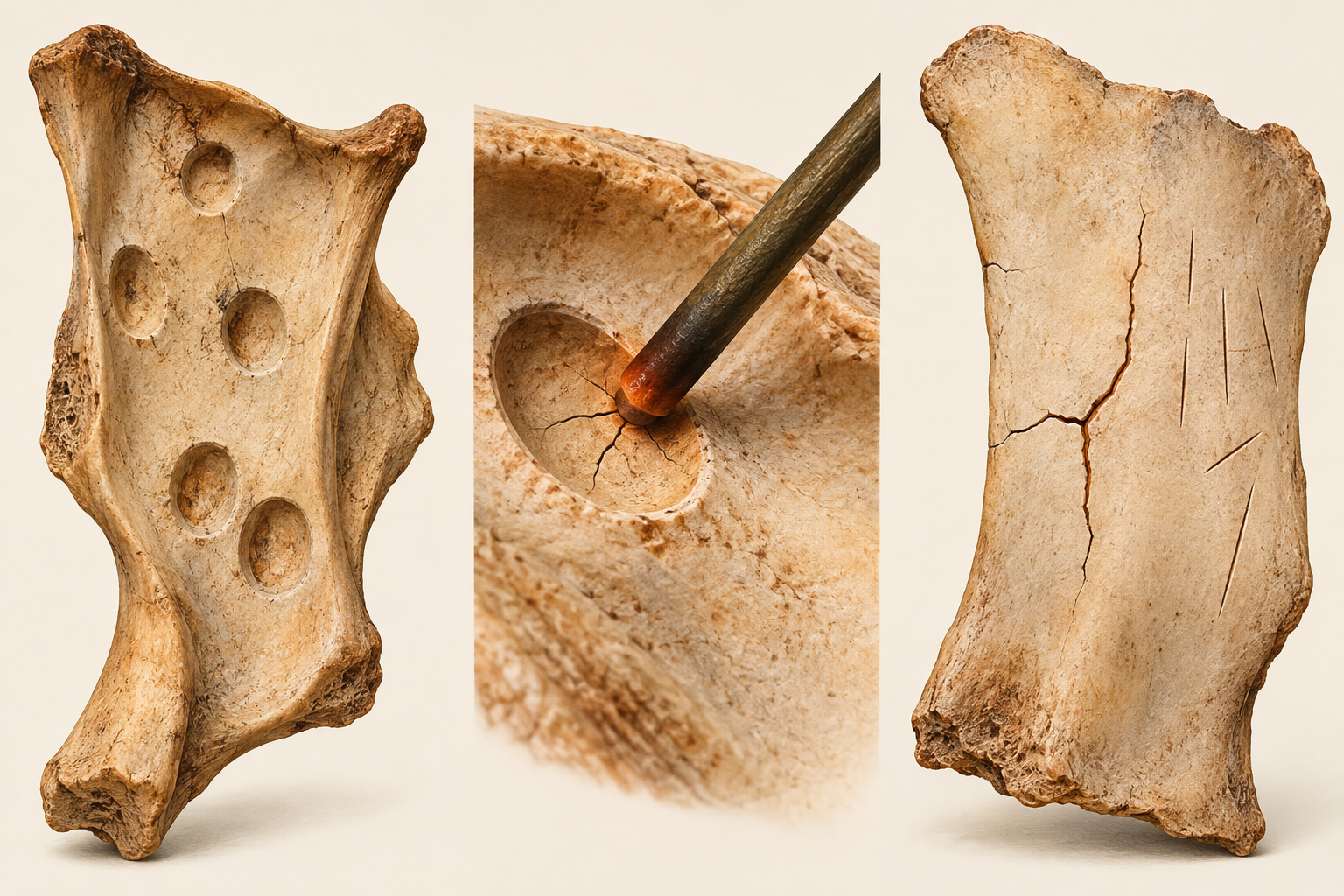
Most of the evidence considered belongs to the late Shang, especially the Yinxu region near modern Anyang in Henan. Diviners used cattle shoulder blades and the lower shells, or plastrons, of turtles. The material could be trimmed and polished, with hollows prepared on the reverse; heat was then applied, causing fractures. The practitioner interpreted the cracks, and writing might be cut alongside them to identify the occasion or record a divinatory proposition. Preparation hollows, thermal fissures, and intentionally incised signs are distinguishable features even when they occupy the same object.[1][2]
The distinction matters because a physical crack does not by itself spell out 'war will occur' or 'no harm will follow'. Such claims require a preserved text and a linguistic interpretation. Moreover, the sequence of inscription and recording need not have been identical in every instance, and the surviving text may be incomplete. The accompanying image is a modern explanatory illustration, not a photograph of any of the inscriptions discussed here.[3]
Four textual functions, not a mandatory four-step script
Wang Tao describes a useful analytical pattern in oracle-bone records: a preface specifying a date or diviner; a divinatory charge; a prognostication or judgment; and, sometimes, a verification entry reporting an outcome. Complete examples are uncommon, however. A surviving inscription need not contain every component, and not everything written on a bone is itself divination: occasional calendrical and administrative notations are also known.[4]
The expression conventionally translated as a 'question' or 'charge', associated with zhen 貞, need not contain an interrogative particle. Wang Tao explains the scholarly disagreement over whether these formulations should be read as questions, declarative propositions submitted to testing, or statements about determining what is correct. Translating every charge as 'Will it...?' can therefore impose an interrogative grammar that may not be present in the evidence. This is a substantive disagreement about how the procedure worked.[5]
War in the extracts: two propositions are not an answer and its fulfilment
Columbia University's Asia for Educators publishes selected English translations of late Shang warfare inscriptions, drawn from Sources of Chinese Tradition (1999). Extract 24A addresses attacks by the Fang and a proposal to mobilise men in response; 24B formulates a denial that Di ordered the attackers to cause harm. Extract 23, by contrast, associates the attackers' harm with an order from Di. The selections preserve different possible explanations and responses. They do not by themselves document that the mobilisation occurred or independently establish the action of a supernatural agent.[6]
Here Di is a divine power within the world of the Shang court, not automatically equivalent to the 'God' of a much later tradition. The numbers 23, 24A and 24B are editorial identifiers for the published extracts, not accession numbers for museum objects whose images have been collated with these translations. These selections also lack an unambiguous final military outcome that can be checked independently against the claimed divination.[6]
There are genuinely opposed charges in other records. In an example identified as Heji 945, Wang Tao presents formulations about Gu bringing dogs or horses and alternatives in which he does not bring them. These are contrasting possibilities submitted to divination. That pattern cannot simply be projected onto every set of short published extracts.[7]
The white foal: when does an outcome begin?
Heji 3411 makes the problem sharper. In Wang Tao's published transcription and explanation, one proposition concerns a foal expected to be white, followed by words stating that it was not white. Earlier scholars took the final negative words as part of a two-option question: white or not white. Qiu Xigui, as reported by Wang Tao, instead separates them from the charge and treats them as a later verification of the outcome.[8]
The difference is consequential. In the first reading, both alternatives belong to the proposition to be tested; in the second, an expectation is followed by a report that it did not materialise. Calling the latter a 'verification' does not mean a modern historian witnessed the foal's birth or independently proved all details. It identifies a textual function under a particular segmentation. It also challenges any impression that Shang divination records invariably reported successful predictions.[8]
Why a photograph of another bone is not a translation witness
Cambridge University Library identifies CUL.52 as a bone whose inscription concerns an ox sacrificed to a royal ancestor. Its catalogue provides images and describes the preparation of heated hollows, but the material available in the consulted record does not supply a full legible translation for word-by-word checking. Neither the warfare propositions 24A and 24B nor the foal passage in Heji 3411 should be ascribed to CUL.52: those are separate documentary witnesses.[9]
A different scapula in the British Library, Or. 7694/1535v, has also been photographed from the side showing rows of preparation hollows. That photograph can illustrate the physical substrate; it cannot establish the wording of the Columbia or Wang Tao examples. Fine inscriptions are not independently decipherable from a reduced image. The identity of a pictured object and the source of a published translation must remain separate questions.[3]
A royal archive, not a census of belief
War, hunting, illness, rain, and offerings are prominent partly because the surviving record is strongly shaped by the interests of the Shang court and its royal ritualsRitualAn organised or distinguished practice meaningful to a community; it may leave traces, but its form alone does not reveal an associated doctrine.Glossary · Click to read the explanation. Collecting practices, fragmentation, loss, and modern antiquities circulation further distort what has survived. The corpus cannot be treated as a sample of every Shang person's experience or of all regional forms of divination. Repeated questions show what concerned particular recorders, not automatically how often the corresponding event happened beyond the court.[10]
Dating requires similar care. Cambridge's catalogue assigns its collection a broad range around 1400–1200 BCE, whereas accounts of late Shang and Yinxu work with other, overlapping chronological ranges. The precise reign years given for Wu Ding in Columbia's introduction should not be applied mechanically to every inscription. This study therefore assigns no exact year to Heji 3411 or to the warfare selections without evidence specific to those witnesses.[11]
The writing itself can be contested
Victor H. Mair's 2001 study discusses University of Pennsylvania Museum bone 55-34-7, whose inscription he reads as possibly referring to a sacrifice of two sheep or perhaps bovines. He suspected a graph resembling an eye might have been added later; he also judged a different object, 65-2-8, to be a fake. These are his published assessments at that time, not the results of a new conservation examination. The case shows why recognising an ancient writing style does not automatically authenticate every mark or settle a fragment's later collection history.[12]
A limited comparison clarifies the kind of evidence involved. The Piacenza bronze liver is an Etruscan model organising divine names across a surface; some Shang bones preserve written charges, prognostications, and claimed outcomes. This contrast does not demonstrate a historical connection between Etruria and China.[13]
What has actually been established?
Oracle bones attest to a material procedure involving heat and fractures, and to written practices of testing propositions in the milieu of the Shang royal court. The published excerpts show that warfare and its possible causes could be formulated as divinatory issues, while other inscriptions include subsequent reports that can even contradict an initial expectation. But a thermal crack, a written charge, a diviner's reading, and a later claim about what happened are distinct categories of evidence.
The most defensible conclusion is that we possess an archive of recorded tests and interpretations, not an instrument for proving prophetic power. Moving from 'the inscription says it happened' to 'it independently happened as described' requires corroboration beyond the inscription itself.
References and notes
- Wang Tao, “Shang ritual animals: colour and meaning (part 1),” Bulletin of SOAS 70/2 (2007). The preparation and heating described are archaeological procedures, not observations of the modern figure. pp. 311–312, “Shang rituals and divination” Return to the text ↑
- Cambridge University Library, “Chinese Oracle Bones,” CUL.1,52,155. Its description covers prepared hollows, heat, cracks and inscription. The present study used the supplied saved catalogue capture; the live page could not be reopened and its images were not inspected here. “About” section, description of the procedure Return to the text ↑
- Comparative historical photograph: British Library Or. 7694/1535v, Wikimedia Commons file page, CC0 1.0; it does not depict Heji 3411 or Columbia’s selected texts. The figure reproduced here is a separate modern illustration, not a tracing of the British Library image. File page, object identifier and licence Return to the text ↑
- Wang Tao, cited article, distinguishes preface, charge, prognostication, and verification while stressing the rarity of complete examples and other kinds of writing on bones. p. 312, opening paragraphs Return to the text ↑
- Wang Tao discusses zhen 貞 and the lack of explicit interrogative particles in most charges, without resolving all inscriptions. Works cited in his footnotes were not read solely from those references. pp. 312–313, note 31 Return to the text ↑
- Columbia, “Oracle-Bone Inscriptions of the Late Shang Dynasty: On Warfare,” extracts from de Bary and Bloom, eds., Sources of Chinese Tradition, vol. 1 (1999), pp. 8, 11–12. The online excerpts were read, not the complete volume or its Chinese witnesses. extracts 23, 24A, 24B Return to the text ↑
- Wang Tao presents the opposed formulations about bringing dogs and horses in Heji 945; they do not themselves document the completion of every proposed action. p. 330, Heji 945 example Return to the text ↑
- Wang Tao, Heji 3411, published transcription and discussion of whether “not white” is part of the charge or the verification, citing Qiu Xigui. The original Heji 3411 bone was not independently collated for this study. pp. 330–331, Heji 3411 and discussion of bai bu bai Return to the text ↑
- Cambridge catalogue CUL.1,52,155 identifies CUL.52 as concerning an ox sacrifice to a royal ancestor. The supplied Translation view did not yield a readable translation; no identity with Columbia extracts or Heji 3411 was established. About, Title/CUL.52, supplied catalogue capture Return to the text ↑
- Wang Tao surveys Yinxu oracle-bone records and diviner groups. The selection-bias discussion is an inference about this courtly archive, not a census of the Shang population. pp. 305–306 and 311–313 Return to the text ↑
- Cambridge gives a broad date range for its catalogued group, not for every piece. Columbia’s introduction gives precise reign years for Wu Ding; this study does not treat them as a resolved chronology for all witnesses. catalogue Date of Creation; compared with Columbia introduction Return to the text ↑
- Victor H. Mair, “The Case of the Wayward Oracle Bone,” Expedition 43/2 (2001), full HTML article read. His assessment of an anomalous graph on 55-34-7 and of 65-2-8 is his 2001 judgment, not a new technical examination. paragraphs on 55-34-7, Fig. 5 and 65-2-8 Return to the text ↑
- IL Archive, “The Piacenza Bronze Liver: Divine Names and the Limits of Reconstructing Divination,” existing published artefact record 1171. This is a comparison of evidence types, not a proposed historical transmission. comparison of evidence types only Return to the text ↑
Suggest a correction · Suggest a source for this record
Cite this record
IL Archive, «Shang Oracle Bones: Charges, Cracks, and the Recording of Outcomes», https://ilarchive.com/en/studies/shang-oracle-bones-question-and-event
Continue reading