Artifact · Inscription
The Piacenza Bronze Liver: Divine Names and the Limits of Reconstructing Divination
An object record bringing together its image, metadata, rights, and context.
- Names
- Liver of Piacenza · Piacenza Bronze Liver
- Timeline
- From 150 BCE to 50 BCE
- Region
- Piacenza / Etruria (Italy)
A small Etruscan bronze model of a sheep’s liver, found near Piacenza in 1877 with short inscriptions; the entry weighs the celestial-division hypothesis and its function without inventing a confirmed context of use.
Estimated reading time: 6 min Published Last reviewed:
Share article
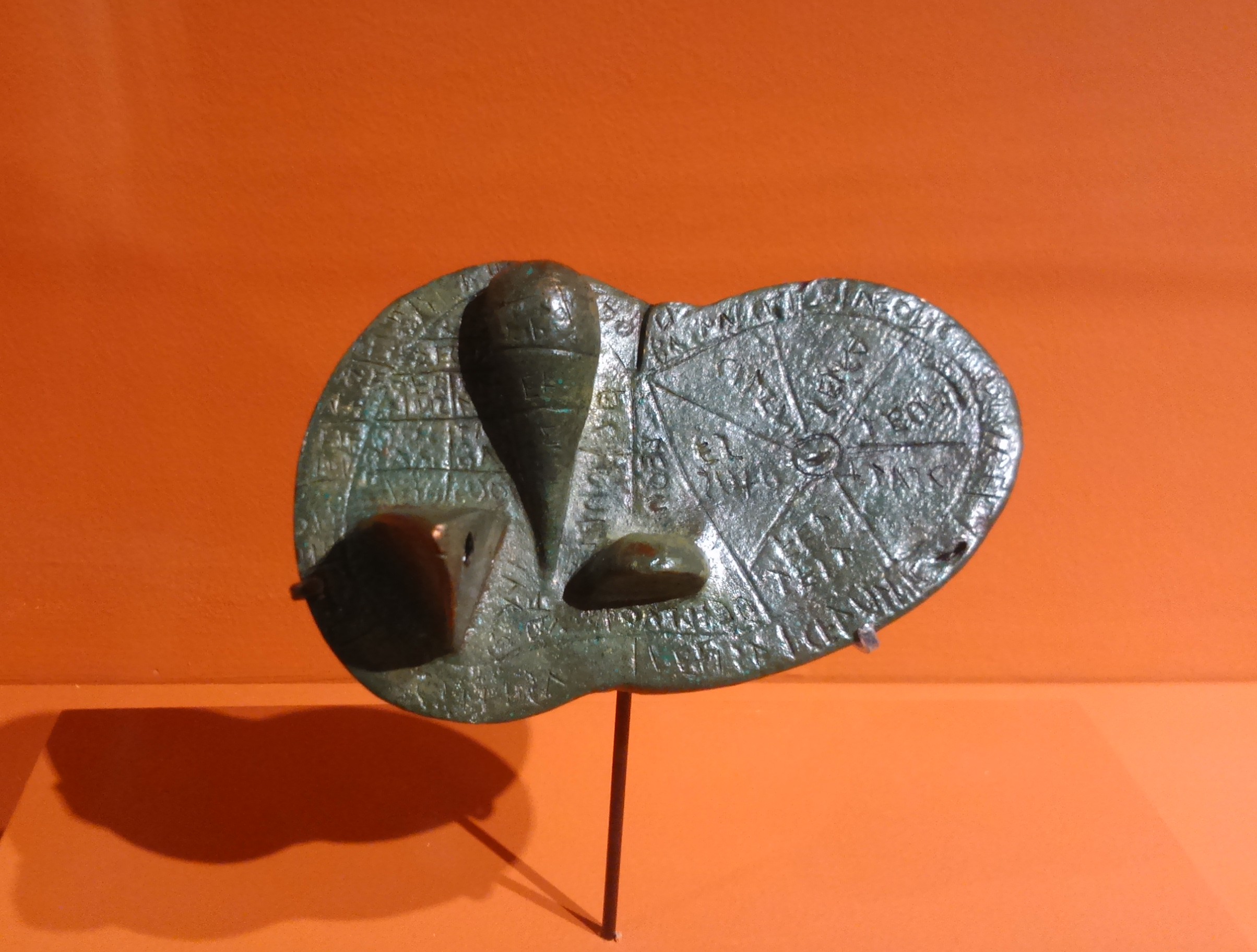
Photograph
Photograph by Shonagon, Wikimedia Commons, Liver_of_Piacenza.jpg, CC0 1.0; original file unaltered.
The original Piacenza bronze liver model on a display stand against an orange background. Incised divisions, short Etruscan labels and anatomical projections are visible. This is a single-face view, not an independent reading of the inscriptions or proof of how divination was practised. Shonagon’s original photograph, uncropped and unaltered
Image source · LicenseObject details
- Title
- The Piacenza Bronze Liver: Divine Names and the Limits of Reconstructing Divination
- Timeline
- From 150 BCE to 50 BCE
- Region
- Piacenza / Etruria (Italy)
- Rights
- CC0
Text
Introduction
Does a bronze model of a sheep's liver map the gods, or did it help a diviner interpret signs in a sacrificed animal? The Liver of Piacenza, discovered in 1877, bears Etruscan labels within incised divisions on one face and two further labels on the other. It provides physical evidence for an ordered relationship between an anatomical model and religious names. It does not preserve a detailed excavation record or instructions for performing a particular divination. This entry separates what was cut into bronze from subsequent scholarly readings and cosmological reconstructions.
A small bronze object, not a complete ritual manual
The artifact represents an animal liver, normally identified as that of a sheep. Raised anatomical features include structures associated with the gallbladder and lobes; incised lines and brief labels in the Etruscan language cover the flat and curved surfaces. Piacenza's Civic Museums at Palazzo Farnese describe a solid bronze casting made by the lost-wax process, assign manufacture broadly to northern Etruria between the late second and first half of the first century BCE, and distinguish this from the date of discovery. The city's cultural tourism listing supplies approximate dimensions of 126 × 76 × 60 mm—the overall object, not a flat inscription panel. [1][2]
The model was found near Gossolengo in the province of Piacenza on 26 September 1877 and donated to the civic museum in 1894. The publicly described find does not establish an excavated tomb, an identifiable sanctuary, an ancient owner or the name of an individual diviner. Nor should its dates of discovery and donation be mistaken for the time of casting or incision. [1]
There is also a history to the technical description. In 1988 Alessandro Morandi noted the lack, at that point, of an adequate technological study and considered whether perforations could suggest the use of sheet components. The museum's present solid lost-wax description and Morandi's historically situated observation should be attributed separately, not silently conflated into a technical conclusion beyond our examination. [1][3]
Divisions, sides and counts
The face modelled on the visceral surface is partitioned around the edge and across its anatomical features. Researchers commonly distinguish sixteen marginal regions from internal groups of uneven shapes. Morandi's numbered epigraphic list records forty positions or units on this face, followed by numbers 41 and 42 on the reverse. Bouke van der Meer's book describes forty-two Etruscan inscriptions overall. These are conventions of cataloguing and analysis: they do not establish forty-two distinct gods, one unambiguous deity per cell, or a fixed number of independent prophecies. A single region may contain several written elements; a name may recur; and not every expression is necessarily a divine name. [3][4]
The raised parts help explain why the divisions do not form a regular flat grid. After examining the object in 1987, Morandi argued from incision marks and their deviations across a hard surface that the letters were probably cut after casting. Modern photographs convey the arrangement but are not substitutes for a close epigraphic examination of every small sign, let alone evidence for the position of the hands of an ancient diviner. [3]
Two short examples of reading
For cell 3 in Morandi's numbering, the scholar prints `tins` and highlights a correction to an earlier reading `Ani`. A useful distinction follows. First are the actual marks on bronze; next is an editor's Latin-letter transliteration; finally comes the identification of a divine name associated in scholarship with Tinia. The written group is not a sentence explaining an omen, and presenting rival readings does not make them both fully preserved readings of the same signs. [5]
On the less extensively inscribed face, Morandi's list has `tivs` at position 41 and `usils` at 42. The latter is normally connected with the sun, the former with the moon or month. Interpretations of their grammatical forms and the exact reading vary; `tivr` is found in other discussions. Accordingly, we report Morandi's own transcription, separate the proposed meanings, and do not claim to have read Etruscan from the photograph independently. [5]
An inscription that may not name a god
The sequence written `metlvmd` occupies position 38 in Morandi's presentation. Rather than identifying another deity, he argues for a connection with Etruscan institutional vocabulary and proposes an interpretation involving an assembly or ordered body of responsibilities. He contrasts this with geographic or territorial interpretations advanced in earlier scholarship. The suggestion cannot simply be converted into an attested “council of gods” or the proper nameProper nameA name that identifies a particular person, place, group, or entity in context, unlike a common noun denoting a class. Spelling alone may not settle the distinction.Glossary · Click to read the explanation of an identifiable historical institution. [6]
The problem matters for the whole object. A sign may be comparatively clear while its linguistic analysis remains uncertain. Is the label a name, an epithet, a grammatical marker of association or a statement of place or function? A small inscribed compartment is no guarantee that its contents fit the same lexical category as those of its neighbours. [5][6]
Mapping heaven onto a liver?
Van der Meer reads the divine-name network on both faces as a microcosm reflecting an Etruscan division of heaven. The sixteen regions around the rim encourage comparison with a later Latin account of heavenly divisions, including that of Martianus Capella in the fifth century CE. Yet this author wrote centuries after the object was made. The comparison is a scholarly model for explaining arrangement, not a contemporary key proving the compass bearing or practical omen value of every sector. [4][7]
Inspection of sacrificial entrails belonged to kinds of ritualRitualAn organised or distinguished practice meaningful to a community; it may leave traces, but its form alone does not reveal an associated doctrine.Glossary · Click to read the explanation and divination found in more than one ancient region. Resemblances with clay liver models from MesopotamiaMesopotamiaHistorical region associated with the Tigris and Euphrates: Uruk, Ur, Eridu, cuneiform, Sumer, Akkad, Babylon and Assyria, their languages and cults, and the limits of archaeological evidence.Glossary · Click to read the explanation are meaningful as comparisons between surviving material forms; they are not proof of direct borrowing or of a single training institution spanning those centuries. The bronze preserves a set of ordered inscriptions, not the outcome of a documented prediction. [4][7]
Competing uses and the missing context
The Piacenza museum names several proposals: a teaching model for liver examination, a practitioner's mnemonic aid, or an element of an honorary statue. It also considers funerary deposition or a votive gift as possibilities suggested partly by the object's preservation. None is securely established by a stratified archaeological context or an ancient statement of purpose. Calling it a diviner's “manual” is convenient, but it should not invent a specific lesson, temple, ritual participant or divination event. [1][8]
A useful contrast is provided by the earlier Pyrgi Gold Tablets, whose Etruscan and Phoenician texts belong to a dedicatory setting. They are neither copies of the Piacenza object nor sources for its letter readings. The comparison instead clarifies that different inscribed religious objects can preserve different kinds of acts—public dedication, classification, or potentially professional reference.
What the object can establish
The bronze is evidence for a small anatomically shaped liver model bearing an intentional network of Etruscan writing, including repeated and abbreviated forms. Critical epigraphyEpigraphyThe study of writing preserved on physical objects and monuments: its documentation, reading, dating, translation, material context and historical interpretation.Glossary · Click to read the explanation has corrected readings that were once accepted, and the uneven arrangement offers material for reconstructing how specialists may have ordered divine competencies. The exact use of this particular bronze, its former owner, its lost deposition context and the full mapping of its sections to a celestial scheme remain separate questions. The artifact documents a tradition of organizing names and places on a model; it does not hand us the script for a historical divination or proof that any prediction came true.
References and notes
- Piacenza Civic Museums, “Il Fegato di Piacenza”; material, casting, dating and find history, with alternative uses clearly treated as hypotheses. Accessible indexed Italian text, manufacturing and discovery paragraphs; direct full-page retrieval failed. Return to the text ↑
- Visit Piacenza municipal cultural guide, “Fegato etrusco.” Object dimensions 126 × 76 × 60 mm and collection summary; local guide, not a conservation report. Return to the text ↑
- Alessandro Morandi, “Nuove osservazioni sul fegato bronzeo di Piacenza,” MEFRA 100/1 (1988), 283–297. Printed pp. 283–285 and 287, including his object examination and transcription; the plates themselves were not independently inspected. Return to the text ↑
- L. Bouke van der Meer, The Bronze Liver of Piacenza: Analysis of a Polytheistic Structure (1987). Publisher overview and contents only, including the 42-inscription count and microcosm interpretation; not the full monograph. Return to the text ↑
- Morandi, “Nuove osservazioni sul fegato bronzeo di Piacenza” (1988), editorial readings Tins and Tivs/Usils; no independent collation of letters. Printed p. 284 n. 5; p. 287 positions 3, 41–42; p. 288 on contested abbreviation readings. Return to the text ↑
- Morandi, “Nuove osservazioni sul fegato bronzeo di Piacenza” (1988), discussion of metlvmd as institutional vocabulary rather than a securely identified divine name. Printed p. 287, position 38; pp. 290–297, especially 293–297 for the institutional and territorial interpretations. Return to the text ↑
- Van der Meer (1987), publisher synopsis; Morandi (1988) on later celestial analogies. Publisher summary and Morandi’s printed pp. 283–284, 295–297 only; neither the full van der Meer book nor Martianus Capella was read. Return to the text ↑
- Piacenza Civic Museums, “Il Fegato di Piacenza,” alternative functions and the absence of a securely documented deposit. Indexed passage on didactic aid, practitioner’s memorandum, honorary statue, votive or funerary deposition; not an excavation report. Return to the text ↑
Archive records may be reviewed and refined as better evidence or sources become available. Suggest a correction
Suggest a correction · Suggest a source for this record
Cite this record
IL Archive, «The Piacenza Bronze Liver: Divine Names and the Limits of Reconstructing Divination», https://ilarchive.com/en/artifacts/piacenza-bronze-liver