Artifact · Inscription
The Pyrgi Gold Tablets: Dedication in Two Languages and the Limits of Equivalence
An object record bringing together its image, metadata, rights, and context.
- Names
- Lamine d’oro da Pyrgi · Pyrgi Gold Tablets
- Timeline
- From 525 BCE to 500 BCE
- Region
- Pyrgi (Santa Severa), coastal Etruria, Italy
Three gold tablets from the Pyrgi sanctuary (two Etruscan, one Phoenician) record a dedication linked to Thefarie Velianas and Uni/Astarte near the end of the sixth century BCE, showing the limits of linguistic equivalence.
Estimated reading time: 7 min Published Last reviewed:
Share article
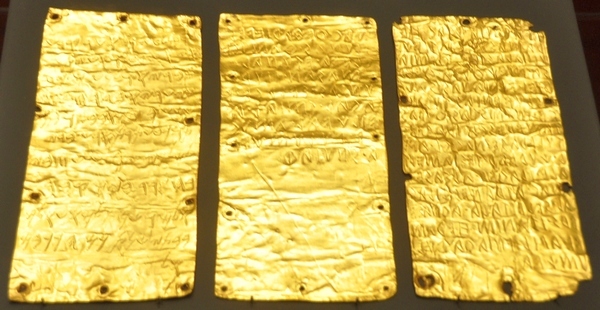
Photograph
Photograph by Jona Lendering, Livius; image licensed CC0 1.0 Universal.
Three gold-coloured modern replicas of the Pyrgi tablets side by side against a dark background. Not the excavated originals; the resolution is insufficient for an independent reading of their inscriptions
Image source · Related reference · LicenseObject details
- Title
- The Pyrgi Gold Tablets: Dedication in Two Languages and the Limits of Equivalence
- Timeline
- From 525 BCE to 500 BCE
- Region
- Pyrgi (Santa Severa), coastal Etruria, Italy
- Rights
- CC0
Text
Introduction
The three Pyrgi gold tablets are not one document reproduced word for word in three versions. They record a religious dedication in two languages: two inscriptions are Etruscan and one is Phoenician. They share a donor, a cultic setting and the broad action of offering, yet differ in arrangement and detail. How far can this bilingual association illuminate what Thefarie Velianas did at Pyrgi, and where does one language cease to explain the other?
This entry treats the tablets as one connected archaeological group. It examines a short passage from the published Phoenician text alongside the Etruscan evidence, without claiming a new complete translation or turning a dedication into an undocumented political narrative.
Three tablets from a coastal sanctuary
Pyrgi, at modern Santa Severa on the Italian coast, served as the port of the Etruscan city of Caere, now Cerveteri. Its sanctuary yielded three inscribed gold sheets, two in Etruscan and one in Phoenician. The National Etruscan Museum dates them to the end of the sixth century BCE. They were discovered on 8 July 1964. The name “Pyrgi Gold Tablets” identifies a connected archaeological group, not three word-for-word copies of a single document. [1]
The Villa Giulia museum catalogue names Cerveteri as the production place and Pyrgi as the provenance, attributes the findspot to Temple B, and lists Room 13a as the current location. Its single dimensions entry gives 19 × 9 cm without providing separate measurements for the three sheets. It records “without i.n.” for the inventory number and 1964 as the acquisition date. None of these fields supplies three individual measurements or an inventory number that can be reconstructed. Temple B is dated to about 510 BCE, an architectural context date rather than the exact day of the dedicatory act. [2]
Gold, perforations, display and deposition
The inscriptions were engraved on thin gold sheets. The museum describes holes in the metal and gold nails, suggesting that the tablets were once mounted for display, perhaps on a doorframe. Maras and Wallace distinguish small iron nails from the larger gold-headed examples, which they consider too large to have held the sheets: the exact fixing arrangement remains an inference. The excavated objects were folded or rolled and buried in a sanctuary deposit, not found still attached to a door. The researchers place the discovery in a small sacred precinct near Temple B, in the open area in front of Temple A. [1] [3]
The accompanying photograph shows modern replicas, not the original archaeological sheets. It illustrates only the general appearance of the displayed copies. It cannot be used to decipher or align the letter-forms; the textual discussion instead relies on the published readings and analyses cited in the notes.
Three moments must remain distinct: the production and inscription of the gold in the late sixth century BCE, its removal from any proposed display position and subsequent deposition at an undetermined date, and the archaeological discovery in 1964. Reconstructing the exact display location is an inference from material evidence. Nor does careful burial on its own establish a war, a treaty, or some particular crisis as the cause of concealment. [3]
Who dedicated what, and to whom?
In the published transliteration analysed by José Ángel Zamora, the Phoenician inscription begins lrbt lʿštrt. A deliberately short rendering is “To the Lady, to Astarte.” This Latin-letter presentation normalizes the scholarly transcription; it does not reproduce the engraved characters, claim a full translation, or settle every question of word division. The following expression ʾšr qdš ʾz points to “this sacred place.” It identifies an offering or dedicated cultic space, not the complete architectural plan of the sanctuary. [4]
The inscription names Thefarie Velianas as the actor, in a Phoenician title which Zamora explains as “king over Caere” or a ruler “reigning over Caere.” The language publicly links a political authority to a cultic donation. But rendering this title as “king” does not by itself establish the precise Etruscan constitution or make the Phoenician institution of kingship directly applicable. Zamora understands the central verbs as making and giving the sacred place: a religious act also commemorating the standing of the ruler. [5]
A Phoenician formula for a local occasion
Zamora identifies a recognizable votive sequence: the receiving deity, the dedicated object, the actions, the donor with his title, and details of time, mode and place. That structure makes the broad action intelligible even when individual terms remain disputed. It also reveals how a Phoenician scribe could use inherited dedicatory conventions to express the particulars of an Etruscan sanctuary and political setting. [5]
The Phoenician text contains calendrical and ritualRitualAn organised or distinguished practice meaningful to a community; it may leave traces, but its form alone does not reveal an associated doctrine.Glossary · Click to read the explanation language, including a month associated with “sacrifices to the Sun,” a reference to the third year of Thefarie’s reign, another month, and a day designated by the “burial of the deity.” These are inscriptions and scholarly readings, not secure equivalents of months in the modern calendar. They need not describe a single instant: in Zamora’s structural analysis, the date of the gift and a date connected with the reason for the vow can play different roles. They cannot provide an exact modern year for mounting the tablets or a complete reconstruction of the ceremonies. [5]
Where the languages meet
Maras and Wallace reproduce the longer Etruscan inscription containing unialastres and θefariei velianas. The shorter Etruscan tablet begins with a different form of the dedicator’s name and includes unias. Such elements connect the ruler and cultic addressee across the group, supporting the broad association of the Etruscan Uni with the Phoenician Astarte in this dedication. They do not establish a permanent one-to-one translation for every Etruscan word. [6]
The shorter inscription has its own wording and organization. Some expressions have been interpreted in relation to a cultic calendar or recurring celebration. The researchers also discuss possible correspondences between the calendar expressions in the two languages, while marking uncertainties about their dates. Neither Etruscan text can therefore be reduced to an already decoded Phoenician paraphrase, and the pair should not be fused into one invented translation. [6]
Where equivalence breaks down
Even the Phoenician, whose main dedicatory framework can be understood, contains disputed terms. Zamora discusses tw, which earlier interpretations treated as a word for a small religious building or chapel. He shows why that syntactic reading raises problems and examines alternatives. Reference to a “sacred place” does not determine how many buildings were constructed, or the exact function of each. A proposed architectural translation is not a directly observed excavation feature. [7]
The closing expressions are also debated. They may include an augural wish or other symbolic language, but pronouns and the detailed picture remain subject to interpretation. The difference between published letter readings, editorial segmentation, possible restoration and interpretive translation therefore matters. This entry has not undertaken a new examination of the original gold surfaces or an independent critical edition of the Etruscan letters; it follows the specified scholarly editions and discussions only to the extent recorded in its references. [7]
Uni, Astarte and the political horizon
Rendering the recipient as Uni in Etruscan and Astarte in Phoenician suggests that the same dedication could address or be intelligible to audiences with different religious vocabularies. This is a functional correspondence in a particular ritual context, not proof of a common origin, an identical cult history, or an exhaustive equivalence of the two goddesses. A Phoenician inscription in this port also belongs to a wider Mediterranean setting of contact. The museum places it alongside ties between Caere and Carthage; the surviving words, however, are those of a votive dedication, not a military treaty. [8]
Nor should the tablets be called a duplicate of the Rosetta Stone. The latter preserves a priestly decree in related versions, whereas Pyrgi offers dedicatory texts that differ in extent and content, including two distinct Etruscan inscriptions. The comparison is useful precisely when its limits are kept clear: it helps identify the donor, the cultic recipient, the place and some chronological language, without automatically deciphering every remaining Etruscan expression. [1]
What Pyrgi adds
The tablets show a ruler presenting a sacred act in two languages at a port connected to the wider Mediterranean world. Their points of agreement establish a historical setting; their differences reveal the choices of different inscriptional traditions. Holes, folding and the archaeological findspot add the material history of possible display, deposition and modern recovery. The value of this group is not a claim that Etruscan has been fully deciphered, but a case study in reading language and archaeology together while leaving unresolved claims about divine identity, political alliances and architecture properly open. [8]
References and notes
- National Etruscan Museum, Villa Giulia, “Pyrgi Tablets”; institutional account of the group, discovery, deposition and three inscriptions. Complete publicly available institutional webpage; object and discovery description. Return to the text ↑
- National Etruscan Museum, Villa Giulia, “Pyrgi Tablets,” object record; provenance, material, dimensions, inventory status and dating. Complete publicly accessible catalogue record; CIE 6314–6315 and KAI 277 are catalogue references, not editions consulted here. Return to the text ↑
- Daniele F. Maras and Rex E. Wallace, “Uni and the Golden Gift of Thefarie: The 50th Anniversary of the Discovery of the Gold Tablets of Pyrgi,” Etruscan News 17 (Winter 2015). Web-rendered text of pp. 1, 4 and 20; findspot, sanctuary context and material interpretation; no direct examination of the original tablets. Return to the text ↑
- José Á. Zamora, “Pyrgi Revisited. An Analysis into the Structure and Formulae of Pyrgi’s Phoenician Text,” Studi Epigrafici e Linguistici 32–33 (2015–2016): 69–79. Printed p. 71, Phoenician transcription and section A, lines 1–5, read through online rendered text; not an autopsy or a new facsimile collation. Return to the text ↑
- Zamora, “Pyrgi Revisited,” analysis of Phoenician dedicatory formulae, the ruler’s title and dating clauses. Selected passages of printed pp. 70–74 and 78, read as online-rendered text; not a complete page-image verification of the article. Return to the text ↑
- Maras and Wallace, “Uni and the Golden Gift of Thefarie”; Etruscan text transcriptions and ritual comparisons. Web-rendered pp. 4 and 20; longer and shorter Etruscan inscriptions and proposed calendar correspondences. Only brief textual examples are used. Return to the text ↑
- Zamora, “Pyrgi Revisited,” discussion of contested architectural vocabulary and the closing formula. Selected passages of pp. 75–78, including tw and competing analyses; uncertainties in the final clause remain explicit. Return to the text ↑
- National Etruscan Museum, “Pyrgi Tablets”; institutional interpretation of Uni/Astarte, Etruscan–Carthaginian contacts and the Rosetta Stone comparison. Entire institutional page; political background is interpretive context, not a treaty text on the tablets. Return to the text ↑
Archive records may be reviewed and refined as better evidence or sources become available. Suggest a correction
Suggest a correction · Suggest a source for this record
Cite this record
IL Archive, «The Pyrgi Gold Tablets: Dedication in Two Languages and the Limits of Equivalence», https://ilarchive.com/en/artifacts/pyrgi-gold-tablets