Artifact · Inscription
The Rosetta Stone: Priestly Decree and Royal Cult
An object record bringing together its image, metadata, rights, and context.
- Names
- Memphite Decree on EA24 · Rosetta Stone
- Timeline
- 196 BCE
- Region
- Ptolemaic Egypt, Nile Delta
A fragment of a granodiorite stela dated by the Memphis decree of 196 BCE. The entry reads the priests’ decree honouring Ptolemy V and distinguishes Egyptian, written in hieroglyphs and demotic, from Greek.
Estimated reading time: 8 min Published Last reviewed:
Share article
Photograph
© Hans Hillewaert, photograph of the original object via Wikimedia Commons, CC BY-SA 4.0.
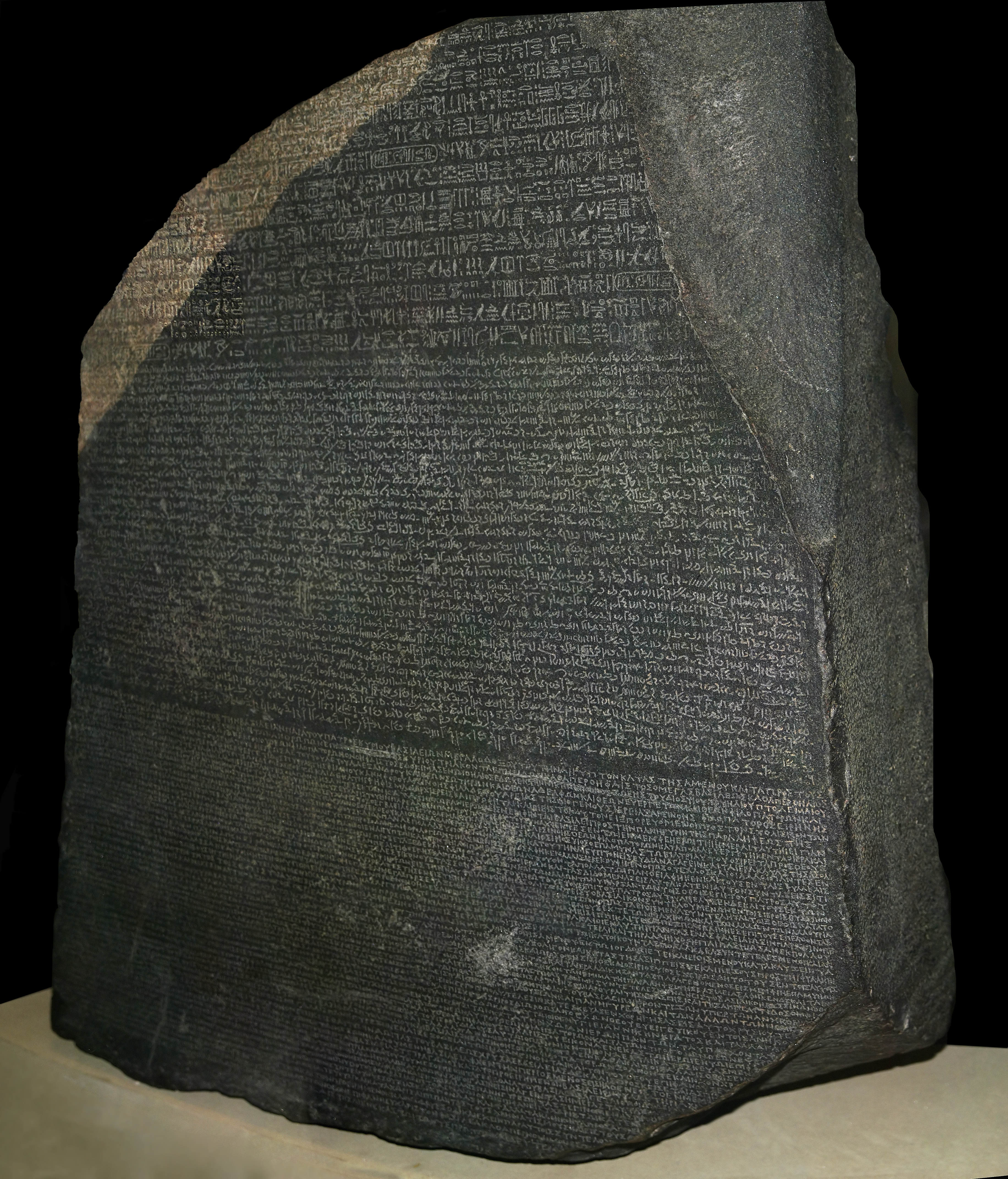
The original Rosetta Stone, British Museum EA24, a broken granodiorite stela with hieroglyphic, Demotic, and Greek registers. The photograph documents their arrangement and damage, not a restored complete text
License · Image sourceObject details
- Title
- The Rosetta Stone: Priestly Decree and Royal Cult
- Timeline
- 196 BCE
- Region
- Ptolemaic Egypt, Nile Delta
- Rights
- CC BY-SA
Text
Introduction
The “Rosetta Stone” was not produced to teach later scholars to read hieroglyphs. It is a surviving fragment of a granodiorite stela bearing a decree issued by priests assembled at MemphisMemphis in EgyptMemphis is an ancient Egyptian city near Mit Rahina south of present-day CairoGlossary · Click to read the explanation in 196 BCE to establish honors for Ptolemy V in Egyptian temples. Its modern fame as a key to decipherment can obscure its original purpose: negotiating and displaying the relationship between a Macedonian-origin monarchy and Egyptian priestly institutions. This entry begins with EA24 itself, then examines the decree’s gifts, coercion, and ritualRitualAn organised or distinguished practice meaningful to a community; it may leave traces, but its form alone does not reveal an associated doctrine.Glossary · Click to read the explanation provisions while separating preserved stone, editorial restoration, translation, and historical inference.
The surviving stone, not a complete reconstructed stela
The original fragment is British Museum EA24, catalogued as grey-and-pink granodiorite, measuring 112.30 cm at its greatest surviving height, 75.70 cm wide, and 28.40 cm thick. Its top is lost and its margins broken. Reconstructions sometimes give the full monument a rounded upper portion and a royal offering scene, but neither is preserved on this fragment. The accompanying photograph shows the original stone, not the modern touchable replica mentioned separately by the Museum. Three distinct writing areas remain visible.[1][2]
The Museum records 14 surviving hieroglyphic lines at the top, 32 Demotic lines in the middle, and 54 Greek lines below. Some secondary accounts count the Greek rows differently by one; here the Museum catalogue’s count is followed. These are surviving lines on EA24, not complete original registers or equivalent translation units. Much of the upper hieroglyphic passage is gone, so Greek or parallel Egyptian wording cannot by itself turn missing hieroglyphs into preserved signs. The photograph is useful for the artifact’s layout, not for an independent collation of every character.[1][7][11]
Three different moments: decree, discovery, and reception
The decree is dated to the ninth regnal year of Ptolemy V, 196 BCE. That date belongs to the decision commemorated and the inscription’s ancient context, not to the rediscovery. The fragment’s original temple setting is not securely known, even though the text instructs that copies be erected in temples. It was reportedly found in 1799 reused in a fortification near Rashid/Rosetta. A secondary building context does not establish where this particular stela first stood. The British Museum places the discovery within French military construction near Fort Saint Julien and cautions that the precise story has become blurred.[2]
In the Museum's account, the stone came into British hands following the 1801 Alexandria agreement, reached England in February 1802, and was presented to the Museum in July 1802. This is the holding institution’s account of acquisition, not an independent legal judgment about title or a claim of historical Egyptian consent. 1822 belongs to a major modern advance in decipherment, not to any ancient stage of this decree.[2]
Who speaks, and to whom?
Long royal and divine titulary introduces a resolution associated with priests, sacred scribes, and other temple officials gathered at Memphis for the king’s coronation celebrations. The priests collectively resolve to honor Ptolemy V, a ruler of the Macedonian-origin Ptolemaic dynastyPtolemaic dynasty in EgyptDynasty of Macedonian origin ruling Egypt as kings from 305 to 30 BCE, amid Greek and Egyptian traditions.Glossary · Click to read the explanation. The text is therefore not a first-person autobiography dictated by the king. Instead, it recounts his benefits as the priesthood presents them and formally specifies cultic responses in the temples. Comparisons with Horus and divine images construct legitimacy; they are not neutral measurements of the state of the country.[3]
The decree envisages placement near the king’s image in temples of several ranks, employing scripts suited to different literate groups of scribes, priests, and administrators. Not every visitor could necessarily read each section. The intended institutional distribution is attested in the decree, but execution in every temple cannot be verified from this single find. The distinction between audience, prescribed placement, and observed archaeological distribution matters.[6][8]
Benefactions: patronage, obligations, and limits
In the published translation of the Demotic version, Ptolemy is credited with substantial money and grain for sanctuaries, protection of divine estates and orchard revenues, reductions or cancellations of taxes, and remission of arrears to the crown. The narrative also refers to freeing prisoners or resolving longstanding charges and to returning some people displaced by unrest to their homes and possessions. It names privileges concerning entry to the priesthood, annual journeys required of temple officials, naval impressment, and portions of the fine linen supplied to the treasury. These are differentiated provisions, not a universal amnesty or a modern code of rights.[3]
The king appears as benefactor and guarantor of temple stability, while the priesthood publicly validates his right to honors. Such reciprocity helps explain how royal legitimacy and temple resources were mutually represented amid political unrest. None of the provisions is an independently audited record of its own implementation. A later bibliographical analysis of the Memphite decree highlights the need to compare its witnesses and scholarly editions; only that study’s accessible summary was consulted here, not its unpublished or inaccessible arguments.[3][10]
Violence alongside protection
The text is not solely a celebration of generosity. The Demotic translation describes a rebel fortress under a form rendered Sk3n, the diversion or obstruction of its water channels, its capture, and the killing of opponents. It also refers to severe punishment of rebel leaders at Memphis. The published Greek rendering names Lycopolis in the parallel account. Matching the textual names to a specific modern location and establishing the events in detail require evidence beyond the royal-priestly narrative.[4][9]
By depicting rebels as enemies of temples and divine command, the decree presents the monarch’s coercive force as protection of sacred order. Such statements are valuable evidence for how the issuers wished the conflict to be remembered, not independent proof of every charge, body count, or moral characterization. Conversely, the political nature of the rhetoric is not itself proof that no violence occurred.[4]
What the priests prescribed in return
The resolution orders a royal statue to be placed beside the local deity’s image in each temple and priestly service to that statue three times daily. It prescribes a royal shrine to accompany divine shrines in major processions, monthly observances linked to the king’s birthday and succession, and an annual festival of five days. Royal-cult designations were to enter priestly documents and rings, while those private individuals who wished could keep a likeness of the shrine at home. The decree does not simply praise a pious king: it organizes his images, names, and ceremonies in an ongoing temple system.[5]
The similarity of honors to those offered to other divine images does not demonstrate that every community understood divinity identically or enacted every clause. The association with PtahPtahPtah is an Egyptian god associated with Memphis, craftsmanship and creationGlossary · Click to read the explanation and Memphis is especially important in this local language of kingship; it cannot be universalized into a single Egyptian religious doctrine.[3][5]
Two languages, three scripts
There are two languages: Egyptian, written in hieroglyphic and Demotic scripts, and Greek, written in Greek letters. A single decree appears in three textual forms, but “the same” does not mean letter-for-letter identity or equal line lengths. Greek offers a text more accessible to later classicists, while the Egyptian registers preserve institutional vocabulary and conventions of honorific titulary. Leipzig’s specialist exhibition compares the publication formula at the end of the versions. The Egyptian versions describe “words of the god” and document writing; the Greek rendering speaks of sacred, native, and Greek characters. Those are published translations under comparison, not fresh readings of signs made from the photograph.[6][7]
Nor is EA24 the only ancient witness of the Memphite decree. Other copies and related fragments assist editors in discussing lacunae, but wording supplied from another monument must remain distinct from marks actually surviving on EA24. The earlier Canopus Decree, issued under Ptolemy III, is a useful comparison within the Ptolemaic genre, not another Rosetta Stone or a source of photographs that could represent this artifact.[2][6]
A short example: words, restoration, translation
At the end of Simpson’s published Demotic translation, PDF page 5, the decree directs that it be inscribed on hard stone in three scripts and set near the royal image in temples of three ranks. This sentence is my brief English paraphrase mediated through Simpson’s translation, not a fresh Demotic transcription or a claim that every ancient sign is visible on the surviving stone. The PDF does not provide line-by-line critical numbering for this English passage; its reliable locator here is the translation's last paragraph on page 5.[5]
Carol Andrews’s published translation of the Greek passage expresses a corresponding injunction, while Leipzig’s three-script comparison marks restored elements with brackets in some edited renderings. An editor’s brackets are not automatically characters preserved on EA24. The inscription bears a decree intending wide temple dissemination; whether each ordered copy was installed is a separate historical question. Translation, supplementation, and inference are not interchangeable.[6][7]
The afterlife of the stone
Greek, already readable, helped scholars locate royal names and parallel phrases. Thomas Young identified phonetic elements in foreign royal names, while Jean-François Champollion announced a crucial advance in 1822 concerning hieroglyphic sounds. His use of Coptic and other Egyptian inscriptions, and the continued work that followed, preclude a single-person, single-day legend of complete decipherment. The stone became a modern symbol of multilingual decipherment, yet that reception should not eclipse the decree’s ancient cultic and political purpose.[2]
What EA24 does and does not establish
This physical fragment is a dated 196 BCE witness to a priestly decree honoring Ptolemy V, written in two languages and three scripts, with statements about patronage, revolt, and an organized royal cult. It illuminates the language through which court and clergy represented their mutual interests. By itself it does not identify the stela’s first shrine, prove that every order was enforced, independently count victims, or demonstrate unanimous assent throughout Egypt. Keeping surviving letters, editions, translations, and reception apart is a core practice of epigraphyEpigraphyThe study of writing preserved on physical objects and monuments: its documentation, reading, dating, translation, material context and historical interpretation.Glossary · Click to read the explanation.[1][8]
References and notes
- British Museum, “stela / The Rosetta Stone,” object EA24; identification, material, dimensions, surviving scripts and condition. Object page: Museum number, Description, Dimensions, Condition and Location fields consulted; its bibliography was not read in full. Return to the text ↑
- British Museum, “Everything you ever wanted to know about the Rosetta Stone,” published 14 July 2017, updated 2 July 2026; institutional account of the decree and modern history. Read relevant sections on age, copies, scripts, discovery, decipherment, text, acquisition and the touchable replica; not an on-site gallery inspection. Return to the text ↑
- “TRANSLATION OF THE DEMOTIC TEXT ON THE ROSETTA STONE / The Memphite Decree,” university-hosted Simpson translation. PDF header gives R. R. Simpson, closing source note R. S. Simpson; discrepancy retained. All five PDF pages read; especially p. 1 for priestly resolution and p. 2 for grain, taxation, exemptions and prisoners. PDF credits Demotic Grammar in the Ptolemaic Sacerdotal Decrees (1996), pp. 258–271; the book itself was not read. Return to the text ↑
- Simpson’s university-hosted Demotic translation, on the rebel fortress, waterways, assault and punishments. PDF pp. 2–3, paragraph beginning with the fortress Sk3n and continuing through royal punitive measures; published translation, not independent sign reading. Return to the text ↑
- Simpson’s Demotic translation, royal images, temple service, festivals and final order to inscribe and display the decree. PDF pp. 4–5, especially final paragraph of p. 5 on hard stone and three scripts; no critical original-line numbering is provided for this English text. Return to the text ↑
- Leipzig research consortium exhibition, “All Good Things come in Threes,” on the three publication clauses and the Ptolemaic decree genre. Relevant “Three Languages – one Decree II,” “Facts and Figures,” and “History of Acquisition” sections read; not every embedded source or the cited Andrews/Quirke volume. Return to the text ↑
- Carol Andrews’s published translation of the Greek section as reproduced by Attalus, crediting a British Museum publication; mediation, not an independent Greek edition. Web translation consulted, especially closing cultic instructions and the final inscription/publication clause; cited 1985 volume not independently read. Return to the text ↑
- UCL Institute of Archaeology, “Texts in Archaeology,” 2024–25 handbook; object/context teaching questions and links to EA24 and Simpson. Printed p. 13 (PDF page index 12) only; course handbook, not original research establishing a new reading of the decree. Return to the text ↑
- Greek-section translation attributed to Carol Andrews at Attalus; Lycopolis episode compared with the Demotic Sk3n passage. Middle Greek translation around editorial marker [25], from Lycopolis to suppression of the rebels; not a fresh reading of the carved Greek. Return to the text ↑
- M. V. Panov, “Memphite Sacerdotal Decree: Sources and Historiography,” Manuscript (2020), bibliographical approach to versions and editions. Publisher’s English abstract and bibliographic details only; Russian full text not read and no claims attributed to unconsulted internal pages. Return to the text ↑
- Wikimedia Commons, specific file “Rosetta Stone.JPG,” photograph by Hans Hillewaert, taken 21 November 2007; current file revision 26 August 2014. Photographer, Description, Date, Permission, Attribution and File history checked. Unrelated English structured caption discarded. Supplied JPEG hash and actual 340-pixel/zoom image inspected. Return to the text ↑
Archive records may be reviewed and refined as better evidence or sources become available. Suggest a correction
Suggest a correction · Suggest a source for this record
Cite this record
IL Archive, «The Rosetta Stone: Priestly Decree and Royal Cult», https://ilarchive.com/en/artifacts/rosetta-stone-ea24
Continue reading