Entity · Research method
Epigraphy
A reference page linking a name, group, or concept to the materials that discuss it.
Epigraphy investigates inscribed objects, readings, translations, dates and archaeological contexts. Case studies of Safaitic BES19s 77.1 and the Mesha Stele show how religious claims require careful limits.
Estimated reading time: 9 min Published Last reviewed:
Share article
Text
Introduction
How can writing cut into a rock serve as historical evidence, and how do we establish what it actually says? Epigraphy studies inscriptions surviving on stone, buildings, tablets and other physical supports. Research begins with visible marks, but identifying the script, reading the words, translating them, dating the inscription and interpreting its significance are separate steps. Confidence in one step does not guarantee confidence in the next.
This article follows an inscription from its discovery to its digital publication, then tests those methods against a SafaiticSafaiticAn Ancient North Arabian consonantal script used for rock inscriptions recording names, kinship, pastoral movement and prayers in the pre-Islamic deserts of Syria, Jordan and northern Arabia.Glossary · Click to read the explanation inscription from north-eastern Jordan and the Moabite Mesha SteleMesha SteleA ninth-century BCE Moabite royal basalt stele at the Louvre (AO 5066; KAI 181). Its inscription names Chemosh, Omri, Israel and YHWH (line 18). A proposed “House of David” reading in damaged line 31 is disputed.Glossary · Click to read the explanation. Particular attention is given to religious names and prayers: they offer direct evidence for expressions used by particular writers, not an automatic reconstruction of an entire community's beliefs.
What does epigraphy study?
An inscription is writing physically placed on an object or surface. Its marks may be incised, pecked or painted on a boulder, vessel, monument or wall. Epigraphers consider the form and arrangement of marks, the language and message, the support carrying them, and the relationship of text to adjacent pictures or other marks. A text might commemorate a death, proclaim royal achievements, give an instruction or record a traveller's brief presence. A short graffito can be as historically revealing as a monumental decree. [3]
Epigraphy overlaps with archaeology, philology and palaeography, the study of handwriting and changing letter forms. Palaeography asks how characters were made and how their shapes varied; epigraphy connects those observations to an inscribed object's production, setting and uses. The boundaries are not identical across traditions: Egyptian epigraphy, for example, also deals closely with the interaction of written signs and images. Research on Greek and Latin inscriptions likewise ranges across social, legal and religious life, not just royal history. [4]
The object, its photograph and its edition are not the same
A single inscription exists for researchers at several levels: the physical surface and its damage; photographs or facsimiles documenting it; a transcription of what appears; transliteration into an accessible alphabet; decisions about word boundaries; and finally explanation and translation. An individual letter can be clear while the meaning of the word remains disputed. EpiDoc, a standard for digital scholarly editions, records both editorial interventions in texts and the material history of their supports. [5]
A printed translation is therefore not a direct photograph of ancient writing. Even an excellent translation embodies choices. Supplemented passages or doubtful letters need to remain distinguishable from surviving marks. A scholarly overview of the discipline includes discovery, publication, commentary and critical discussion as parts of epigraphic work rather than limiting it to deciphering signs. [6]
Why findspot and provenance matter
The likely purpose of an inscription depends in part on its setting. A carving along a travel route may have functioned differently from one on a grave marker or sanctuary wall. A field record can document location, archaeological context, writing direction and associations with other inscriptions or rock drawings. The place where writing was executed should also be distinguished from the place where the support was later found: objects may be moved or reused. [7]
When find circumstances are poorly documented, questions about who commissioned a stone, where it stood and who could see it become harder to answer, even if its letters are legible. An unprovenanced object offered for sale is not equivalent to a documented excavation. Equally, the year in which researchers record a rock is not the year its inscription was carved.
Photography, recording and close examination
Field documentation generally needs both an overall view of the object and detailed images of the inscribed surface, together with scale, orientation and condition information. Raking light can reveal shallow marks that are almost invisible under frontal illumination. Overlapping photographs may also be processed into three-dimensional models, with choices of method determined by the surface and the research question. [8]
Reflectance Transformation Imaging (RTI) draws on photographs made under different lighting conditions to help viewers inspect subtle surface relief. Such enhancement can make faint strokes easier to examine, but it cannot by itself prove that a line is an ancient letter or distinguish all deliberate cuts from cracks. Those judgments require contextual assessment and competing readings as well as imaging. [9]
Script, language and transliteration
A script is a system for recording linguistic units, whereas a language is what people communicate through it. The name of an alphabet therefore does not by itself disclose a writer's ethnic identity or the precise language of a text. SafaiticSafaiticAn Ancient North Arabian consonantal script used for rock inscriptions recording names, kinship, pastoral movement and prayers in the pre-Islamic deserts of Syria, Jordan and northern Arabia.Glossary · Click to read the explanation designates a family of alphabetic forms used in the deserts of what are now southern Syria, north-eastern Jordan and northern Arabia. The Online Corpus of the Inscriptions of Ancient North Arabia (OCIANA)OCIANA: Ancient North Arabian InscriptionsOCIANA is an evolving academic database of ancient North Arabian inscriptions, with edited transliterations, translations, commentary, references, photographs and provenance; not a substitute for the stones.Glossary · Click to read the explanation explains that Safaitic has 28 consonantal letters, can run in different directions and generally lacks spaces between words. Reading entails determining boundaries and interpreting the context, not simply replacing each glyph with a printed letter. [10]
“Ancient North Arabian” is an umbrella designation for several scripts, not a single language or a unified social group. An edition should distinguish transcription of visible signs, transliteration into Roman characters and the linguistic interpretation that proposes words and grammatical structures. The same distinction is useful for cuneiformCuneiformWriting with wedge-shaped signs, developed from Mesopotamian recording traditions and used for several languages from the third millennium BCE.Glossary · Click to read the explanation, a writing system used to record different languages. [11]
Damage, restoration and alternative readings
Scholarly editions employ signs for missing, damaged or uncertain characters, although precise conventions differ between projects. The cuneiform documentation of Oracc explains, for example, that square brackets may enclose missing signs restored by an editor, a question mark may signal uncertainty, and damage differs from total loss. A smooth translation should not allow editorial reconstruction to masquerade as letters still present on the object. [12]
Guidance on publishing translations likewise warns against concealing illegible text behind unmarked fluent prose. Where alternatives are supported by evidence, the reader benefits from seeing them and the reasons for choosing between them. A better photograph or a newly documented parallel may change a reading; editions therefore need attribution to an editor and, where applicable, a dated version. [19]
How are inscriptions dated?
Archaeological contexts, working techniques, letter forms, titles, names and internal dating formulae can all contribute to a date. None automatically identifies an exact year. Scripts may remain in use for generations, rulers may share names, and a stone may have existed long before its text was added. EpiDoc's dating guidelines explicitly allow different dates for a text and its physical support, as well as ranges and confidence levels associated with dating criteria. [13]
Safaitic inscriptions are conventionally placed broadly between the first century BCE and the fourth century CE. OCIANA notes evidence suggesting that the beginning of the script's use may extend back to at least the third century BCE. This is a general chronology for a writing tradition, not a date automatically applicable to every individual carving. [10]
A documented case: inscription BES19s 77.1
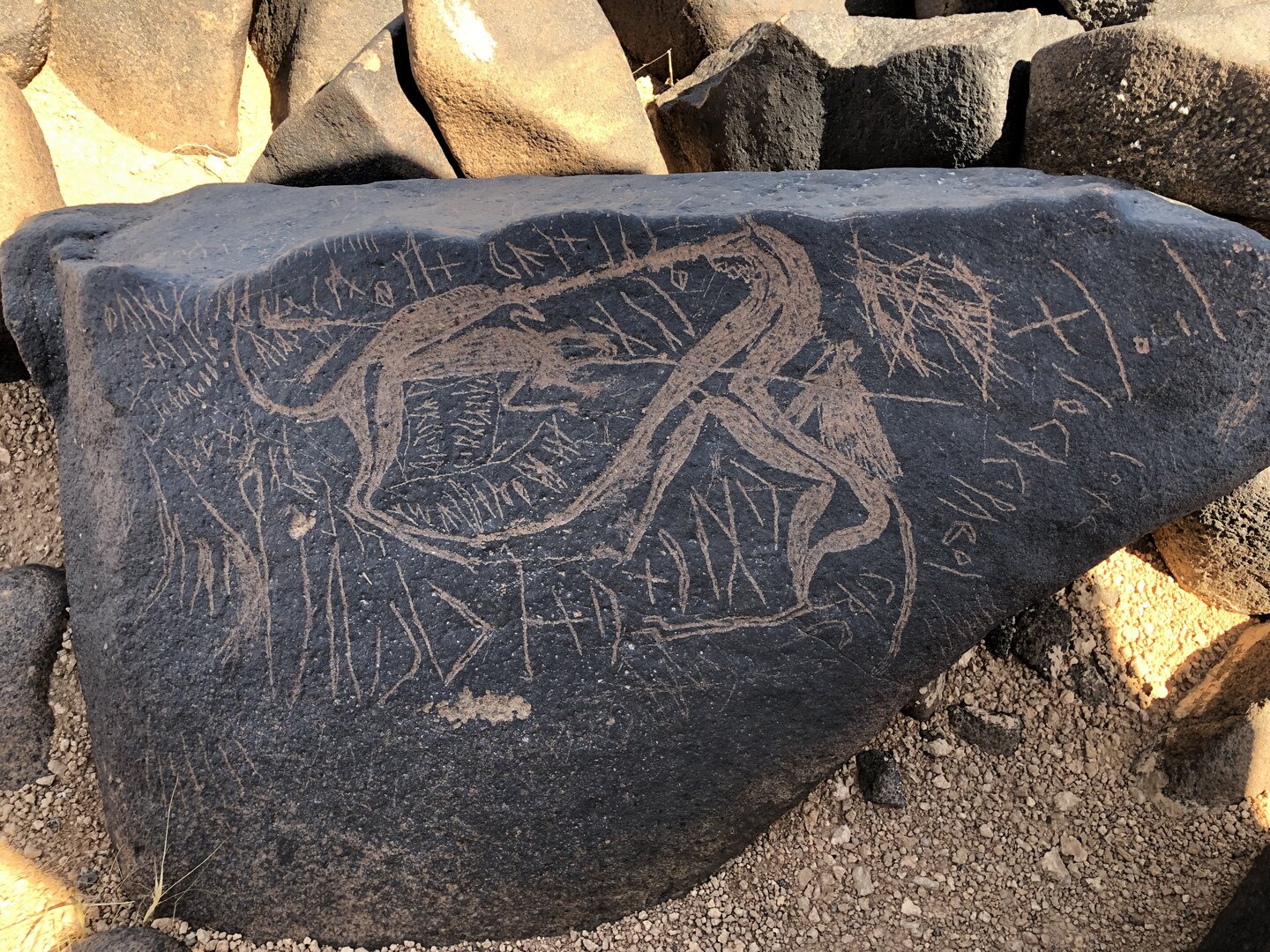
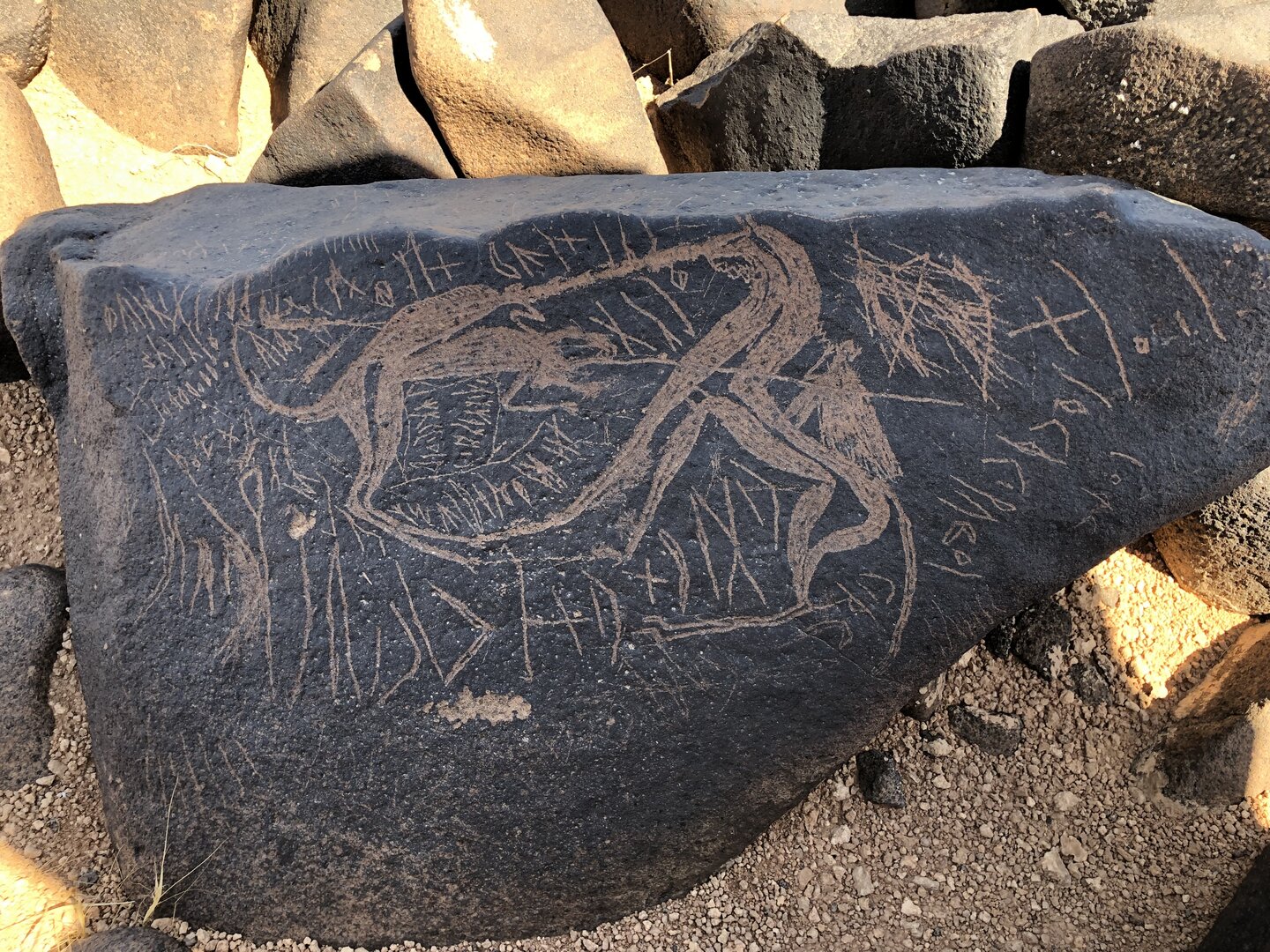
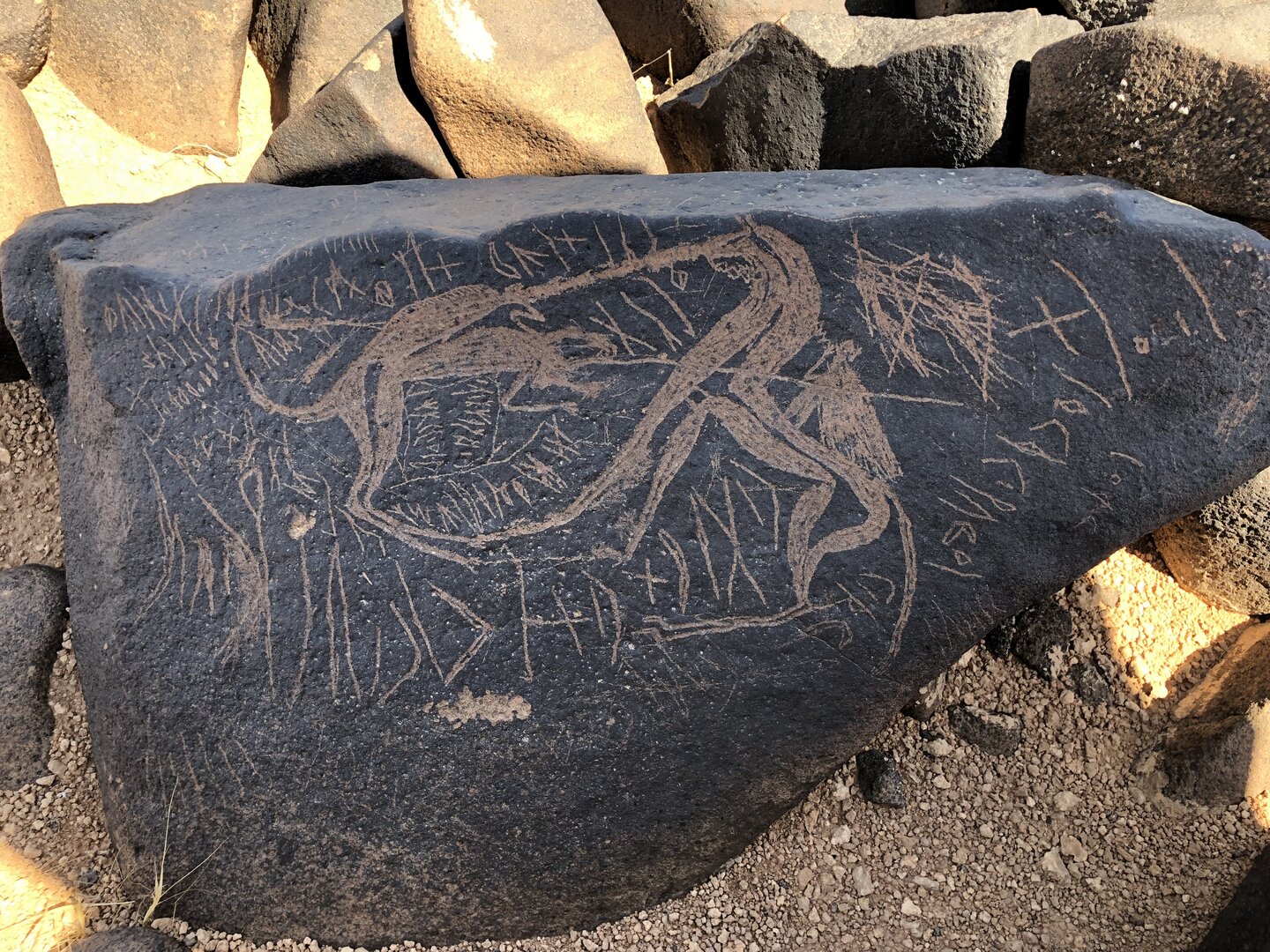
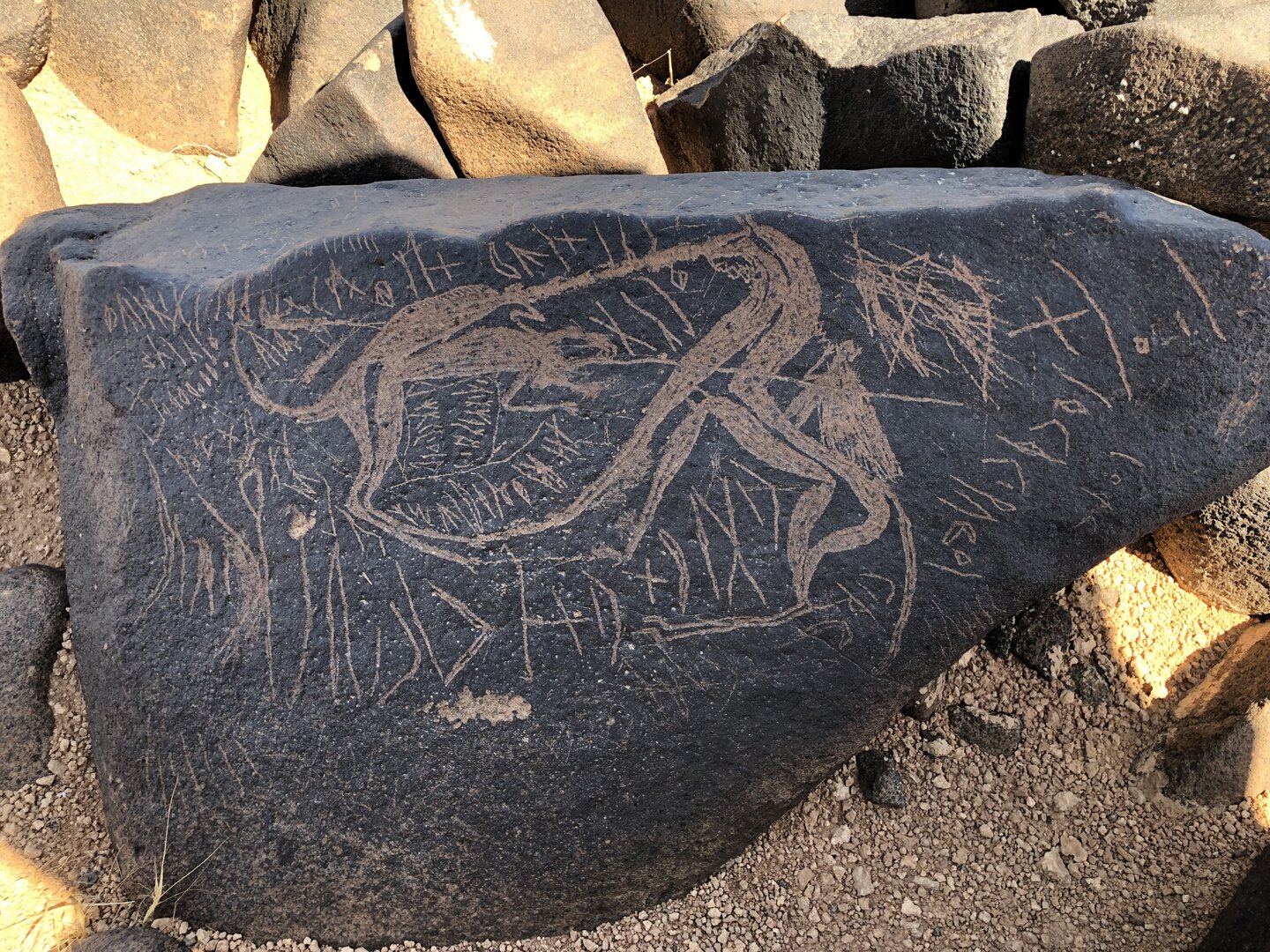
The cover photograph shows BES19s 77.1, recorded at Firʿ Wādī al-Ḫuḍarī in Jordan's Al-Mafraq Governorate. Its OCIANA record gives 2019 as its year of discovery and indicates that it remains in situ. The writing is identified as a winding Safaitic inscription. Associated figures are described as a predator attacking a person while a mounted warrior attempts a rescue; the catalogue does not identify those figures as portraits of the gods mentioned in the writing. [2]
The edition by Ahmad Al-JalladAhmad Al-JalladResearcher in Arabian inscriptions, the history of Arabic and Semitic languages.Glossary · Click to read the explanation reads a genealogy, a stay in the valley while travelling, a reference to the “year of ʿbdt”, an appeal to AllatAllatAn ancient Arabian goddess attested by Safaitic and Nabataean inscriptions, monuments in Palmyra, and the Quran; her roles and interpretations vary with period and context.Glossary · Click to read the explanation against someone who would erase the carvings, seasonal astronomical references, and a concluding request for relief addressed to AllāhAllahAllāh: the Arabic designation of the one God in Islam, also used in other Arabic-speaking traditions. Its pre-Islamic attestations vary in context and historical meaning.Glossary · Click to read the explanation. This is an account of Al-Jallad's published reading and English translation, not an independent decipherment of the carved letters. His commentary connects ʿbdt to one of the Nabataean kings called Obodas without identifying which ruler is meant. A possible drought setting is his interpretation of the appeal and seasonal sequence, not an explicit statement of every surrounding circumstance on the stone. [2]
The record's value lies in its intersection of genealogy, travel, seasonal observation and invocations. But those are not all the same kind of evidence. The drawings are visible features; describing their action involves interpretation; recognizing words requires philology; and suggesting that the writer appealed to a creator deity during a shortage of rain is an explanatory hypothesis in the commentary. Each claim calls for an appropriate degree of confidence.
What can a divine name establish?
On the published edition, Allat and Allāh are invoked in different passages of this one text. This supports a limited, significant conclusion about the language of one writer's appeals, especially when examined alongside comparable inscriptions. It does not alone define an entire desert population's theology, establish that a name carried exactly the same meaning in every later century, or turn the nearby human and animal designs into depictions of either deity. [2]
A different Safaitic record, KRS 18, offers a striking warning against forced certainty. The editor notes that a key verb may refer either to keeping watch or to being cold and hungry, and accordingly considers different interpretations of the closing request. This is a documented dispute about word meaning, while the text's catalogue identity remains secure. It shows why commentary and the critical apparatus matter alongside a readable translation. [18]
A comparison: the Mesha Stele and its paper squeeze
The Mesha SteleMesha SteleA ninth-century BCE Moabite royal basalt stele at the Louvre (AO 5066; KAI 181). Its inscription names Chemosh, Omri, Israel and YHWH (line 18). A proposed “House of David” reading in damaged line 31 is disputed.Glossary · Click to read the explanation provides a different case from ancient Moab, in the ninth century BCE. The Louvre catalogues the surviving basalt monument as AO 5066, recording that it is fragmented, reassembled and partially supplemented. Its 34-line Moabite inscription presents King Mesha's military and political achievements and his relationship with the god ChemoshChemoshMajor Moabite deity in the ninth-century BCE Mesha Stele, credited with restoring territory and receiving war booty; also named in Hebrew texts from another perspective.Glossary · Click to read the explanation. It is an ancient royal account written from a particular political standpoint, not an impartial chronicle of everything that happened. [14]
The museum separately catalogues AO 5019, an incomplete paper squeeze taken in 1869 from the ancient inscription. This distinction helps scholars ask which readings are supported directly by surviving stone, which rely on early impressions, and which have been supplied in modern editions. The nineteenth-century date of the paper impression must not be confused with the date of the ninth-century BCE text. [15]
Digital corpora as research tools
OCIANA brings together images, readings, translations, commentary, provenance and earlier bibliography under identifiable records. The Cuneiform Digital Library Initiative (CDLI) likewise offers object catalogues, images and downloadable textual data. EpiDoc standards enable editions to document provenance, editorial decisions and different layers of the evidence. These resources make comparison and correction far easier, but they are neither identical in coverage nor frozen in one version. [1] [16] [17]
Viewing a record online is not direct inspection of a stone. Some sides may be unphotographed, a new edition may alter an old reading, and a precise date may remain unknowable. A rigorous citation therefore preserves the object identifier, responsible edition, available update date, passage examined and limits of access. It does not imply that a person who consulted a specialist's translation personally read the ancient script.
A working conclusion
Before accepting a claim based on an inscription, a reader can ask: What object is this? Where was it found and where is it now? Does the image actually show the proposed marks? Who supplied the transliteration and translation? Which letters are lost or disputed? What evidence supports the date and the historical interpretation?
The special strength of epigraphy is that physical materials preserve words from past societies, sometimes even the voice of a traveller otherwise absent from literary histories. Its limit is that no text, however clear, automatically reveals the complete convictions of its maker or every event around it. Physical observation, critical edition, translation and historical argument remain connected but distinct kinds of work.
References and notes (19)
- OCIANA. “About This Project.” The Ohio State University. Corpus provides readings, translations, commentary, context and images; digital consultation, not physical stone inspection. Return to the text ↑
- Ahmad Al-Jallad / OCIANA. “BES19s 77.1.” Updated 25 June 2026. Firʿ Wadi al-Khudari, Jordan: Allat then Lh; drought explanation is commentary, and ʿbdt does not identify which Obodas here. Original image © Al-Jallad, CC BY as stated, no version number supplied. Return to the text ↑
- Vanessa Davies and Dimitri Laboury, eds., “Introduction,” The Oxford Handbook of Egyptian Epigraphy and Paleography, 2020. Publisher-hosted Introduction webpage read; chapter catalogued as pp. 1–10; not the whole handbook. Return to the text ↑
- Christer Bruun and Jonathan Edmondson, eds., The Oxford Handbook of Roman Epigraphy, Oxford University Press, 2014. Publisher abstract and table of contents only; no full chapters read. Return to the text ↑
- EpiDoc collaboration, “EpiDoc Guidelines: Ancient documents in TEI XML,” version 9.8, 18 March 2026. Guidelines landing/introductory page, especially textual and material description; not all guidelines. Return to the text ↑
- William Tabbernee, “Epigraphy,” The Oxford Handbook of Early Christian Studies, 2009, pp. 120–139. Only the publisher chapter abstract read; pages 120–139 not accessed. Return to the text ↑
- EpiDoc Guidelines, “Findspot and find context,” v. 9.8, 2026. Online section on findspot, context and relation to original location; no field inspection. Return to the text ↑
- Historic England, “Geospatial Survey Techniques: Photogrammetry, Structure from Motion, Laser Scanning and BIM Explained.” Public technical overview on overlapping imagery and 3D survey; separate guidance not read. Return to the text ↑
- Historic England, “Multi-light Imaging: Highlight-RTI for Cultural Heritage,” publication page, 2018. Publication description and contents list only; 72-page PDF not read. Return to the text ↑
- OCIANA, “Safaitic,” Ohio State University, script description. Complete accessible script-description webpage on spread, letters, direction and dating ranges. Return to the text ↑
- OCIANA, “Ancient North Arabian,” script-family overview. Accessible script-family overview on classification and diversity; not an edition of its full corpus. Return to the text ↑
- Oracc, “ATF Quick Reference,” conventions for transliterating cuneiform. Online reference table for breakage, damage and uncertainty signs; no independent tablet reading. Return to the text ↑
- EpiDoc Guidelines, “Original date of text and/or object,” v. 9.8, 18 March 2026. Online section on text/object dates, ranges, precision and dating evidence. Return to the text ↑
- Musée du Louvre, collection record “Stèle de Mesha,” inv. AO 5066; KAI 181. Object catalogue: inventory, condition, medium, language, 34 lines and dating; Moabite text not independently read. Return to the text ↑
- Musée du Louvre, “Estampage de la stèle de Mesha,” inv. AO 5019, produced 1869. Catalogue record for the incomplete paper squeeze and its relation to AO 5066; not physically examined. Return to the text ↑
- Cuneiform Digital Library Initiative, “Search results / Download,” interface documentation. Search/download options for catalogue, text and bibliographic data; no full dataset or individual tablets examined. Return to the text ↑
- Tom Elliott, Gabriel Bodard, Hugh Cayless et al., “EpiDoc: Epigraphic Documents in TEI XML,” project homepage, 2006–2026. Project homepage explaining encoding of texts and objects; no software execution or dataset validation. Return to the text ↑
- OCIANA, “KRS 18,” transliteration, translation and commentary; updated 16 September 2024. The published record and discussion of two senses of ḫrṣ; no original-script collation. Return to the text ↑
- Oracc, “Translations,” ATF editorial conventions for uncertainty and lacunae. Online translation conventions on supplied, broken and uncertain text; no independent cuneiform translation. Return to the text ↑
Suggest a correction · Suggest a source for this record
Cite this record
IL Archive, «Epigraphy», https://ilarchive.com/en/entities/epigraphy
Continue reading
Related readings