Entity · Database
OCIANA: Ancient North Arabian Inscriptions
A reference page linking a name, group, or concept to the materials that discuss it.
An evolving academic corpus of ancient North Arabian inscriptions, with transliterations, translations, apparatus, images and context. This guide traces its history and critically compares Safaitic, Dadanitic and Taymanitic records.
Estimated reading time: 8 min Published Last reviewed:
Share article
Text
Introduction
How can a reader use a digital corpus of ancient North Arabian inscriptions without confusing marks on stone, an editor’s proposed reading, and a historian’s interpretation? OCIANA makes transliterations, translations, commentary, images, and provenance data available together. This entry examines the project's history and scope and shows how to test its evidence through named inscription records. It is not a survey of the entire database or a first-hand examination of the stones. [1]
Reading guide
- What OCIANA covers and how it works.
- From the SafaiticSafaiticAn Ancient North Arabian consonantal script used for rock inscriptions recording names, kinship, pastoral movement and prayers in the pre-Islamic deserts of Syria, Jordan and northern Arabia.Glossary · Click to read the explanation Database to the Ohio State platform.
- Scripts, regions, and chronological ranges.
- Record identifiers, readings, and critical apparatus.
- A close example: BES19s 77.1.
- Two comparisons: U 002 and WTay 02.
- The cover photograph and its rights.
- Evidential limits and good citation practice.
What the corpus is
OCIANA stands for the Online Corpus of the Inscriptions of Ancient North Arabia. It is a resource for epigraphyEpigraphyThe study of writing preserved on physical objects and monuments: its documentation, reading, dating, translation, material context and historical interpretation.Glossary · Click to read the explanation, the study of surviving inscriptions through their letters, language, physical context, and publication history. According to the project's own account, entries present a scholarly romanized transliteration, an English translation, previous readings and commentary where appropriate, bibliography, provenance, and relationships to neighbouring carvings or structures. Photographs and facsimiles are supplied when suitable material is available, so the depth of documentation differs from one entry to another. [3]
Its ambition is to bring together known inscriptions of northern and central Arabia and related material found elsewhere. This is an ongoing aim, not a claim that every ancient text has already been collected. A photograph, an edited transliteration, and a modern-language translation are three different evidential layers; none automatically substitutes for the others.
A project with several historical stages
OCIANA grew from the Safaitic Database begun in 1994 by Michael C. A. Macdonald, Laïla Nehmé, and Geraldine King. A later Oxford phase at the Khalili Research Centre, running from 2013 to 2017, involved Daniel Burt, Ali Al-Manaser, and María del Carmen Hidalgo-Chacón Díez alongside Macdonald. Oxford's project description also records a 2012 demonstration release containing 3,420 previously unpublished Safaitic inscriptions, and plans to incorporate Dadanitic, Taymanitic, Hismaic, Safaitic, and other corpora. These are dates in the history of digital editing, not dates of the ancient texts. [3] [4]
The rebuilt platform was launched at The Ohio State University in September 2024 by its Digital Lab for Ancient Textual Objects (DLATO), accompanied by a public workshop on 12–13 September. Oxford's webpage documents the former project phase; Ohio State's project page describes the present host. The two should not be confused. [5]
The Oxford research repository has a catalogue description for a 2017 XML snapshot said to contain 37,955 inscription records. Only the indexed repository description, not the XML dataset, was available to this review. That figure belongs to a dated snapshot and should not be passed off as today's live corpus total. [15]
Ancient North Arabian refers to several scripts
OCIANA uses Ancient North Arabian as an umbrella designation for scripts of the South Semitic family attested in northern Arabia, Jordan, southern Syria, and sometimes further afield. Its examples include Dadanitic in oasis settings, Taymanitic around Taymāʾ, SafaiticSafaiticAn Ancient North Arabian consonantal script used for rock inscriptions recording names, kinship, pastoral movement and prayers in the pre-Islamic deserts of Syria, Jordan and northern Arabia.Glossary · Click to read the explanation in desert inscriptions, and Hismaic. The institutional introduction expressly leaves open how these script varieties relate genetically. The umbrella term therefore does not establish a single language, people, or religion. [6]
The wider writing traditions range from the early first millennium BCE into the early centuries CE. For Safaitic, the site's conventional range is the first century BCE to the fourth century CE, while noting evidence for earlier use. Such an approximate range cannot independently date a particular undated stone. Nor are the texts exclusively religious: many name individuals and ancestors or mention movement, herding, conflict, offerings, and petitions. [7]
How to check an inscription entry
Begin with the inscription's siglum, its stable record URL, and the last-updated date. Transliteration is an editorial representation of signs in roman characters, not the ancient script itself. Compare it with the attributed English translation, the Apparatus Criticus, the commentary, bibliography, provenance, current location, and any images. The search page can filter by script, country, subject, or the presence of genealogies, prayers, and narratives. [8] [9]
The site's editorial conventions explain that square brackets [ ] in transliteration indicate supplied letters; curly braces { } flag doubtful readings; and repeated dashes mark illegible material or damage without giving an exact letter count. The apparatus records earlier, sometimes incompatible proposals. These marks are tools of a digital scholarly edition, not necessarily marks present on the original rock. [8]
BES19s 77.1: the inscription and its interpretation
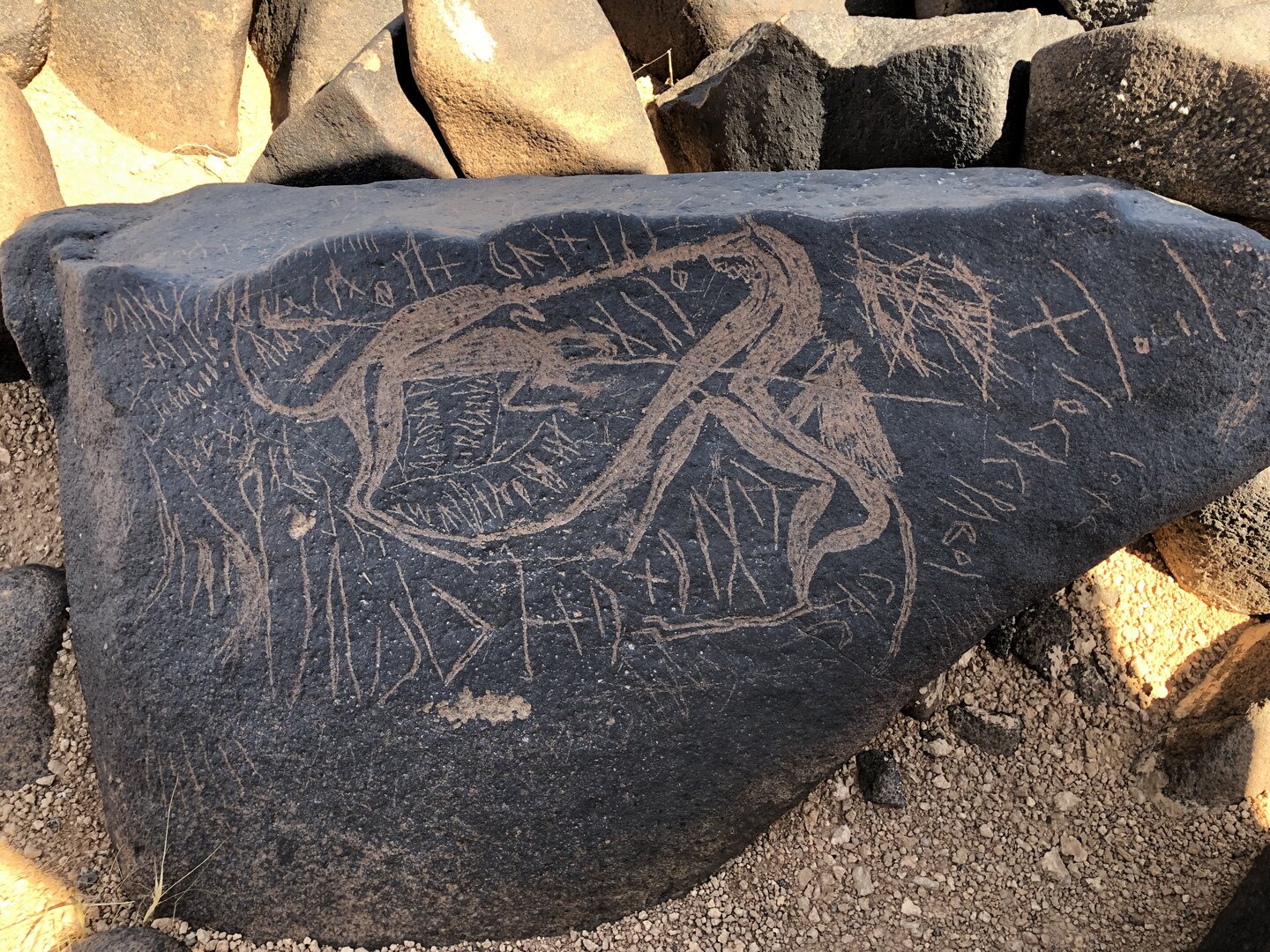
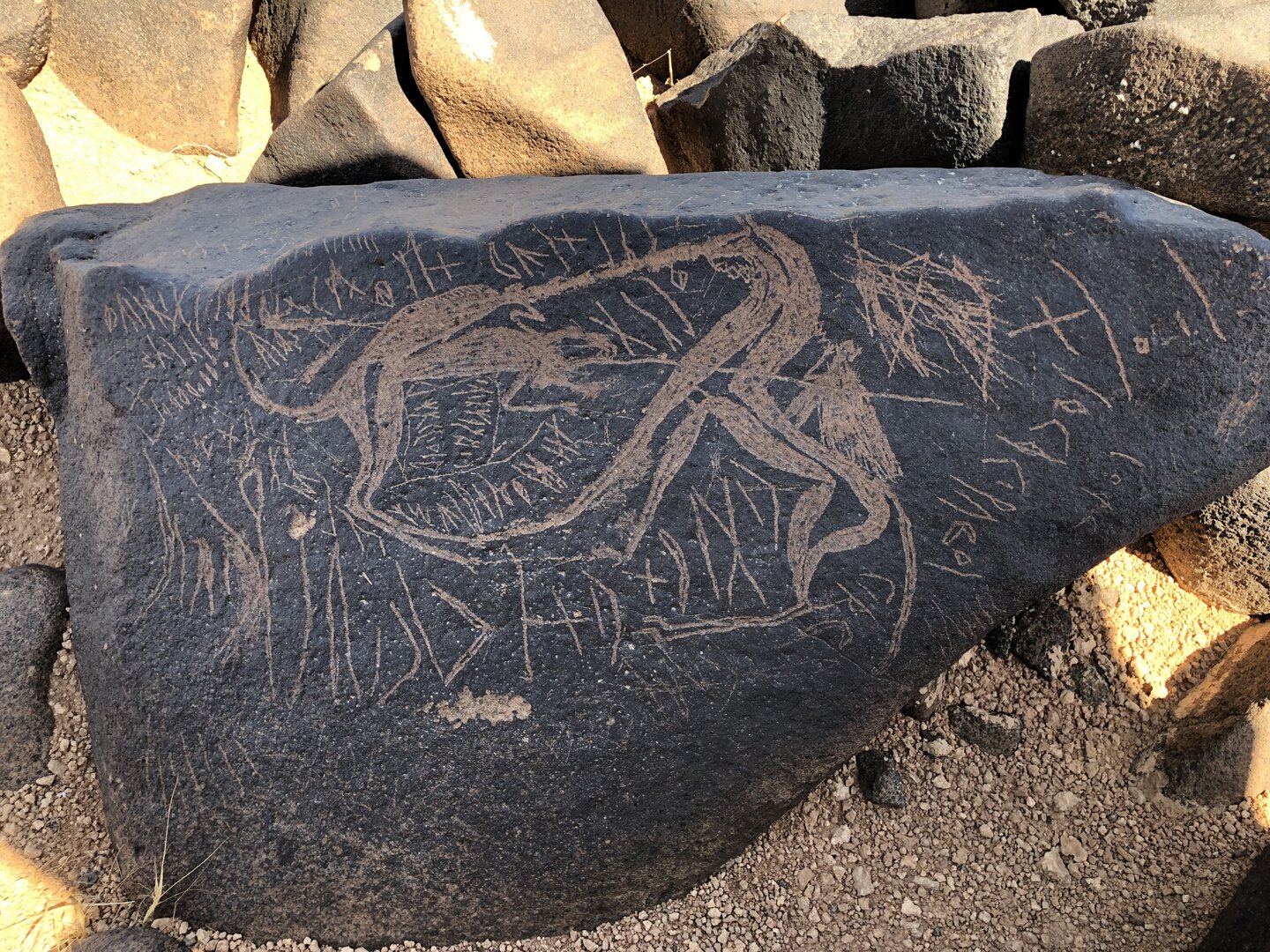
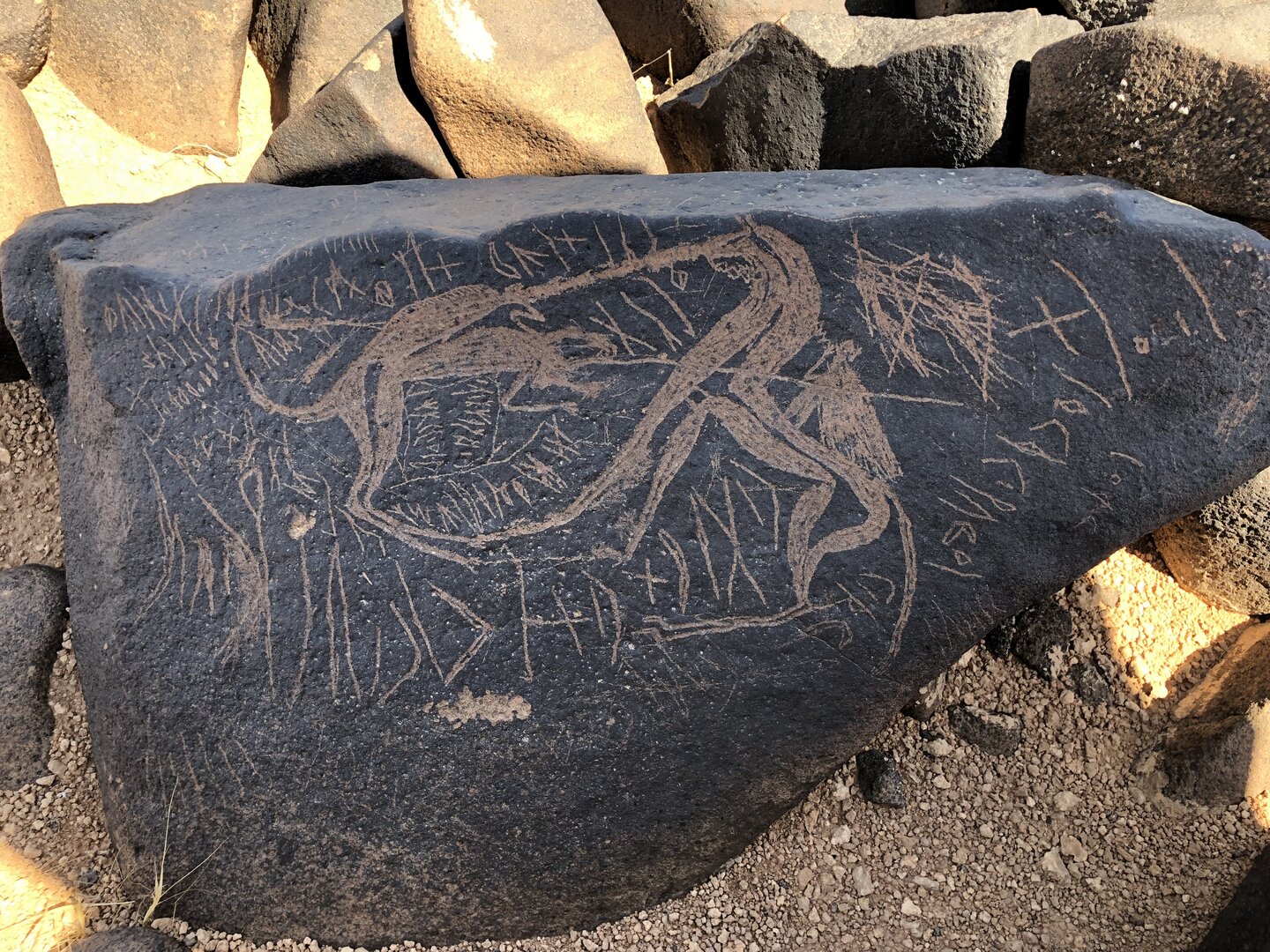
The BES19s 77.1 record describes a Safaitic inscription (variant 2 in the site's classification) documented by the Badia Epigraphic Survey in 2019 at Firʿ Wādī al-Ḫuḍarī, in al-Mafraq Governorate in present-day JordanJordan, the modern countryModern Levantine country independent as a kingdom in 1946, whose present territory includes Dhiban and ancient Moabite sites.Glossary · Click to read the explanation. The stone is reported to remain in situ. OCIANA attributes its reading, translation, and commentary to Ahmad Al-JalladAhmad Al-JalladResearcher in Arabian inscriptions, the history of Arabic and Semitic languages.Glossary · Click to read the explanation and dates its latest recorded revision to 25 June 2026. 2019 is the field recording date and 2026 the digital record update; neither is the ancient carving date. [2]
In the published transliteration and translation, the writer ʿbd names his ancestors, notes camping in a valley in the year named after ʿbdt, invokes AllātAllatAn ancient Arabian goddess attested by Safaitic and Nabataean inscriptions, monuments in Palmyra, and the Quran; her roles and interpretations vary with period and context.Glossary · Click to read the explanation against anyone who effaces the carvings, mentions star periods associated with seasonal movement and access to water, and petitions Lh—identified by the editor as AllāhAllahAllāh: the Arabic designation of the one God in Islam, also used in other Arabic-speaking traditions. Its pre-Islamic attestations vary in context and historical meaning.Glossary · Click to read the explanation—for relief. Parts of the lettering and the end are incomplete. The account here follows OCIANA's modern edition: this archive has not independently deciphered the original Safaitic letters on the rock. [2]
The commentary associates the year named ʿbdt with one of the Nabataean kings called Obodas, without deciding which king. Al-Jallad suggests that a crisis affecting rain and grazing may have prompted an appeal to divine help. This meteorological reconstruction is an interpretation, supported by contextual work on seasons and constellations; the genealogy, appeals, and sequence of star periods are features of the edited text. Al-Jallad's zodiac studies and Macdonald's article on seasons supply relevant scholarly context, but this review accessed the publisher abstracts and excerpt, not those articles in full. [13] [14]
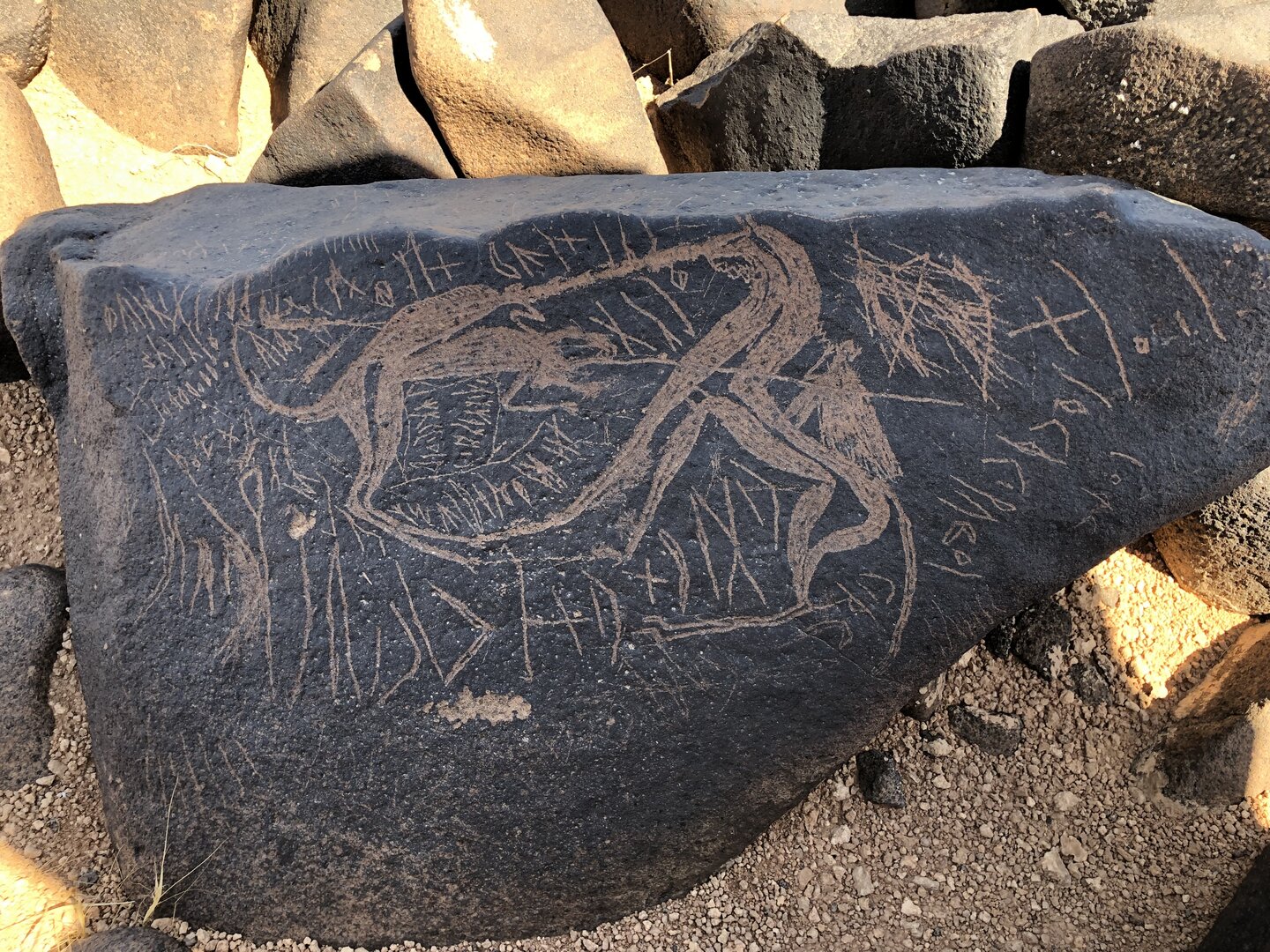
The record describes accompanying rock art as a predator attacking a person while a mounted warrior attempts a rescue. Their physical association is important contextual evidence, but it does not identify the figures as images of Allāt or Allāh. Al-Jallad's monograph also cautions against treating human figures in rock art as divine images by default; this review consulted the book description and a published extract from the relevant chapter, not the whole chapter. [12]
Two comparative checks: Dadanitic and Taymanitic
U 002, a damaged Dadanitic inscription from al-ʿUlā, is presented as referring to a ẓll rite associated with Ḏġbt. The apparatus sets out different restorations of the broken text and attributes an alternative interpretation of the rite to Albert Sima. The entry makes a practical difference visible: surviving letters, editorial supplements, and interpretation of the act are not the same thing. The same entry inconsistently labels its technique “in relief” in a structured field but “incised” in the commentary; without checking the object, this review leaves the conflict unresolved. [10]
WTay 02, near Taymāʾ, is a Taymanitic text referring in its published reading to Ṣlm. Its apparatus preserves materially different earlier readings and translations, and reports that some scholars treated its final four letters both as part of this inscription and of WTay 44. These comparisons are methodological exercises, not tests of religious truth. Kootstra, Winnett, and van den Branden have not been checked here in their original publications: their positions were read as reported and attributed by OCIANA. [11]
A real photograph, not a database logo
The supplied cover is a real photograph of the rock bearing BES19s 77.1. It is not the OCIANA logo, a newly designed reconstruction, or independent evidence that the pictured humans and animals represent deities. Visual comparison with the photograph on the official inscription page confirms the dark stone, incisions, and surrounding scene. The item-specific credit states Image © Ahmad Al-Jallad; CC BY, without specifying a licence version. Attribution and rights have therefore been retained as published; no version has been invented or generalized to other photographs on the site. [2]
The central scene remains clear at a width of 340 pixels and in a square crop, although individual carved letters cannot be reliably read at that size. For those, the reader must consult the full-resolution image and edited text. The original file is retained byte-for-byte with its pre-existing asset identity and SHA-256 checksum.
What the evidence can and cannot support
OCIANA's strength lies in bringing scattered publications together under persistent record URLs, enabling comparisons and preserving alternative readings. Yet the visible record is conditioned by image quality, physical preservation, surveys, older copies, and editorial decisions. Some entries lack adequate photographs or independently established dates. The distribution of collected texts also reflects where people surveyed, recorded, and published them; a high frequency of particular prayers cannot by itself measure the religion of an entire population.
For a reproducible reference, cite the siglum and URL, the credited editor where given, the page's revision date and the date of consultation. Distinguish discovery from carving, and carry uncertain letters and lacunae through into any historical argument. Seasonal or royal identifications should be attributed as interpretations. A subsequently updated web entry should also be compared with earlier publications whenever its claims are material to the argument.
Conclusion
OCIANA is a powerful tool for checking inscriptional evidence, not a substitute for the stone or for textual criticismTextual criticismComparison of written witnesses and ancient translations to explain variant readings and textual transmission, distinguishing attested text from restorations and inferred ancestors.Glossary · Click to read the explanation. The Safaitic, Dadanitic, and Taymanitic examples show how a reader can keep artifact, edited signs, translation, and historical hypothesis distinct. This entry is based on the specific pages, records, and scholarly excerpts documented in its notes, not on a complete review of thousands of entries or independent fluency in their ancient writing systems.
References and notes (15)
- OCIANA, main portal and “About This Project”, The Ohio State University. Project scope and separate transliteration, translation and photograph; original link to portal retained, direct About page in [3]. Return to the text ↑
- Ahmad Al-Jallad, “BES19s 77.1”, OCIANA, ed. A. Al-Jallad and M. C. A. Macdonald, updated 25 June 2026. Transliteration, translation, commentary, 2019 field recording at Firʿ Wādī al-Ḫuḍarī, and item-specific image © Al-Jallad; CC BY without version. Obodas unspecified; drought explanation is editorial. Return to the text ↑
- OCIANA, “About This Project”, The Ohio State University. Full displayed project description: aims, 1994 origins, Oxford phase, September 2024 relaunch. Return to the text ↑
- University of Oxford, “Online Corpus of the Inscriptions of Ancient North Arabia (OCIANA)”, historical project page. Project account of the 2012 pilot (3,420 texts) and the 2013-funded expansion; not current hosting status. Return to the text ↑
- Ohio State University Center for Epigraphical and Palaeographical Studies, “Digital Arabia: OCIANA 2.0 Launch Workshop”, 12–13 September 2024. Launch announcement and dated program; not an ancient inscription date. Return to the text ↑
- OCIANA, “Ancient North Arabian”, script overview. Full displayed overview: constituent scripts, regions, and unsettled genealogical classification. Return to the text ↑
- OCIANA, “Safaitic”, script overview. Full displayed overview: distribution, conventional/earlier dates, genres and letter orientation. Return to the text ↑
- OCIANA, “Explanation of editorial conventions”. Editorial symbols and initial explanations, especially supplied/doubtful/unreadable signs and sigla. Return to the text ↑
- OCIANA, “Inscription Search”, search interface. Visible search fields and filters only; no complete result-set enumeration. Return to the text ↑
- OCIANA, “U 002”, Dadanitic record from al-ʿUlā, updated 8 January 2025. Transliteration, translation, apparatus, commentary, technique and site fields; relief/incision discrepancy. Return to the text ↑
- OCIANA, “WTay 02”, Taymanitic record near Taymāʾ, updated 8 January 2025. Transliteration, translation, apparatus and competing readings including relation to WTay 44. Return to the text ↑
- Ahmad Al-Jallad, The Religion and Rituals of the Nomads of Pre-Islamic Arabia, Brill, 2022. Book description, table of contents and opening extract for chapter 6 (pp. 84–86); not full chapter or book. Return to the text ↑
- Ahmad Al-Jallad, “An ancient Arabian zodiac. The constellations in the Safaitic inscriptions, Part I”, Arabian Archaeology and Epigraphy 25 (2014), 214–230. Publisher abstract and bibliographic details only; full article not read. Return to the text ↑
- Michael C. A. Macdonald, “The Seasons and Transhumance in the Safaitic Inscriptions”, Journal of the Royal Asiatic Society 2/1 (1992), 1–11. Publisher record and visible opening extract on seasons, rain and stars only, not the full study. Return to the text ↑
- Daniel Burt, “The Online Corpus of the Inscriptions from Ancient North Arabia (OCIANA)”, Oxford Research Archive, 2017 dataset. Indexed repository metadata only reports 37,955 XML records; repository page returned 403; XML not downloaded or read. Return to the text ↑
Suggest a correction · Suggest a source for this record
Cite this record
IL Archive, «OCIANA: Ancient North Arabian Inscriptions», https://ilarchive.com/en/entities/ociana
Continue reading