Entity · Writing system
Safaitic
A reference page linking a name, group, or concept to the materials that discuss it.
- Names
- Safaitic script
- Region
- Southern Syria; north-eastern Jordan; northern Saudi Arabia
Safaitic is an ancient North Arabian consonantal script. Pastoral inscriptions document genealogy, travel, grief and prayer; four published witnesses clarify both the evidence and the limits of dating and interpretation.
Estimated reading time: 7 min Published Last reviewed:
Share article
Video
The Name No One Owns | The Road of El
More than four thousand years ago a palace burned at Ebla, and one small word waited in its clay: ʾl, El. We follow it through names and inscriptions, from Ebla, Mari and Ugarit to the kings of Samʾal, Karatepe and Saba and the stones of the basalt desert, then set the Torah's names and the Arabic question side by side. Some scenes are AI-generated illustrations.
The YouTube player loads only when you press play. Watch on YouTube
Text
Introduction
Is Safaitic a single language or a way of writing, and what can its inscriptions tell us about their authors? The rock texts of the desert, carved by people who often named themselves, offer unusually direct evidence for herding, travel, grief and prayer in northern Arabia before Islam. This account examines the writing system and its uncertain chronology, then compares four published records, keeping what the texts say distinct from the editors’ interpretations. “Safaitic” is neither the name of a unified creed nor a date automatically applicable to every inhabitant of the region.
Contents
- Name and distribution: a script, not one people
- Consonants, direction and the problem of pronunciation
- Dating a writing tradition, not every stone
- What did writers leave on the rocks?
- BES19s 77.1: a season, two petitions, an illustrated rock
- A pastoral witness: AAWAB 14
- Wahballāh in Safaitic and Greek: WH 1849 and WH 1860
- What the evidence proves—and leaves open
Name and distribution: a script, not one people
Safaitic is a scholarly name for an Ancient North Arabian writing system used especially in the basalt deserts stretching across southern Syria, north-eastern JordanJordan, the modern countryModern Levantine country independent as a kingdom in 1946, whose present territory includes Dhiban and ancient Moabite sites.Glossary · Click to read the explanation and northern Arabia. The name is associated with the volcanic al-Ṣafā region south-east of Damascus, where examples figured early in the history of modern exploration; the script’s actual distribution is much wider. The OCIANAOCIANA: Ancient North Arabian InscriptionsOCIANA is an evolving academic database of ancient North Arabian inscriptions, with edited transliterations, translations, commentary, references, photographs and provenance; not a substitute for the stones.Glossary · Click to read the explanation corpus documents tens of thousands of inscriptions in this tradition, mostly graffiti on rocks and grave-markers rather than texts preserved in books. [1][12]
Here Safaitic first identifies the script, not a linguistically uniform community. Linguists examine the speech varieties represented by the texts and their connections to Old Arabic and other Semitic varieties. Letter shapes alone cannot establish an author’s dialect, religion or ancestry. In his 2015 grammar, Ahmad Al-JalladAhmad Al-JalladResearcher in Arabian inscriptions, the history of Arabic and Semitic languages.Glossary · Click to read the explanation describes Old Arabic dialects attested in Safaitic; for this review, the institutional bibliographic description and summary were consulted, not the whole book. [4]
Consonants, direction and the problem of pronunciation
The script has 28 consonantal signs. Vowels are not written; an inscription may change direction, wind around rock art or curve along the stone, and word divisions are not regularly marked. Reading thus involves identifying signs, deciding where words begin and end, and interpreting the vocabulary before proposing a translation. A name without vowel signs does not by itself record its full pronunciation. [1]
Under OCIANA’s editorial conventions, braces around a letter, as in {t}, indicate doubt about its reading; ---- stands for an unreadable passage, while square brackets mark letters restored by an editor. These are modern critical signs, not embellishments carved by the ancient author. The Latin-letter strings below are published transliterations, not fresh decipherments of the stones made for this article. [5]
Dating a writing tradition, not every stone
OCIANA conventionally places Safaitic between the first century BCE and the fourth century CE, while reporting epigraphic and archaeological evidence suggesting a beginning at least as early as the third century BCE. This describes the approximate span of a tradition, not the date of any particular graffito. A ruler’s name, an event or archaeological context may help date an individual text, though a “year of the king” formula need not identify which king was meant. Fawwaz Khraysheh’s 1995 study illustrates the difficulties of matching inscribed historical allusions to absolute chronology; only its accessible opening and abstract, not the entire article, were reviewed here. [1][6]
What did writers leave on the rocks?
Many texts begin with a name and genealogy and move on to herding, searching for water or pasture, fear of raiders, the building of a shelter, or grief for a relative. Prayers for safety, mercy or rainfall and curses on people who erase an inscription also occur. These are records of individuals in distinct circumstances, not a single rule for all desert inhabitants or an agreed hierarchy of their gods. [1][7][8]
Several divine names appear in the corpus. Although AllatAllatAn ancient Arabian goddess attested by Safaitic and Nabataean inscriptions, monuments in Palmyra, and the Quran; her roles and interpretations vary with period and context.Glossary · Click to read the explanation is invoked frequently, frequency alone cannot establish that every author regarded her in the same way. In his study of Safaitic religion, Al-Jallad examines multiple deities and types of petition as part of an attempted reconstruction based on their contexts. For his 2022 book, we accessed the opening excerpt of chapter 3, not the entire chapter. [10]
BES19s 77.1: a season, two petitions, an illustrated rock
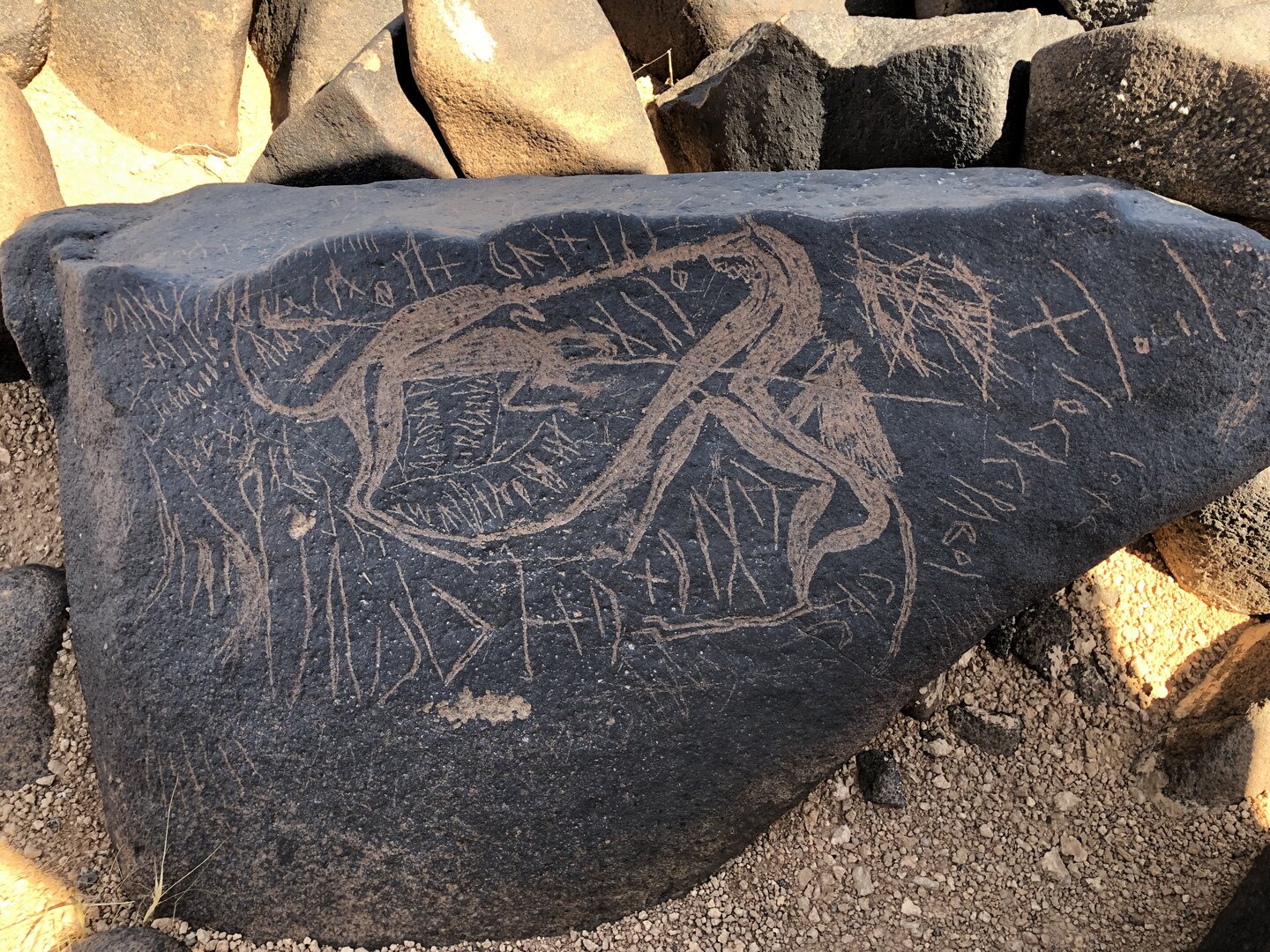
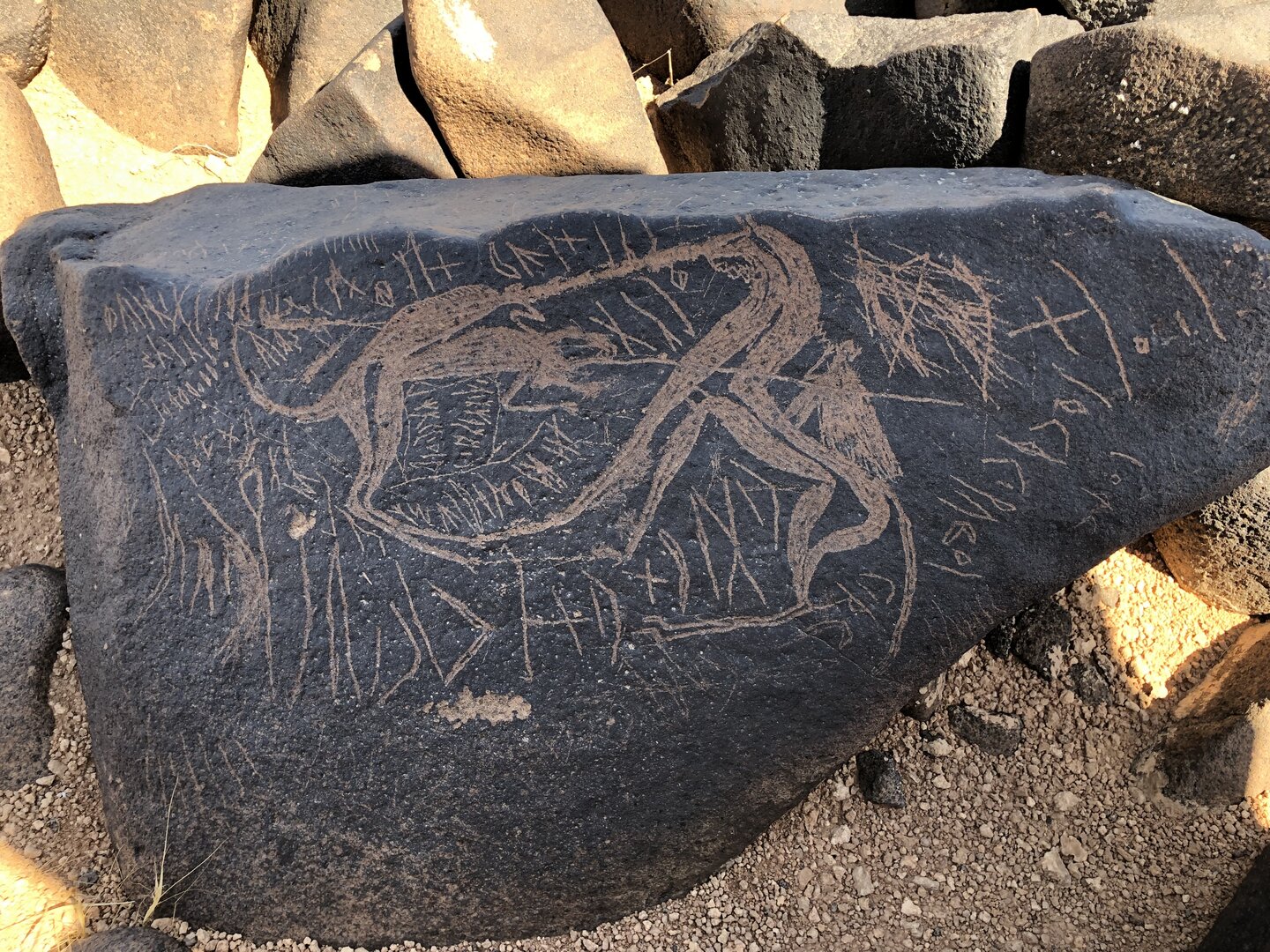
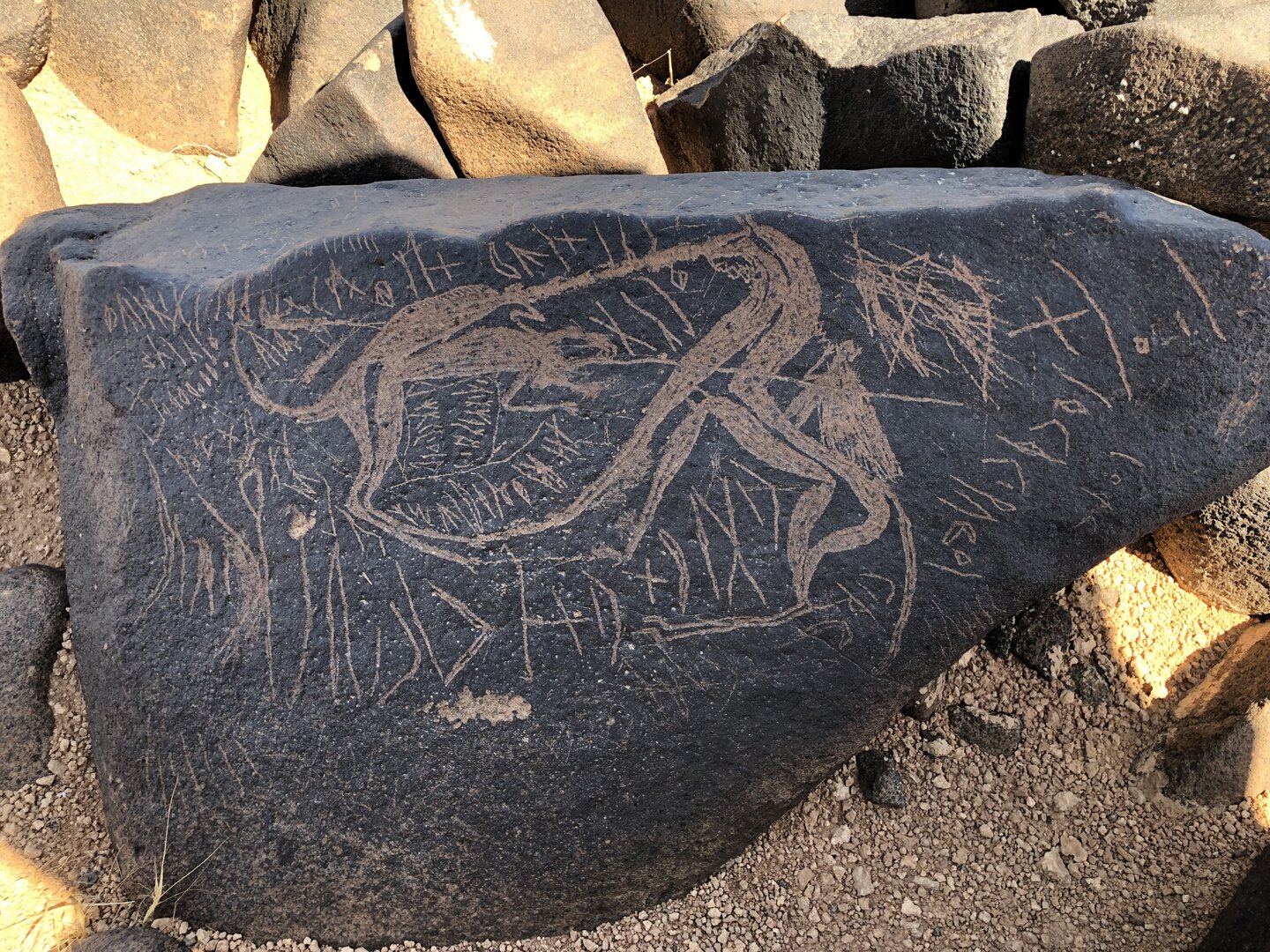
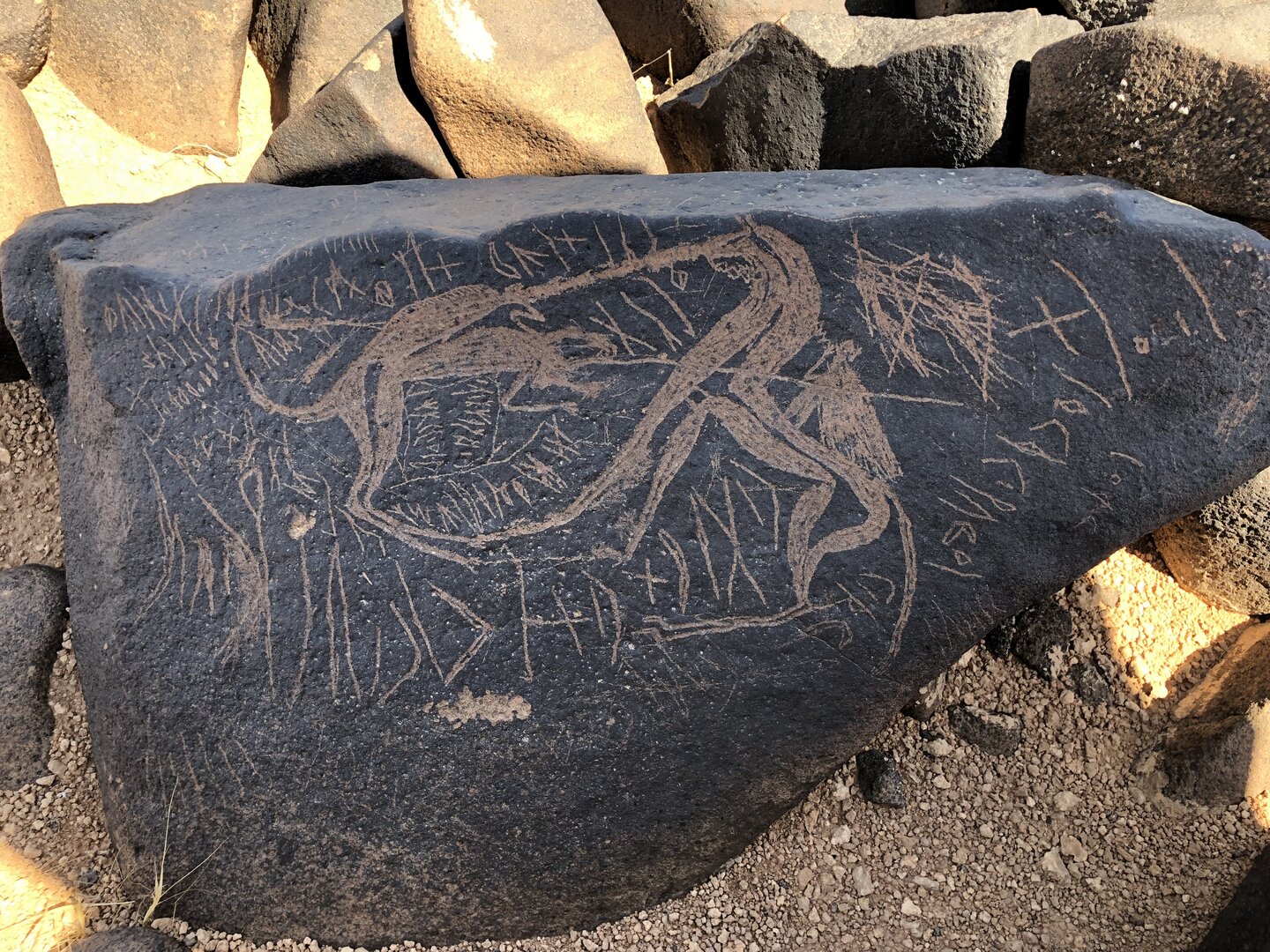
The cover reproduces an authentic photograph of BES19s 77.1, recorded in 2019 at Firʿ Wādī al-Khuḍarī in Jordan’s Al-Mafraq Governorate and listed by OCIANA as remaining in situ. Its transcription and translation are credited to Al-Jallad. A man identified in the edition as ʿbd provides a genealogy, records camping in the valley while migrating and refers to the “year of ʿbdt.” The editor interprets that last name as Obodas, borne by more than one Nabataean king. This wording does not select a particular Obodas, so no exact calendar year has been assigned to the stone here. [3]
The published translation also follows visits to water across four astral periods interpreted as Aquarius, Aries, Libra and Scorpio. Al-Jallad discusses these expressions in connection with seasons and the cycle of rains. The transcribed words are the epigraphic evidence; linking them to a seasonal system and explaining conditions of drought belong to the editor’s comparative interpretation, not to an engraved date or to proof that the writer used a modern calendar. [3]
The writer calls on Allat to deprive anyone effacing the writing of pasture, and later asks lh, interpreted by the editor as AllahAllahAllāh: the Arabic designation of the one God in Islam, also used in other Arabic-speaking traditions. Its pre-Islamic attestations vary in context and historical meaning.Glossary · Click to read the explanation, for relief. The two invocations have different immediate purposes. Mentioning both names does not assert that they designate one deity. Al-Jallad further suggests that the appeal may reflect drought associated in his reconstruction with the absence of the storm god Baʿlšamīn: that suggestion is commentary, whereas Baʿlšamīn is not named in the published inscription. OCIANA describes accompanying rock art as a predator attacking a person while a mounted warrior attempts a rescue. It does not identify the figures as depictions of Allat or Allah. [3][11]
A pastoral witness: AAWAB 14
AAWAB 14, recorded in Al-Wādī al-Abyaḍ in Al-Mafraq on 18 June 2021, has a long genealogy, a reference to pasturing sheep, a petition to Allat for the safety of whoever reads the writing of Ġlmt, and expressions of grief for the author’s father and mother. Everyday activity, remembrance and invocation are joined here without yielding a universal liturgical formula. [7]
OCIANA notes damage near the close of the text and several doubtful letters, as well as an unusual shape for t in the name lt. The editors also propose, without certainty, that some expressions lacking a visible definite article could reflect dialect variation. It would therefore be misleading to fix the damaged final word as a certain personal name or to call unfamiliar letter forms mere errors. [7]
Wahballāh in Safaitic and Greek: WH 1849 and WH 1860
WH 1849 names a writer whblh, son of ẓnʾl, and refers to a shelter, horsemen and an invocation of Allat for security. OCIANA records a corrected reading for the fourth name (mlk) and notes that another word (bḫr) remains obscure. WH 1860, also catalogued as WH Greek 2, is an inscription in the Greek language and Greek script, not a Safaitic text transcribed into Greek letters. Its three names correspond to the first three of WH 1849. Both records come from WH Cairn 25 in Al-Mafraq, but their museum inventory numbers differ: the proposed link is between named witnesses, not between either one and the cover photograph. [8][2]
The Greek writes the first name ΟΥΑΒΑΛΛΑΣ, a valuable comparison with whblh: Al-Jallad takes it to support Wahb-allāh, rather than “Wahb-lāh.” His presentation was checked in appendix 2 of his 2020 University of Chicago book, printed page 115 (PDF page 139). The identical sequence of three names makes common authorship of WH 1849 and WH 1860 likely, not certain. Evidence for the pronunciation of a personal name does not, by itself, disclose the author’s complete theology. [2][9]
What the evidence proves—and leaves open
Together these witnesses establish a widespread consonantal writing tradition, named kinship connections, movement, petitions and mourning, and a variety of religious expressions. The occasional Greek comparison helps reconstruct some pronunciations, not the missing vowels of every Safaitic text. A carved animal cannot automatically be identified with a god; divine names cannot simply be equated; and the “year of Obodas” cannot become a precise date without establishing which ruler is intended. [1][2][3][11]
Safaitic gives us access to individual voices from the pre-Islamic desert, not to a single, uniform “Safaitic religion.” The numbered references allow readers to compare the recorded reading, translation, photographs and editorial comments before weighing wider scholarly reconstructions.
References and notes (12)
- OCIANA (Ohio State University), “Safaitic,” scholarly corpus description. Script description: geography, conventional date range, 28 consonants, changing direction and lack of word division; complete displayed description consulted 21 October 2026. Return to the text ↑
- OCIANA, “WH 1860 / WH Greek 2,” ed. A. Al-Jallad and M. C. A. Macdonald (updated 11 December 2024). Greek ΟΥΑΒΑΛΛΑΣ, three names matching WH 1849; likely, not certain, common author; a Greek-language record, Amman Museum 14174. Record fields and commentary read. Return to the text ↑
- Ahmad Al-Jallad, “BES19s 77.1,” ed. A. Al-Jallad and M. C. A. Macdonald, OCIANA (updated 25 June 2026). Published transliteration and translation: Lt then Lh, four astral periods and ʿbdt; distinguish epigraphic text, interpretive commentary and rock art. Photograph © Ahmad Al-Jallad, CC BY version unspecified; Firʿ Wādī al-Khuḍarī, Jordan. Complete record reviewed. Return to the text ↑
- Ahmad Al-Jallad, An Outline of the Grammar of the Safaitic Inscriptions (Leiden: Brill, 2015), Studies in Semitic Languages and Linguistics 80. University of Groningen catalogue and publisher description only; chapters and the full book were not read. Return to the text ↑
- OCIANA, “Explanation of editorial conventions.” Sections on doubtful/restored/lost letters, vocative h and definite article h-; displayed conventions page consulted. Return to the text ↑
- Fawwaz H. Khraysheh, “New Safaitic Inscriptions from Jordan,” Syria 72 (1995), 401–414. Abstract and opening of printed p. 401 only (Persée), not the entire article; historically allusive date formulae. Return to the text ↑
- OCIANA, “AAWAB 14,” ed. A. Al-Jallad and M. C. A. Macdonald (updated 16 September 2024). Published transcription, translation and commentary on damaged letters, possible dialect variation, grief for both parents; complete record. Return to the text ↑
- OCIANA, “WH 1849,” ed. A. Al-Jallad and M. C. A. Macdonald (updated 16 September 2024). Genealogy, invocation of Allat, revised mlk and opaque bḫr; Amman Museum 14186; entire record. Return to the text ↑
- Ahmad Al-Jallad, The Damascus Psalm Fragment: Middle Arabic and the Legacy of Old Ḥigāzī (University of Chicago, 2020), appendix 2, “Pre-Islamic Graeco-Arabic Texts.” Printed p. 115 (PDF p. 139/160), WH 1860, Greek spelling, proposed pronunciation and probable common author; full book not read. Return to the text ↑
- Ahmad Al-Jallad, The Religion and Rituals of the Nomads of Pre-Islamic Arabia (Brill, 2022). JSTOR open preview: opening excerpt only of ch. 3 “Divinities and Their Roles in the Lives of Humans” (chapter spans pp. 56–72); not full chapter. Return to the text ↑
- Ahmad Al-Jallad, The Religion and Rituals of the Nomads of Pre-Islamic Arabia (Brill, 2022). JSTOR excerpt: opening of ch. 6 “Visual Representation of Deities and the Divine World,” pp. 84–86; only excerpt consulted. Return to the text ↑
- Gonzague Ryckmans, “L’épigraphie safaïtique,” Comptes rendus de l’Académie des Inscriptions et Belles-Lettres 85/1 (1941), 27–32. Printed p. 28 only, via Persée, on the al-Ṣafā name, rock inscriptions and genealogies; not the complete article. Return to the text ↑
Suggest a correction · Suggest a source for this record
Cite this record
IL Archive, «Safaitic», https://ilarchive.com/en/entities/safaitic
Continue reading