Artifact
The Code of Hammurabi Stele (Louvre Sb 8): The Object, Its Image and Its Journey to Susa
An object record bringing together its image, metadata, rights, and context.
- Timeline
- From 1792 BCE to 1750 BCE
- Region
- Mesopotamia
A black basalt pillar, 2.25 metres tall, carries a picture of a king before a god and one of the best-known legal texts of the ancient world. What the object is, how it reached Susa, and what scholars still debate.
Estimated reading time: 6 min Published Last reviewed:
Share article
Photograph
Photo: Mbzt, CC BY 3.0, via Wikimedia Commons; object: Musée du Louvre
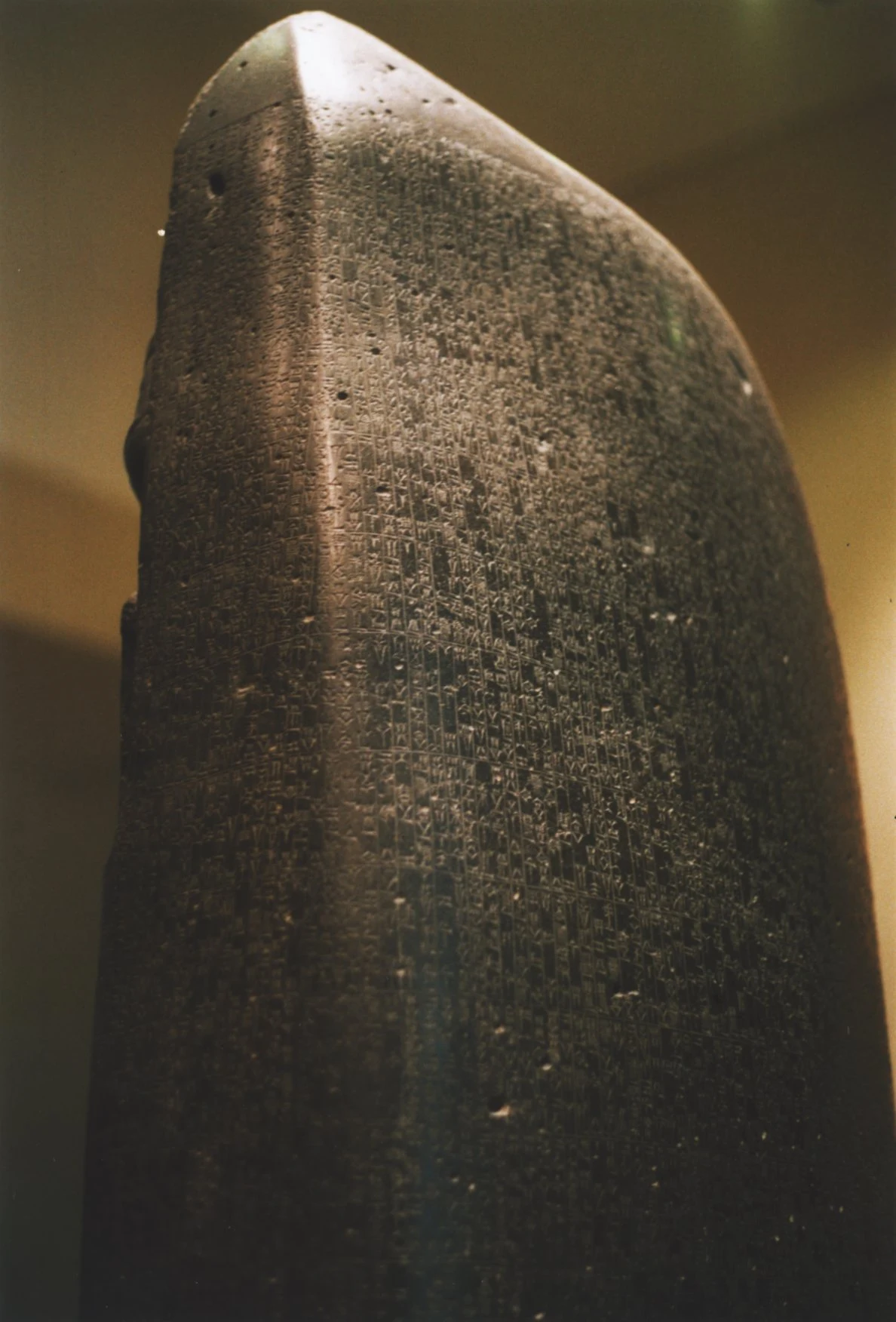
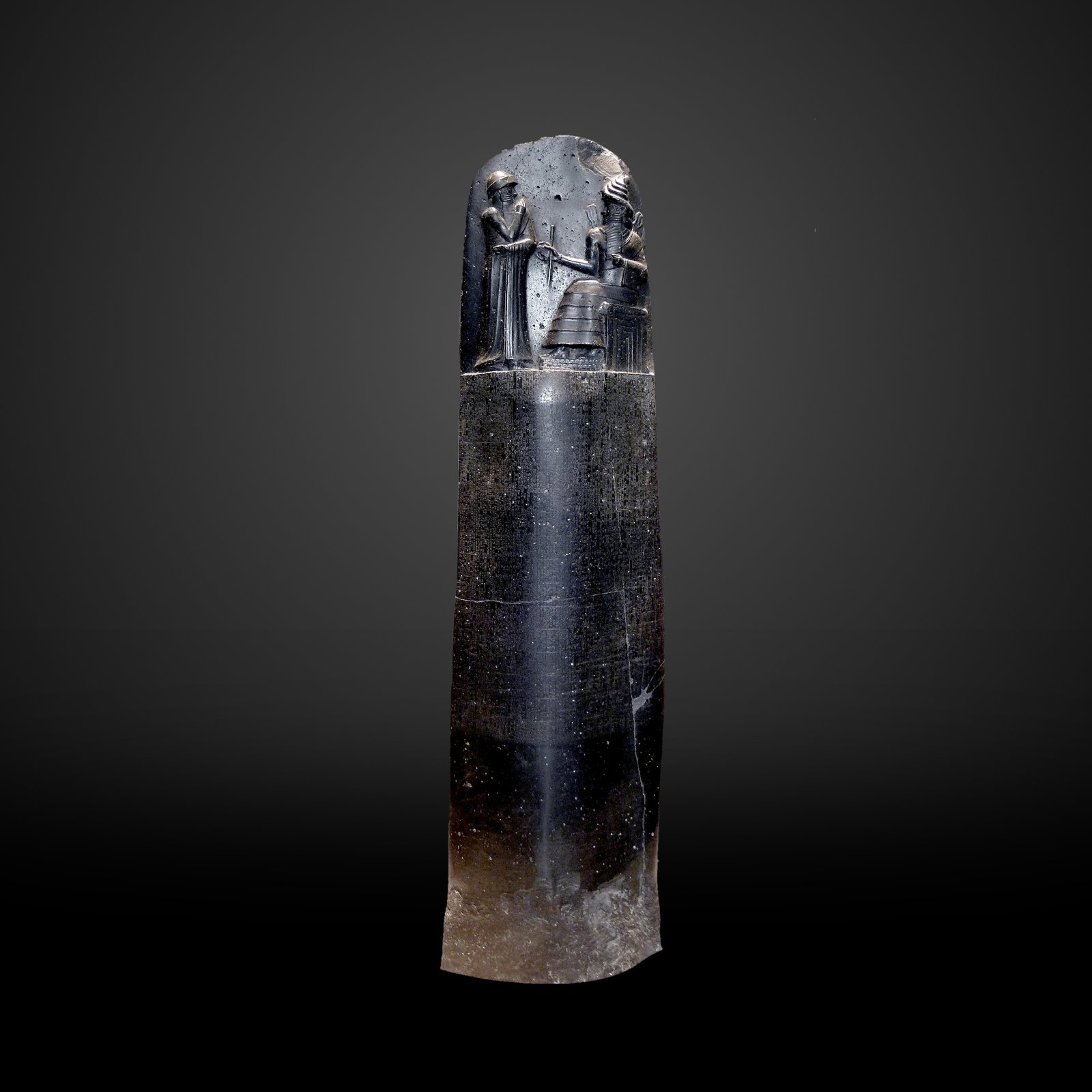
The front of the black basalt stele of Hammurabi, 225 cm high, in the Louvre (Sb 8): a relief of the king before the seated god Shamash above columns of cuneiform law text
License · Image sourceObject details
- Title
- The Code of Hammurabi Stele (Louvre Sb 8): The Object, Its Image and Its Journey to Susa
- Timeline
- From 1792 BCE to 1750 BCE
- Region
- Mesopotamia
- Rights
- CC BY
Text
Introduction
Most people meet the "Code of HammurabiHammurabiKing of Babylon in Mesopotamia, reigning around 1792–1750 BCE. A celebrated legal text preserved on a stele and cuneiform copies bears his name.Glossary · Click to read the explanation" as a list of laws in a book. But the text was first cut into stone, on a tall pillar that a king had set up to be seen. That pillar survives, and it is one of the most visited objects in the Louvre.
This entry is about the stone itself: what it is made of, what its picture shows, how a monument made in Babylonia was found in IranIranIran is the modern country containing Shush, ancient SusaGlossary · Click to read the explanation, and what scholars still argue about. The laws it carries are described in our entries on the Laws of HammurabiLaws of HammurabiAn eighteenth-century BCE Babylonian legal text in Akkadian, presenting property, family, labor and injury provisions within Hammurabi’s account of justice.Glossary · Click to read the explanation and on the king, HammurabiHammurabiKing of Babylon in Mesopotamia, reigning around 1792–1750 BCE. A celebrated legal text preserved on a stele and cuneiform copies bears his name.Glossary · Click to read the explanation.
The object
The stele is kept in the Department of Near Eastern Antiquities of the Louvre under the number Sb 8 (the "Sb" stands for Susa, and the object also has the excavation number AS 6064). It is a single block of basalt, a hard dark volcanic stone, 225 cm high, 79 cm wide and 47 cm thick. The Louvre lists it as broken. [1] A pillar is meant to be read from the front: at the top is a carved scene, and below it the text is cut in columns. [1][3]
The museum dates it to the First Dynasty of BabylonBabylonBabylon is an ancient city in central present-day Iraq, south of BaghdadGlossary · Click to read the explanation, in the reign of Hammurabi, whose years are usually given as about 1792 to 1750 BCE. [1] Wikipedia gives about 1753 BCE for the text, placing it late in the reign, and notes that the date rests partly on the list of the king's achievements in the prologue. [3] That is an estimate, not a date written on the stone.
Found in three pieces at Susa
The stele was found at Susa, in what is now south-western Iran, during the French excavations directed by Jacques de Morgan. The Louvre records the discovery as 1901–1902, and the reports say it was found in three large fragments between December 1901 and January 1902, then put back together. [1][3] Under the arrangement of the time, finds were divided between the excavators and the state, and this stele went to the French state and the Louvre. [1] The first edition of the text was published in 1902 by Jean-Vincent Scheil. [3] Our entry on SusaSusa, ancient ShushSusa is an archaeological city at Shush in southwestern present-day IranGlossary · Click to read the explanation describes the site.
The Louvre also holds many smaller pieces of the same text from Susa. One of them, a tiny gabbro fragment only about 4.5 cm across (Sb 14689, found in 1906–1908), preserves parts of four columns of a copy of the text, showing that Susa once held more than one inscribed monument. [2] Wikipedia mentions fragments of a second, and perhaps a third, stele found with the main one. [3]
Why a Babylonian monument was in Susa
Susa was an Elamite city, not a Babylonian one, and the stele was made for a Babylonian king. The usual explanation is that it was carried off as war booty. Wikipedia says the stele was taken to Susa about six hundred years after it was made, and cites Martha Roth's suggestion that it came from Sippar, a city where Hammurabi lived late in his reign. [3] The Elamite king Shutruk-Nahhunte is known to have invaded Babylonia in about 1158 BCE and to have taken monuments from cities such as Babylon, Sippar and Eshnunna; on the stele of Naram-Sin, which he also carried to Susa, he left an Elamite inscription of his own. [4] So the removal of the Hammurabi stele in the same campaign is a reasonable inference, but nothing that we have read states it directly, and the exact original standing place is not proven. [3][4]
The erased columns
Near the bottom of the front, seven columns of text, each with more than eighty lines, were polished away in antiquity. Scheil proposed that Shutruk-Nahhunte ordered this so that he could write his own inscription there. [3] Other copies of the Code, more than fifty of them from places such as Babylon and NinevehNineveh and KuyunjikNineveh is an ancient Assyrian city near Mosul in northern Iraq; Kuyunjik is one of its archaeological moundsGlossary · Click to read the explanation, let scholars fill in much of the missing text. How many laws were lost is itself uncertain: Scheil counted 34 in 1902, while other sources give a larger number. [3]
The picture at the top
The relief shows the king standing before a seated god, who is identified as ShamashShamashMesopotamian god of the sun and justice, shown before Hammurabi on an eighteenth-century BCE stele preserved in the Louvre.Glossary · Click to read the explanation, the sun god and the god of justice. [1] In the Louvre's words, the god hands the king a ring and a staff. [1] Wikipedia describes Shamash with a horned crown and flames rising from his shoulders. [3] Our entry on ShamashShamashMesopotamian god of the sun and justice, shown before Hammurabi on an eighteenth-century BCE stele preserved in the Louvre.Glossary · Click to read the explanation gives more on the god.
What exactly is being handed over is debated. Some read the ring and rod as signs of rule, some as the tools of a builder (rods and ropes for measuring), and Martha Roth, as reported on Wikipedia, thought the measuring tools the most likely. [3] Scheil took the seated figure to be Hammurabi and the standing one to be Shamash, with the god dictating the laws, but most accounts reverse this. [3] It has also been suggested that the beards of the two figures were reworked after the stele reached Susa. [3] The safest statement is that the picture shows a meeting between king and god that supports the king's role and the justice of his rulings. [1]
The text under the picture
Below the relief come about four thousand lines of cuneiformCuneiformWriting with wedge-shaped signs, developed from Mesopotamian recording traditions and used for several languages from the third millennium BCE.Glossary · Click to read the explanation in the Old Babylonian language. They fall into three parts: a prologue of about 300 lines, in which the gods give Hammurabi his kingship; the laws, in the form "if a man does this, then this follows"; and an epilogue of about 500 lines, which includes curses on anyone who would damage or ignore the monument. [3] Modern editions number the laws up to 282. [3] The prologue names MardukMardukBabylon’s leading god, worshipped at Esagil and elevated in the Akkadian Enūma eliš. His symbols include a spade and mušḫuššu dragon. His earliest origins remain obscure; Nibiru is no evidence of a planetary homeland.Glossary · Click to read the explanation and other gods; Wikipedia notes that the epilogue calls on a long series of gods, among them Anum, EnlilEnlilEnlil/Ellil: a major Mesopotamian god associated with destinies, kingship, and Ekur at Nippur, already prominent in third-millennium god lists. His name’s origin and cult beginnings remain debated.Glossary · Click to read the explanation, EaEnkiMesopotamian deity also known as Ea, linked with Eridu and the Abzu (deep fresh waters), wisdom, incantations, and narratives of creation and cosmic order. Later written attestations do not identify the deity of Eridu’s earliest layers.Glossary · Click to read the explanation, Shamash, Sin and IshtarInanna / IshtarA prominent Mesopotamian goddess whose Sumerian name Inanna became associated with Akkadian Ishtar across diverse traditions. She was associated with desire, war, royal authority and Venus, while local forms and genealogies varied among texts.Glossary · Click to read the explanation. [3]
What is debated
The old name "Code" suggests a set of rules that judges applied. Scholars do not agree. Wikipedia sets out three views: that it is real legislation, that it is a record of decided cases, or, following Fritz Kraus, that it is a work of learned reflection, like the collections of omens. [3] The reasons given for doubt include that no Mesopotamian court record is known to cite it, and that it leaves out large areas of life. The same page notes that the text became part of scribal teaching, because copies were made during and long after the reign, some about a thousand years after the stele was carved. [3] The stone, then, was both a public monument and the source of a text that scribes kept copying.
Why it matters
The stele is one of the clearest cases in which the object itself tells a story that the text alone cannot: a king, a god, a hard stone, a city that lost it, and a conqueror who, on one proposal, had part of it erased. Careful readers keep apart what can be seen on the stone (its size, its relief, its erasure), what the sources state (the find at Susa), and what is inferred (that it came from Sippar, that Shutruk-Nahhunte took it, and what the relief means).
Photograph
The image on this page is a photograph of the front of the stele in the Louvre, by Mbzt, published on Wikimedia Commons under the Creative Commons Attribution 3.0 licence. [5]
References and notes
- Musée du Louvre, Département des Antiquités orientales, collection record 'Code de Hammurabi' (stele, Sb 8, AS 6064) Whole record: numbers, basalt, 225 x 79 x 47 cm, Susa 1901-1902, Jacques de Morgan, date, decoration, inscription, acquisition by division, location, 2008 exhibition Return to the text ↑
- Musée du Louvre, collection record 'Fragment de stèle inscrite du code de Hammurabi' (Sb 14689, AS 6155) Whole record: gabbro, 4.5 x 4.8 x 1.14 cm, found at Susa 1906-1908, four columns of a copy Return to the text ↑
- Wikipedia, 'Code of Hammurabi' (secondary summary citing Scheil 1902, Roth, Kraus 1960, Finkelstein 1961 and others) First 200,000 characters: object, discovery, Shutruk-Nahhunte proposal, erased columns, relief and its interpretations, text structure, copies, debate on the nature of the text; used as a pointer to the scholarship Return to the text ↑
- Wikipedia, 'Shutruk-Nahhunte' (secondary summary) Section on the Babylonian campaign of 1158 BCE: monuments taken to Susa and his inscription on the stele of Naram-Sin Return to the text ↑
- Wikimedia Commons, file 'P1050763 Louvre code Hammurabi face rwk-gradient.jpg' (Mbzt, CC BY 3.0) Whole file page: author, date, licence, size, description Return to the text ↑
Archive records may be reviewed and refined as better evidence or sources become available. Suggest a correction
Suggest a correction · Suggest a source for this record
Cite this record
IL Archive, «The Code of Hammurabi Stele (Louvre Sb 8): The Object, Its Image and Its Journey to Susa», https://ilarchive.com/en/artifacts/code-of-hammurabi-stele
Continue reading