Ancient text
Laws of Hammurabi
A text for line-by-line reading, with transliteration, translation, and resources.
An eighteenth-century BCE Babylonian legal text in Akkadian, presenting property, family, labor and injury provisions within Hammurabi’s account of justice.
Metadata
These are descriptive fields, not conclusions.
- Edition
- 5
Text
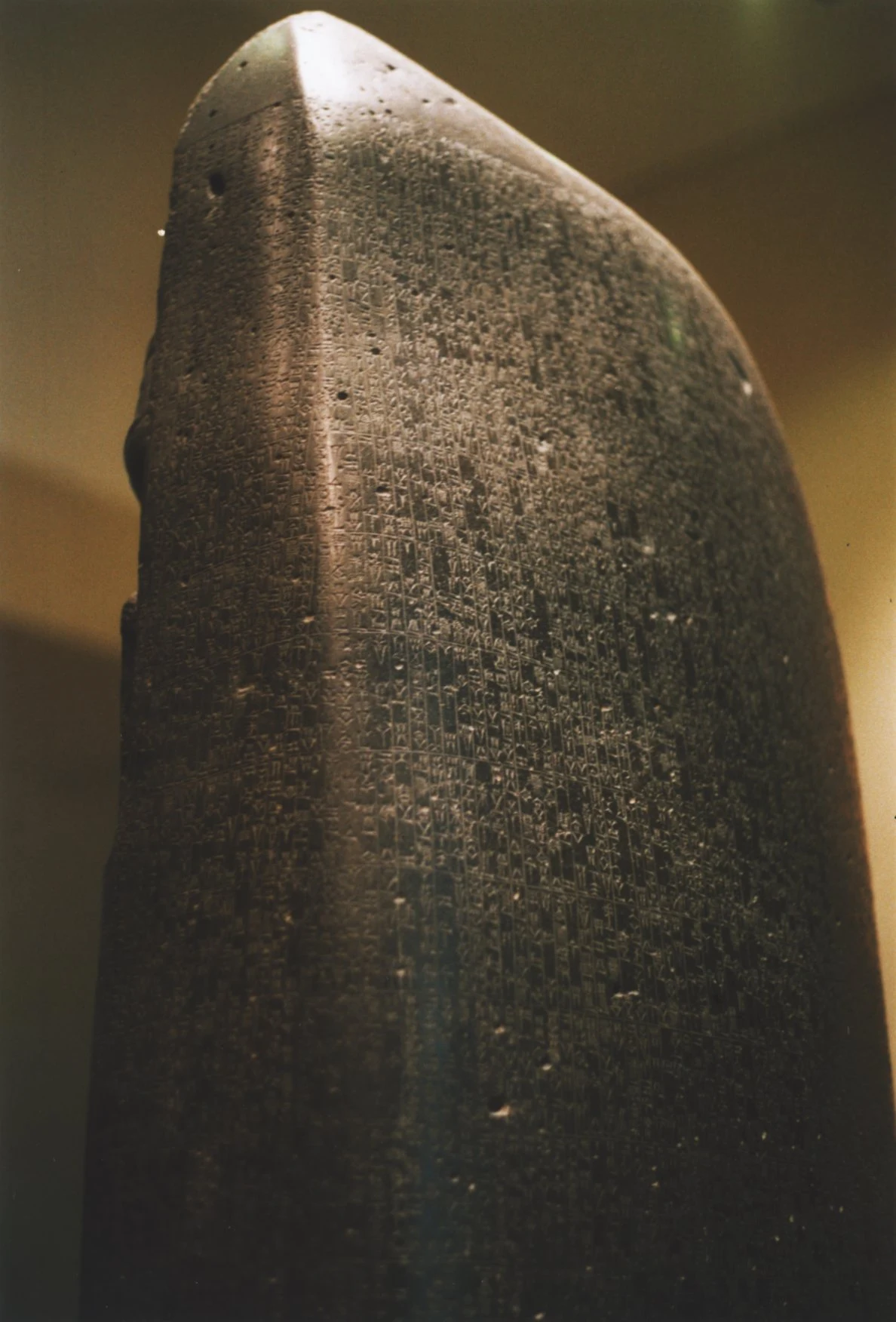
The Laws of HammurabiHammurabiKing of Babylon in Mesopotamia, reigning around 1792–1750 BCE. A celebrated legal text preserved on a stele and cuneiform copies bears his name.Glossary · Click to read the explanation are an eighteenth-century BCE text from BabylonBabylonBabylon is an ancient city in central present-day Iraq, south of BaghdadGlossary · Click to read the explanation in MesopotamiaMesopotamiaA historical region associated with the Tigris and Euphrates, home to many societies and civilisations.Glossary · Click to read the explanation. They were written in AkkadianAkkadianAn ancient East Semitic language written in cuneiform in Mesopotamia.Glossary · Click to read the explanation, a Semitic languageSemitic languagesA language family including Akkadian, Ugaritic, Hebrew, Aramaic and Arabic.Glossary · Click to read the explanation used in the region. One witness is Louvre stele SB 8, associated with King Hammurabi in the Old Babylonian period. [1]
The text presents cases in a form resembling “if this happens, this is the ruling,” concerning property, family, labor, injuries and other matters. A prologue and epilogue celebrate royal justice. Modern paragraph numbering reaches 282; editors supplied these numbers for reference rather than finding them carved beside ancient provisions. [2]
Scholars study the collection’s role in proclaiming royal justice, training scribes and relating to practice. Court records and other collections help clarify the society it reflects and how it was used. Calling it a code alone does not determine how it was applied. [4]
References and notes
- Louvre SB 8 catalogue: Old Babylonian Akkadian text associated with Hammurabi in the eighteenth century BCE; identity and date checked. Louvre SB 8 catalogue: language, identity and date metadata. Return to the text ↑
- Robert Francis Harper’s 1904 public-domain translation. Specified provisions, prologue and epilogue consulted; sensitive passages checked against academic quotations in Wright and Slanski. Its older social-category translations are not current philological authority. Paragraph numbering is modern editorial convention. Robert Francis Harper, 1904; §§117, 196–214, 250–252; prologue and epilogue Return to the text ↑
- Full 14-page article read from Yale’s repository. It examines monument, text, image, audience, copying and royal justice. An interpretation of the monument’s function does not establish universal enforcement or absence of practical influence. Kathryn E. Slanski, Yale Journal of Law & the Humanities 24 (2012), pp. 97–110; especially 101–108 Return to the text ↑
Research history
Substantive changes are retained here. Minor copy edits remain in the internal operational log.
-
Substantive record update
-
Substantive record update
-
Substantive record update
-
Substantive record update
Archive records may be reviewed and refined as better evidence or sources become available. Suggest a correction
Suggest a correction · Suggest a source for this record
Cite this record
IL Archive, «Laws of Hammurabi», Edition 5, https://ilarchive.com/en/texts/hammurabi-law-collection