Artifact
The Black Obelisk of Shalmaneser III: Tribute Scenes and the Name "Jehu, Son of Omri" (British Museum ME 118885)
An object record bringing together its image, metadata, rights, and context.
- Timeline
- From 827 BCE to 824 BCE
- Region
- Mesopotamia
A black stone pillar from Nimrud shows five foreign rulers bowing to an Assyrian king. One caption names "Jehu, son of Omri", the only picture of an Israelite king, though scholars still argue over the name.
Estimated reading time: 6 min Published Last reviewed:
Share article
Photograph
Photo: Osama Shukir Muhammed Amin, CC BY-SA 4.0, via Wikimedia Commons; object: British Museum
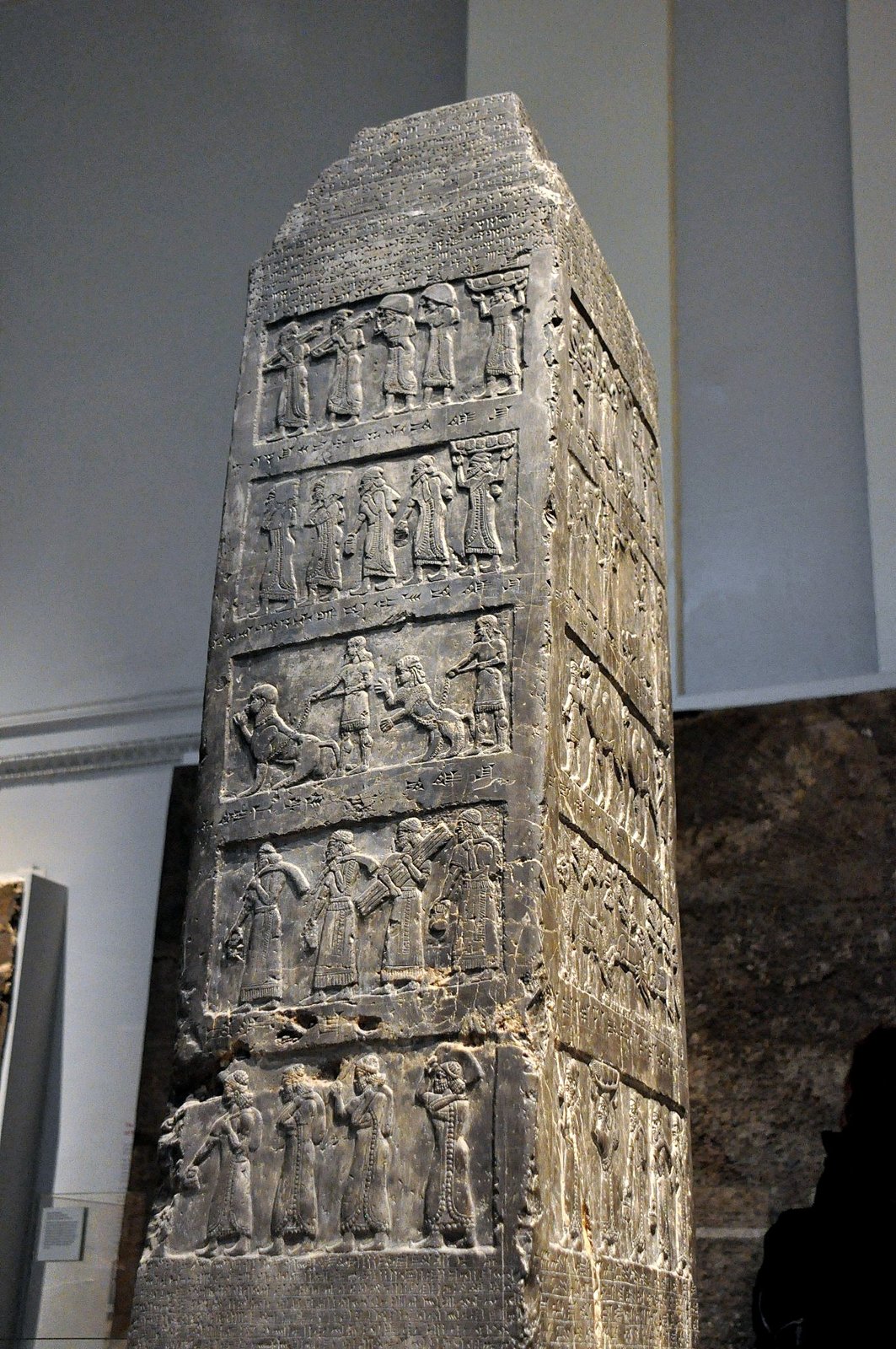
The Black Obelisk of Shalmaneser III in the British Museum (ME 118885), a black limestone pillar about two metres high from Nimrud, carved on four sides with rows of tribute scenes and cuneiform captions; two sides are visible
License · Image sourceObject details
- Title
- The Black Obelisk of Shalmaneser III: Tribute Scenes and the Name "Jehu, Son of Omri" (British Museum ME 118885)
- Timeline
- From 827 BCE to 824 BCE
- Region
- Mesopotamia
- Rights
- CC BY-SA
Text
Introduction
In 1846 the archaeologist Austen Henry Layard dug out of the ruins of Nimrud, in northern IraqIraqIraq is a modern country encompassing much of ancient MesopotamiaGlossary · Click to read the explanation, a black stone pillar about two metres tall. Its four sides are covered with small carved pictures and rows of cuneiformCuneiformWriting with wedge-shaped signs, developed from Mesopotamian recording traditions and used for several languages from the third millennium BCE.Glossary · Click to read the explanation writing. The pictures show men from far-off lands bowing to the Assyrian king Shalmaneser III and bringing him gifts. In the second row, one of those men is named in the caption as "Jehu, son of Omri".
This entry looks at the object: when and where it was found, how it is built, what the pictures and captions say, and why the name in one caption is still discussed. We keep apart what can be seen and read on the stone, what the Bible says, and what scholars only propose.
The object
The Black Obelisk is a pillar of dark limestone, with a top shaped like a small stepped tower. It is kept in the British Museum under the number ME 118885. A reference text gives its height as about 1.98 m and its width as about 45 cm. [1] An obelisk, in this sense, is a tall four-sided monument carved with writing and pictures; it is not the same as the needle-shaped Egyptian obelisk. The text is in AkkadianAkkadianAn ancient East Semitic language written in cuneiform from the third millennium BCE; its varieties include Babylonian and Assyrian, and it served in international diplomacy.Glossary · Click to read the explanation, the main language of Assyria, written in cuneiform, the wedge-shaped script pressed or cut into clay and stone. [1]
It is dated to the last years of Shalmaneser III, who ruled from 858 to 824 BCE. One source gives its making as 827–824 BCE and says it was set up in 825 BCE in the central square of Nimrud (ancient Kalhu). [1] Another text says the annals on it run up to the king's 31st year, which is 828 BCE. [2] Both dates fall in the same few years, and the stone does not carry a closing line that would tell us which event it was made for. [2] The same reference text says that only two complete Neo-Assyrian obelisks are known; the other is the much older White Obelisk. [1]
Where it was found
Layard found the obelisk in 1846 at NimrudNimrud: ancient KalhuNimrud is the site of the Assyrian city Kalhu in present-day northern Iraq, near Mosul.Glossary · Click to read the explanation. One text places the find in Shalmaneser's palace at Kalhu. [2] We have not seen the excavation record, so we do not state the exact spot more closely. The captions were first published in Layard's Inscriptions, plate 98. [2]
The five rows of pictures
Each of the four sides carries five small scenes, so there are twenty in all. Over each scene runs a short cuneiform caption. [1] The five rows show foreign rulers, or their envoys, bringing gifts and bowing before the Assyrian king. As listed in one source, from top to bottom they are:
- Sua of Gilzanu, a land in north-west IranIranIran is the modern country containing Shush, ancient SusaGlossary · Click to read the explanation;
- "Yaua of Bit Omri", usually read as Jehu;
- an unnamed ruler of Musri, in the north of Iraq;
- Marduk-apil-usur of Suhi, on the middle Euphrates;
- Qalparunda of Patin, in the area of Antakya in TurkeyTurkeyTurkey is a modern country including Anatolia and territory in southeastern EuropeGlossary · Click to read the explanation. [1]
Our two sources spell some names and places a little differently; for example, the annals text has Qarparunda of Hattina. [2] The long rows of writing above and below the pictures are the king's annals: a year-by-year account of campaigns, led by the king and by his chief general, up to his 31st year. [1][2] Some details have led one source to suggest that this general, Dayyan-Assur, may have ordered the monument. [1] That is an idea, not a statement on the stone.
The Jehu panel
The second row shows a man bending to the ground in front of the king, with attendants carrying gifts behind him. The caption names the giver as Ia-ú-a, "son of Omri" (written Hu-um-ri-i or similar). One translation of it begins, "The tribute of Jehu, son of Omri; I received from him silver, gold…" and goes on to list golden vessels, tin, a staff for a king, and wooden objects whose name is hard to translate. [1][2] The tribute is usually dated to about 841 BCE. [1][3]
The figure and his attendants are dressed differently from the other people in the scene, which marks them as people of the LevantThe LevantThe Levant is a regional name for lands along the eastern MediterraneanGlossary · Click to read the explanation, the lands along the eastern Mediterranean. Whether the clothes show how people in Israel really dressed is not known. [4] The panel is often described as the only picture we have, from the ancient Near EastAncient Near EastModern scholarly label for ancient societies of Mesopotamia, the Levant, Anatolia and Iran, sometimes extending to Egypt and other neighbours depending on the study; not one civilization or religion.Glossary · Click to read the explanation, of an Israelite or Judaean king. [1][3] "Omri" here points to the northern kingdom of Israel. For the history, see our entries on ancient IsraelAncient IsraelName attested for a population on the Merneptah Stele around 1208 BCE, later for the northern Iron Age kingdom and for broader textual and religious identities; the senses are not identical.Glossary · Click to read the explanation, on OmriOmri, king of IsraelNinth-century BCE ruler of ancient Israel, named in the Mesha inscription's account of Moab's subjection.Glossary · Click to read the explanation and on SamariaSamaria: city and regionAncient city and administrative region; the city’s site is at Sebastia, northwest of Nablus in the West Bank.Glossary · Click to read the explanation, the city associated with Omri's dynasty.
Is this the Jehu of the Bible?
The first translator, Henry Rawlinson, did not link the name to the Bible in 1850; he took it for a prince missing from the Assyrian annals. The Reverend Edward Hincks proposed in 1851 that he was the biblical Jehu, and most scholars still agree. [1]
Two things keep the question alive. First, the Bible does not present Jehu as a son of Omri. In 2 Kings 9–10 he is a military officer, called the son of Jehoshaphat, son of Nimshi, who rose against the family of Ahab, Omri's son, and ended that dynasty. [3] George Smith doubted the identification in 1875 for this reason, and later scholars such as P. Kyle McCarter and Edwin R. Thiele also raised problems. [1] Second, the Assyrians used the phrase "house of Omri" (Bit Humri) for the kingdom of Israel and its rulers for a long time after Omri's day. [3][5] "Son of" in the caption can therefore mean "of the house, or land, of Omri" and not "child of". One source prefers the reading "Omride", meaning a member of that line of kings in the wider sense, and notes that Jehu's grandfather might himself have been a son of Omri, though this is only a possibility. [3][5] A few scholars have proposed that the caption means another king of Israel, Jehoram. [1]
The Bible does not mention any tribute from Jehu to Assyria, and the Assyrian text does not mention the events of 2 Kings. The two sources do not contradict each other, but neither tells the other's story. Some historians suggest that Jehu paid in order to gain Assyrian support against Aram, the state of Damascus. That is a reasonable guess about his motives, not something either source says. [3]
Why it matters
The Black Obelisk is not mainly a religious object. It is a royal monument that shows how Assyria wished to be seen: a king who stands, and rulers from many lands who kneel and bring gifts. But for readers of the Bible it provides something rare, a ruler named in scripture seen in a contemporary picture, with the name of his land written next to him. It also shows how far apart two viewpoints can be. In 2 Kings, Jehu is the central actor; for Assyria he is one tribute-bearer among five. The stone does not tell us how Jehu himself saw the matter.
Photograph
The photograph shows the Black Obelisk standing in the British Museum, with Side D on the left and Side A on the right. It was taken by Osama Shukir Muhammed Amin and is published on Wikimedia Commons under the Creative Commons Attribution-ShareAlike 4.0 licence. [6]
References and notes
- Wikipedia, 'Black Obelisk of Shalmaneser III' (secondary summary) Whole article via page fetch: discovery 1846, ME 118885, size, five registers and tributaries, Jehu caption, history of the identification, scholarly doubts Return to the text ↑
- Context of Jewish Scripture (COJS), 'Annals Edition 4: The Black Obelisk, 828 or 827 BCE' (translation after Luckenbill, Ancient Records I, 590-593; epigraphs published in Layard, Inscriptions, pl. 98) Whole page via page fetch: description, findspot, Jehu caption wording, annals to the 31st year, no closing formula Return to the text ↑
- Wikipedia, 'Jehu' (secondary summary) Passages on the Black Obelisk, tribute c. 841 BCE, 'son of Omri', 2 Kings 9-10, Tel Dan, Aram Return to the text ↑
- University of Michigan Near Eastern Studies image database, 'Nimrud/Kalhu: Black Obelisk of Shalmaneser III, detail 3 of 4' Whole record via page fetch: description of the Jehu panel, dress of Levantines Return to the text ↑
- Wikipedia, 'Omri' (secondary summary) Passages on 'Bit Humri', the Black Obelisk and the 'Omride' reading Return to the text ↑
- Wikimedia Commons, file 'The Black Obelisk of Shalmaneser III, 9th century BC, from Nimrud, Iraq. The British Museum.jpg' (Osama Shukir Muhammed Amin, CC BY-SA 4.0) File metadata via the Commons API: author, licence, description, 1361 x 2048 px Return to the text ↑
Archive records may be reviewed and refined as better evidence or sources become available. Suggest a correction
Suggest a correction · Suggest a source for this record
Cite this record
IL Archive, «The Black Obelisk of Shalmaneser III: Tribute Scenes and the Name "Jehu, Son of Omri" (British Museum ME 118885)», https://ilarchive.com/en/artifacts/black-obelisk-shalmaneser
Continue reading