Artifact · Inscription
The Sarcophagus of Ahiram from Byblos (KAI 1)
An object record bringing together its image, metadata, rights, and context.
- Timeline
- From 1000 BCE to 901 BCE
- Region
- The Levant
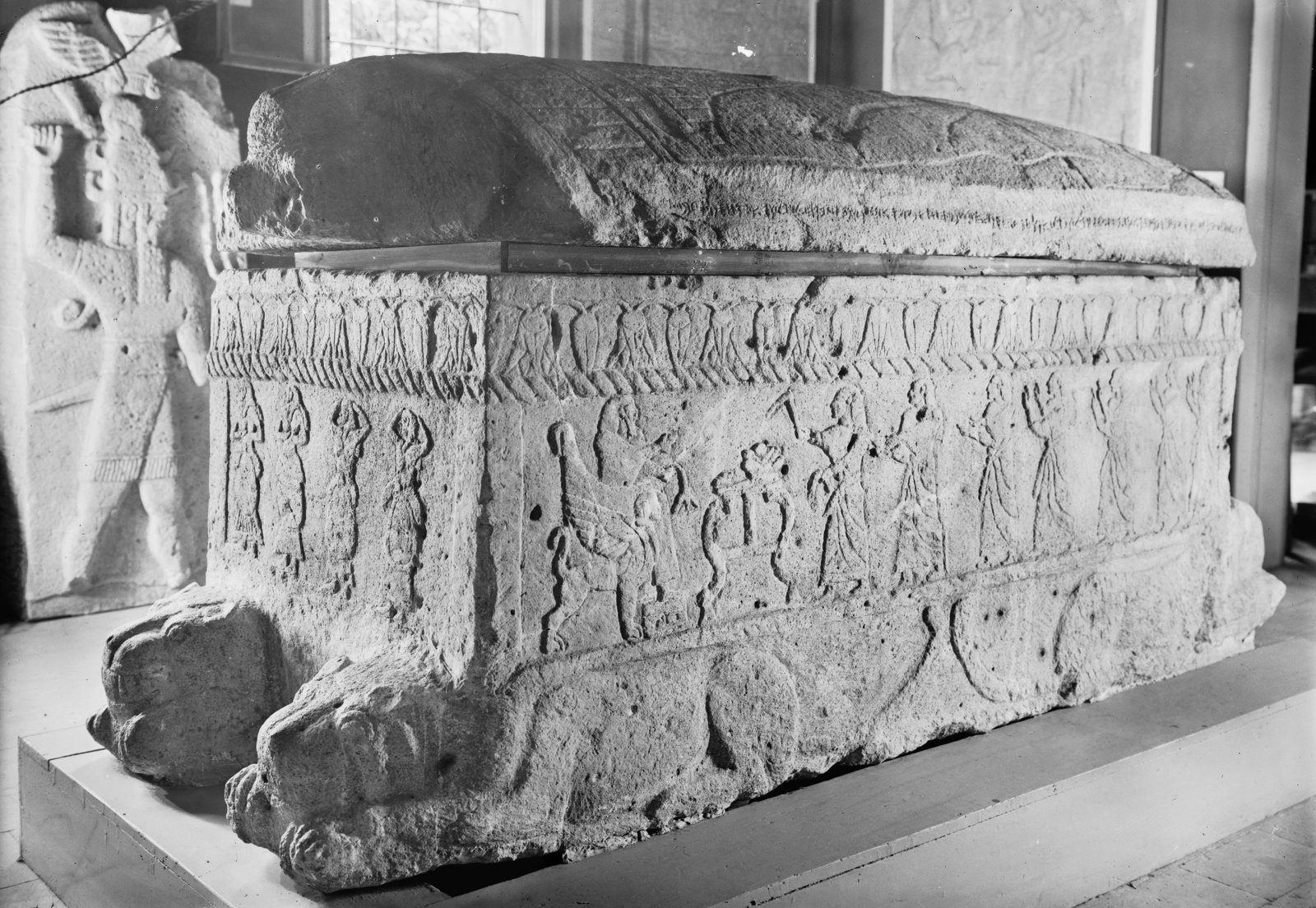
Ahiram’s limestone coffin from Byblos rests on four carved lions. A Phoenician inscription runs across the chest and lid. It names the man who provided the burial and warns rulers against opening the coffin.
Estimated reading time: 4 min Published Last reviewed:
Share article
Photograph
Matson Photo Service, 1936, Library of Congress, LC-DIG-matpc-03491, via Wikimedia Commons. Public domain.
The limestone sarcophagus of Ahiram from Byblos in a photograph from 1936. The lion supports and the carved procession on the long face are visible
Image sourceVideo
The First Letter: How a Picture of an Ox Became Your Alphabet
The letter A began as a picture: the head of an ox, scratched into the rock of the Sinai desert perhaps close to four thousand years ago. Along the way we say plainly which answers are firm and which are still argued: when the alphabet was born, and whether miners or scribes made it. Some scenes are AI-generated illustrations.
The YouTube player loads only when you press play. Watch on YouTube
Object details
- Title
- The Sarcophagus of Ahiram from Byblos (KAI 1)
- Timeline
- From 1000 BCE to 901 BCE
- Region
- The Levant
- Rights
- Public domain
Text
Introduction
The Sarcophagus of Ahiram is a carved limestone coffin from Tomb V of the royal necropolis at ByblosByblos / JbeilByblos, or Jbeil, is a coastal city in Lebanon north of Beirut.Glossary · Click to read the explanation, now in the National Museum of Beirut as no. 2086. Four resting lions support the chest. Its reliefs display an offering procession and a seated figure whom the Université Saint-Joseph catalogue identifies as Ahiram. The Phoenician inscription, known as KAI 1, gives his name and records that his son provided the coffin for his burial. The relationship between the carving of the chest and the addition of the text remains debated. [1][2][3][4]
Lions, offerings and mourners
The Université Saint-Joseph records a length of 300 cm, a width of 114 cm and a height of 147 cm. It describes the stone as yellowish limestone with traces of red, brown and black paint. The lions lie along the base with their heads projecting at the corners. A row of inverted lotus flowers runs around the upper part of the chest. [1]
On the front, the enthroned figure holds a cup and a drooping lotus. Winged sphinxes flank the throne and a table of food stands before it. The catalogue counts seven people in the approaching procession. Some carry offerings and others raise their arms. On the reverse, figures bring gifts and lead a goat. Each short side shows four women whose gestures the catalogue interprets as mourning. Two bearded figures face each other on the slightly rounded lid. The catalogue tentatively identifies one as Ahiram’s son. [1]
Writing across the chest and the lid
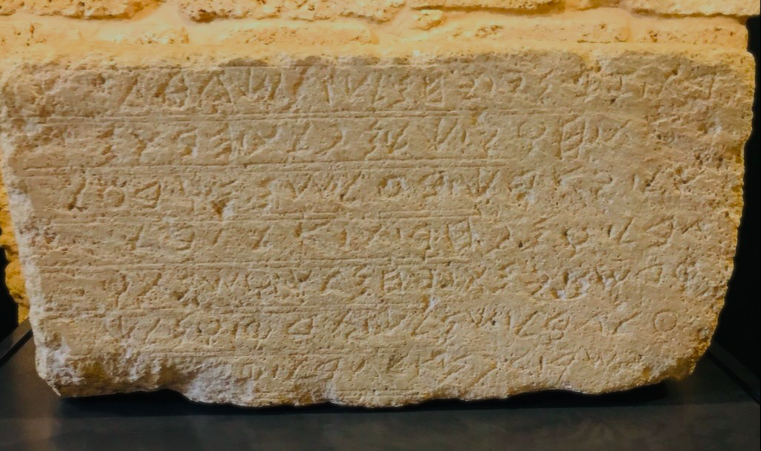
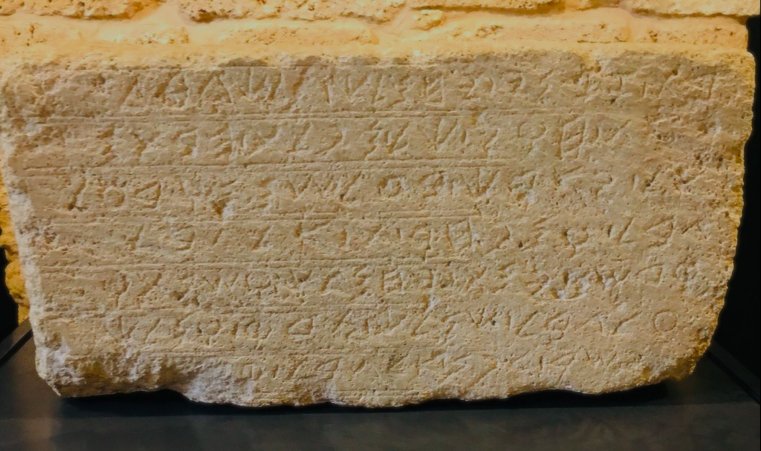
The lettering runs from right to left across two edges of the monument. The edition published by René Dussaud in 1924 begins with the short side. The Digital Editions of Aramaic and Phoenician Sources describes a line on the upper rim of the chest that turns the corner and continues along the long edge of the lid. The placement of the letters on two parts of the stone has helped prompt the proposal that the sculptors made the coffin before a place for the text had been planned. [1][2][3][5]
Date estimates depend on which part of the monument is being dated. The Université Saint-Joseph catalogue places the coffin in the tenth century BCE, and its separate inscription record proposes the first half of that century for the text. The Digital Editions of Aramaic and Phoenician Sources reports John C. L. Gibson’s archaeological dating of the stone coffin to the thirteenth century BCE and gives the tenth century for the Phoenician inscription. The earlier date for the stone is a proposal for an older coffin that could have been inscribed later. [1][2][3][4]
A dedication and a warning
The opening names Ahiram and records that the coffin was made for him by his son. The son’s name is damaged. The traditional reading, Ittobaal, takes a damaged sign as taw, the letter for t. The Université Saint-Joseph’s inscription record describes a proposal to read that sign as samek, the letter for s, and restore a different name ending in Baal. The city is called Gebal in the inscription, the ancient name used here for Byblos. [1][2][3][5]
The longer part addresses a king, a governor or a military commander who opens the coffin. The university’s object catalogue presents the loss of the sceptre and throne, the departure of peace from Byblos and the erasure of the offender’s inscription as consequences. Hanna Jenni proposes a different reading of the sentence. She understands the danger to the city and its authority as part of the circumstances of the violation, with the curse directed at the violator. The two readings show how the scope of the warning depends on where a reader divides the Phoenician clauses. [1][3][4]
Tomb V and the discovery
Pierre Montet reported in 1923 that his team had located additional shafts near the tomb exposed by a cliff collapse in February 1922. The university’s object catalogue dates the discovery of the sarcophagus to February 1922. Dussaud’s first scholarly edition and the Digital Editions of Aramaic and Phoenician Sources place the inscribed coffin in Montet’s 1923 campaign. Dussaud also records an alphabetic graffito on the wall of the shaft. The two inscriptions have separate identifiers, KAI 1 for the coffin and KAI 2 for the graffito. [1][2][4][5][6]
Quick answers
Where was Ahiram’s sarcophagus found?
It was found in Tomb V of the royal necropolis at Byblos. The National Museum of Beirut holds it under inventory number 2086. [1][4][5]
When was the Phoenician inscription carved?
The university’s inscription record and Hanna Jenni place it probably in the first half of the tenth century BCE. The age of the stone coffin itself is debated. [2][3][4]
Who had the coffin made for Ahiram?
The inscription credits his son. His damaged name is conventionally read Ittobaal. [1][3][4]
What does the inscription warn against?
It warns rulers and commanders against opening the coffin. It invokes harm to royal power and speaks of the erasure of the offender’s inscription, with different readings of the clauses concerning Byblos. [1][3][4]
References and notes
- Université Saint-Joseph de Beyrouth, “Sarcophage d’Ahirom, roi de Byblos,” National Museum of Beirut no. 2086 Object record, material, pigment traces, dimensions, all four sides and lid, tenth-century dating and Hélène Sader’s reading of the inscription. The record gives February 1922 for the discovery. Return to the text ↑
- Digital Editions of Aramaic and Phoenician Sources, “KAI 001,” The Ohio State University Metadata and description. The 1923 discovery, placement of the lines, Gibson’s earlier date for the stone and the tenth-century dating of the writing. Return to the text ↑
- Université Saint-Joseph de Beyrouth, “Inscription funéraire du sarcophage d’Ahirom,” KAI 1 Translation and commentary. Damaged name of the son, proposed alternative reading, layout, proposed reuse and early first-millennium dating. Return to the text ↑
- Hanna Jenni, “Zu den phönizischen Inschriften des Grabes V in Byblos: Graffito im Grabschacht (KAI 2) und Inschrift auf dem Sarkophag (KAI 1) Aḥiroms,” in Neue Beiträge zur Semitistik, Alter Orient und Altes Testament 425, Ugarit-Verlag, 2015, pp. 121–138 Author’s abstract. Tomb V, two inscriptions, conventional reading Ittobaal, the proposed date and the alternative interpretation of the curse. Return to the text ↑
- René Dussaud, “Les inscriptions phéniciennes du tombeau d’Ahiram, roi de Byblos,” Syria 5, no. 2 (1924), pp. 135–157 P. 135, the third campaign in 1923, Tomb V, the shaft graffito and the discovery of the coffin. P. 136, Montet’s copy and rubbing and the short-side line before the long-side line. Return to the text ↑
- Pierre Montet, “Résultats de la troisième campagne de fouilles à Byblos,” Comptes rendus des séances de l’Académie des Inscriptions et Belles-Lettres 67, no. 5 (1923), p. 388 Early report of the third campaign. The February 1922 cliff collapse had exposed a nearby tomb before the 1923 search for further shafts. Return to the text ↑
Archive records may be reviewed and refined as better evidence or sources become available. Suggest a correction
Suggest a correction · Suggest a source for this record
Cite this record
IL Archive, «The Sarcophagus of Ahiram from Byblos (KAI 1)», https://ilarchive.com/en/artifacts/ahiram-sarcophagus-kai1
Continue reading