Entity · Concept
The Phoenician Alphabet
A reference page linking a name, group, or concept to the materials that discuss it.
- Timeline
- From 1050 BCE to 146 BCE
- Region
- The Levant
A set of 22 consonant letters, written right to left, used in the coastal cities of the Levant from about 1000 BCE. Greek, Aramaic, Hebrew and many later scripts descend from it. Its early dates rest on few inscriptions.
Estimated reading time: 4 min Published Last reviewed:
Share article
Video
The First Letter: How a Picture of an Ox Became Your Alphabet
The letter A began as a picture: the head of an ox, scratched into the rock of the Sinai desert perhaps close to four thousand years ago. Along the way we say plainly which answers are firm and which are still argued: when the alphabet was born, and whether miners or scribes made it. Some scenes are AI-generated illustrations.
The YouTube player loads only when you press play. Watch on YouTube
Text
Introduction
The Phoenician alphabet is the script of the coastal cities of the LevantThe LevantThe Levant is a regional name for lands along the eastern MediterraneanGlossary · Click to read the explanation in the early first millennium BCE. It has 22 letters, each standing for one consonant, and it is the common ancestor of most alphabets in use today. This entry says what the script is, which inscriptions show it, and where the evidence is thin.
What the script is
The Phoenician alphabet is an abjad: it normally writes consonants and leaves the vowels to the reader. Its 22 consonant letters run from right to left. In some later Punic inscriptions, certain consonant letters also indicate vowel sounds. [5]
Each letter had a name, and the name began with the sound the letter stands for. This habit is called acrophony ("first sound"). Bet means "house" and stands for b; mem means "water" and stands for m; resh means "head" and stands for r. The first letter, aleph, means "ox" or "head of cattle". The meanings of a few names, such as het and samekh, are uncertain. [1] The HebrewHebrewA Northwest Semitic language of the Canaanite group, encompassing Iron Age epigraphy, Biblical, Rabbinic, medieval and Modern Hebrew; its scripts and pronunciations changed over time.Glossary · Click to read the explanation letter names are largely descended from these, and the Greek names alpha, beta, gamma and delta are close relatives.
Where it comes from
The Phoenician script developed out of earlier West Semitic alphabetic writing. The signs in some of the earliest inscriptions resemble Egyptian hieroglyphs, which may have inspired their forms. The date and circumstances of the first adaptation are debated. At Tel Lachish, an inscribed potsherd came from a deposit dated to around the middle of the fifteenth century BCE. It is a securely dated example of early alphabetic writing in the southern Levant. [6] This site describes the earliest examples in its entry on Serabit el-Khadim and Wadi el-Hol: The Earliest Alphabetic Inscriptions.
The Ugaritic alphabetUgaritic alphabetAlphabetic cuneiform system of Late Bronze Age Ugarit, using thirty chiefly consonantal written signs, distinct from Akkadian syllabic cuneiform.Glossary · Click to read the explanation was written in wedge-shaped signs, usually on clay. It represents a Late Bronze AgeLate Bronze AgeAn archaeological period around 1600–1200 BCE in much of the Near East, with international diplomacy, exchange and religious diversity; its endpoints vary by region.Glossary · Click to read the explanation form of alphabetic cuneiform alongside the tradition of linear signs from which the Phoenician script developed. [7]
The dating problem
Paolo Merlo includes short inscriptions assigned to the twelfth and eleventh centuries BCE in his treatment of the Phoenician script. The longer early inscriptions from Byblos offer more signs to compare, and their individual dates still depend in part on how scholars interpret the letter forms. [5][8][9]
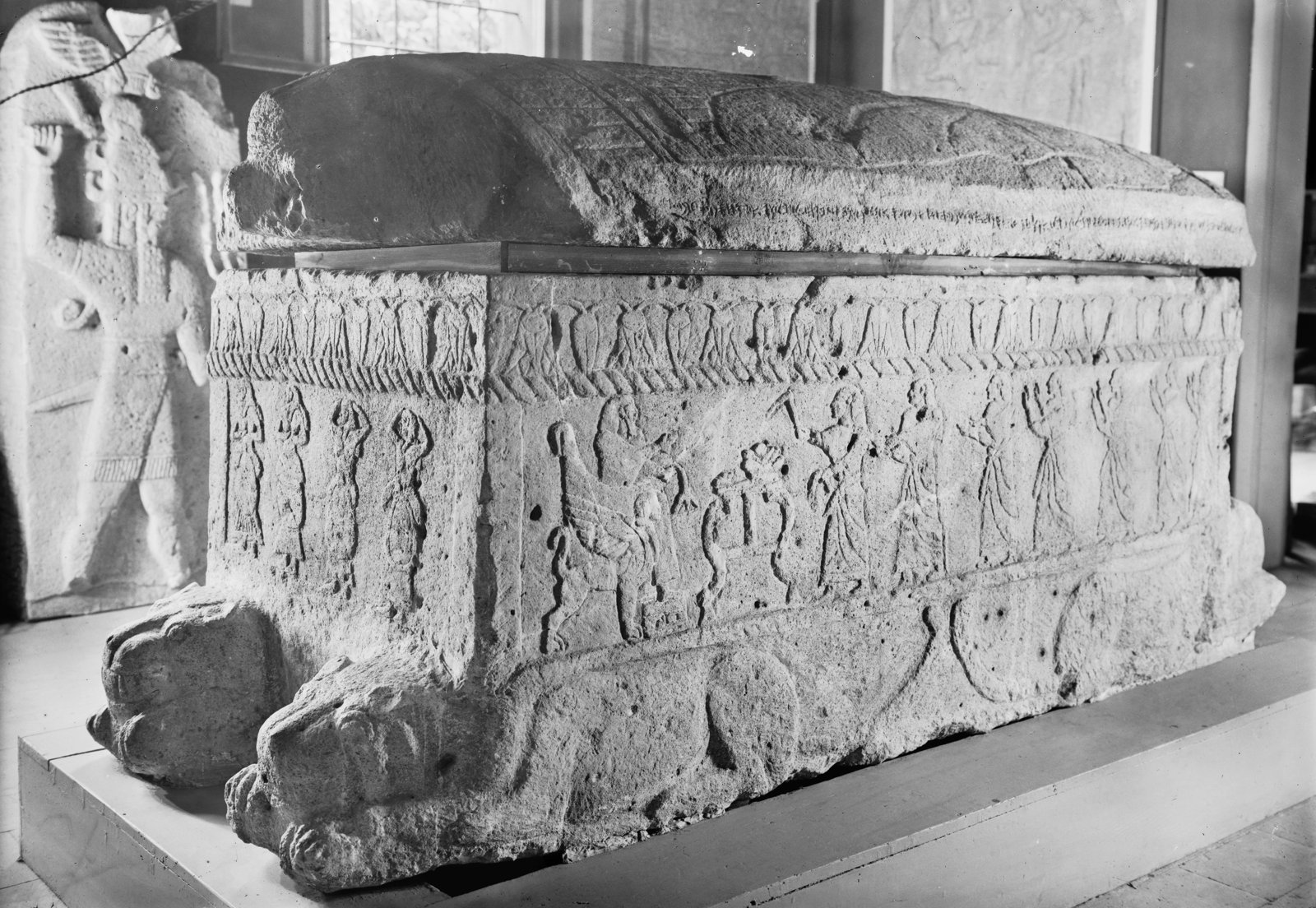
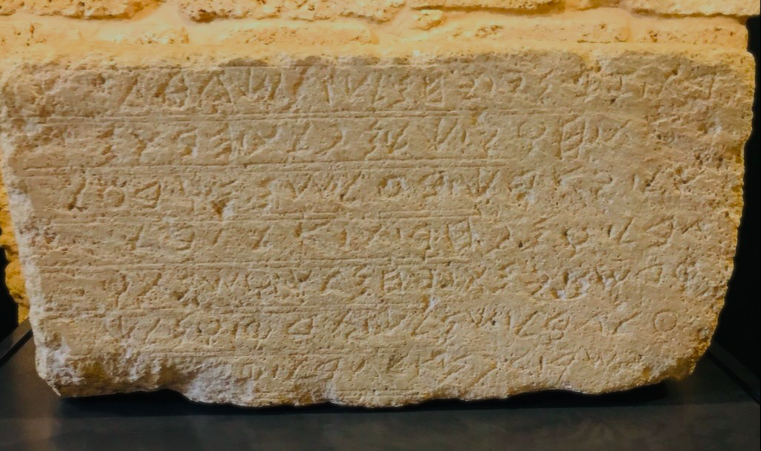
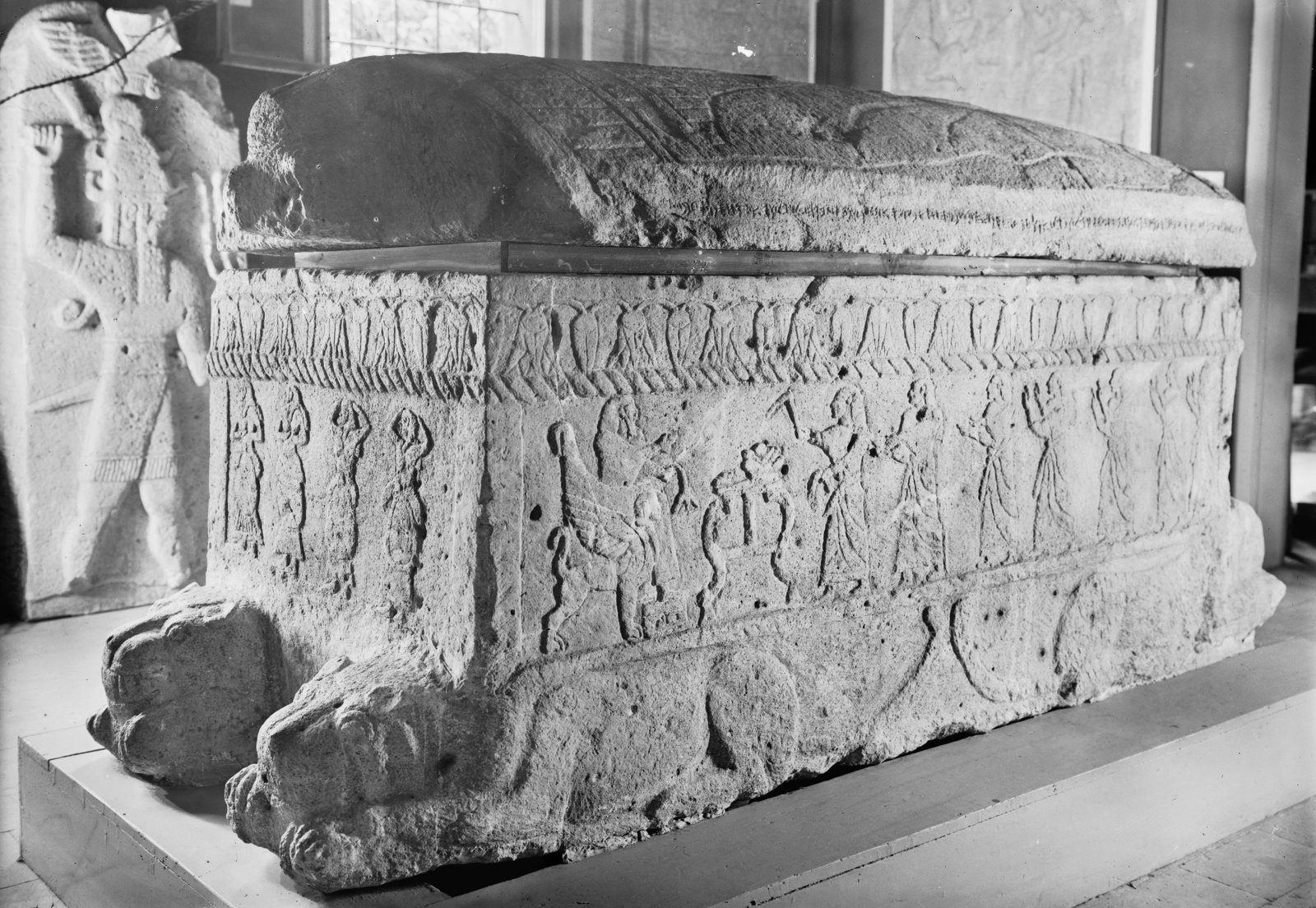
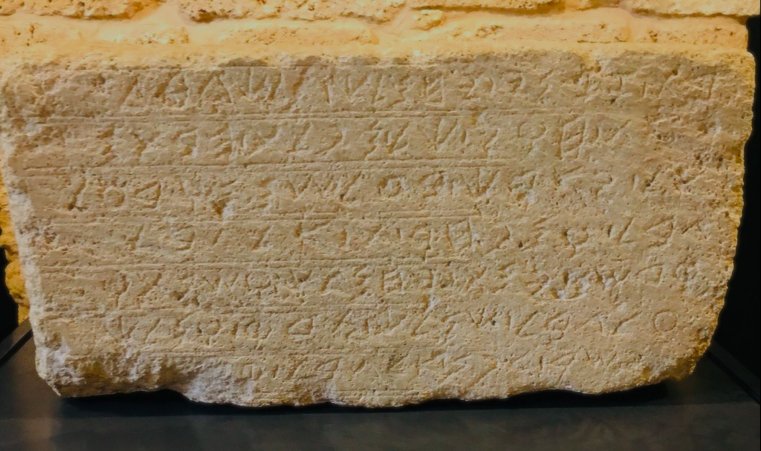
Several early royal inscriptions are from ByblosByblos / JbeilByblos, or Jbeil, is a coastal city in Lebanon north of Beirut.Glossary · Click to read the explanation. DEAPS dates the lettering on Ahiram’s sarcophagus to about 1000–975 BCE and the Yehimilk inscription to about 950–920 BCE on paleographic grounds. [8][9] Maurice Dunand published Yehimilk’s inscription in 1930. King Yehimilk says that he built or rebuilt a temple. The text asks Baalshamem, the Mistress of Byblos and the assembly of the holy gods of Byblos to prolong the reign of the king, whom it calls legitimate and rightful. [9]
At Tel Zayit, the excavators found a stone bearing a 22-letter abecedary, a list of letters, in a context they date to the mid-tenth century BCE. They describe the writing as a transitional linear script of central and southern Canaan, related to early Phoenician writing and anticipating later Hebrew forms. [10]
Spread and descendants
The script was used for Phoenician and for Punic in the western Mediterranean. Hebrew, Ammonite, Moabite and Edomite are related languages, while communities in the region used distinct local varieties of alphabetic writing. [5][14][17] The ninth-century BCE stele of Kilamuwa from Zincirli, now in Berlin, carries a royal text in Phoenician. [11][12] At Pyrgi, three gold sheets bear two inscriptions in Etruscan and one in Phoenician. [13] Neo-Punic continued to be written in Roman North Africa. [5]
The archaic Greek alphabets adapted a Phoenician model, including the use of letters for vowels. Latin developed from a Greek model through Etruscan writing. [7][16] The Samaritan script continues the older Hebrew tradition. The square script used for Hebrew developed from Aramaic, as did Arabic through the Nabataean branch. [17][18] The wider story is told in the study From Pictures to Letters: How the Alphabet Was Born.
The Greek historian HerodotusHerodotusFifth-century BCE Greek historian whose account of the Persian Wars includes reports on peoples, court and empire.Glossary · Click to read the explanation says that PhoeniciansPhoeniciansCommunities of Levantine coastal cities known for Mediterranean contact during the first millennium BCE.Glossary · Click to read the explanation who came with Cadmus brought letters to Greece. [15]
What we can and cannot say
- The script has 22 consonant letters, written right to left. [1]
- Its development from Proto-Sinaitic and Proto-Canaanite writing is well supported, though the exact route is debated. [1]
- Proposed dates for the earliest inscriptions depend on which texts are included. The dates assigned to the Byblos texts are based in part on their letter forms. [5][8][9]
- Which people first made an alphabet is still debated; the name "Phoenician" marks the stage when the script is well attested, not a proven point of invention. [1]
References and notes
- Wikipedia, 'Phoenician alphabet' (secondary summary) Read first 100,000 of 190,162 characters, plus a further section from 100,000 (numerals, Unicode, chronology, disputes): letters and names, direction, 1050 BCE convention, al-Khader arrowheads, languages written, descendants, Carthage Return to the text ↑
- Wikipedia, 'Yehimilk inscription' (secondary summary; cites Dunand 1930, Fouilles de Byblos I no. 1141, and Rollston 2008 in MAARAV 15) Page read: text of the inscription, find place, 10th century BCE date Return to the text ↑
- Wikipedia, 'Zayit Stone' (secondary summary) Page read: find place, size, abecedary, script debate Return to the text ↑
- Wikipedia, 'Kilamuwa Stela' (secondary summary) Page read: find place, museum, date, language Return to the text ↑
- Paolo Merlo, “Phoenician,” Writing, Mnamon: Ancient Writing Systems in the Mediterranean, Scuola Normale Superiore, English translation revised by Melanie Rockenhaus. Letter inventory, direction of writing, dates given for early short inscriptions, and late Punic use. Return to the text ↑
- Felix Höflmayer, Haggai Misgav, Lyndelle Webster and Katharina Streit, “Early Alphabetic Writing in the Ancient Near East: The ‘Missing Link’ from Tel Lachish,” Antiquity 95, no. 381 (2021), 705–719. Introduction, archaeological find context, and radiocarbon model and figs. 5–6. Return to the text ↑
- Willemijn Waal, “On the ‘Phoenician Letters’: The Case for an Early Transmission of the Greek Alphabet from an Archaeological, Epigraphic and Linguistic Perspective,” Aegean Studies 1 (2018), 83–125. Opening discussion of West Semitic writing, Ugaritic cuneiform and the Greek adaptation. Return to the text ↑
- Digital Editions of Aramaic and Phoenician Sources, Ohio State University, “KAI 001,” Aḥiram’s sarcophagus. Date (Paleographic) and General Notes, including the different dates of the object context and text. Return to the text ↑
- Digital Editions of Aramaic and Phoenician Sources, Ohio State University, “KAI 004,” Yehimilk’s inscription. Date (Paleographic), General Notes on Dunand’s publication, and John C. L. Gibson’s translation of the building account and prayer. Return to the text ↑
- Ron E. Tappy, P. Kyle McCarter, Marilyn J. Lundberg and Bruce Zuckerman, “An Abecedary of the Mid-Tenth Century B.C.E. from the Judaean Shephelah,” Bulletin of the American Schools of Oriental Research 344 (2006), 5–46. Open abstract, the 22-letter abecedary, find context and script classification. Return to the text ↑
- Digital Editions of Aramaic and Phoenician Sources, Ohio State University, “KAI 024,” Inscription of Kilamuwa. Language, object information and edition of the Phoenician royal inscription from Zincirli. Return to the text ↑
- Staatliche Museen zu Berlin, Vorderasiatisches Museum, “Stele des Fürsten Kilamuwa,” S 06579, collection object 1744119. Object identity and collection. Return to the text ↑
- Museo Nazionale Etrusco di Villa Giulia, “Pyrgi Tablets.” Catalogue description of three gold tablets and the languages of their texts. Return to the text ↑
- Mnamon, Scuola Normale Superiore, “Phoenician,” Language. Linguistic relatives and the association of Late Punic with Neo-Punic writing. Return to the text ↑
- Herodotus, Histories, book 5, translated by A. D. Godley, Loeb Classical Library (1922), published online by LacusCurtius, University of Chicago. Chapters 58–59, the Phoenicians who came with Cadmus and the name of their letters. Return to the text ↑
- Mnamon, Scuola Normale Superiore, “Latin,” Writing. Origin of the Latin alphabet through Etruscan mediation. Return to the text ↑
- Mnamon, Scuola Normale Superiore, “Hebrew,” Writing. Development of local Hebrew writing, emergence of the square script from Aramaic, and survival of the older tradition in Samaritan. Return to the text ↑
- Ahmad Al-Jallad and Hythem Sidky, “A Paleo-Arabic Inscription on a Route North of Ṭāʾif,” Arabian Archaeology and Epigraphy 33, no. 1 (2022), 202–215. Introduction, history of the Arabic script from Nabataean Aramaic. Return to the text ↑
Suggest a correction · Suggest a source for this record
Cite this record
IL Archive, «The Phoenician Alphabet», https://ilarchive.com/en/entities/phoenician-alphabet
Continue reading