Period
Late Bronze Age
- Timeline
- From 1600 BCE to 1200 BCE
- Region
- The Near East
An archaeological period approximately 1600–1200 BCE in much of the Near East, marked by rival kingdoms, Amarna diplomacy, metal exchange and Ugarit’s archives, with uneven regional endings.
Estimated reading time: 6 min Published Last reviewed:
Share article
Text
Introduction
What does the “Late Bronze Age” mean when the Nile Valley, AnatoliaAnatoliaAnatolia is the region occupying the Asian part of present-day TurkeyGlossary · Click to read the explanation, MesopotamiaMesopotamiaHistorical region associated with the Tigris and Euphrates: Uruk, Ur, Eridu, cuneiform, Sumer, Akkad, Babylon and Assyria, their languages and cults, and the limits of archaeological evidence.Glossary · Click to read the explanation and the LevantThe LevantThe Levant is a regional name for lands along the eastern MediterraneanGlossary · Click to read the explanation had different states, languages and gods? This entry treats the period as a framework for dating and comparison, then follows what can be documented about power, exchange, writing and ritualRitualAn organised or distinguished practice meaningful to a community; it may leave traces, but its form alone does not reveal an associated doctrine.Glossary · Click to read the explanation. It also approaches the period's endings through evidence that differs from place to place, rather than assuming a single collapse on a single date.
In much of the ancient Near EastAncient Near EastModern scholarly label for ancient societies of Mesopotamia, the Levant, Anatolia and Iran, sometimes extending to Egypt and other neighbours depending on the study; not one civilization or religion.Glossary · Click to read the explanation, a conventional range is approximately 1600–1200 BCE, although archaeological boundaries vary by region. The Syrian coastal city of UgaritUgaritAncient city and kingdom at Ras Shamra on the Syrian coast, flourishing between the fourteenth and early twelfth centuries BCE and preserving multilingual archives.Glossary · Click to read the explanation offers one way into this history: competing kingdoms, interconnected networks and multilingual archives existed at the same time. [1] [2]
A period label, not a civilization
“Late Bronze Age” is a scholarly designation for archaeological sequences, settlement layers, pottery assemblages and historical developments in parts of the second millennium BCE. It does not mean that bronze was invented then or that iron replaced it everywhere in 1200 BCE. Museum chronologies commonly place the period around 1600–1200 BCE in Mesopotamia and Anatolia, whereas Egypt's New Kingdom—a different historical periodization—continues to approximately 1070 BCE. One starting date therefore cannot be imposed on every city, nor can the end of an archaeological period stand for the end of all its states. [3] [4]
Kingdoms and shifting frontiers
Egypt's New Kingdom, particularly the Eighteenth and Nineteenth Dynasties, exercised military and diplomatic power in parts of the Levant. In central Anatolia, the Hittite kingdom expanded into an empire. Other powers included Mitanni across northern Mesopotamia and Syria, the rising Assyrian state, and Babylonia, long governed by the Kassite dynasty. Their territories and relative strengths changed over the centuries; these were neither equal nor fixed political units. [4] [5]
Coastal cities such as Ugarit, meanwhile, maintained their own palaces, administrations and relations with major powers. The result was a competitive but connected political landscape, not a unified “Bronze Age empire.” Evidence for cities, villages and mobile communities is uneven because different kinds of texts and material remains survive.
Royal letters: diplomacy and dependence
A major body of evidence is the AmarnaAmarna / AkhetatenAmarna is the archaeological site of Akhetaten, Akhenaten’s fourteenth-century BCE capital in Middle Egypt, preserving royal boundary stelae, temples, houses and cemeteries.Glossary · Click to read the explanation correspondence, a collection of fourteenth-century BCE cuneiformCuneiformWriting with wedge-shaped signs, developed from Mesopotamian recording traditions and used for several languages from the third millennium BCE.Glossary · Click to read the explanation tablets recovered in Egypt. Most were written in AkkadianAkkadianAn ancient East Semitic language written in cuneiform from the third millennium BCE; its varieties include Babylonian and Assyrian, and it served in international diplomacy.Glossary · Click to read the explanation, then widely employed for international communication. Some passed between powerful kings; others came from subordinate local rulers seeking assistance or pledging loyalty. In a tablet held by the Metropolitan Museum, Abi-milkuAbi-milkuAbi-milku was a fourteenth-century BCE ruler of Tyre, known from letters to Egypt’s kingGlossary · Click to read the explanation, ruler of coastal TyreTyreTyre is a city on the coast of present-day southern Lebanon and an important ancient Phoenician centerGlossary · Click to read the explanation, seeks protection from the Egyptian king within an unequal relationship. In another, the Assyrian king Ashur-uballit sends an envoy and gifts to establish diplomatic contact. The different positions of the correspondents matter. [6] [7]
These are surviving letters, not a complete register of international affairs. They chiefly reveal the interests, anxieties and conventions of courts and scribes. Their shared written medium does not establish a common spoken language or religion across the region.
Ships, metals and moving goods
Bronze manufacture required copper and tin in proportions that varied with the alloy's use. The Uluburun wreck, found off southern Anatolia and dated to around 1320 BCE, carried material from far-reaching networks: roughly ten tonnes of copper and one tonne of tin, alongside glass, ivory, pottery and luxury goods. It is powerful physical evidence for movement across the eastern Mediterranean, although a ship's destination, each item's route and the identities of its owners involve different levels of reconstruction. [8]
A large Cypriot copper ingot in the Metropolitan Museum illustrates a known form in which metal was transported. Such networks did not distribute their benefits equally to every household: prestigious cargoes and extant documents disproportionately illuminate wealthy people and institutions. [9]
Ugarit: a city of archives and scripts
Ugarit, at Ras Shamra near present-day LatakiaLatakiaA coastal city in Syria, south of ancient Ugarit at Ras Shamra.Glossary · Click to read the explanation, flourished during the fourteenth, thirteenth and early twelfth centuries BCE. Excavations uncovered a palace, sacred precincts, houses, and literary and administrative tablets. Its records attest several languages and writing systems. CuneiformCuneiformWriting with wedge-shaped signs, developed from Mesopotamian recording traditions and used for several languages from the third millennium BCE.Glossary · Click to read the explanation was used extensively, alongside the locally developed Ugaritic alphabetUgaritic alphabetAlphabetic cuneiform system of Late Bronze Age Ugarit, using thirty chiefly consonantal written signs, distinct from Akkadian syllabic cuneiform.Glossary · Click to read the explanation, usually described as a system of thirty alphabetic cuneiform signs. This differs from the syllabic cuneiform system used to write Akkadian. [10] [11]
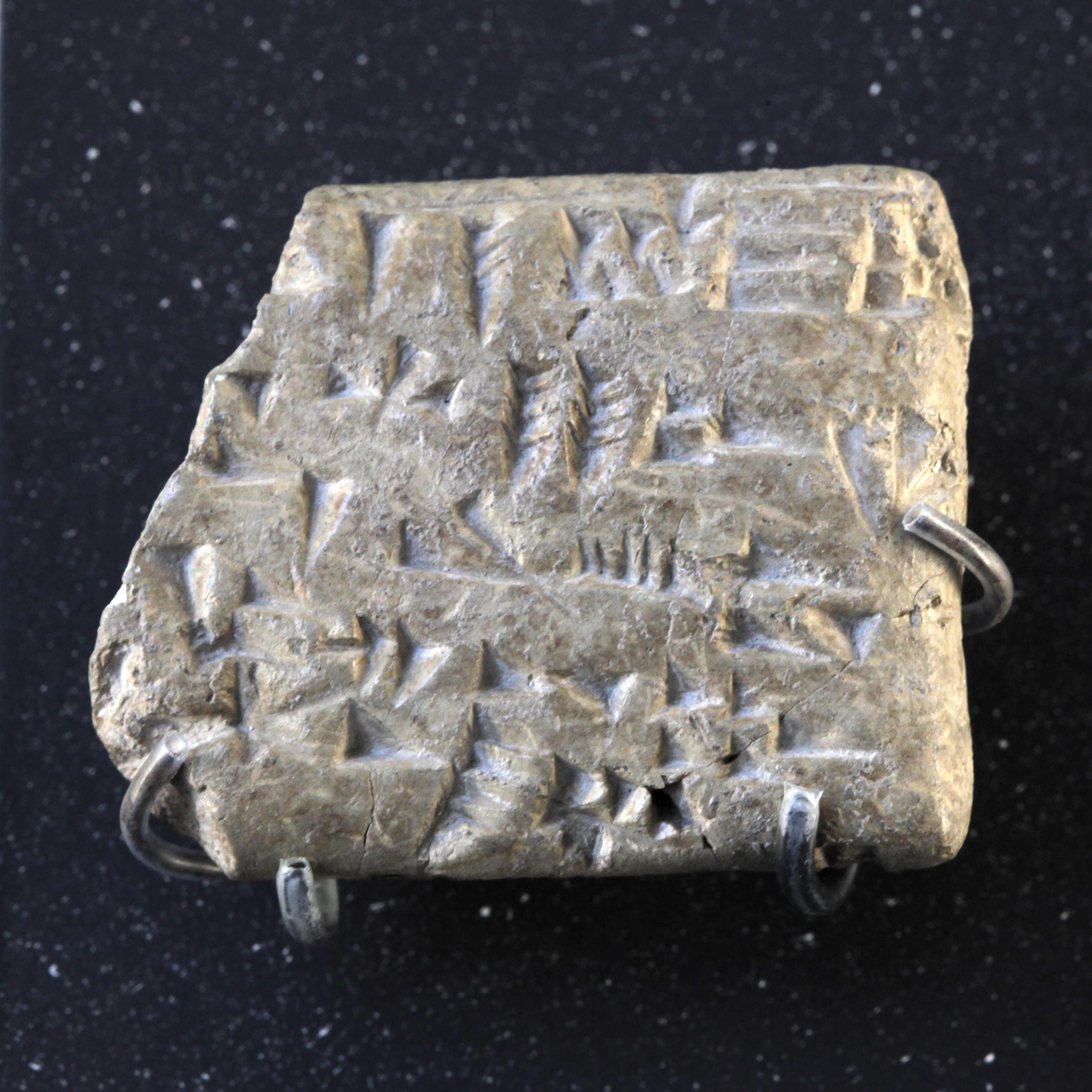
The tablet photographed for this entry is a specific example, not a universal model for Late Bronze Age writing: a fragment of an Ugaritic abecedary held at the Louvre, inventory AO 19992, excavation number RS 10.087, dated in the museum catalogue to 1400–1200 BCE, with seven letters missing. It records the alphabetical sequence and is consistent with scribal learning; alone, it cannot establish one author or date for all Ugaritic literature. [12]
Work and authority beyond the palaces
Alongside myths and royal correspondence, Ugarit's documents record transactions, contracts, families, provisions and crafts. They show the central administration organizing resources, labour and production. Scribes learned local and Babylonian written traditions, while school texts point to differing skills and responsibilities. Such evidence is valuable for social history but preserves the voices and concerns of literate institutions more fully than the lives of most inhabitants. [13]
Gods and rituals, not a single creed
Ugarit preserves temples, ritual spaces and texts referring to numerous deities. Among them were BaalBaalUgaritic storm god and warrior king who defeats Yamm, builds his palace with El’s consent and confronts Mot. References to El and Dagan as fathers do not define a single genealogy.Glossary · Click to read the explanation, the storm god; ElElEl is a senior deity in Late Bronze Age Ugaritic texts, portrayed as father of the divine family and a council authority, alongside his consort Athirat. This entry does not cover every linguistic use of El.Glossary · Click to read the explanation, a senior authority in many narratives; and DaganDaganA god worshipped in Syria and Mesopotamia, especially at Tuttul and Terqa on the Euphrates, and associated with royal authority. His name appears as Dagon in the Hebrew Bible; no ancient image of him is securely identified.Glossary · Click to read the explanation, associated with a temple area. The Baal CycleBaal CycleA group of Late Bronze Age Ugaritic religious texts recounting Baal’s conflicts, relationships with the gods and the building of his palace.Glossary · Click to read the explanation contains mythological poetry about kingship and divine conflict. Ritual records illuminate other settings, including royal cult practice. A poem is not simply a ritual manual, and a palace rite cannot be treated as a statement of every inhabitant's beliefs. [14] [15]
Egypt, Hatti and Babylonia had different institutional religious traditions. Images, names, objects and ideas sometimes crossed boundaries, but arguing that a particular ritual was transmitted requires context and evidence for a historical pathway, not resemblance alone.
Around 1200 BCE: uneven endings
Major changes affected parts of the eastern Mediterranean in the late thirteenth and early twelfth centuries BCE. Mycenaean palace systems ended; the Hittite state disintegrated; and Ugarit was destroyed around 1180 BCE. Yet one destruction layer cannot explain the entire region, nor can all the transformations securely be attributed to the so-called “Sea Peoples,” drought or earthquakes. [2] [16]
In his critical review of Jesse Millek's reassessment and recent studies on the dating of Mycenaean palace destructions, Guy D. Middleton stresses that some reputed destructions were misdated or assumed without adequate evidence. Even attested destructions did not all occur simultaneously or demonstrably share one cause. This is a scholar's interpretation grounded in re-examination of archaeological reports, not an individual ancient eyewitness account. Other states and communities persisted, often through substantial change. [16]
What can the evidence establish?
A letter records the language and requests of its writer within particular political conventions; a shipwreck records the movement of goods while leaving routes open to interpretation; a school tablet witnesses a local written practice. Read together with stratigraphy and regional chronologies, these sources reveal intense interconnection alongside social, political and religious diversity. They also reveal differing endings. A single culture, single religion or single cause of collapse cannot be inferred from the period's name alone.
References and notes (16)
- The Metropolitan Museum of Art, “Art of Second Millennium B.C. Explored in Landmark Exhibition,” exhibition announcement, 15 December 2008. Section on “large territorial states,” dating the Late Bronze Age c. 1600–1200 BCE and naming the participating kingdoms. Return to the text ↑
- French Ministry of Culture, “Ugarit – Ras Shamra,” archaeological site presentation. Site overview, flourishing, scripts and languages, and destruction around 1180 BCE; institutional synthesis, not an edition of ancient texts. Return to the text ↑
- Metropolitan Museum of Art, “Mesopotamia, 2000–1000 B.C.,” Heilbrunn chronology. Chronological table: LBA 1600–1200, Mitanni, Middle Assyria and the Kassite dynasty; regional chronology only. Return to the text ↑
- Catharine H. Roehrig, “Egypt in the New Kingdom (ca. 1550–1070 B.C.),” Metropolitan Museum of Art. Opening historical paragraphs on New Kingdom chronology and Egyptian activity in western Asia. Return to the text ↑
- Metropolitan Museum of Art, “Anatolia and the Caucasus, 2000–1000 B.C.,” timeline. Chronology for central Anatolia, including Hittite empire c. 1380–1200 BCE. Return to the text ↑
- Metropolitan Museum of Art, “Amarna letter: Royal Letter from Abi-milku of Tyre,” object 24.2.12. Object overview, c. 1347–1330 BCE, Akkadian and vassal relationship; no claim to a complete transcription. Return to the text ↑
- Metropolitan Museum of Art, “Amarna letter: Royal Letter from Ashur-uballit,” object 24.2.11. Object summary describing envoy and gifts; ancient letter not read in full. Return to the text ↑
- Institute of Nautical Archaeology, “Uluburun Late Bronze Age Shipwreck Excavation.” Public project overview and cargo/dating sections, c. 1320 ± 15 BCE; not the complete excavation monograph. Return to the text ↑
- Metropolitan Museum of Art, “Copper ingot,” object 11.140.7. Object record: Cypriot attribution, broad date c. 1450–1050 BCE and exchange of copper ingots. Return to the text ↑
- Anne-Sophie Dalix, “Les alphabets à Ougarit,” French Ministry of Culture. Sections on discovery, thirty signs, diffusion and limits; not a reading of all original tablets. Return to the text ↑
- Carole Roche-Hawley, “Corpus et langue / La documentation textuelle d’Ougarit,” Ministry of Culture. Sections on multiple languages and scripts and uses of Akkadian/Ugaritic in schooling, administration and cult. Return to the text ↑
- Louvre, “tablette,” AO 19992 / RS 10.087, collections catalogue. Full public object record: incomplete seven-letter Ugaritic abecedary, 1400–1200 BCE, discovery and inventory. Return to the text ↑
- Juan-Pablo Vita, “La société ougaritique,” French Ministry of Culture. Public sections on social structure, households, administration and professions; not full contract editions. Return to the text ↑
- French Ministry of Culture, “Les lieux dévolus aux pratiques religieuses,” Ugarit. Sections on ritual sites and the royal orientation of much surviving cultic documentation. Return to the text ↑
- French Ministry of Culture, “Le cycle de Baal,” archaeological presentation. Opening paragraphs on poems, alphabetic script and proposed royal-banquet performance; not ancient tablets in full. Return to the text ↑
- Guy D. Middleton, “Getting closer to the Late Bronze Age collapse in the Aegean and eastern Mediterranean, c. 1200 BC,” Antiquity 98 (2024), 260–63. Open review article text on Cambridge Core, including critique of destruction lists and regional timing; the two books reviewed were not read. Return to the text ↑
Suggest a correction · Suggest a source for this record
Cite this record
IL Archive, «Late Bronze Age», https://ilarchive.com/en/periods/late-bronze-age